- 144 pages
- English
- ePUB (mobile friendly)
- Available on iOS & Android
eBook - ePub
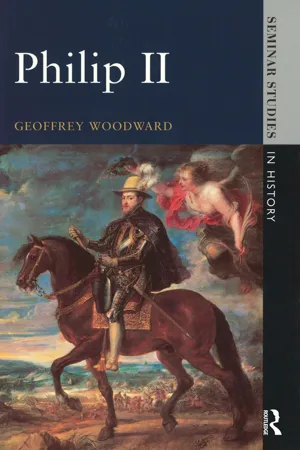
Philip II
About this book
Any assessment of Philip II's rule assumes the appearance of a paradox. In analysing the nature and impact of Philip II's rule and government, the author seeks to examine the extent of the changes in royal finance, the economic and social issues, the impact of religion -- both within Spain and throughout its Empire -- and the aims and motives behind the king's foreign policy.
The Background
1
Charles V’s Legacy
On 16 January 1556 Emperor Charles V abdicated as King of Spain and formally transferred the last of his possessions to his only son Philip. The inheritance was impressive by any standards. The Iberian kingdoms of Castile, Aragon, Catalonia, Valencia and Navarre had been brought together by the union of Isabella and Ferdinand, ‘the Catholic Kings’, and secured by their grandson Charles. In effect, Philip’s Spain was a dynastic union rather than a unified country, a geographical expression rather than a nation state. Each dominion was autonomous and equal, distinguished by its own laws, language and customs, so that subjects identified themselves more readily with their país* than with their monarch. Not until the 1590s did Castilians refer to the ‘Spanish Empire’; even the term ‘español’ was imported from Provence (82). National consciousness was slow to develop partly because Aragon was oriented more towards the Balearics, Sardinia, Sicily and Naples and the recently acquired Duchy of Milan, but also because Castile’s mantle of imperialism stretched south and west towards North Africa, the Caribbean, and Central and South America. To these two areas of divergent interests a third had been added which altered the entire configuration of Habsburg Spain. In 1555 Charles transferred his Burgundian territories from the House of Austria to Philip and Spain (40, 80, 153). In reality Burgundy had little in common with the Spanish Habsburgs. Town councils, provincial assemblies and stadholders* throughout the seventeen Dutch provinces had resisted earlier attempts by Charles to impose a more centralised administration. Only the nobility remained outwardly loyal, mainly because their Regent, Mary of Hungary, had had the good sense to include them in the Council of State and to respect their chivalric Order of the Golden Fleece (61). Unless it was carefully handled, Philip’s Burgundian inheritance would prove more of a liability than an asset (see pp. 61–71).
Political and geographical disunity was, however, offset by a common strain of Catholicism which permeated the Spanish character and created a powerful spiritual bonding. Since the beginning of the Reconquista*, Christian Spaniards believed their destiny was to expel the Moors from the mainland and to purge Spain of this religious and cultural blight. It was the Most Catholic King’s duty to defend the interests of God and His Church both in Spain and beyond, a responsibility which Charles had taken very seriously. He had encouraged the Inquisition* to arrest the growth of Uluminism* in the 1520s and Erasmianism* in the 1530s and, although there were isolated pockets of heresy discovered subsequently, his principal concern had been the external threat of the Turks and their suspected links with fifth-columnist Moriscos* in Spain. As the empires of Suleiman, the Turkish Sultan, and Charles expanded in the Mediterranean and Central Europe, clashes occurred at the periphery like the interaction of continental plates, but neither side was strong enough to inflict a decisive defeat. Charles’s preoccupation with French and German problems in the 1550s, allied to his deteriorating health, saw the initiative pass to the Ottomans who seized Tripoli, Peñón de Vélez and Bougie. The Turkish threat to mainland Spain, her Mediterranean possessions and remaining outposts in North Africa was the most serious challenge facing Philip at his accession (38) (see pp. 77–80).
His greatest domestic problem in 1556 was financial, a direct legacy of the political and imperial achievements of the Catholic Kings and Charles V. In 1554 the Regent Joanna, Charles’s sister, informed him that revenues had already been pledged for the next six years and she could not see how the administration could continue to support his wars. Two years later Philip inherited a state debt of some 36 million ducats and an annual deficit of 1 million ducats. In fact, Charles had financed his imperial commitments by a series of expedients without ever tackling the fundamental issues. The wealthiest sectors of society were exempt from paying direct taxation and the burden fell on the poorer groups. Although most ordinary revenue came from indirect taxation, the system was unequal and in need of reform; but the landed, clerical and merchant classes resisted any attempt to introduce new taxes or extend existing ones. Outside Castile, the provincial Cortes* proved even more unwilling to defray the crown’s costs, arguing that taxes should be spent where they were raised. Increasingly the Low Countries came to subsidise Charles’s wars and in 1555 were supplying over 3 million ducats a year (141). Although there was some merit in Charles’s claim that ‘I cannot be sustained except by my realms of Spain’, he meant in effect Castile and the Netherlands. Fortunately the volume of gold and silver from the Spanish Indies had also been steadily growing, but much of this money was already earmarked to pay off crown debts. Isabella and Ferdinand had introduced the practice of issuing juros* (credit bonds) to bankers, thereby mortgaging future state income. By 1556, 68 per cent of ordinary revenue was consumed in servicing and repayment of these juros. Far worse was the practice of granting asientos* (advanced contracts) to foreign and Spanish financiers whereby the crown received a loan in return for bills of exchange. Asiento repayments came to over 14 million ducats in 1556 and the Cortes regularly complained of the vice-like grip foreign bankers had on Spain’s finances (17) (see pp. 33–8).
Charles introduced no fundamental changes to the financial administration but instead allowed the bureaucracy to multiply and the level of expenditure to increase accordingly. Admittedly he was not helped by the steady rise in inflation which saw prices in Spain double between 1500 and 1550, but his response was to raise direct and indirect taxation and resort to a variety of money-raising schemes. Crown land was leased at favourable terms, rents farmed out and land sold off, and public offices, privileges and monopolies granted to those who could pay. In this way many royal salt, silver and mercury mines had been privatised and the right to administer the land belonging to the Maestrazgos* (Military Orders) had been granted to the Fuggers, the Augsburg bankers, in 1525 (70). Philip inherited many serious financial difficulties from his father and would have been well advised to apply Charles’s advice: ‘Attend closely to finances and learn to understand the problems involved.’ Regrettably, neither Charles nor Philip paid much attention to this aphorism.
2
Philip II’s Character
Philip was born in Valladolid on 21 May 1527, the eldest son of Charles V and Isabella of Portugal (see Genealogical Table, p. 114). In more ways than one he was the product of his parents: short in stature with an upright posture, his most striking features were his large blue eyes set in an egg-shell complexion, his reddish hair and his disproportionate upper jaw and tip [doc. 1]. He had neither a strong physique nor good health, and within twenty years his body had become rounded, his hair and beard turned white and his eyes were bloodshot with fatigue.
Philip’s early education fell to Martínez Siliceo and Bartolomé de Carranza and a variety of specialist scholars. He soon developed a liking for mathematics and architecture but showed no flair for foreign languages and only felt comfortable when speaking Castilian, which partly explains his self-consciousness in the company of foreigners and his reluctance to travel outside Spain. Don Juan de Zúñiga was put in charge of physical activities, but it soon became clear that the prince much preferred walking, dancing, music, playing piquet, chess and reading books on natural history to robust activities. Philip was an aesthete, not an athlete. Charles recognised the value of Philip acquiring political experience as soon as possible: at the age of twelve he attended council meetings, at sixteen became Regent of Spain and in his twenties travelled to Milan, the Empire, the Netherlands and England. But it was not Philip’s wish to be away from Spain. ‘Travelling about one’s kingdoms is neither useful nor decent,’ he once informed his son, and after 1559 he never left the Iberian peninsula (123).
Philip’s devotion to the Catholic faith owed much to his mother. Isabella of Portugal spent many hours each day in prayer, and in his infancy Philip was surrounded by clerics whom he was taught to revere. Throughout his life, he attended Mass daily, heard sermons weekly and received Communion quarterly. Pious and orthodox in his devotion to the Catholic Church, he endowed monasteries and shrines, kept religious books at his bedside and saw evidence of divine intervention in all affairs. God was omniscient; His cause was Philip’s cause.
Traditionally, Philip has been seen as hostile to occult philosophy, yet recent research clearly contradicts this view. He is known to have acquired more than 200 books on magic, kept a horoscope prepared by Matthias Hacus, received frequent advice from astrologers, ordered all extant works by the medieval Majorcan philosopher Ramón Lull to be brought to the Escorial, and patronised alchemists like Diego de Santiago (50, 136, 143). Throughout his life he developed an interest in mathematics, science and technology. In 1583 he founded an Academy of Mathematics and Science and established four chairs under the directorship of Juan Herrera to educate Spanish students in military engineering, architecture, navigation and mathematics. He financed inventions such as Giacomo de Francisco’s secret method of careening ships’ bottoms and Antonio Marin’s war machine which ‘fires shot and darts with much impetus and effect, and without expense in powder or danger of fire’ (51, p. 134). Philip’s mind was never closed or narrow, and his thirst for knowledge was insatiable – particularly if it would give him a military advantage or benefit him personally.
From an early age he had been an avid collector of manuscripts, books and works of art. Pliny, Dante and Petrarch nestled alongside Aesop’s Fables and writings by Erasmus and Teresa of Avila. The Prado came to possess the paintings of Bosch, Brueghel and Titian whom he particularly liked, as well as the works of Spaniards like Pacheco and Coello whom he disliked (4, 168). At his death his palaces housed more than 700 paintings and the largest private library in Europe. Philip used his knowledge of architecture to design and oversee personally the building of several palaces. Each possessed a distinctive feature: at Casa de Campo, mock sea-battles were performed on artificial lakes and fountains; Aranjuez became the principal repository of thousands of varieties of trees, plants and herbs; Casa and Aranjuez housed elephants, rhinos and lions, and at El Bosque a royal game reserve was built to provide deer and pheasant for hunting. Undoubtedly the Escorial is the greatest monument to Philip’s love of architecture, mathematics and spiritual devotion. It was designed by Bautista and completed by Herrera, and Philip chose its site 48 km from Madrid and 1,000 metres above sea level on the foothills of the Guadarramos (86). Part palace where Philip resided most spring and summer months from 1566, part mausoleum where he housed his dead relatives, and part Jeronimite monastery, the Escorial embodied Philip’s temperament. In it he was isolated from his councillors and subjects at large; it was his ultimate defence against an intrusive world. There amid the dark, narrow corridors and secret passages, in austere cells built of grey granite blocks, he occupied a small room overlooking the monastic church of San Lorenzo.
As the seasons changed so the court progressed from one palace to another, and if its ethos was not as lively and resplendent as under Charles, it was far from dull. Dancers, acrobats, buffoons and more than twenty dwarfs, including several from the Zaragoza lunatic asylum, entertained the royal household, and a particular favourite was the retarded Magdalena Ruiz who could be relied upon to act the fool. More serious entertainment was provided by the court composer Tomás Luis Vitoria, the organist Antonio de Cabezón and chorister Philippe Rogier, who together with 150 musicians fulfilled the King’s love of music, even if he disdained the innovative musical chants of Palestrina in favour of traditional plainsong. Dramatists and writers like Lope de Vega, Lipsius, Montano and Velasco were patronised by the crown, and the poet Juan Rufo received a 500-ducat subsidy towards the cost of publishing his Austriada, an epic poem about the Habsburgs (4).
Philip’s relationship with people was deceptive and has deceived many historians mainly because he developed an iron self-control to mask his feelings in public. Outwardly he appeared reserved and courteous, performing his daily routine in a grave and dignified manner. An arch-bureaucrat dedicated to the endless task of administrating his monarquía*, he spent nine hours a day every day reading and annotating papers, listening to advice and taking decisions. Men who knew him, like Cardinal Granvelle, viewed him as a procrastinator and claimed that ‘in all his affairs, his sole decision consisted in remaining eternally indecisive’. Although there is much truth in this remark, Professor Parker has reminded historians that Philip only appears hesitant and uncertain in times of crisis because a great amount of documentary evidence written by the King at such moments has survived (123). Given the changing nature of international affairs and the slowness of communications, it was often wiser to be cautious and prudent (116, 117). Yet once Philip had taken a decision he kept to it in an inflexible, determined manner. C. G. Bratli suggests that ‘history should list this steadfastness of purpose – which people so often term intolerance and fanaticism – as the most striking quality of that King’, but to Philip appearance was everything and a compromise or retraction was a sign of weakness even when he was wrong (11, p. 129). It is this juxtaposition of irresolution and constancy, of weak- and high-mindedness which makes him such a paradox (36, 97). Of course, he was not above deceit and could be as ruthless as the next prince, but to label him a ‘systematic liar and hypocrite’, ‘the great father of lies who sat in the Escorial’, as some historians have done, throws more light on them than on him (118, 121).
Philip’s private life functioned around his public duties; the one rarely interrupted the other. At pre-determined times he was available for his family – at 10 a.m. before Mass, after dinner at 9 p.m. and just before bed – but for most of the day he was alone. ‘Being by himself is his greatest pleasure,’ commented the Venetian ambassador, who for once may have been right. The King regarded marriage as a dynastic and diplomatic obligation, but misfortune necessitated his marrying four times. Maria of Portugal (1543—45) died giving birth to Don Carlos; Mary Tudor (1554—58), with whom he spent seventeen months, died childless; Elizabeth of Valois (1560—68) produced two daughters, but the sudden death of the Queen and Don Carlos within ten weeks of each other obliged Philip to marry again....
Table of contents
- Cover
- Title
- Copyright
- Contents
- Dedication
- INTRODUCTION TO THE SERIES
- Part One: The Background
- Part Two: Descriptive Analysis
- Part Three: Assessment
- Part Four: Documents
- GENEALOGY: PHILIP II’S FAMILY
- GLOSSARY
- BIBLIOGRAPHY
- INDEX
Trusted by 375,005 students
Access to over 1.5 million titles for a fair monthly price.
Study more efficiently using our study tools.
Frequently asked questions
Yes, you can cancel anytime from the Subscription tab in your account settings on the Perlego website. Your subscription will stay active until the end of your current billing period. Learn how to cancel your subscription
No, books cannot be downloaded as external files, such as PDFs, for use outside of Perlego. However, you can download books within the Perlego app for offline reading on mobile or tablet. Learn how to download books offline
Perlego offers two plans: Essential and Complete
- Essential is ideal for learners and professionals who enjoy exploring a wide range of subjects. Access the Essential Library with 800,000+ trusted titles and best-sellers across business, personal growth, and the humanities. Includes unlimited reading time and Standard Read Aloud voice.
- Complete: Perfect for advanced learners and researchers needing full, unrestricted access. Unlock 1.5M+ books across hundreds of subjects, including academic and specialized titles. The Complete Plan also includes advanced features like Premium Read Aloud and Research Assistant.
We are an online textbook subscription service, where you can get access to an entire online library for less than the price of a single book per month. With over 1.5 million books across 990+ topics, we’ve got you covered! Learn about our mission
Look out for the read-aloud symbol on your next book to see if you can listen to it. The read-aloud tool reads text aloud for you, highlighting the text as it is being read. You can pause it, speed it up and slow it down. Learn more about Read Aloud
Yes! You can use the Perlego app on both iOS and Android devices to read anytime, anywhere — even offline. Perfect for commutes or when you’re on the go.
Please note we cannot support devices running on iOS 13 and Android 7 or earlier. Learn more about using the app
Please note we cannot support devices running on iOS 13 and Android 7 or earlier. Learn more about using the app
Yes, you can access Philip II by Geoffrey Woodward in PDF and/or ePUB format, as well as other popular books in History & Early Modern History. We have over 1.5 million books available in our catalogue for you to explore.