eBook - ePub
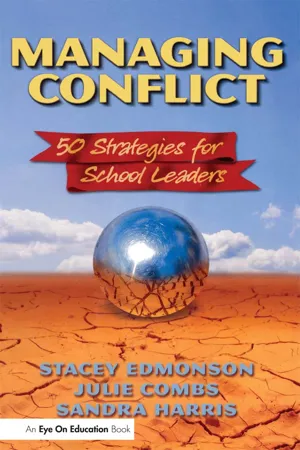
Managing Conflict
50 Strategies for School Leaders
- 128 pages
- English
- ePUB (mobile friendly)
- Available on iOS & Android
eBook - ePub
About this book
This book offers 50 easy-to-read strategies for managing conflicts in your school involving students, parents, and teachers. Individually, these strategies provide specific insights into conflict resolution, reduction, and management. As a whole, the 50 strategies provide a comprehensive method to lead constructive change in your school. With quotes, examples, and reflection questions, this book offers ideas that help you lead with confidence.
Information
Section III
Fine-Tunning Your Conflict Management Skills
By now you have a better understanding of conflict management. Along with the 17 strategies which improved your understanding, you have 14 additional strategies to help you be more proactive in managing conflict. This final section has 19 ideas to assist you in fine-tuning the conflict management skills that you are developing as a leader.
32
Examine Your Expectations
Shoot for the moon. Even if you miss, you’ll land among the stars.
—Brian Littrell
—Brian Littrell
Your expectations can be a source of conflict. As you reflect on a recent conflict, consider the role that expectations may have played.
For example, as a principal, I wanted to hire the very best teachers I could find. I wanted teachers to be obviously dedicated to the success of every student. Staff recruitment, selection, and retention were my highest priority. Consequently, I invested hours in reviewing applications, conducting interviews, and checking references. As a result, many of the teachers on the campus were highly committed to students and put in many extra hours beyond the “normal” workday. Campus administrators and mentor teachers coached and assisted the few teachers not meeting these expectations. The efforts resulted in a school filled with outstanding and dedicated teachers. High expectations became part of the fabric of the school.
As the district grew, patterns of campus enrollments changed. Some campuses grew quickly; others experienced declining student enrollments. As a result, district administrators reassigned teachers to schools with openings.
If you have been a principal in such a situation, you can predict the conflicts. Teachers were reassigned with minimal input from the principals. In several cases, teachers who needed a change thrived in a new setting. Yet, I often received the teachers in need of a “change” who had been hired by another principal. When this happened, I inquired and was told that the fair way to reassign teachers was to distribute the concerns and allow these teachers another chance. After all, we had a great campus!
I understand that some teachers need a fresh start, but I did not think this was fair. It seemed that our school was being “rewarded” with more challenges.
Regardless of whether you agree or disagree about the fairness of the situation, balancing your expectations can help you manage conflict.
In the end, I accepted the decision and welcomed the teachers (after I shared my thoughts with the district administrators). I was wrong about some of the teachers; they really did thrive. Yet, with others, we offered assistance and eventually helped some decide that they had better options than teaching.
You may experience conflict when you feel disappointed or frustrated and your expectations are not met. Researchers have connected high expectations to increased student achievement. It is not wrong to have expectations and goals. Recognize when unmet expectations are at the heart of a conflict. You can then examine the expectations and decide if they were reasonable or even possible. Having a building of dedicated teachers is a worthy goal; every child deserves such a teacher. However, to expect perfection in the midst of district growth is not always possible. Shoot for the stars and learn to be “okay” when you land on the moon instead.
Reflect:
1. How would you describe your expectations related to your performance?
2. How would you describe the expectations of teachers and students?
3. Consider a recent conflict. What were your expectations related to the incident?
4. How can the act of identifying the expectations (yours and others) help you manage future conflicts?
Remember, examine your expectations
Shoot for the stars; be willing to accept it when you land on the moon instead.

33
Know When Your Standards Are Too High
The nice thing about standards is that there are so many of them to choose from.
—Andrew S. Tanenbaum
—Andrew S. Tanenbaum
I have high standards and a little bit of pride when I claim that! Do you have high standards? Do your coworkers, your spouse, or your children frequently disappoint you? Are the standards for you and others reasonable, given the time, energy, and resources available? Conflicts can occur when our standards are unreasonable or when we have not clearly communicated our standards.
Recently, we coordinated a large conference. We invested many hours of planning, arranging room reservations, refreshments, and audiovisual equipment. We produced slick flyers and many participants registered. We arranged several guest speakers and planned a schedule of sessions. The program was prepared and three people carefully edited every word; yet at the conference, we found several mistakes in the program. Ugh!
One of my challenges involves keeping my standards in check. I wanted an error-free publication; it was about 98% error free. Considering the available staff and time, this was our best possible effort. It is likely that some noticed the mistakes, but the mistakes did not affect the outcomes of the conference for those attending. Sometimes, high standards can lead us into conflict.
For those of you with perfectionist tendencies, it may sound like heresy to “lower” your standards. In reality, rather than lowering standards, you might learn to select the most important ones. Having high standards does not mean being inflexible; instead, by keeping the focus on what is important, we avoid situations that instigate conflict.
One way to manage your standards is to extend the same measure of grace and kindness that you would like extended to you. There are times in our lives when we cannot maintain our own standards or those of others. Illness. Divorce. Debt. Emergencies. Babies. Aging parents. Life happens for me, you, and teachers, too. Offer help, compassion, understanding, and time. You will do well to make adjustments.
Reflect:
1. As a leader of the school, what are your standards for yourself?
2. How do you manage the frustration and disappointment of not meeting goals that you or your school has established?
3. Do you believe that you must do everything well or, if you do not, then you are incompetent?
Remember, know when your standards are too high
By keeping the focus on what is important, we avoid situations that create conflict for our families and coworkers.
34
Invite Difference
Honest differences are often a healthy sign of progress.
—Mahatma Ghandi
—Mahatma Ghandi
One source of conflict tends to happen when we interact with people who are different than we are. We tend to be most comfortable with people who are like us in dress, appearance, and tastes. We find conversation and relating to be easier when we have things in common.
Some of us may lack knowledge about different groups and cultures, as we may have had little chance for interaction. Because we lack understanding, we tend to assume that others have experienced the world in the same way we have.
Each culture has specific beliefs, foods, customs, holidays, religious beliefs, and celebrations. Some have different languages. Although there are obvious differences between various ethnic and cultural groups, many times there are more differences among the individuals within the same group.
In addition, there are many other types of groups besides those based on culture. We may mentally group students in our schools by where they live, whether they rent or own a home, and by the characteristics of their parents (volunteers, working moms, college educated, etc.). What are some of the subgroups in your school--ethnic, economic, geographic, and others?
Do you have a tendency to generalize or make assumptions? As principal of an ethnically diverse student body, I interacted with parents from various ethnic groups. After a few months, I noticed that a few fathers from one cultural group would not shake my hand but would greet the assistant principal, who was a man. I thought their actions were disrespectful and due to me being a woman. I felt offended, but kept quiet. It was not until I learned more about the norms of specific cultures that I realized that these fathers were actually treating me with respect. Because we lack understanding, we sometimes make untrue assumptions. Untested assumptions can add fuel to future fires.
When we invite opportunities to learn and interact with those different from us, we widen our perspectives. Such openness and understanding can serve as a resource in times of conflict.
Reflect:
1. Recently, what have you learned about others’ differences?
2. When was the last time you experienced a new culture, food, or event?
3. What are some of the assumptions you have about different demographic groups of students in your school?
4. How have you increased the understanding of various groups?
Remember, invite difference
When we invite opportunities to learn and interact with those who may be different from us, we widen our perspectives.
35
Look Below the Surface
There is more than meets the eye. You will never know all the facts.
—Anonymous
—Anonymous
Sometimes you might find yourself immersed in a conflict where you do not have all the information and you do not know the history. For example, once I found myself in the middle of a conflict between veteran teachers. The teachers did not agree on how to spen...
Table of contents
- Cover
- Title Page
- Copyright Page
- Table of Contents
- Introduction
- Section I: Understanding Conflict Strategies
- Section II: Developing Proactive Strategies
- Section III: Fine Tuning Your Skills
- Conclusion
- Appendix
- References
Trusted by 375,005 students
Access to over 1.5 million titles for a fair monthly price.
Study more efficiently using our study tools.
Frequently asked questions
Yes, you can cancel anytime from the Subscription tab in your account settings on the Perlego website. Your subscription will stay active until the end of your current billing period. Learn how to cancel your subscription
No, books cannot be downloaded as external files, such as PDFs, for use outside of Perlego. However, you can download books within the Perlego app for offline reading on mobile or tablet. Learn how to download books offline
Perlego offers two plans: Essential and Complete
- Essential is ideal for learners and professionals who enjoy exploring a wide range of subjects. Access the Essential Library with 800,000+ trusted titles and best-sellers across business, personal growth, and the humanities. Includes unlimited reading time and Standard Read Aloud voice.
- Complete: Perfect for advanced learners and researchers needing full, unrestricted access. Unlock 1.5M+ books across hundreds of subjects, including academic and specialized titles. The Complete Plan also includes advanced features like Premium Read Aloud and Research Assistant.
We are an online textbook subscription service, where you can get access to an entire online library for less than the price of a single book per month. With over 1.5 million books across 990+ topics, we’ve got you covered! Learn about our mission
Look out for the read-aloud symbol on your next book to see if you can listen to it. The read-aloud tool reads text aloud for you, highlighting the text as it is being read. You can pause it, speed it up and slow it down. Learn more about Read Aloud
Yes! You can use the Perlego app on both iOS and Android devices to read anytime, anywhere — even offline. Perfect for commutes or when you’re on the go.
Please note we cannot support devices running on iOS 13 and Android 7 or earlier. Learn more about using the app
Please note we cannot support devices running on iOS 13 and Android 7 or earlier. Learn more about using the app
Yes, you can access Managing Conflict by Stacey Edmonson,Sandra Harris,Julie Combs in PDF and/or ePUB format, as well as other popular books in Education & Behavioural Management. We have over 1.5 million books available in our catalogue for you to explore.