Whereas most psychology books discuss current or future trends, this one focuses on the past. It consists of a collection of important and historically significant writings by a select group of men and women who, over the past 50 years, were honored by their colleagues for their distinguished contributions to the field of personality assessment. Published from 1939 through 1989, most of the papers were SPA Presidential addresses or presentations by the recipients of the Society's Distinguished Contributions Award. Taken as a whole, they provide a unique perspective on the evolution of personality assessment in America from the perspective of those who have made important contributions to that history. The writings are not merely of historical interest, but intrinsically important scientific contributions, some of which were in danger of being lost or forgotten. The editors feel it is important to preserve and pass on this valuable legacy for the education and edification of later generations.
It is not only its historical perspective that makes this book unique. This book provides first-hand discussions of crucial issues in personality assessment written by the gifted men and women who were actually grappling with these problems at the time, without knowing what the outcomes would be. Readers will find that these papers provide insights not only into the conflicts and controversies, but also into the ideas, attitudes, and emotions of the men and women who took part in them.
eBook - ePub
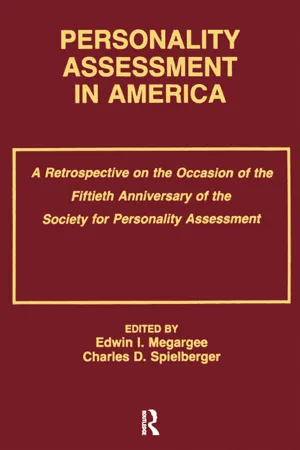
Personality Assessment in America
A Retrospective on the Occasion of the Fiftieth Anniversary of the Society for Personality Assessment
- 200 pages
- English
- ePUB (mobile friendly)
- Available on iOS & Android
eBook - ePub
Personality Assessment in America
A Retrospective on the Occasion of the Fiftieth Anniversary of the Society for Personality Assessment
About this book
Information
Personality Assessment in America: An Introduction
The history of the projective test movement and the evolution of the Society for Personality Assessment both began with the Rorschach Inkblot Technique. Hermann Rorschach published his inkblots and the monograph reporting his research with them in 1921. He was only 38 when he died from appendicular peritonitis a year later. His associate, Emil Oberholzer, became the executor of Rorschach’s intellectual legacy, arranging for the posthumous publication of Rorschach’s blind analysis of a case (Rorschach & Oberholzer, 1923).
Oberholzer was also active in teaching the Rorschach technique to others, one of whom was David Levy, who introduced the technique in the United States in 1924 (Beck, 1972; Pichot, 1984). That same year, an English translation of Rorschach’s posthumous paper (Rorschach & Oberholzer, 1923) appeared in the Journal of Nervous and Mental Diseases. In 1928, Levy taught the Rorschach technique to Samuel Beck, who used the instrument in his doctoral dissertation and, in 1930, published the first original work on the Rorschach in English (Beck, 1972).
In the early 1930s, Beck studied the Rorschach technique with Oberholzer in Zurich, and Marguerite Hertz and Zygmunt Piotrowski began their pioneering work with the instrument. In 1935, Bruno Klopfer, who had learned the technique in Switzerland, arrived on the scene. He founded the Rorschach Institute and the Rorschach Research Exchange which, respectively, evolved into the Society for Personality Assessment and the Journal of Personality Assessment. We shall discuss the history of the Society and its journals below.
Rorschach’s master work on his technique, Psychodiagnostik: Methodik und Ergebnisse eines Wahrnehmungs-diagnostichen Experiments (Rorschach, 1921), which was available only in German until 1942, merely provided the broad outlines of his technique. Without Rorschach to supervise its development, different followers began to diverge in their conception of the particulars of administration, scoring and interpretation. Over the years, Samuel Beck, Bruno Klopfer, Marguerite Hertz, Zygmunt Piotrowski and, somewhat later, David Rapaport each developed their own distinctive approaches.
By the 1950s, as John Exner (1980) notes in his article “But it’s only an inkblot,” there were at least five different, competing, “Rorschachs” in America, each with its own partisans. These schools were not above criticizing one another. For example, in the Journal of Personality Assessment, which had been founded by Bruno Klopfer and was then being edited by his son, Walter, Samuel Beck criticized the senior Klopfer’s system as being, “… hazardous because it is subjective (Beck, 1972, p. 107).”
Meanwhile, two other personality assessment instruments were being developed in America, each of which would serve as the prototype for a number of other tests. At Harvard, Henry Murray (1943) was pursuing research that would culminate in the publication of the Thematic Apperception Test (TAT), an instrument closely related to his theory of personality. The development of the TAT would inspire Murray’s students to create a number of related apperceptive techniques such as the Children’s Apperception Test (Bellak, 1954) and the Make-A-Picture-Story(MAPS) (Shneidman, 1949) test. Like the Rorschach, the apperceptive tests were administered individually, and differing approaches to administration, scoring and interpretation soon emerged.
Further west, Starke Hathaway and J. C. McKinley (1967) were developing the Minnesota Multiphasic Personality Inventory (MMPI), an empirically derived paper-and-pencil self-report inventory. Because it could easily be administered to large groups and scored by various automated devices, its 556 items would serve as a spawning ground for hundreds of other scales, some derived empirically and some rationally. In the years that followed, other researchers would develop a wide array of structured personality inventories.
By the middle of the century, there were a number of competing instruments available for the assessment of personality characteristics. Each had its own set of adherents, and competition could be fierce. Such rivalries are hardly surprising. Before the advent of high-speed electronic computers and substantial government grants, developing a new test was an even more demanding, labor-intensive task than it is today. Test authors did not invest the years of time and effort required to construct and validate a new test unless they had serious reservations about the instruments already available and were convinced of the superiority of their own approach.
Differences among the instruments developed to assess personality were exacerbated by the fact that the proponents of rival tests often differed in their theoretical orientations. Rorschach workers were partial to dynamic and gestalt approaches, whereas Murray’s followers preferred his need-press schema. The “dust-bowl empiricists” of the Midwest seemed to the Easterners to be atheoretical, or at least not especially influenced by theoretical concerns.
Proponents of projective and structured techniques also differed in their approaches to research. Neither the Rorschach nor the TAT was easily amenable to conventional statistical analyses, or to the commonly accepted methods for establishing reliability and validity (Krugman, 1939). Their advocates favored “idiographic” research involving the extensive and intensive study of a few individual cases. In contrast, the MMPI and its cousins yielded quantitative scores that appeared more amenable to conventional statistical and psychometric analyses. Because these tests were designed for group administration, it is not surprising that the MMPI’s proponents were more partial to “nomothetic” research involving large samples.
With America’s entry into the Second World War, many service personnel were trained as military psychologists. After the War, the Veterans Administration began a major program of training clinical psychologists, and, in the late 1940s and early 1950s, personality assessment was a primary focus. The stage was set for a vigorous debate. Which methods were best? What criteria should be used to evaluate them? Is it possible to validate projective techniques? Do structured instruments reflect anything other than response sets? Which is better, clinical or statistical prediction? What techniques and approaches should be taught to graduate students? These were the questions confronting clinicians when many of the papers in this book were being written.
In retrospect, the advocates of structured and projective approaches actually had more in common than they realized, but, as is often the case, it was the polarized theoretical orientations and methodological predilections that produced the polemics. Later, in the 1960s and early 1970s, the whole enterprise of personality assessment came under attack from several quarters. As Marguerite Hertz (1970) and Irving Weiner (1983) note in their contributions to this volume, “Projective techniques in crisis” and “The future of psychodiagnosis revisited,” radical behaviorists who felt relearning techniques could correct all disorders regardless of etiology questioned the need for diagnosis, as did those humanists who felt that categorization and classification stripped clients of their humanity.
Behaviorists such as Walter Mischel (1968), who contended that behavior was primarily determined by situational circumstances, also challenged trait-based personality theories and techniques of assessment. Others questioned the morality of a clinical psychology devoted to the diagnosis and treatment of individuals when there were broad social issues affecting the welfare of large groups of people that needed to be addressed. During this period, the questions became more fundamental. Should projective techniques or any other form of individual assessment be taught at all? Are not personality assessment techniques simply another tool used to suppress the disenfranchised? How can a Society for Personality Assessment (SPA) justify its existence? Before we turn to the papers that address these issues, let us first sketch the history of the SPA during this period.
A BRIEF HISTORY OF THE SOCIETY FOR PERSONALITY ASSESSMENT
The Society traces its roots to the Rorschach Institute founded in 1939 by Bruno Klopfer, who served as its Director until 1947. Over the years a gradual process of what we might term “ecumenical evolution” took place. In 1948 the Rorschach Institute was renamed the “Society for Projective Techniques and the Rorschach Institute,” and in 1959 it became simply the “Society for Projective Techniques.”
By the 1960s, the Society had become the only professional psychological organization exclusively devoted to personality assessment, but many members and potential members were interested in structured as well as projective techniques. In 1965, their interests were formally recognized as the name of the Society was changed to “Society for Projective Techniques and Personality Assessment.” In 1970 this cumbersome title was simplified to “The Society for Personality Assessment,” which it has remained for over 20 years.
In 1936, even before he established the Rorschach Institute, Bruno Klopfer had begun the Rorschach Research Exchange. This mimeographed Journal, which was probably one of the earliest “desktop publications,” quickly became the primary publication outlet for articles dealing with the Rorschach. Beginning in 1939, the Exchange became the official publication of the Rorschach Institute, and of the societies that evolved from it, altering its name to keep pace with the broadening interests of the Society. The name of the Society’s journal was first changed to The Journal of Projective Techniques, then it became the Journal of Projective Techniques and Personality Assessment and finally the Journal of Personality Assessment. Throughout this evolution, the volumes have been numbered consecutively to reflect its origin in 1936 as the Rorschach Research Exchange. For 35 years, Bruno Klopfer served as the Editor, from 1936 through 1971. After Bruno Klopfer’s death, his son Walter edited the Journal until shortly before his death. Robert Davis served as interim editor, followed by Irving B. Weiner who became Editor in 1985. Selections from each period of the Journal’s history are included in the present volume.
In 1970 and 1971, there was a major debate over whether the 32-year-old Society could, or even should, continue as an autonomous professional organization. Relatively few of the Society’s 800 members participated in its activities or governance, most seeming content simply to receive the Journal regularly. As Marguerite Hertz noted in her 1970 “Great Man” address, “Projective techniques in crisis,” many questioned the need for and, especially, the validity of personality assessment. President-Elect Arthur C. Carr wrote, “At present there is a diminished interest in and a general pessimism among psychologists about the future of personality assessment, resulting in a potential threat to the existence of our Society” (1971, p. 203).
By this time, the Society had adopted the custom of meeting in conjunction with the annual convention of the American Psychological Association, but it was becoming increasingly difficult for autonomous organizations such as SPA to obtain time on the APA program. In view of these complications, and in response to the perceived threats to the Society’s survival as an autonomous organization, then-current SPA President Norman Farberow and Past-President Kenneth B. Little suggested that the Society affiliate with APA, either as a separate Division or as a Section of the Division of Clinical Psychology (Farberow & Little, 1970). Calling these proposals “defeatist in nature and ill-advised in action,” President-Elect Arthur Carr (1971) argued that the Society should remain autonomous:
Our Society unites all those who believe in the continuity of assessment. We believe assessment will be here long after more current fads often prominently espoused at APA conventions cease to be considered fashionable. Our group believes that the valid criticisms leveled against current techniques of assessment can be met only through continued research and education.… (p. 203).
As a Society our membership must continue to work for those objectives in which we believe. It would seem that our present efforts can best be organized, our future goals best realized through an organization maintained specifically and solely for its main purpose,—the perpetuation and enhancement of relevant theories of and techniques for personality assessment (p. 204).
Carr’s position prevailed and the SPA retained its independence. As the decade progressed, advances in psychometric theory and methods, coupled with progress in computer technology, paved the way for the development of new assessment techniques, and revisions and improvements in already existing measures. As Irving Weiner points out in his 1983 selection, “The future of psychodiagnosis revisited,” the emergence of new specialty areas such as behavioral medicine and geropsychology, advances in understanding the etiology of psychopathology, and the development of a variety of different interventions all served to reinvigorate psychodiagnosis and assessment.
The 1980s witnessed a period of new and more vigorous leadership. Efforts to expand the membership base were quite successful, and the Society now sponsored a popular Midwinter Meeting. Spielberger and Piotrowski (1992) recently reported:
Over the past three years, membership in SPA has increased dramatically. The Society now has over 2,000 members, more than double the number in 1987…. The large increase in membership and the changing orientation and interests of SPA members have contributed to a substantial expansion in the number of published pages in the Journal of Personality Assessment, which now covers a significantly broader range of relevant topics.
Some of this growth can be attributed to increased interest in cognitive psychology among clinicians and researchers alike. As Sidney Blatt (1990) notes in his paper that concludes this book, this movement has given new life to assessment techniques, such as the Rorschach and TAT, which provide samples of cognitive behavior that can be related to personality functioning. Blatt’s views are borne out by a recent survey of the SPA membership. Although a majority of the members still describe themselves as adhering to a psychodynamic (42.0%) or psychoanalytic (13.1%) orientation, 23.6% now claim a cognitive or cognitive-behavioral orientation (Spielberger & Piotrowski, 1992). Less than 2% indicate a behavioral orientation.
As it enters its second half century, the Society for Personality Assessment is once again active and vigorous. Nevertheless, there are still challenges to be faced. The declining emphasis on personality assessment in graduate training programs, the advent of largely unvalidated, computerized interpretive programs, controversial revisions in major assessment techniques, and the proliferation of new tests are but a few. These issues are discussed in the concluding chapter of this volume.
HISTORY OF THE DISTINGUISHED CONTRIBUTION AWARD
Because a number of the papers that we have included in this volume were prepared as Award addresses, the history of this honor should be outlined. What is now known as the “Bruno Klopfer Distinguished Contribution Award” was originally known as the “Great Man Award.” Samuel J. Beck was the first recipient in 1965, followed by Bruno Klopfer (1966), Henry A. Murray (1967) and Robert R. Holt (1969). (No Award was presented in 1968.)
In 1970, Marguerite Hertz received the “Great Man Award.” In presenting it, Past-President Louise Bates Ames dryly noted, “Though as far as I know, neither of us is an active member in the Women’s Liberation Movement, I am delighted that [Marguerite Hertz] should be the first woman to receive our Great Man Award.” Hertz was the last person to receive the “Great Man” award, which thereafter became the “Distinguished Contribution Award” until Bruno Klopfer’s death, when the Society renamed it in his honor. Hertz was also the first honoree who delivered an Award address that was printed in the Society’s Journal, along with the photograph and lifetime bibliography of the recipient.
In subsequent years, the Award was presented to Zygmunt A. Piotrowski (1971), Molly R. Harrower (1972), William E. Henry (1973), Louise Bates Ames (1974), Sylvan S. Tomkins (1975), Edwin S. Shneidman (1976), Albert I. Rabin (1977), Roy Schafer (1978), Paul E. Meehl (1979), John E. Exner, Jr. (1980), Martin Mayman (1981), Gordon F. Derner (1982), Irving B. Weiner (1983), Richard H. Dana (1984), Stephen A. Appelbaum (1985), Walter G. Klopfer (posthumous, 1985), Harrison G. Gough (1987), Wayne H. Holtzman (1987), Sidney J. Blatt (1989), Charles D. Spielberger (1990) and Leopold Bellak (1991). Most, but not all, delivered addresses that were published in the Society’s Journal. The 1992 Award will be presented to Lee J. Cronbach (1992).
SELECTION OF PAPERS
We bring forth this volume with mixed feelings of prid...
Table of contents
- Cover
- Half Title
- Title Page
- Copyright Page
- Table of Contents
- Preface
- 1. Personality Assessment in America: An Introduction
- Key contributions from the Journals of the Society for Personality Assessment: 1938–1988
- 2. (1938). Out of the inkwell: The Rorschach method. Rorschach Research Exchange, 3–4, 91–100.
- 3. (1943). Some theoretical considerations regarding the Rorschach method. Rorschach Research Exchange, 7, 41–53.
- 4. (1955). The impact of projective techniques on basic psychological science. Journal of Projective Techniques, 19, 453–469.
- 5. (1955). Personality research and theories of personality structure. Journal of Projective Techniques, 19, 361–371.
- 6. (1957). Psychological variables in human cancer. Journal of Projective Techniques, 21, 332–340.
- 7. (1958). Henry A. Murray: An appreciation. Journal of Projective Techniques, 22, 143–144.
- 8. (1958). Formal aspects of the TAT–A neglected resource. Journal of Projective Techniques, 22, 163–172.
- 9. (1959). Personality development in adulthood and old age. Journal of Projective Techniques and Personality Assessment, 34, 384–390.
- 10. (1962). Projections on a triptych: Or, a hagiology for our time. Journal of Projective Techniques and Personality Assessment, 26, 380–387.
- 11. (1968). The metamorphosis of projective techniques. Journal of Projective Techniques and Personality Assessment, 32, 403–404.
- 12. (1970). Projective techniques in crisis. Journal of Projective Techniques and Personality Assessment, 34, 449–467.
- 13. (1979). A funny thing happened to us on the way to the latent entities. Journal of Personality Assessment, 42, 564–577.
- 14. (1980). But it’s only an inkblot. Journal of Personality Assessment, 44, 563–576.
- 15. (1983). The future of psychodiagnosis revisited. Journal of Personality Assessment, 47, 451–459.
- 16. (1984). Megatrends in personality assessment: Toward a human science professional psychology. Journal of Personality Assessment, 48, 563–579.
- 17. (1990). The Rorschach: A test of perception or an evaluation of representation. Journal of Personality Assessment, 55, 394–416.
- Epilogue
- 18. Reflections on Fifty Years of Personality Assessment and Future Directions for the Field
- Combined Reference List for Key Contributions
Trusted by 375,005 students
Access to over 1.5 million titles for a fair monthly price.
Study more efficiently using our study tools.
Frequently asked questions
Yes, you can cancel anytime from the Subscription tab in your account settings on the Perlego website. Your subscription will stay active until the end of your current billing period. Learn how to cancel your subscription
No, books cannot be downloaded as external files, such as PDFs, for use outside of Perlego. However, you can download books within the Perlego app for offline reading on mobile or tablet. Learn how to download books offline
Perlego offers two plans: Essential and Complete
- Essential is ideal for learners and professionals who enjoy exploring a wide range of subjects. Access the Essential Library with 800,000+ trusted titles and best-sellers across business, personal growth, and the humanities. Includes unlimited reading time and Standard Read Aloud voice.
- Complete: Perfect for advanced learners and researchers needing full, unrestricted access. Unlock 1.5M+ books across hundreds of subjects, including academic and specialized titles. The Complete Plan also includes advanced features like Premium Read Aloud and Research Assistant.
We are an online textbook subscription service, where you can get access to an entire online library for less than the price of a single book per month. With over 1.5 million books across 990+ topics, we’ve got you covered! Learn about our mission
Look out for the read-aloud symbol on your next book to see if you can listen to it. The read-aloud tool reads text aloud for you, highlighting the text as it is being read. You can pause it, speed it up and slow it down. Learn more about Read Aloud
Yes! You can use the Perlego app on both iOS and Android devices to read anytime, anywhere — even offline. Perfect for commutes or when you’re on the go.
Please note we cannot support devices running on iOS 13 and Android 7 or earlier. Learn more about using the app
Please note we cannot support devices running on iOS 13 and Android 7 or earlier. Learn more about using the app
Yes, you can access Personality Assessment in America by Edwin I. Megargee, Charles D. Spielberger, Edwin I. Megargee,Charles D. Spielberger in PDF and/or ePUB format, as well as other popular books in Psychology & Clinical Psychology. We have over 1.5 million books available in our catalogue for you to explore.