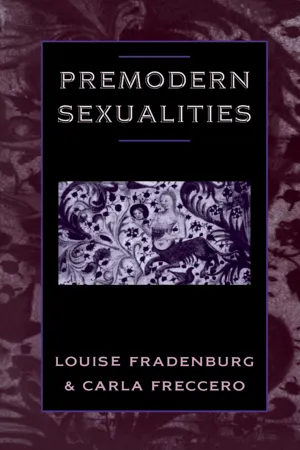
Premodern Sexualities offers rigorous new approaches to current problems in the historiography of sexuality. From queer readings of early modern medical texts to transcribing and interrogating premodern documents of sexual transgression, the contributors bring together current theoretical discourses on sexuality while emphasizing problems in the historicist interpretation of early textualizations of sexuality. Premodern Sexualities clarifies the contributions literary studies can make--through its emphasis on reading strategies--to the historiography of sexuality.
- 288 pages
- English
- ePUB (mobile friendly)
- Available on iOS & Android
eBook - ePub
Premodern Sexualities
About this book
Information
Part One
The Erotics of Conquest
The History that Will Be | 1 |
I take my title from an episode in the first volume of Eduardo Galeano’s brilliant trilogy, Memory of Fire.1 In it, for once in these narratives of the European invasion of the Americas, the Spaniards find themselves surrounded by natives, forced to drink urine since their water supplies have been exhausted, dependent upon the arrows shot into their fortress for firewood. The Araucanian chief approaches, addressing the Spanish captain, telling him to assess his situation and to surrender before his fortress is burned and all inside are killed. The Spaniard refuses:
“Then you’ll die!”
“So we die,” says Bernal, and yells: “But in the long run we’ll win the war! There’ll be more and more of us!”
The Indian replies with a chuckle.
“How? With what women?” he asks.
“If there are no Spanish ones, we’ll have yours,” says the captain slowly, savoring the words, and adds: “And we’ll make children on them who’ll be your masters!” (1985, 138).
This episode sets the terms for my concerns in this essay. The Spaniard speaks of the future with absolute certainty. If his words seem authoritative, it is because of the hindsight we bring to them; their truth would seem to be guaranteed by history, by the facts of conquest that have determined that the so-called Americas were founded in the massive destructiveness of European incursion. The Spaniard speaks, that is, with a foresight that accounts of the history of the Western hemisphere would seem to confirm.
The response of the Indian chief, his chuckle, points, however, to an impossibility that he sees in the Spaniard’s prediction. Unless the population of Europe were to be transferred to the New World, he implies, the Spaniards must reproduce, and lacking women, that would seem to set a limit upon the Spaniard’s prediction that there will be “more and more of us.” The ironies that attend this moment are legible through narratives that Galeano mobilizes elsewhere in his book. On the one hand, the New World will be populated massively, with the refuse of Europe, castoffs as well as those who inhabit a futurity unavailable in the Old World—soldiers, criminals, missionaries, merchants—even the conquistadors were men on the make with dim prospects in their feudal homeland. Further, the trade in African slaves will forever alter the demography of the Americas. On the other hand, the Spaniard’s assurance that the subjugation, rape, and enslavement of native women will produce a population of half-breeds true to their fathers—men who will continue these initial acts of rapine until the entire land is devastated, women who will remain serviceable to their masters—opens itself to another reading. Nothing guarantees, in the long run, that history will confirm the Spaniard’s prophecy.2 Indeed, given the impure origins of a “mestizo America,” an America that is characterized by contingent and shifting relations between and among cultures, the future cannot rest securely on the stratified and hierarchized power relations between Europeans and indigenes, between men and women, that the Spaniard assumes to be forever in place.3
Galeano’s narrative depends upon, even as it undermines, the assurance of the Spanish version of truth and history; it disturbs the implicit analogy between Indians and women, Spaniards and men, the inevitability that heterosexual relations are a means solely of reproducing the values of the father. In short, Galeano locates his ironies in this episode within the assumption that only through sexual reproduction is social reproduction possible; while the Spaniard depends upon this belief, his all-but-defeated status, his sexual rapacity at the point of death, undermine the security of his final taunt. The episode closes, that is, by opening a space for a rejoinder; it implies that there might be something uncontrollable in sexual/social reproduction. This episode resonates with others in Memory of Fire, as even the title of the book means to imply, since it suggests that the holocaustal destructiveness of the invasion of the New World also inspires, burns in, memories that prove to be indelible loci of resistance. Therefore the episode also has an irony directed against the biologism voiced by the Indian chief, for cultural transmission and reproduction do not simply take place biologically; claims of descent or racial affiliation can hardly be reduced to determinations of genetic quantification.4 For Galeano, one site (somewhat idealistically) for these possibilities lies in the scenes of writing and reading in his book, the way, for instance, this episode positions a reader’s identification with the Araucanian chief against the Spaniard’s deterministic view and self-satisfied assurance. To see that in this moment the history that will be is an open question, not the one foreclosed by the Spaniard and by those who have written as if he spoke with the voice of history, is to become engaged in a scene of revisionary reading made possible not simply by Galeano’s text, but by its full imbrication in the multiples of history that enabled him to write in the first place. Any number of voices, now, could find themselves in the open space of implicit rejoinder.
The themes, then, that I wish to pursue here are centered on the relation between the writing of history as prediction and as retrospection. The history that will be is, after all, as much how we recount what happened as how we project a future; the history that will be is, inevitably, a history of the present, that divided site that must look both ways at once. The loci for my speculations in what follows are those suggested by Galeano: relations between colonial narratives and modes of cultural transmission that exceed the assumption that historical reproduction is tied to heteronormativity.
It would be possible to recast the reading of Galeano that I have offered into a more explicit theoretical register. This would involve, for instance, translating “the history that will be” into the Derridean idiom and tense of the future anterior: the history that will have been. That is, to oppose the truth of the Spaniard’s vision, the truth assumed in books with titles like The Conquest of America (Todorov 1984), I seek to open the historical text to its multiples, to what Derrida describes in Of Grammatology (1974–1976) as a root system that remains unrooted, to a play of différance that does not mean to ignore the devastations wrought in the New World, but that also seeks to keep open the alternatives that remain, the reserves and resources not entirely effaced in the so-called conquest of America.5 “A text always has several epochs and reading must resign itself to that fact,” Derrida writes (1974–1976, 102). In suggesting that I pursue a Derridean protocol of reading here, I must add several caveats. First, that the historical impact of colonialism is effaced in Of Grammatology, particularly in Derrida’s treatment of Lévi-Strauss, where colonial violence appears as a merely empirical and entirely contingent local instance of the more universal problematic of the violence of the letter (Goldberg 1990, 3–6, 15–18). Moreover, as I will suggest, when one moves from this central chapter in Of Grammatology to Derrida’s reading of Rousseau, the syntax of the scandal of writing is located within a frame of unquestioned heteronormativity. This is so, I would argue, because the chapter on Lévi-Strauss provides a colonialist hinge to Derrida’s text that permits a certain anthropological stance that remains to be read through the chapters on Rousseau, especially as they are organized by the scandalous equation of writing and masturbation. Whether or not this colonialist trajectory from Lévi-Strauss to Rousseau is essential to the Derridean argument, it is also the case that Derridean protocols of reading can be unhinged from their roots. To locate a blind spot in the Derridean account need not mean to inhabit it in this attempt to mobilize Derridean habits of reading to an argument that may not seem ultimately very Derridean at all.
Derrida’s argument with Lévi-Strauss, as is well known, is in large measure methodological. The anthropologist is valued insofar as his work broaches Derrida’s own deconstructive project by failing to deliver a term that would effectively divide nature from culture or, to translate these anthropological terms into their Derridean equivalents, that would divide voice from writing. He is critiqued for the failure in rigor that leads Lévi-Strauss to construct his narrative of the relations between European and indigene as an encounter between a corrupt and literate society and an innocent unlettered one. What is endorsed, then, is the foundational move by which Lévi-Strauss installs the incest taboo as at once natural and cultural. How fundamental this paradigm is to the Derridean project is suggested by the epigraph from Rousseau’s Confessions that stands at the head of the second part of Grammatology: “I felt as if I had committed incest.” How troubling this endorsement is has been more than demonstrated by feminist and especially lesbian-feminist critiques of Lévi-Strauss. The incest taboo installs the traffic in women as the essential trait of sociocultural institutions, and retrospectively guarantees that foundational moment as also, at the same time, natural. The law of culture is also the law of nature, and it mandates heterosexual relations. The responses to this scenario have sought to unpack the consequences of the incest taboo, and therefore valuably contest the foundational moment in Lévi-Strauss that Derrida embraces. Gayle Rubin (1975) troubles this foundational narrative in “The Traffic in Women,” insisting that before the incest taboo that supposedly founds and mandates heterosexuality there must have been an earlier prohibition against same-sex relations, indeed a time before the law that failed to mark gender at all. Monique Wittig’s separatist response takes this foundational moment as propounding a gender difference that renders impossible same-sex desire as fitting within this social bond: thus, for her, a lesbian cannot be a woman since “woman” is that which is traded between men (1992, 20). Luce Irigaray’s critique even more radically locates woman as an imaginary term in this scenario, not merely barring relations between women, but also making the sociocultural a sphere of entirely male relations, woman being only a ruse and a projection (1985, 170–97). Judith Butler’s reading entertains Rubin’s scenario of a time before the law only, finally, to insist that the law is a regulatory device that installs compulsory heterosexuality only through its compulsion to repeat: thus every performance of the social bond is necessarily subject to failure since the need for repetition is the sign of incompletion and imperfection (1990, 72–78).6
To read Derrida’s acceptance of Lévi-Straussian anthropology within these critiques is, of course, to subject his text to a subsequent epoch of reading that exposes how Derrida’s position participates in a normativizing view of the sex/gender system. This anthropological inheritance is particularly salient in Derrida’s analysis of the Rousseau who felt “as if” he had committed incest.
“As if” because, in the imaginary moment of a nature before culture, there could be no incest, because there would have been no law prohibiting it; because after the foundation of society there would be no incest because it is forbidden (“before the prohibition, it is not incest; forbidden, it cannot become incest except through the recognition of the prohibition” [Derrida 1974–1976, 267]). Butler has remarked on how Lévi-Strauss is so entranced by his narrative of prohibition that he overtly declares that incest has never occurred; Derrida’s more oblique statement distances himself from Lévi-Strauss only insofar as he refuses the empirical as a terrain for theoretical operations, that is, because his formulation deals at the level of the law (of the incest taboo) rather than in terms of its operation. Incest can only be an “as if.”
What follows from this? In Derrida’s account, writing, which retranslates the originary natural/social problematic, is a male activity; the single time that Derrida calls up a scene of a woman writing in Rousseau’s text—the scene of the “magic wand” with which the beloved traces her lover’s face—it is to put the pen (the penis) in her hand, and then to elide it with the finger of God, the writer. These interpretive moves—while they may well describe the working of gender in Rousseau’s text—are not unpacked with an aim of providing a critical distance from the gendered relations they describe. Rather, for Derrida, as for Rousseau, the problem of intersubjective relations must inhabit spheres of male-male relations, because woman is that which is written upon or one whose writing can only be a male projection and simulation. The subjective position of autoaffection is male territory. But further: this means that masturbation must be imagined solely as male masturbation in which a fantasmatic woman—Rousseau conveniently calls her mamma—divides the male subject: between his hand and his penis is this image of self-division.
This not only consigns women to the sphere of the imaginary; it also provides a syntax of a compulsory heteronormativity. Derrida reads the scene of writing in Rousseau as one in which the auto of autoeroticism, autoaffection and, by extension, the locus of subjectivity and consciousness, is split by a hetero whose otherness is marked by gender and by the failure of access to activity and subjectivity except in the instance of a simulated writing: “between auto-eroticism and hetero-eroticism, there is not a frontier but an economic distribution” (Derrida 1974–1976, 155). But that economy is, as in Lévi-Strauss, one that depends upon the traffic in women; the other that is requisite to the self, even as it splits the self, is marked as female. To go back from this to our initial colonial instance: Derrida’s scene of writing—as cultural transmission, as foundationally human—depends upon the elisions of nature and culture in the foundational move of Lévi-Straussian anthropology. Heteronormativity assumes a foundational position.
If what remains valuable in the Derridean critique is its potential for troubling any account of ...
Table of contents
- Cover
- Half Title
- Title Page
- Copyright Page
- Table of Contents
- Preface
- Introduction: Caxton, Foucault, and the Pleasures of History
- Part One: The Erotics of Conquest
- Part Two: Medicine and Law
- Part Three: Sexuality and Sanctity
- Part Four: Rhetoric and Poetics
- Contributors
Trusted by 375,005 students
Access to over 1.5 million titles for a fair monthly price.
Study more efficiently using our study tools.
Frequently asked questions
Yes, you can cancel anytime from the Subscription tab in your account settings on the Perlego website. Your subscription will stay active until the end of your current billing period. Learn how to cancel your subscription
No, books cannot be downloaded as external files, such as PDFs, for use outside of Perlego. However, you can download books within the Perlego app for offline reading on mobile or tablet. Learn how to download books offline
We are an online textbook subscription service, where you can get access to an entire online library for less than the price of a single book per month. With over 1.5 million books across 990+ topics, we’ve got you covered! Learn about our mission
Look out for the read-aloud symbol on your next book to see if you can listen to it. The read-aloud tool reads text aloud for you, highlighting the text as it is being read. You can pause it, speed it up and slow it down. Learn more about Read Aloud
Yes! You can use the Perlego app on both iOS and Android devices to read anytime, anywhere — even offline. Perfect for commutes or when you’re on the go.
Please note we cannot support devices running on iOS 13 and Android 7 or earlier. Learn more about using the app
Please note we cannot support devices running on iOS 13 and Android 7 or earlier. Learn more about using the app
Yes, you can access Premodern Sexualities by Louise Fradenburg,Carla Freccero in PDF and/or ePUB format, as well as other popular books in Scienze sociali & Storiografia. We have over 1.5 million books available in our catalogue for you to explore.