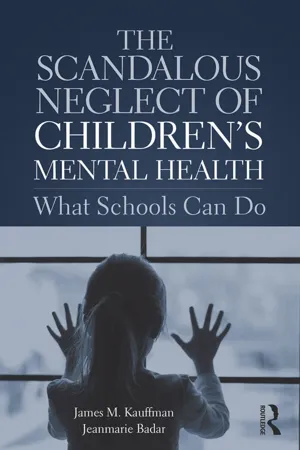
The Scandalous Neglect of Children's Mental Health: What Schools Can Do makes the case that children with mental health needs are under-identified and under-served by schools and other agencies. After reading this brief but powerful book, you will better understand the nature of children's mental health needs and the need for expanded services for children in schools and communities. The risks and benefits of treatment, especially early intervention, are discussed and guidelines for action by teachers, parents, and others are provided. The sad fact is that many people do not understand that most young people with mental health needs never receive any treatment of any kind and most of those who receive any treatment at all receive those services only in schools.
eBook - ePub
The Scandalous Neglect of Children’s Mental Health
What Schools Can Do
- 150 pages
- English
- ePUB (mobile friendly)
- Available on iOS & Android
eBook - ePub
The Scandalous Neglect of Children’s Mental Health
What Schools Can Do
About this book
Information
1
The Scandal
Scandal is a very strong word, often misused to describe something merely disliked. In fact, just about anything someone thinks shouldn’t have been allowed to happen or should have been done but wasn’t done can be described, often wrongly, as a scandal. But an actual scandal is something truly shameful that brings dishonor, something that causes or should cause public outrage.
American society’s failure to recognize and treat children and youth with mental health problems appropriately is outrageous. In fact, we could say it’s a real scandal. But it’s a scandal lots of people don’t know about—or they do know about it but deny it or dismiss it as not really important. Some people recognize it as a bad situation but conclude there isn’t much we can do about it, which isn’t so. Schools can do a lot to address the scandal. But schools alone are not enough.
At least three journalists—Pete Earley, Ron Powers, and Judith Warner—have written poignantly about how people in the general public, including too many educators, have many wrong ideas about problems of behavior and mental health.1 Earley wrote about the difficulty of getting mental health services for his son and others who are seriously mentally ill. Powers, the parent of two sons with mental health needs, one of whom committed suicide, wrote about how little people seem to care about others with mental health needs. Like Earley, Powers used the colloquialism “crazy” in referring to mental illness. Not everyone with a serious mental health problem is considered “crazy.” Warner wrote about how lots of people believe that youngsters with serious emotional or behavioral problems are identified for no good reason. People may mistakenly believe that difficul-ties like attention deficit hyperactivity disorder (ADHD) are minor, or believe that kids with such problems typically get undeserved attention, or too much treatment, or too often are medicated.
People often suggest that most children with ADHD or other problems at school just need shaming or stern discipline or physical punishment, ways of reacting to children’s behavior that usually make the problems worse. Misunderstanding and mistreatment of children with mental health problems are common in both communities and schools. The fact is that many problems related to mental health are often first noticed in schools, and teachers are therefore in a particularly good position to recognize the scandal and do something about it.
The fact is that many problems related to mental health are often first noticed in schools, and teachers are therefore in a particularly good position to recognize the scandal and do something about it.
A true scandal is like a low-grade fever, a clear sign that something’s wrong and is going to get worse if it isn’t dealt with appropriately. The topic of this book is a relatively unknown scandal that doesn’t cause much anger in the general public because it’s so well disguised. Misinformation is repeated so often, or a false impression is created so well and made so seductive, that most people believe something untrue. They believe things that truly qualify as “fake news.”
Too many people don’t care about children’s mental health. They are ignorant of the facts or wish them away. They think that kids are typically rushed to treatment for minor or imaginary problems, the equivalent of getting overly concerned about the sniffles or giving hypochondriacs attention for their fantasies. Or they don’t seem to realize that behavior like that of presidential candidate and later President Donald Trump is indicative of a mental disorder. Some people see Trump’s suggestions of violence and torture; his bullying, mocking, and belittling of others; his lack of empathy for fellow human beings; his refusal to apologize or take responsibility for his statements or actions; his mendacity, blaming others for his mistakes or mis-deeds; racism, sexism, xenophobia, braggadocio, denial of reality, and self-aggrandizement as normal rather than hideously disturbed.2 Some people say that Trump’s supporters, though, are normal, even if Trump isn’t. But, even if most of his supporters are mentally and behaviorally normal, that does not mean President Trump’s behavior is normal or should be “normalized” or seen as a model for anyone, child or adult.
Many Americans seem not to recognize some forms of mental illness when they see them, and this unwillingness to see aberrant behavior for what it is, particularly when it is antisocial conduct, contributes to the scandalous neglect of young people’s as well as adults’ mental health needs. In fact, many individuals in positions of power and authority have chosen to ignore, excuse, or further enable and abet Mr. Trump’s verbal and nonverbal behavior. They fail to point out the unacceptability of public displays of emotional ill health, unpredict ability, and intellectual instability. In doing so, they likely encourage imitation of unacceptable behavior by youngsters. Agnosticism regarding emotional and behavioral aberrance in high-profile leaders does not suggest timely recognition of the mental health needs of children and youth.3
Many Americans seem not to recognize some forms of mental illness when they see them, and this unwillingness to see aberrant behavior for what it is, particularly when it is antisocial conduct, contributes to the scandalous neglect of young people’s as well as adults’ mental health needs.
We hasten to add that most individuals with mental health needs are not dangerous. Danger ousness is heightened by two things: (1) antisocial behavior, especially aggression and extreme social withdrawal, both of which may be indicated by verbal or physical behavior or a combination of them, and (2) an individual’s ability to coerce or harm others, such that the greater the person’s sphere of influence, the greater the danger. That is, danger may be confined to parents, siblings, or relatively few others if the person’s power over others is relatively low; but the danger is magnified by higher executive authority and greater power over others.
Children may be extremely antisocial, but they seldom have much actual power over others. However, their mental health issues are seldom addressed until those issues have become extreme. Children experience precisely the opposite of easy access to mental health care. Kids and their parents typically endure horrible problems that aren’t addressed for years, if ever.
Clever politicians encourage the misperception of what’s scandalous and say we can’t afford to deal with such problems now anyway—or offer the opinion that the problem is lack of moral fiber or strength of kids and their families. Or they may tell us, sure, we need better mental health services—but then skirt the issue of cost and never talk about what actually needs to be done. Calls for attention to mental health issues of adults or children are easy, popular, and politically advantageous, particularly after mass shootings, but appropriate action and needed funding are difficult and seldom provided. The real scandal is disguised by evasion and misinformation, which are indefensible on rational as well as moral grounds. But the wrong impression, the evasion and the misinformation, seem to “work,” in that they convince the general public to believe a fiction and ignore the truth.
Part of the smoke screen that hides the real scandal has to do with labels. So, we digress somewhat here to address some problems of terminology. Most people don’t understand that the real scandal in both mental health and special education is the neglect of children who need help in their homes, communities, and schools. The differences between mental illness and the federal special education category called “emotional disturbance” are important. In some ways, the differences and similarities are confusing, and we discuss the differences and the overlap between them further in Chapter 3. Suffice it to say at this point that they are overlapping and that both mental health (or psychological) services and special education for children and youths with emotional/behavioral disorders or problems are important and that both are characterized by scandalous neglect.4
The American Psychiatric Association has its own terminology and acronyms for various forms of mental illness, as we mention below. Children who have mental health problems or need special supports in school because of emotional or behavioral disabilities have attracted many different labels and much confusing terminology. States vary in the terminology they use to designate students falling into various special education categories. Many of these students need special psychological/psychiatric and educational supports, and these supports are often not provided, especially not in schools. For example, an investigation into special education in Chicago public schools found not only that special education funding was reduced in most categories at the expense of students’ welfare, but that the largest cuts in services related to special education were in psychological support.5
Children with mental health problems are often considered in schools to have “emotional and behavioral disorders” (EBD) or “emotional disturbance” (ED).6 People may wonder what distinguishes “emotional” from “behavioral,” “disturbance” from “disorder,” or even divert attention to the conjunctions “and” and “or.” In our opinion, these linguistic quibbles have no merit in distinguishing one group of children from another or making better sense of the problem. We should not get hung up on these issues about labels.
Then there are those who don’t want to label a child or the child’s problems in any way. Well … just try talking about something without saying what it is—using a word (label) for it! And then there are people who want to label the problem or the service, just not the individual. But, if you think about it a little, you’ll see that, first, people are always labeled by their special problems; second, people are always labeled by the services they get. And there are those who want to use some euphemism such as “challenged” to avoid social stigma associated with other words. But a euphemism like “challenged” is useless unless its meaning is fudged, simply because everybody faces challenges. “Challenged” and other euphemisms make humorists’ careers, because when people figure out how the word is being used they tend to laugh at the clumsy attempt to avoid a reality. We can’t do away with labels or avoid labeling kids except by not talking about their prob lems or the services they get, even if we talk only in “code.” Worry about labels is mostly a diversion, a distraction from recognizing and dealing with problems. Certainly, we should avoid “street language” and epithets, but not the language (labels) of professionals.
We can’t do away with labels or avoid labeling kids except by not talking about their problems or the services they get, even if we talk only in “code.” Worry about labels is mostly a diversion, a distraction from recognizing and dealing with problems.
We might also use terms associated with psychiatry, psychology, community men tal health services, or special education such as “conduct disorder” (CD), “obsessive-compulsive disorder” (OCD), “oppositional defiant disorder” (ODD), “attention deficit hyperactivity disorder” (ADHD), and many others. Terms like these are used in the Diagnostic and Statistical Manual of the American Psychiatric Association (often referred to simply as the DSM). These labels may be important for teachers and parents to understand when talking about particular individuals. Terms such as these may convey important information about the nature of a problem and its treatment. However, they must be explained appropriately to teachers and parents.7
But, back to the children and youth who are the focus of what we consider a real scandal. Who are we talking about? Not just those in the federal special education category of “emotional disturbance” under the federal law named in 2004 as The Individuals with Disabilities Education Improvement Act (originally enacted by Congress in 1975 and better known today as the IDEA). We do focus on those who might be considered to have emotional and behavioral disorders as their most obvious problem (the ED category in the federal law). As we discuss later, the ED special education category under federal law overlaps with the group of children and youth known to have a variety of mental health difficulties. The kids typically have similar difficulties regardless of what they’re called.
We could consider children with a wide variety of labels and conditions. For example, we could discuss those who are said to have a developmental disability or those with intellectual disabilities (formerly called mental retardation). Lots of kids with special needs are neglected, and their neglect is outrageous. As we said, though, our major focus is on those who have mental health problems.
Most children with seriously impairing emotional or behavioral problems—no, not those just having a little trouble, but those with problems that mental health experts judge to be really bad—get no treatment at all. Nothing. They don’t get special education, and they don’t get any other treatment for mental health problems, such as counseling or psychotherapy or medical prescriptions. Even the few who do get special education or other treatment usually get help only after their need is so long-standing, so outrageous, so undeniable, so obvious, or so in-your-face that people can’t stand it anymore. Often, any help children with even these obvious problems get is too little and too late. What they usually get is inadequate, ineffective intervention long after their problems first became clear. Their problems are allowed to grow so severe, so bad that their effective treatment is very, very difficult.
Most people understand that the longer you let a physical problem go before treating it, the harder it is to treat. We know that a physician’s chances of treating an illness successfully go way down when something like cancer is in an advanced stage. But, for some reason, many people don’t seem to understand that the same is true for mental health problems. They seem to expect miracles, to expect great outcomes regardless of the stage to which the emotional or behavioral problem has been allowed to progress.
Most people understand that the longer you let a physical probl...
Table of contents
- Cover
- Title
- Copyright
- Dedication
- Contents
- Meet the Authors
- Preface
- Acknowledgements
- 1 The Scandal
- 2 Measurement of Mental Health
- 3 Mental Health Problems Kids Have
- 4 Common Causes of Children’s Mental Health Problems
- 5 Prevention Remains a Good Idea, But Is Seldom Practiced
- 6 What We Should Do
- 7 What Educators Should Do First
- References
Trusted by 375,005 students
Access to over 1.5 million titles for a fair monthly price.
Study more efficiently using our study tools.
Frequently asked questions
Yes, you can cancel anytime from the Subscription tab in your account settings on the Perlego website. Your subscription will stay active until the end of your current billing period. Learn how to cancel your subscription
No, books cannot be downloaded as external files, such as PDFs, for use outside of Perlego. However, you can download books within the Perlego app for offline reading on mobile or tablet. Learn how to download books offline
Perlego offers two plans: Essential and Complete
- Essential is ideal for learners and professionals who enjoy exploring a wide range of subjects. Access the Essential Library with 800,000+ trusted titles and best-sellers across business, personal growth, and the humanities. Includes unlimited reading time and Standard Read Aloud voice.
- Complete: Perfect for advanced learners and researchers needing full, unrestricted access. Unlock 1.5M+ books across hundreds of subjects, including academic and specialized titles. The Complete Plan also includes advanced features like Premium Read Aloud and Research Assistant.
We are an online textbook subscription service, where you can get access to an entire online library for less than the price of a single book per month. With over 1.5 million books across 990+ topics, we’ve got you covered! Learn about our mission
Look out for the read-aloud symbol on your next book to see if you can listen to it. The read-aloud tool reads text aloud for you, highlighting the text as it is being read. You can pause it, speed it up and slow it down. Learn more about Read Aloud
Yes! You can use the Perlego app on both iOS and Android devices to read anytime, anywhere — even offline. Perfect for commutes or when you’re on the go.
Please note we cannot support devices running on iOS 13 and Android 7 or earlier. Learn more about using the app
Please note we cannot support devices running on iOS 13 and Android 7 or earlier. Learn more about using the app
Yes, you can access The Scandalous Neglect of Children’s Mental Health by James M. Kauffman,Jeanmarie Badar in PDF and/or ePUB format, as well as other popular books in Education & Education General. We have over 1.5 million books available in our catalogue for you to explore.