![]()
1 Early warnings
1.1 Introduction
Early warnings play a key role in the management of NEC contracts, and are covered within the TSC by Clauses 15.1 to 15.4. They are also mentioned in Clauses 61.5 and 63.8, which we will discuss later in Section 1.3.
Early warnings are a key component of the overall risk management process in the TSC. The process is not about liability, but instead about the Parties collaborating to identify, mitigate or remove the effect of matters which could cause difficulty to the service provision.
Early warnings are an essential and valuable risk management tool within the NEC contracts, the TSC obliging the Service Manager and the Contractor to notify each other as soon as either becomes aware of any matter which could affect the project in terms of time, cost or quality.
Clause 15.1 requires the Contractor and the Service Manager to give an early warning by notifying the other as soon as either becomes aware of a matter which could:
• increase the total of the Prices;
• interfere with the timing of the service; or
• impair the effectiveness of the service.
As with many NEC clauses, this one must be interpreted carefully.
The requirement is to notify, and this must be done separately from other communications, in accordance with Clauses 13.1 and 13.7. The obligation is to notify as soon as either becomes aware of a matter, and this can often be difficult for parties to demonstrate one way or the other.
Sometimes correspondence or records may show when the Contractor or Service Manager first became aware of something, but this can be a matter of subjective interpretation. Note that the contract says ‘becomes aware’ not ‘should have become aware’.
This sometimes causes confusion, but if we take as an example that the Contractor is instructed by the Service Manager to use a particular methodology and the Contractor knows from experience that the methodology would probably not be sufficient to meet the requirements of the Scope, then the Contractor should give an early warning.
The Contractor and Service Manager may also give an early warning by notifying the other of any other matter which could increase the Contractor’s total cost. One could query whether a matter which could increase the Contractor’s cost, but not affect the Prices, should be an early warning matter, or for that matter, whether it should be anything to do with the Service Manager, particularly if Option A has been selected so the Contractor is not looking to recover this additional cost through the contract.
However, the words are ‘the Contractor may give an early warning’ so he is not obliged to do so. This provision is designed to encourage collaboration between the parties, irrespective of their contractual liability.
Note also within Clause 15.1, the Contractor is not required to give an early warning for which a compensation event has previously been notified, so, as an example, if the Service Manager gives an instruction which changes the Scope, it is a compensation event, for which neither the Service Manager nor the Contractor are required to give early warning.
The early warning procedure obliges people to be ‘proactive’, dealing with risks as soon as the parties become aware of them, rather than ‘reactive’, waiting to see what effect they have then trying to deal with them when it is often too late. Encouraging the early identification of problems by both parties puts the emphasis on joint solution finding, rather than blame assignment and contractual entitlement.
The authors have come across situations where Clients and Service Managers appear hostile to the receipt of early warnings from Contractors. Sometimes they are viewed as the first stage in a compensation event process or similar. That may be so, but not always, and in effect could prevent a compensation event occurring or at least lessen its effect.
Early warnings have a vital role to play in the TSC and their use should be encouraged, not discouraged. Clause 15.1 requires the giving of early warnings; they are not optional, the Contractor and the Service Manager are obliged to issue them (read Clauses 15.1, 10.1 and 10.2 together). Clause 10.1 requires the participants to ‘act as stated’ and Clause 10.2 to ‘co-operate’, therefore early warnings should be issued freely and received just as freely.
Statistically speaking one would expect an equal number of early warnings to be issued by the Service Manager and the Contractor. Typically though, the ones issued by the Contractor frequently outnumber the ones issued by the Service Manager. There are sanctions for the failure to issue early warnings and we will discuss these later. There is no ‘ready reckoner’ for how many early warnings should be issued but an absence of them should be viewed as more worrying than a plethora of them.
Early warnings are one of the most important and valuable aspects of the contract and it is perhaps surprising that, whilst a few other contracts refer to an early warning process, only the NEC contracts set out in clear detail what the parties are obliged to do, with appropriate sanctions should the parties not comply (see Clauses 11.2(6), 61.5 and 63.8).
1.2 Notifying early warnings
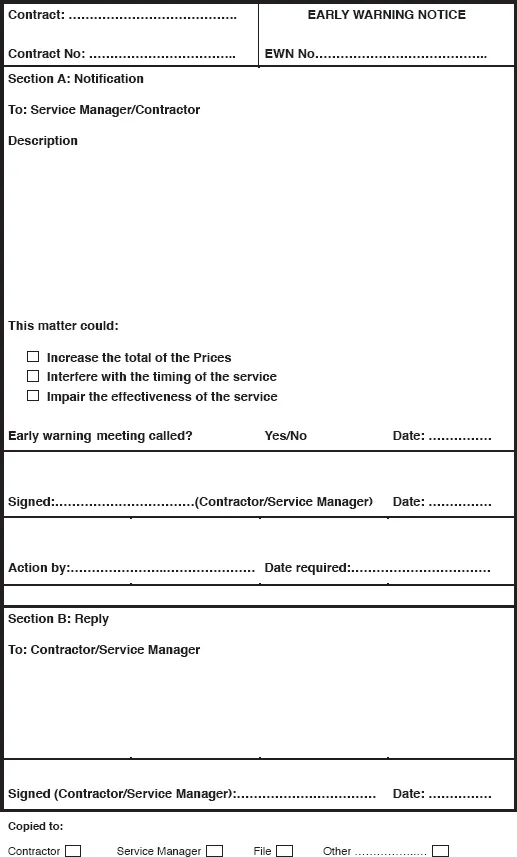
The contract requires (Clause 13.1) that all instructions, notifications, submissions, etc. are in a form that can be read, copied and recorded, so early warnings should not be a verbal communication such as a telephone conversation. If the first notification is a telephone conversation, or a comment in a meeting, it should be immediately confirmed in a suitable format to give it contractual significance. Figure 1.1. shows a typical template for an early warning notice.
Also, Clause 13.7 requires that notifications which the contract requires must be communicated separately from other communications, therefore early warnings must not be included within a long email or letter, which covers a number of issues, or embodied within the minutes of a progress meeting.
There are some key words within the obligation to notify:
• ‘The Contractor and the Service Manager’ – No one else has the authority or obligation to give an early warning. The Service Manager is therefore notifying on behalf of himself, the Client and many possible others who he represents within the contract. The Contractor is notifying on behalf of himself, his Subcontractors and again many possible others who he represents under the contract.
Service Managers are often criticised for seeing early warnings as something the Contractor has to do, and in fact as previously stated, most early warnings are actually issued by the Contractor. However, the Contractor and the Service Manager are obliged to give early warnings each to the other, so it is critical that Service Managers play their part in the process.
As an example, if the Service Manager becomes aware that he will be late in delivering some technical information to the Contractor, he should issue the early warning as soon as he becomes aware that the information will not be delivered to the Contractor, and not wait and subsequently blame the Contractor for not giving an early warning stating that he has not received the information!
• ‘As soon as’ – means immediately. There are a number of clauses within the contract that deal with the situation where the Contractor did not give an early warning. Whilst the party who gives the early warning must do so as soon as he becomes aware of the potential risk, the other party should respond to an instruction to attend an early warning meeting (see below) as soon as possible.
• ‘Could’ – not must, will or shall. Clearly there is an obligation to notify even if it is only felt that something may affect the contract, but there is no clear evidence that it will.
It must be emphasised that early warnings are not the first step towards a compensation event as is often believed. Early warnings feature in a completely separate section of the contract and in fact the early warning provision is intended to prevent a compensation event occurring or at least to lessen its effect. It can also be used to notify a problem which is totally the risk of the notifier. It is also worth mentioning that early warnings are a notice of a future risk, not a past one. The parties are not required, nor is it of any value, to notify a risk that has already happened.
Figure 1.1 Typical template for an early warning notice.
The nature and format of early warnings can have an impact on how they are received and what reaction is prompted. Contractual parties are often keen to identify the flaws of their counterparties, but the obligation here potentially requires parties to identify and record their own failures. Common sense is therefore needed in how these are identified.
The ‘matters’ which require an early warning to be given are essentially the three determinants of success in any service provision: price, time and quali...