Time for Solutions! Overcoming Gender-related Career Barriers shares the who, what and how to reduce gender inequalities in the workplace. Clearly the time is now since inequities are hampering the economy and simply wrong. Who needs to change? And, how? These can be more difficult questions to answer. This book identifies a wide range of issues that need attention and provides direction pertaining to who needs to do what. Gender diversity studies have concentrated on the plight of women which unfortunately still needs consideration. We go beyond the problems of women to see what some in the LGBTQ community are facing and what needs to happen to reduce their barriers. Interestingly, there are a few universal solutions that are not complicated to implement. All it takes is paying attention to individual needs and implementing sociological solutions that create long-term inclusion. Of course, the devil is in the details. Authors of this book provide those details.
- 208 pages
- English
- ePUB (mobile friendly)
- Available on iOS & Android
eBook - ePub
p.1
PART I
Breaking the shackles of gender-related expectations
Assessing and acknowledging reality
p.3
1
THE GLOBAL VIEW OF GENDER DISCRIMINATION IN BUSINESS
A story of economic exclusion
Laurel Steinfield and Linda Scott
Introduction
Collectively, women are the largest group in the world that face discrimination. Gender inequalities are a global phenomenon that occur inside and outside of the workplace. As this chapter will detail through a review of global data, the aggregated trends are consistent: women in businesses and leadership are faced with unequal career progression and unequal pay, as well as significant gaps in access to capital, all around the world. Moreover, these inequalities increase as women in organizations progress up the leadership chain and into higher tiered management positions. For entrepreneurs, these inequalities are made visible through their lack of access to financing and under-representation in more lucrative industries. As we argue, the pervasiveness of this problem means, firstly, that it is not an individual performance or capabilities issue with the “woman” who needs to “lean in.” Rather, it is a result of patriarchal biases imbedded in institutional structure, practices, policies, and imperatively, our own minds and implicit biases. Secondly, it is not just about employment or leadership or entrepreneurship as the trends we show repeat across each of these fields. Instead, there is a more systemic problem: the economic exclusion of women. Gender discrimination in business and leadership translates into a lack of access to positions of power where financial decisions are made. The wage gap, limitations on capital for entrepreneurial endeavors, and their exclusion from more profitable industries lead to a reduction of women’s investment power and ability to challenge men’s control over the global financial system. We raise concerns that go beyond the boardroom and C-suite to question the capital gap between women and men and its implications for women and economies. We interrogate policies and practices that are often believed to be solutions, such as maternity leaves or mentoring programs, and suggest plausible adjustments and actions for business and policy makers.
p.4
The data
The data we use is taken from the available records of large non-governmental bodies, including the World Economic Forum (WEF) (such as its Global Gender Gap Reports), the World Bank’s database and Enterprise surveys, the OECD and its Social Institution and Gender Index, the UNDP (United Nations Development Program), and the ILO (International Labor Organization) that have been collected annually for almost a decade. We likewise include findings based on our review of the academic literature, results from the World Values Survey (done every five years), and intermittent reports produced by the World Bank, OECD, IMF, Economist Intelligence Unit, WEF, and Booz & Company’s (now called strategy&) work on the Third Billion. Additional grey papers based on corporate’s self-reporting, such as LeanIn.Org and McKinsey & Co’s Women in the Workplace, and the WEF’s Corporate Gender Gap Report (produced once off in 2010), are used to provide insights into the awareness of the gender gap amongst business representatives and the existence of the often-invisible forms of gender biases in the workplace.
The trends
The exclusion of women from the formal labor markets
Globally, female labor force participation rates remain lower, on average, than men’s participation rates (refer to Figure 1.1). Although participation rates are comparable in some countries, especially in lower income countries, such as sub-Saharan Africa where women and men have to work out of necessity, discrepancies can be excessive in other countries, such as the MENA region (Middle East and North Africa). Imperatively, these figures mask the over-representation of women in more precarious forms of employment, such as the informal agricultural industry or part-time labor where there are fewer legal and social protections (e.g. pensions, health benefits, unemployment or maternity protection), and in sectors with lower remuneration. As the ILO’s Global Employment Trends find (2016b), women are on average 25–35% more likely to be in vulnerable employment in countries in sub-Saharan Africa and MENA region.
p.5
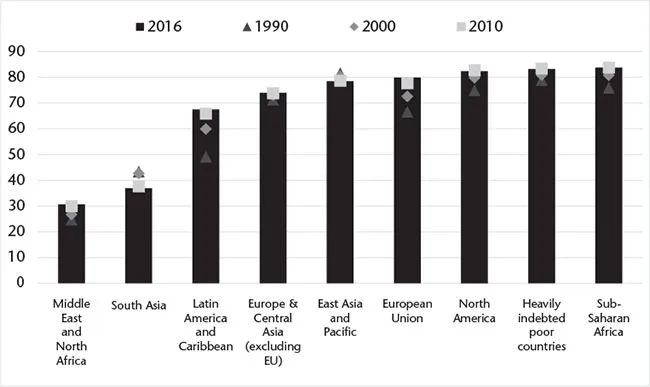
FIGURE 1.1 Gender gap in labor force participation (male minus female labor force participation rates, in percentage points), 1990–2016
Source: ILO 2016a.
The downward stair-step of career progression
Exploring the data related to women in business and leadership demonstrates that in all nations, organizational types (corporates, governments, NGOs) and across industries, women as a population incur a downward stair-step of career progression, as well as increasing wage gaps as they move up into managerial and leadership roles. The downward stair-step, as per Figures 1.2 and 1.3, shows that although women and men may be achieving parity in labor force participation rates and gaining entry into lower level managerial positions, the ratio of women to men decreases in a stair-step fashion at each level of management, with a smaller percentage of women in middle management and a significantly smaller percentage of women in top management and on board. Figure 1.2 results are from the WEF’s (2010) Corporate Gender Gap Report—a report based on their survey with the Human Resource directors of 100 of the largest employers in the 30 OECD-member countries and BRIC (Brazil, Russia, India, and China) (3,400 companies). Notably, although the US companies have a larger proportion of women in their pipeline, these women are stuck in the middle: none of the companies interviewed had women CEOs.
p.6
The capital gap
The capital gap between men and women can be seen in two critical areas: wages and access to loans. The gender gap in wages exists at every level and in every industry. Imperatively, the wage gap is the largest at the top, in management positions, where women earn on average 21% less than their male counterparts (OECD 2012). Figure 1.4 exemplifies how the gender gap is generally the largest for those women who are in the top 10% earnings category. Lower or entry level jobs tend to be graded, with information about expected pay more publicly available. As women progress in their career, knowledge about pay raises, or what the position should earn, becomes increasingly less transparent and more dependent on negotiation and subjective assessments of performance. As our subsequent review of studies demonstrates, implicit gender biases negatively affect women’s negotiations and performance-based assessments, contributing to the gender gap in pay and promotions.
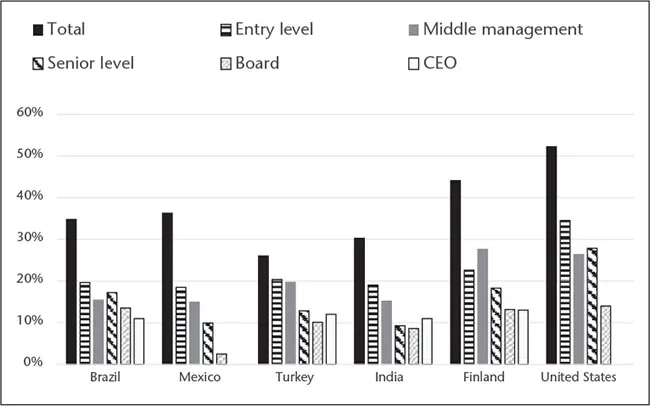
FIGURE 1.2 The global trend of the downward stair-step of career progression for women (percentage of women to men represented in corporate roles)
Source: WEF 2010.1
p.7
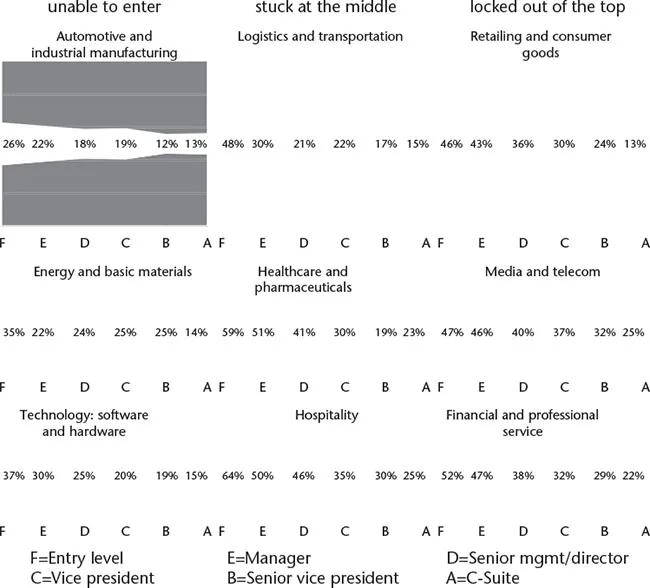
FIGURE 1.3 The downward stair-step trend for women by industries (US based companies)
Source: LeanIn.org and McKinsey & Company (2016). Data is based on surveys with 118 US based companies with a total of 30,000 employees.
p.8
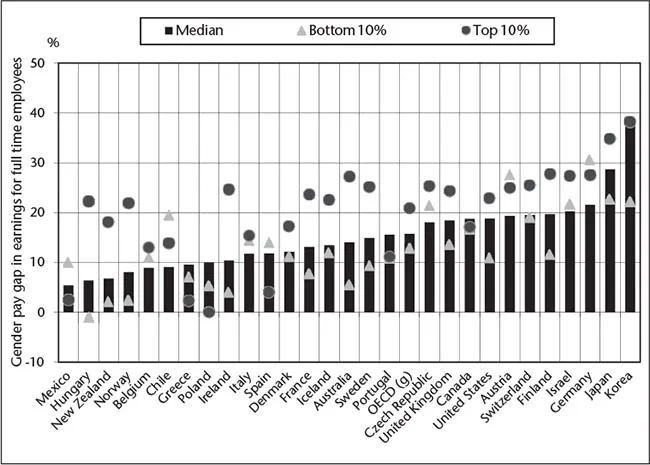
FIGURE 1.4 The gender wage gaps by earning categories
Source: OECD 2012, 167; http://dx.doi.org/10.1787/888932676070.
Note: The wage gap is defined as the difference between male and female wages divided by male wages (at the first decile, median and ninth decile of the earnings distribution).
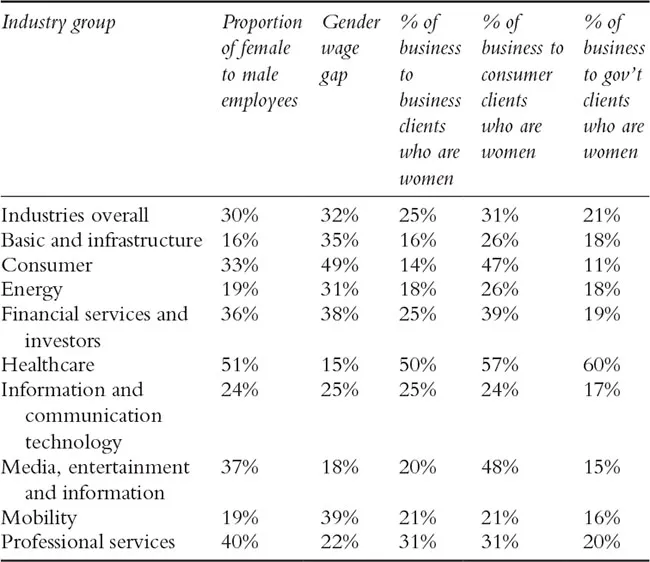
The wage gap does vary by industry (as per Table 1.1). And in comparing Figure 1.3 and Table 1.1, trend lines become apparent: industries that have more women at the top or have more women as a percentage of clientele (as per the Healthcare industry or the Media/Telecom industry) report lower wage gaps. The directionality of this relationship, however, is unknown, and, moreover, it is not always guaranteed. The Financial and Professional Services, for example, which have on average 22% of their C-suite represented by women, have significant wage gaps ranging from 22–36%. The Consumer market, which has a significant percentage of a female consumer base (47%) and representation of women in their workforce (at 33%), holds the highest wage gap at 49%. Outliners such as these are important to note: they indicate a rigidity of gender biases. Indeed, prior studies show that having more women in a job can increase wage gaps because “women’s work” is undervalued. Elvira and Graham (2002) in their study of Fortune 500 financial corporations, found that for every 10% increase in the proportion of females in a job, individual employees in that job received 1% less in base salary and in total compensation, were 8.4% less likely to get a bonus, and, when given, received 7.5% less in incentive bonuses.
p.9
TABLE 1.1 The gender gap in wages versus female share of customer base, by industry
Source: WEF 2016b, 2.
In regard to loans, studies have produced mixed results as to whether women face discrimination in accessing loans and higher interest rates. Many studies report that women entrepreneurs do not request financing as much as men (see for example Moro, Wisniewski, and Mantovani 2017), yet these studies (and many that control for other “variables,” e.g. size of business, geography, etc.), fail to consider whether women are really choosing to refrain from financing or if the markets are choosing for them. Studies show that within the market there are hostile and discriminatory practices and gender biases that limit women’s credit histories and asset bases. These act to push women away from high-asset, high-investment industries (refer to McAdam 2013 for a review). In microfinance, for example, women face a glass ceiling in accessing sufficient capital (Agier 2013), which constrains the ambits of their entrepreneurial ventures. The smaller scale of women’s ventures contributes to substantially lower earnings, with self-employed women earning on average 30–40% less than their male counterparts (OECD 2012). The espoused factors of “limited management experience” and the devotion of “less time to their businesses than men” (ibid., p. 16) underscores more systemic issues at play, including a woman’s access to experience, to networks, and societal expectations of how she should be spending her time. This is a global problem.
p.10
Across the world there is a pattern in which a lower amount of financing is given to women entrepreneurs. This trend exists in developed and developing countries alike, and in countries with more liberal versus restrictive policies for women owned businesses. For example, in Lebanon, which has restrictions that limit women’s participation in the economy, 33.5% of SME businesses had women as part- or full-owners yet only 3% of bank loans went to women (IFC 2013a; OECD 2014). In the US, where its Equal Credit Opportunity Act (1974) has “led the way in nondiscrimination in access to credit” (World Bank 2015, 18), similar numbers are recorded: in 2012 women-owned businesses made up 30% of small businesses2 yet accounted for only 4.4% of the value of loans from all sources (Cantwell 2014). This financing gap exists across types of capital, getting progressively worse as it moves from financial institutions with more female representation, such as crowdfunding, (Marom, Robb, and Sade 2016) to male dominated institutions (i.e. venture capital) (Zarya 2017) where capital investment requests tend to be higher. Statistics available at a global level on developing and emerging economies likewise reflect a similar trend as per Figure 1.5. These results would argue that it is not that women do not need financing but that they are being excluded from financial markets and limited in how, where, and when they can contribute to economies.
p.11
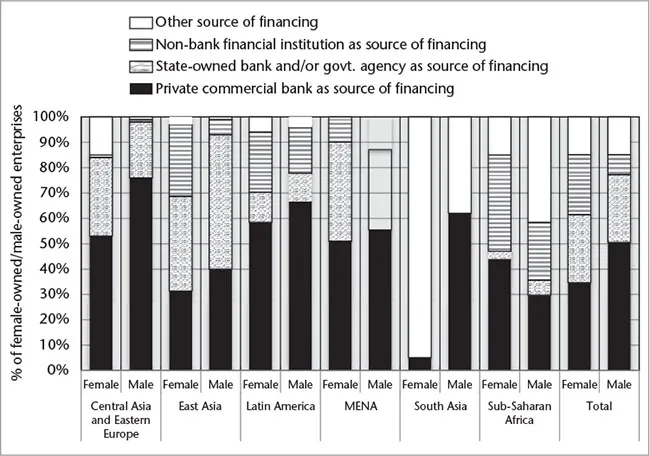
FIGURE 1.5 Methods of financing for female-owned versus male-owned enterprises
Source: World Bank Finances 2017.
The perceived causes: qualification gaps, laws, traditions, media, and biology
Qualification gaps
A common cause attributed to women’s stalled career progressions is that women’s levels of qualifications are not com...
Table of contents
- Cover Page
- Time for Solutions!
- Praise
- Title
- Copyright
- Contents
- List of Illustrations
- Notes on Contributors
- Acknowledgements
- Introduction
- Part I Breaking the Shackles of Gender-Related Expectations: Assessing and Acknowledging Reality
- Part II Clearing the Path: Recognizing Obstacles and Opportunities
- Part III Creating Paths for Gender Equality: Overcoming Career-Threatening Obstacles
- Index
Trusted by 375,005 students
Access to over 1.5 million titles for a fair monthly price.
Study more efficiently using our study tools.
Frequently asked questions
Yes, you can cancel anytime from the Subscription tab in your account settings on the Perlego website. Your subscription will stay active until the end of your current billing period. Learn how to cancel your subscription
No, books cannot be downloaded as external files, such as PDFs, for use outside of Perlego. However, you can download books within the Perlego app for offline reading on mobile or tablet. Learn how to download books offline
Perlego offers two plans: Essential and Complete
- Essential is ideal for learners and professionals who enjoy exploring a wide range of subjects. Access the Essential Library with 800,000+ trusted titles and best-sellers across business, personal growth, and the humanities. Includes unlimited reading time and Standard Read Aloud voice.
- Complete: Perfect for advanced learners and researchers needing full, unrestricted access. Unlock 1.5M+ books across hundreds of subjects, including academic and specialized titles. The Complete Plan also includes advanced features like Premium Read Aloud and Research Assistant.
We are an online textbook subscription service, where you can get access to an entire online library for less than the price of a single book per month. With over 1.5 million books across 990+ topics, we’ve got you covered! Learn about our mission
Look out for the read-aloud symbol on your next book to see if you can listen to it. The read-aloud tool reads text aloud for you, highlighting the text as it is being read. You can pause it, speed it up and slow it down. Learn more about Read Aloud
Yes! You can use the Perlego app on both iOS and Android devices to read anytime, anywhere — even offline. Perfect for commutes or when you’re on the go.
Please note we cannot support devices running on iOS 13 and Android 7 or earlier. Learn more about using the app
Please note we cannot support devices running on iOS 13 and Android 7 or earlier. Learn more about using the app
Yes, you can access Time for Solutions! by Susan M. Adams in PDF and/or ePUB format, as well as other popular books in Business & Business General. We have over 1.5 million books available in our catalogue for you to explore.