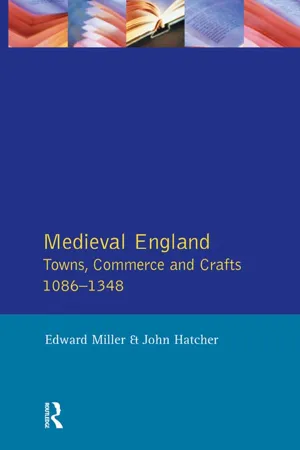
- 488 pages
- English
- ePUB (mobile friendly)
- Available on iOS & Android
eBook - ePub
CHAPTER ONE
Domesday Book and Beyond
The Anglo-Saxon chronicler’s account of the proceedings of the Domesday commissioners in 1086 makes clear the bias of their investigations. They were sent ‘all over England into every shire … to ascertain … how much land and livestock the king himself owned in the country’, and ‘how much each man who was a landholder here in England had in land and livestock’, so that the shameful fact was that not an ox or a cow or a pig escaped notice in their record.1 Their prime concern, in other words, was with a profoundly rural world, a bias which reflected the realities of eleventh-century England. This was not, however, the whole truth about England at that time, and indeed Domesday Book tells us something about communities which had urban features and, occasionally, about men engaged in other than agricultural occupations. These notices, unfortunately, are fleeting, inconsistent and often enigmatic; and the record of urban groups is seriously incomplete, if only because the towns may not have been part of the original scope of the enquiry. In consequence, the Domesday entries for towns represent a ‘haphazard and incomplete’ transfer of old materials relating to the dues which boroughs owed to the king or sheriff. A further result is that the Domesday information about towns principally relates to things as they had been in or before 1066 and provides nothing like the systematic description of urban communities which the commissioners assembled for rural manors in 1086. For some places, moreover, including London, Winchester and probably Coventry, there are no entries at all; and the information given about others, including Bristol, is of the slightest.2
Domesday, all the same, offers a point of departure, although it needs to be supplemented wherever possible with evidence from the sparse written records of late Anglo-Saxon England, from coins which have survived in some quantity, and perhaps most of all from the findings of archaeologists which are the most likely source of genuinely new information. The historian’s need to cast his net widely is all the greater because the many signs of economic and social development in the pre-Conquest generations have become increasingly clear to us. A recent suggestion that these generations experienced a ‘first English industrial revolution’3 is almost certainly an exaggeration; but the period from the ninth century onwards witnessed urban and industrial expansion, together with an intensification of agricultural production, which together enabled the England the Normans conquered to support a substantially larger population than it had in King Alfred’s day. These developments of the late Saxon centuries were a prelude to many of the features revealed, however imperfectly, by Domesday Book, and they enable us to fill, although necessarily tentatively, some of the many gaps in that record.4
1. CRAFTS AND CRAFTSMEN
Domesday at once makes abundantly clear that much of what might be described as industry had nothing to do with towns. Right through the Anglo-Saxon centuries, indeed, a high proportion of craftsmen had been villagers. Smiths, for example, were indispensable for making and maintaining many of the tools and implements required by farmers, and by 1066 a smith was the one ‘rural specialist’ to be found in most villages.5 Not every smith, of course, was a village blacksmith of this sort. There were slave smiths, at least in the north, who were probably tied to the service of a particular lord or lady; there were a few urban specialists like Spileman the sword-maker who occupied a tenement in Winchester; and in a few places there were little concentrations of smiths – eight at Glastonbury and a sufficient number to pay substantial rents at Green’s Norton and Towcester (Northants.) – possibly to provide central services for a wealthy landlord or staffing for an incipient iron manufacturing centre. Smiths, in turn, imply the existence of iron miners and smelters of whom archaeologists have uncovered traces in at least 29 of the 41 English counties, although Domesday tells us little of them. There are stray references to smelting in Hampshire, Sussex and Wiltshire; there were iron mines around Rhuddlan over the Welsh border with Cheshire; rents of iron were paid in Dorset, Somerset and Gloucestershire; there were iron workers at Moulton (Devon) and Hessle (Yorks.); and there were ironworks at Corby and elsewhere in Northamptonshire as well as at Castle Bytham (Lincs.).6 Other branches of mining are still more rarely mentioned. Domesday records lead miners and rents of lead in Derbyshire, but not elsewhere; and tin leaves scarcely a trace in any early record.7
Many of these country smiths, miners and metal workers, like their successors later in the middle ages, are likely to have been part-time specialists, combining their craft with small-scale farming. Their individual and aggregate production, too, was doubtless meagre. There were, of course, other rural craftsmen in the Domesday countryside, although their traces are even fainter. Quarries, for instance, were noted at Taynton (Oxon.) and at four places in Sussex, that at Bignor supplying millstones; and potters were recorded at Westbury (Wilts.), Haresfield (Glos.) and Bladon (Oxon.), representing a good deal less than a full directory of eleventh-century rural pottery-making. Archaeologists have found potters’ kilns in at least five Norfolk villages and at Michelmersh (Hants.); Domesday place names indicate the presence of potters at Potterton (Yorks.) and Potterne (Wilts.); and it has been suggested that much of the Saxo-Norman St Neots ware was made locally in villages over a wide area of eastern England, and that the expansion of the industry in East Anglia and the Midlands in the eleventh century may have taken place largely in villages rather than, as earlier, in towns. There are also signs of a similar development in the same period in the south-west Midlands and parts of Wessex, for demand there was increasingly met by producers serving only a restricted area with hand-formed articles, by contrast with the wheel-thrown pots widely distributed from fewer manufacturing centres in the tenth century. Industrial expansion, in other words, often took place in a rural context.8
Domesday Book is even less informative about the countrymen and countrywomen who spun the yarn and wove the cloth needed both by ordinary folk and their betters. Many of these rural textile workers were doubtless, like many rural smiths and miners, farmer-craftsmen rather than craftsmen pure and simple, and as such they are not distinguished in the ranks of eleventh-century villagers. On the other hand, we do have certain knowledge of one west country estate in the eleventh century which possessed the equipment needed for cloth making, and it is likely that it would have been available in most manorial centres and many other households besides. Those who used the manorial equipment may sometimes have been slaves, for the property bequeathed by a tenth-century Dorset lady included a slave weaver and a slave seamstress (both women), and Eadred the weaver and his family were freed from slavery at Durham in the eleventh century. We are again reminded that a good deal of ‘industrial’ production, apart from being imperfectly distinguished from agriculture, was to some degree a matter of household self-supply. Just as, in the making of pottery, ‘simple household production’ gave place only slowly to production by specialist craftsmen, so much cloth was made for domestic use by slaves or servants in the headquarters of large estates; and in lesser households ‘homespuns were produced in the home by and for the family’.9 At the very least, it can be said that textile skills were indigenous in the Anglo-Saxon countryside.
Non-agricultural occupations were only of major importance in relatively few country places, but exceptional in this respect were the locations where salt was made by evaporation from sea water or from brine from inland springs. Salt was an indispensable commodity. As the salter in Ælfric’s Colloquy pointed out, without him cellars and storehouses would be empty, for salt was needed to preserve meat and butter and cheese, as well as to season vegetables. It also generated revenue for kings and landlords, a fact which won its production attention in Domesday Book, which records salterns scattered along the coasts from Lincolnshire to the Bude estuary in North Cornwall. In some places they were so numerous they must have needed considerable bodies of workers.10 There were 180 salterns, for instance, in the Marshland of north-west Norfolk, where the settlement which would become the town of King’s Lynn may already have been forming on the spoil heaps deposited by the salters, whose activities in this way literally raised land from the sea. Many of these salterns were appendages of agricultural estates, like that which was entered under the manor of Nether Wallop in the interior of Hampshire, although doubtless the saltern itself lay near the coast. Presumably it was designed to meet the desmene requirements of that manor; and the Count of Mortain and his household may have consumed at least part of the salt produced in his manor of Studland (Dorset), with its 32 attached salterns. Salters, too, probably often worked only part-time at this trade, for salt boiling was mainly a summer activity; and in north Norfolk some salters may have brought sheep with them to graze on the salt marshes during the production season. This coastal industry remained close to the farming world.11
The same is true to some extent of the inland salt industry, although that centred on the Droitwich (Worcs.) brine springs does have a somewhat more specialized appearance. The Droitwich industry was well known to William of Malmesbury and Domesday has much to say about it, and by that time it was already old. In the ninth century Droitwich was known as Saltwic and there were royal taxes on the distribution of its product; and as early as the eighth century there had been salt ‘furnaces’ there.12 In 1086, however, there were villeins as well as burgesses at Droitwich; some burgesses owed mowing services; and many of the Droitwich salinae were appurtenances of rural manors lying both in the neighbourhood and widely scattered over the West Midlands. Again the ties between industrial activity and agricultural society were very close. The same seems to be true of the salt industry of Nantwich, Middlewich and Northwich in Cheshire. These ‘wiches’ may have been ‘little manufacturing enclaves in the midst of an agricultural district’; but we cannot be sure that the salters were full-time specialists and the salt-houses were certainly manorial appendages. At Nantwich, for example, the earl of Chester had his own salt-house attached to his manor of Acton, and many men of the patria, the surrounding countryside, also had salt-houses there, just as thegns did at Northwich. The earl’s Nantwich salt-house, moreover, supplied his household throughout the year, although some salt might be left over for sale. Rural lordship, in other words, provided a framework for the industry; and it was geared to domestic self-supply as well as the market.13
The salt industry once again illustrates Domesday’s patchy enumeration of rural craftsmen. Because many salters were part-time farmers they are noticed as craftsmen only if, in that capacity, they made a direct contribution to royal or seignorial revenues. They are, for example, rarely mentioned in connection with coastal salterns except occasionally in Devon and Cornwall. Notices of some other rural craftsmen are equally sporadic or even non-existent. We hear nothing of village tanners, tailors or shoemakers, who occur regularly in manorial records a few generations later; and the single carpenter recorded (in Herefordshire) was surely not unique at a time when wood was the principal material for most building and for agricultural tools and implements.14 As we have seen, too, the Domesday record of rural potters is clearly incomplete, and that for millers is even more inadequate. The single miller entered for Cheshire, Herefordshire, Sussex and Shropshire respectively, together with three in Worcestershire and a ‘keeper’ of a mill in Derbyshire, hardly represents an exhaustive enumeration given that there were some 5,624 mills in 3,463 of the 9,250 Domesday manors.15 No doubt, as archaeological finds make clear, in many places grain continued to be ground by hand in querns; but to a significant extent mills, mostly driven by water power, had superseded hand grinding by 1086. T...
Table of contents
- Cover
- Half Title
- Title Page
- Copyright Page
- Table of Contents
- List of maps
- List of abbreviations
- A note on medieval English measures and money
- Preface and acknowledgements
- Map of medieval England
- 1. Domesday Book and beyond
- 2. Medieval industries
- 3. The inland trade
- 4. Overseas trade
- 5. Medieval English towns
- 6. Medieval townsfolk
- 7. England under the three Edwards, 1272–1348
- Select Bibliography
- Index
Trusted by 375,005 students
Access to over 1.5 million titles for a fair monthly price.
Study more efficiently using our study tools.
Frequently asked questions
Yes, you can cancel anytime from the Subscription tab in your account settings on the Perlego website. Your subscription will stay active until the end of your current billing period. Learn how to cancel your subscription
No, books cannot be downloaded as external files, such as PDFs, for use outside of Perlego. However, you can download books within the Perlego app for offline reading on mobile or tablet. Learn how to download books offline
Perlego offers two plans: Essential and Complete
- Essential is ideal for learners and professionals who enjoy exploring a wide range of subjects. Access the Essential Library with 800,000+ trusted titles and best-sellers across business, personal growth, and the humanities. Includes unlimited reading time and Standard Read Aloud voice.
- Complete: Perfect for advanced learners and researchers needing full, unrestricted access. Unlock 1.5M+ books across hundreds of subjects, including academic and specialized titles. The Complete Plan also includes advanced features like Premium Read Aloud and Research Assistant.
We are an online textbook subscription service, where you can get access to an entire online library for less than the price of a single book per month. With over 1.5 million books across 990+ topics, we’ve got you covered! Learn about our mission
Look out for the read-aloud symbol on your next book to see if you can listen to it. The read-aloud tool reads text aloud for you, highlighting the text as it is being read. You can pause it, speed it up and slow it down. Learn more about Read Aloud
Yes! You can use the Perlego app on both iOS and Android devices to read anytime, anywhere — even offline. Perfect for commutes or when you’re on the go.
Please note we cannot support devices running on iOS 13 and Android 7 or earlier. Learn more about using the app
Please note we cannot support devices running on iOS 13 and Android 7 or earlier. Learn more about using the app
Yes, you can access Medieval England by Edward Miller,John Hatcher in PDF and/or ePUB format, as well as other popular books in History & British History. We have over 1.5 million books available in our catalogue for you to explore.