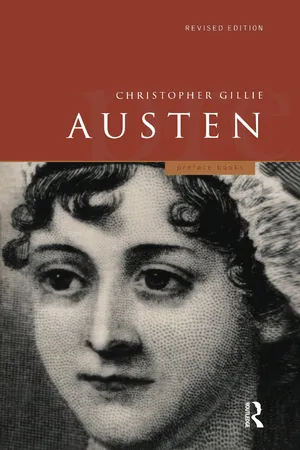
Jane Austen's satirical classical novels have made a lasting contribution to English literature and first gave the novel its distinctly modern character with the treatment of ordinary people in everyday life. Her works, such as Pride and Prejudice, Emma andMansfield Park, remain as popular today as they ever have been, both in book form and a screen adaptations. The Preface Books series approaches the work of Jane Austen from a particular perspective which, by introducing the writer via a biographical sketch and a survey of her cultural and social context, encourages readers to understand her work in the period and style it was written. Christopher Gillie's A Preface to Austen looks at Austen's life and literary background and their effect on her work. Using biographical information, it clearly sets her writing firmly in the context of her times and will be essential reading for anyone interested in the works of Austen.
- 200 pages
- English
- ePUB (mobile friendly)
- Available on iOS & Android
eBook - ePub
About this book
Information
Part OneBiographical Background
Chronological Table
| LIFE AND WORKS | RELEVANT BACKGROUND | |
|---|---|---|
| 1764 | George Austen (1731–1805) marries Cassandra Leigh (1739–1827). He is the rector of Steventon, Hampshire, in the gift of his relative Thomas Knight with estates in Hampshire and Kent. | |
| 1775 | 16 December: Jane Austen born. Seventh of eight children: James (1765–1819); George (1766–1838); Edward (1768–1852); Henry (1771–1850); Cassandra (1773–1845); Francis (1774–1865); Charles (1779–1852). | Sheridan: The Rivals |
| 1776 | Adam Smith: The Wealth of Nations | |
| 1777 | Henry Mackenzie: Julia de Roubigné | |
| Hannah More: Percy (a tragedy) | ||
| 1778 | Fanny Burney: Evelina | |
| Sheridan: The School for Scandal | ||
| 1779 | William Cowper: The Olney Hymns | |
| 1780 | Samuel Johnson: Lives of the Poets | |
| 1781 | An Austen cousin, Elizabeth Hancock, marries the Comte de Feuillide. | Rousseau: Confessions |
| 1782 | Burney: Cecilia | |
| 1783 | Jane and Cassandra sent to school with Mrs Cawley, widow of the Principal of Brasenose, Oxford. School transferred to Southampton. Jane nearly dies of putrid fever. | End of American War of Independence George Crabbe: The Village |
| 1784 | Jane and Cassandra sent to Abbey School, Reading, under Mrs Latournelle. | Cowper: The Task Death of Samuel Johnson |
| 1785 | Education continued informally at home. Learns French, some Italian, the piano, and reads English literature extensively. | |
| 1787 | Family theatricals (including The Rivals) in the Steventon barn. Jane begins to write sketches. | |
| 1789 | Beginning of French Revolution | |
| 1790 | Love and Freindship. | Edmund Burke: Reflections on the French Revolution |
| 1791 | Edward marries Elizabeth Bridges. The History of England. | Thomas Paine: Rights of Man I |
| 1792 | James marries Anne Mathew. Evelyn, Catharine, etc. | Paine: Rights of Man |
| II Mary Wollstonecraft: A Vindication of the Rights of Woman | ||
| 1793 | William Godwin: Political Justice | |
| War with France; French Reign of Terror under the Jacobins | ||
| 1794 | Elizabeth de Feuillide's husband guillotined in France. Jane working at Lady Susan. | Mrs Radcliffe: The Mysteries of Udolpho |
| Godwin: Caleb Williams | ||
| 1795 | Death of James's first wife. Cassandra engaged to Thomas Fowle. | The Directory takes over the government of France |
| 1796–8 | Jane working at Elinor and Marianne (later Sense and Sensibility); Susan (later Northanger Abbey); First Impressions (later Pride and Prejudice). | Burney: Camilla |
| Robert Bage: Hermsprong | ||
| William Wordsworth and Samuel | ||
| Coleridge: Lyrical Ballads | ||
| 1797 | Death of Cassandra's fiancé, Thomas Fowle. James marries Mary Lloyd. Edward inherits Kent and Hampshire estates from Thomas Knight. Henry m. Elizabeth de F. | |
| 1799 | Mrs Austen's sister-in-law, Mrs Leigh Perrot, arrested for shoplifting in Bath. Acquitted. | |
| 1800 | Jane seems to have had a brief romance with a gentleman met at Sidmouth; he dies soon after. | Death of Cowper Maria Edgeworth: Castle Rackrent |
| 1801 | Edgeworth: Belinda | |
| 1802 | Jane receives a proposal of marriage from Harris Bigg Wither; she accepts him but withdraws the next morning. | Peace of Amiens Walter Scott: Minstrelsy of the Scottish Border |
| 1803 | Sells the ms of Northanger Abbey for £10 to Crosby in expectation of publication. | War with France renewed |
| 1804 | Visits Lyme Regis. Begins The Watsons (perhaps an early draft of Emma). The death of Mrs Lefroy, Jane's best friend. | Napoleon declared Emperor of France |
| 1805 | Death of Jane's father. Mrs Austen and her daughters move to Southampton. | Battle of Trafalgar Scott: The Lay of the Last Minstrel |
| 1807 | Charles marries Fanny Palmer. | Madame de Staël: Corinne |
| Crabbe: The Parish Register | ||
| Abolition of slave trade | ||
| 1808 | Scott: Marmion Beginning of Peninsular War | |
| 1809 | Mrs Austen and her daughters move to Chawton in Hampshire, on Edward's estate. Crosby returns the unpublished ms of Northanger Abbey. | Hannah More: Coelebs in Search of a Wife Death of Sir John Moore in Spain |
| 1810 | Scott: The Lady of the Lake | |
| Crabbe: The Borough | ||
| 1811 | Sense and Sensibility published: ‘a novel by a Lady’. | |
| 1812 | Pride and Prejudice sent to publishers; Mansfield Park begun. | Byron: Childe Harold |
| Crabbe: Tales; Napoleon invades Russia | ||
| 1813 | Pride and Prejudice published; well received. Jane's last visit to Edward at Godmersham. | Southey: Life of Nelson |
| 1814 | Mansfield Park published; Emma begun. | Restoration of the Bourbons in France Scott: Waverley |
| 1815 | Jane Austen in London with Henry; the Prince Regent orders his librarian, James Clarke, to give her every attention. Emma consequently dedicated to the Prince Regent. | Battle of Waterloo Scott: Guy Mannering |
| 1816 | Emma published. Walter Scott's essay on Jane Austen in the Quarterly Review. | Byron: The Prisoner of Chillon |
| Scott: The Antiquary, Old Mortality | ||
| 1817 | Persuasion completed and ‘put upon the shelf for the present’. Jane Austen, having contracted Addison's disease, moves to Winchester for better medical attention. Dies on 18 July. | John Keats: Poems |
| 1818 | Publication posthumously of Northanger Abbey and Persuasion. | Mary Shelley: Frankenstein |
1 Character and Family Background
DOI: 10.4324/9781315837628-3
One of the most misleading facts that are widely known about Jane Austen is that her life was what is called ‘uneventful’. Her biography can indeed be quickly summarized.
She was born on 16 December 1775, at her father's rectory at Steventon in Hampshire, the seventh in a family of eight children. She lived with her parents until the death of her father in 1805, and then with her mother until the year of her own death. The household moved from Steventon to Bath in 1801, from Bath to Southampton in 1806, from Southampton to the Hampshire village of Chawton in 1809. Every change of address represents, on the whole, a downward social direction. She died on 18 July 1817, in Winchester, where she and her sister Cassandra had taken lodgings so as to be near her doctor. Her death seems to have been due to a then obscure illness called Addison's Disease. She visited other places, including London and a number of country houses, but she scarcely left the south of England. She and her sister attended boarding-schools at Oxford, Southampton and Reading when she was between the ages of seven and nine, but she received most of her education at home. She never married, though she received at least one proposal; she may have had at least one love affair, but little is known about it except that it was not connected with the proposal. She seems to have had no direct relationships with any of the famous men and women of her time, unless we call the royal invitation to dedicate one of her novels to the Prince Regent a direct relationship. The memorable events seem to have been the publication of the novels: Sense and Sensibility (1811), Pride and Prejudice (1813), Mansfield Park (1814), Emma (1815); after her death, Northanger Abbey and Persuasion, in December 1817.
What, apart from the novels, could appear more commonplace? And for that matter what could be more commonplace than the events in those novels? And yet, as novels, they are so far from being ordinary or commonplace that few by other writers contain so much quickness oflife so well sustained. We do not judge them, of course, by the amount of shock they produce in the nervous system, but by their luminousness. Correspondingly, the facts about Jane Austen's life illuminate her art only in so far as we seek in them what is illuminating, not what is glamorous or startling.
To begin with the large family of which she was a member. The father, George Austen, came from stock which dated itself back to the class of medieval clothiers which were known as ‘the Grey Coats of Kent’—‘a body so numerous and united that at county elections whoever had their vote and interest was almost certain of being elected’, or so a local historian, Hasted, asserted. They continued to flourish as a class into the seventeenth century, and the same historian states that they possessed ‘most of the landed property in the Weald, insomuch that almost all the ancient families in these parts, now of large estates and genteel rank in life, and some of them ennobled by titles, are sprung from ancestors who have used this great staple manufacture, now almost unknown here’. In fact, they provided the varied, vigorous stock which by the eighteenth century was proliferating from commerce into the main professions—the Church, the fighting services, the law—as well as into landowning. In short, they became the gentry, whose upper reaches joined the aristocracy and whose lower ones were among the attorneys, apothecaries and surgeons of the country towns. It was an exceptionally vigorous class, at the height of its vitality if not yet of its influence in George Austen's lifetime. The characteristic vice of its members might be snobbery, since they had the best opportunities for social advancement; their corresponding virtue was a combination of practical force with cultured refinement: an awareness of the commonplace tasks of daily living and of the hardships of the poor, as well as sensitiveness to the life of the mind. This was the class which was to be the subject of Jane Austen's novels.

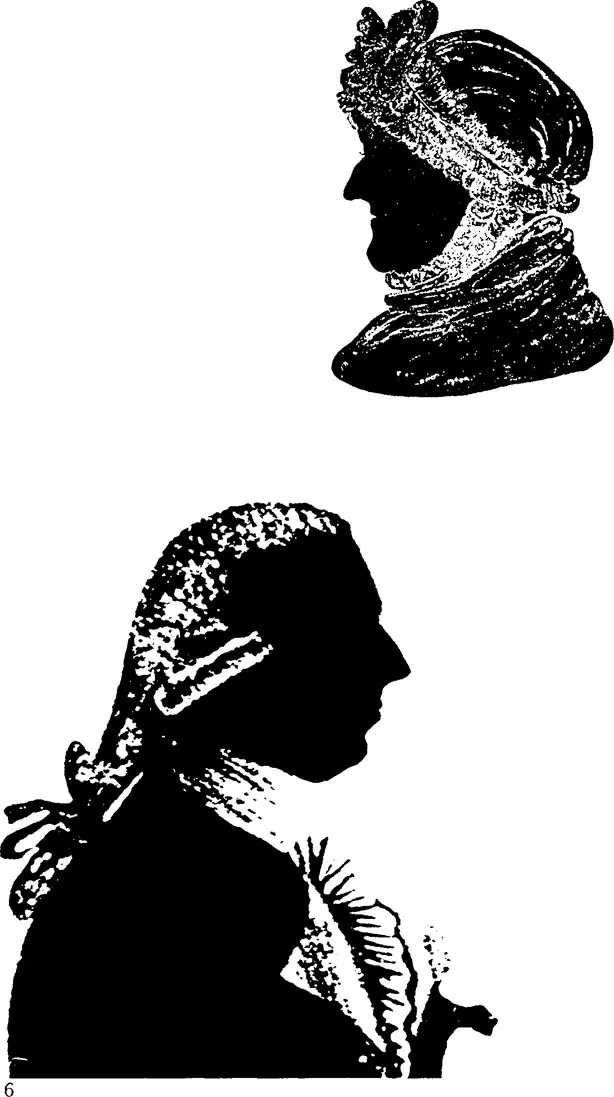
George Austen's father belonged to its lower levels: he was a Tonbridge surgeon, and a comparatively poor man; moreover, both the parents died when George was still a boy. However, a rich uncle paid for his education, and he later gained a scholarship to St John's College, Oxford. He was a schoolmaster for a time, and then became a Fellow of his college. In Oxford he was known as ‘the handsome Proctor’. Besides his good looks, all accounts represent him as a scholarly, affectionate, sweet-tempered man. He took orders in 1760, and another well-to-do relative, Thomas Knight of Godmersham House in Kent, presented him with the living of Steventon. In 1764, he married Cassandra Leigh.
Her family was more eminent than his. She had titled relatives, an ancestor who had been Lord Mayor of London in the reign of Elizabeth, another who had given shelter to Charles I; her grandfather had been brother-in-law to the Duke of Chandos whose ostentation had possibly been satirized by Pope in a Moral Essay, and her uncle was Master of Balliol College, reputed for his wit. Like her husband she was handsome, and like her uncle she was witty; her great-nephew writes: ‘She united strong common sense with a lively imagination, and often expressed herself, both in writing and conversation, with epigrammatic force and point.’ Her own term for it was ‘sprack wit’. She seems to have been a woman of too much assurance to have had any pretensions, and was not afraid to be found ‘busy with her needle’ in the front room of the rectory, on to which the front door directly opened. But she may have been a good deal of a hypochondriac; in one letter, Jane writes: ‘My mother continues hearty, her appetite and nights are very good, but her Bowels are not entirely settled, and she sometimes complains of an Asthma, ...
Table of contents
- Cover Page
- Series Page
- Title Page
- Dedication
- Copyright Page
- Table of Contents
- List of Illustrations
- Acknowledgements
- Foreword
- Introduction
- Part One: Biographical Background
- Part Two: Literary Background
- Part Three: The Art of Jane Austen
- Part Four: Reference Section
- Index
Trusted by 375,005 students
Access to over 1.5 million titles for a fair monthly price.
Study more efficiently using our study tools.
Frequently asked questions
Yes, you can cancel anytime from the Subscription tab in your account settings on the Perlego website. Your subscription will stay active until the end of your current billing period. Learn how to cancel your subscription
No, books cannot be downloaded as external files, such as PDFs, for use outside of Perlego. However, you can download books within the Perlego app for offline reading on mobile or tablet. Learn how to download books offline
Perlego offers two plans: Essential and Complete
- Essential is ideal for learners and professionals who enjoy exploring a wide range of subjects. Access the Essential Library with 800,000+ trusted titles and best-sellers across business, personal growth, and the humanities. Includes unlimited reading time and Standard Read Aloud voice.
- Complete: Perfect for advanced learners and researchers needing full, unrestricted access. Unlock 1.5M+ books across hundreds of subjects, including academic and specialized titles. The Complete Plan also includes advanced features like Premium Read Aloud and Research Assistant.
We are an online textbook subscription service, where you can get access to an entire online library for less than the price of a single book per month. With over 1.5 million books across 990+ topics, we’ve got you covered! Learn about our mission
Look out for the read-aloud symbol on your next book to see if you can listen to it. The read-aloud tool reads text aloud for you, highlighting the text as it is being read. You can pause it, speed it up and slow it down. Learn more about Read Aloud
Yes! You can use the Perlego app on both iOS and Android devices to read anytime, anywhere — even offline. Perfect for commutes or when you’re on the go.
Please note we cannot support devices running on iOS 13 and Android 7 or earlier. Learn more about using the app
Please note we cannot support devices running on iOS 13 and Android 7 or earlier. Learn more about using the app
Yes, you can access A Preface to Jane Austen by Christopher Gillie in PDF and/or ePUB format, as well as other popular books in Literature & English Literary Criticism. We have over 1.5 million books available in our catalogue for you to explore.