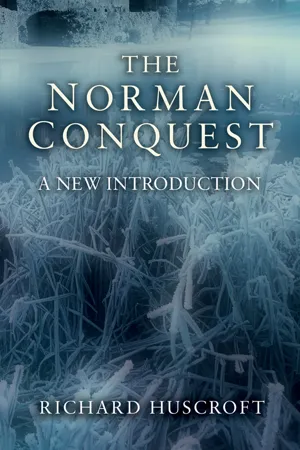
The Norman Conquest was one of the most significant events in European history. Over forty years from 1066, England was traumatised and transformed. The Anglo-Saxon ruling class was eliminated, foreign elites took control of Church and State, and England's entire political, social and cultural orientation was changed. Out of the upheaval which followed the Battle of Hastings, a new kind of Englishness emerged and the priorities of England's new rulers set the kingdom on the political course it was to follow for the rest of the Middle Ages. However, the Norman Conquest was more than a purely English phenomenon, for Wales, Scotland and Normandy were all deeply affected by it too. This book's broad sweep successfully encompasses these wider British and French perspectives to offer a fresh, clear and concise introduction to the events which propelled the two nations into the Middle Ages and dramatically altered the course of history.
- 392 pages
- English
- ePUB (mobile friendly)
- Available on iOS & Android
eBook - ePub
Part One
Preliminaries
Chapter 1
The principal sources
In Western Europe during the earlier Middle Ages, relatively little was recorded in writing and only a small part of that has survived. The Norman Conquest of England, however, because its significance was immediately understood by those who lived during or shortly after it, prompted more contemporary written discussion than many other medieval events. But whilst relatively plentiful, the surviving sources for the Conquest still present a far from complete picture. Huge gaps in absolute knowledge and clear understanding are bound to remain. Moreover, it is unrealistic for a twenty-first-century reader to apply modern standards of historical accuracy to what has survived from the eleventh and twelfth centuries. In the narrative sources, for example, an author’s own preoccupations often blur the lines between truthful description on the one hand, and fable, myth and developing legend on the other. The words attributed to particular individuals are often designed to entertain rather than to inform; the reliability of simple statements of fact cannot be taken for granted. And as for the seemingly more objective administrative sources, specific doubts about their dating, or wider ones about their authenticity often allow only tentative conclusions over their significance. The contents of any one source need as far as possible to be compared with other available material to test their credibility and precision. But even where this is possible, definitive interpretations will usually remain elusive.
All of this makes studying the Norman Conquest a huge and exciting challenge. The scope for differing views and interpretations is enormous, as is the amount of space within which a lively historical imagination can wander and speculate. And it is the problems with the sources and the uncertainty they generate which make the Conquest such a fertile field for ongoing and probably endless scholarly cultivation. What follows here is only a brief introduction to the main sources for the period, and the true extent of that ‘abundant material for writing many books’, which is said to have been available at the court of William the Conqueror, can only be guessed at.1
Narrative sources
Contemporary or near-contemporary views on the Norman Conquest differed according to where, when, why and by whom they were written. In England soon after 1066 and into the twelfth century, the urge to record events was prompted by many different impulses. For some, it was necessary to explain why God had chosen to inflict the Norman invasion on the English people. For others, the intention was to preserve some knowledge and pride in English history and the kingdom’s traditions in the face of a foreign onslaught which threatened to wipe out the old culture. In Normandy, by contrast, the earliest accounts of the Conquest had as their objectives the glorification of William the Conqueror and the justification of his invasion and subjugation of England.
The Anglo-Saxon Chronicle provides the most important narrative account of English history before the twelfth century. A year-by-year description of events (the Chronicle is technically an annal rather than a chronicle) that the compilers considered to be significant, it includes the only account of the Norman Conquest written in the native language of the English people. However, it is not one source, but several. Having been put together first of all in the 890s in Wessex (perhaps at the court of King Alfred (871–99)), the original manuscript of the Chronicle was copied and circulated around the country. The copies might then have been added to, amended or simply left alone by those who came into possession of them. It would then come down to chance to determine whether this extra information found its way into those copies which eventually survived. There are now eight surviving manuscripts of the Chronicle in all, labelled A–H by historians, but for this period C, D and E are the most important.2 The original accounts, on which the surviving copies are based, were all written, using a common source, at different places and different times. Consequently they display different local interests and preoccupations. Therefore, each text of the Chronicle, whilst having much in common with the other versions, is very much an independent source. C is thought to have been compiled first in the early 1040s. It says nothing about the years 1056–65 but it may be a near-contemporary record of what it does describe, until it ends abruptly in 1066 with the Battle of Stamford Bridge still unfinished. The most recent analysis has suggested that, because of the text’s preoccupation with Mercian affairs and the affairs of the earls of Mercia in particular, C was probably composed somewhere in the Midlands, close to the sources of the Mercian earls’ power.3 The pre-1066 parts of D are probably also contemporary, but they are more extensive than C. Manuscript D also provides the fullest account of the early years of the Conquest. It ends in 1079 and has a particular interest in the affairs of northern England, the west midlands and Worcester. The current consensus holds that D was probably compiled by persons close to Ealdred, archbishop of York (d.1069), and it is regarded as being particularly well informed about the deliberations of the kings and their councillors, of whom the Archbishop was one of the most important. Manuscript E continues until as late as 1154. Originally a northern compilation like D, it was continued at Canterbury after 1031 and until 1121 when its composition was carried on at Peterborough. The description in E of the events of the mid-eleventh century which, it is assumed, was written at the time of or very soon after the events it covers, is particularly well disposed towards Earl Godwine and his family.
The Chronicle’s varying accounts of the Conquest are permeated by a sense of doom and misery. The relevant parts of D and E were written in the aftermath of total English defeat, and they have little good to say about either the Normans or the English. The former were brutal and oppressive whilst the latter were sinful and corrupt: the Normans won at Hastings, according to D, ‘even as God granted it to them because of the sins of the [English] people’.4 Moral overtones aside, the Chronicle’s otherwise rather detached and straightforward tone should not be taken for objectivity, and its contents should not be assumed to be authoritative. Local and personal concerns often determined what was included in the surviving copies and what was left out. Nevertheless, the Chronicle is a remarkable source, and where the factual information it contains can be checked, it is usually corroborated. As a result, it provides our basic narrative of the important events, through the voices of the defeated in their own language.
All of the other narrative sources from England were written in Latin. One in particular, however, has a close connection with the Chronicle. The so-called Chronicon ex Chronicis, which was written at Worcester during the first half of the twelfth century, has traditionally been attributed to a monk of Worcester named Florence (d.1118). However, it is now generally thought that the author of this work was another Worcester monk, John. John wrote his history between c.1124 and c.1140, and his account of English history during this period was designed to fit into a much wider description of world events. He used a range of sources, but his principal one for events in England during this period appears to have been a copy of the Chronicle which has since been lost. This lost copy probably resembled D most closely, but it also differed significantly from it and other surviving versions of the Chronicle, so John’s work is of great historical value in providing comments of his own as well as information not found elsewhere.5
Written in England much closer to the events of 1066 themselves was The Life of King Edward (Vita Edwardi Regis). This is an anonymous work, but the scholarly consensus now is that the author was probably a monk from the monastery of St Bertin in St Omer, Flanders. It was probably written in two parts either side of the events of 1066, the first part c.1065–6, and the second c.1067.6 Part I provides a partial history of Edward the Confessor’s reign, but is particularly concerned with the fluctuating fortunes of Earl Godwine of Wessex and two of his sons, Harold and Tostig. Such a focus is not surprising – the work is dedicated to the woman who commissioned it: Queen Edith, Godwine’s daughter and the wife of Edward the Confessor, and the first half of the Life is decidedly pro-Godwine as a result. Part II is a more hagiographical account of the (by then) late King Edward’s saintly qualities. Despite its rather partisan concerns, the Life is still an immensely valuable source. It gives fresh and specific insight into some of the most important events of the closing years of Edward the Confessor’s reign: his building of Westminster Abbey, and the Northumbrian rising of 1065, for example. It also contains the only written account of what happened at the bedside of the dying king.
More talented and more engaging than any of the authors discussed so far was William of Malmesbury. He was certainly the best of all the English historical writers of the twelfth century, and perhaps the first truly great English historian since Bede, who wrote in the eighth century. William was born of mixed English and Norman parentage in about 1095 and he died in 1143. He was a Benedictine monk at the Wiltshire abbey of Malmesbury, but he was also an enthusiastic traveller in search of evidence and materials for his voluminous writings. He wrote histories and saints’ lives, but two of his most important works, and those most relevant here, were The Deeds of the Kings of the English (Gesta Regum Anglorum), and The Deeds of the English Bishops (Gesta Pontificum Anglorum), both of which had been written by the middle of the 1120s.7 The combination of William’s perceptive analysis and his thorough and rigorous method has appealed greatly to later generations of historians. Nevertheless, William still shared the contemporary view that the Norman Conquest was God’s judgement on an immoral and corrupt English nation. He has also been credited with introducing an English ‘imperialist perception of Celtic peoples into history’. He regarded the Welsh, Scots and Irish as uncivilised ‘barbarians’ who lived in poor, primitive societies, whilst the English were ‘prosperous, peaceful, law-abiding, urbanised and enterprising’. This notion of English superiority over their British neighbours has persisted to a greater or lesser degree ever since.8
Two of William of Malmesbury’s contemporaries in England, Henry of Huntingdon and Eadmer, should also be introduced here. Like William, Henry of Huntingdon was of mixed Anglo-Norman parentage. He saw himself very much as an Englishman, however. Born in about 1088, he was taken as a boy to be educated at Lincoln in the household of Bishop Robert Bloet, who had been chancellor to William II and was a close adviser of Henry I. When his father died in 1110, Henry took his place as archdeacon of Huntingdon. Using a variety of written sources, including Bede and the Chronicle, as well as his own recollections and strong oral traditions, Henry wrote his History of the English People between 1123 and 1130 and revised it into the 1140s, and it includes stories not told by anyone else: about Cnut and the waves, for example, and the death of Earl Godwine.9 The dominant theme of Henry’s History was very much the resilience of ‘our people’, however, and the historical continuity which underlay the identity of the English as a separate race. The Norman Conquest was certainly a judgement from God on England’s failings, Henry thought, but it did not wipe out the essential Englishness of the people. More than this, however, it has also been suggested that ‘a developing sense of Englishness’ can be traced in Henry’s work. In other words, whilst his writings from the 1120s still show an awareness of the English as a ‘subject’ people, oppressed by their French conquerors, by the 1140s this feeling has gone and there is little distinction between Norman rulers and English subjects.10 It should be remembered, nevertheless, that working as he did close to Bishop Robert and then to his successor Alexander (the nephew of Henry I’s chief minister Roger, bishop of Salisbury), Henry’s perspective on affairs was a rarefied one. He viewed his own time and the events which had preceded it from the summit of the Anglo-Norman political mountain, and his views on cultural and political assimilation may not have been shared lower down the social scale.
Eadmer was an Englishman, born in about 1064. He spent his career as a monk at Canterbury, where he served the two great post-conquest archbishops, Lanfranc and Anselm. Anselm was Eadmer’s hero, however. Until Anselm’s death in 1109, Eadmer was probably rarely absent from his master’s side and it is his relationship with the saintly prelate which dominates all of his writing. As well as writing a biography of the Archbishop, Eadmer compiled the so-called History of Recent Events (Historia Novorum). On one level a history of his own time...
Table of contents
- Cover Page
- Half Title page
- Title Page
- Copyright Page
- Contents
- Preface
- Money and terminology
- References and abbreviations
- Maps
- Part One Preliminaries
- Part Two The Norman Conquest
- Part Three The impact of conquest
- Part Four Conclusion
- Suggestions for further reading
- Index
Trusted by 375,005 students
Access to over 1.5 million titles for a fair monthly price.
Study more efficiently using our study tools.
Frequently asked questions
Yes, you can cancel anytime from the Subscription tab in your account settings on the Perlego website. Your subscription will stay active until the end of your current billing period. Learn how to cancel your subscription
No, books cannot be downloaded as external files, such as PDFs, for use outside of Perlego. However, you can download books within the Perlego app for offline reading on mobile or tablet. Learn how to download books offline
Perlego offers two plans: Essential and Complete
- Essential is ideal for learners and professionals who enjoy exploring a wide range of subjects. Access the Essential Library with 800,000+ trusted titles and best-sellers across business, personal growth, and the humanities. Includes unlimited reading time and Standard Read Aloud voice.
- Complete: Perfect for advanced learners and researchers needing full, unrestricted access. Unlock 1.5M+ books across hundreds of subjects, including academic and specialized titles. The Complete Plan also includes advanced features like Premium Read Aloud and Research Assistant.
We are an online textbook subscription service, where you can get access to an entire online library for less than the price of a single book per month. With over 1.5 million books across 990+ topics, we’ve got you covered! Learn about our mission
Look out for the read-aloud symbol on your next book to see if you can listen to it. The read-aloud tool reads text aloud for you, highlighting the text as it is being read. You can pause it, speed it up and slow it down. Learn more about Read Aloud
Yes! You can use the Perlego app on both iOS and Android devices to read anytime, anywhere — even offline. Perfect for commutes or when you’re on the go.
Please note we cannot support devices running on iOS 13 and Android 7 or earlier. Learn more about using the app
Please note we cannot support devices running on iOS 13 and Android 7 or earlier. Learn more about using the app
Yes, you can access The Norman Conquest by Richard Huscroft in PDF and/or ePUB format, as well as other popular books in History & British History. We have over 1.5 million books available in our catalogue for you to explore.