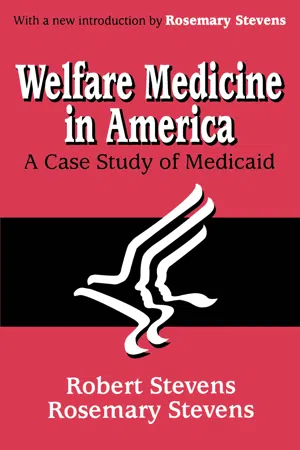
The present study was undertaken for three reasons: Medicaid is a vital program-in the early 1970s it provided care for over one tenth of the American population. It is a huge program-in the same period it consumed over nine billion dollars of public funds. And Medicaid is, in many ways, the most direct involvement with the provision of medical care undertaken by either the federal government or the states. But until the publication of this book, Medicaid had not been studied in depth or in a systematic way. Welfare Medicine in America is the complete history of Medicaid. The authors carefully examine the program's historical antecedents, its strengths, and its weaknesses. In part one, "The Coming of Medicaid," the hows and whys of the establishment of Medicaid are discussed, as are the basic provisions of the program. In part two, "The Euphoric Demise: July 1965-January 1968," the focus is on how Medicaid is administered in the states. In part three, "The Storm: January 1968-July 1970," specific amendments to Medicaid, the costs involved, and other health programs are examined. And in part four, "Benign Neglect: July 1970-June 1973," the role of the courts in administering Medicaid, and its future, are the primary subjects. This history of Medicare, however, goes beyond the specific government program itself and offers a paradigm for inquiring into the problems of medical care in general and the nature and limitations of public medical services. Welfare Medicine in America is a profound analysis of Medicaid and welfare systems, and will be of great use to policymakers, students of welfare and government, and to those working within the medical profession.
- 386 pages
- English
- ePUB (mobile friendly)
- Available on iOS & Android
eBook - ePub
About this book
Information
Part I
The Coming of Medicaid
Introduction
Like other social-welfare programs in America, which often represent a reluctant and veiled acceptance of past problems rather than any clean sweep of idealism, Medicaid can be fully understood only in its historical context. Its structure, administration, and in large part its degree of success and failure were predetermined by existing patterns of public assistance. Its role, particularly its growing political importance, has been emphasized by the failure of Congress to develop any systematic organization of health services outside the public-assistance system. Part I of this book begins the process of unraveling this structure and role.
The provision of medical care to the poor has long been a recognized part of the American system of public relief. Concern over the equitable provision of health services is, however, a twentieth-century phenomenon, born of the great strides in medical science made in the late nineteenth century and accelerating, as they have, to the present. The manifestations of this latter phenomenon have been on the one hand a series of proposals (as yet not enacted) for government-sponsored health insurance covering the whole working population, and on the other an accretion of special programs designed to attack particular deficiencies in the health-care sys-tern or in health-care provision.
The question of how and to whom government health services should be provided has woven through debate after debate. Out of the welfare system eventually came the system of federally subsidized vendor payments in 1950, which in turn generated the Kerr-Mills legislation, with its bold new concept of “medical indigence,” and ultimately Medicaid. Meanwhile, out of a social insurance tradition dating back to nineteenth-century European income-protection schemes for the working population, have come a series of proposals for national health insurance, of which one—Medicare—has been implemented, though effectively limited to the elderly. Whether the government should guarantee health care to the poor or to the whole population remains to this day an open question.
The long debates have, however, left important legacies. Both administratively and conceptually, the American welfare state remains in the shadow of Depression legislation. Indeed, the great Social Security Act of 1935 forms the basis of today’s most important programs of cash assistance, social insurance, and health-care provision. The Social Security Act of 1935 provided a watershed for both the welfare and the health-care movements, in terms of not only what the Act included but also what it left out.1 Out of this Act came the present structures of public assistance, modified and added to in subsequent years. The most notable legacy of the legislation, as far as welfare was concerned, was the so-called categorical structure of federally supported public assistance, divided into separate programs for the aged, the blind, dependent children, and, later, the disabled. These categories, which were seriously eroded for the first time by the Social Security Amendments of 1972, have left indelible marks on public assistance. Perhaps the most obvious has been the prevailing climate of restrictionism. To get on the federally supported public-assistance dole, one had to wear the appropriate label. To be just “poor” was not sufficient.
At the same time, in the failure to include a health insurance program for the whole population in the 1935 legislation, a major opportunity to institutionalize national health insurance as an essential part of the American welfare state was lost. Health benefits did not become a cherished right, as they have in most European countries or as educational benefits have in the United States. Although old-age social security, provided under the 1935 Social Security Act, was equally “socialistic,” it took on a patina of eminent social respectability; indeed, the pension elements of social security have become part of the American way of life.2 The dichotomy has continued, reflected in the contrasting attitudes toward Medicare (social insurance) and Medicaid (public assistance), although both were introduced by the Social Security Act of 1965.
With that introduction, we now look in more detail—but still in outline—at the rise of public assistance, the social insurance movement, and government interest in medical care (Chapter 1). We then examine, in more detail, the federal role in health between 1935 and the Kerr-Mills legislation in 1960 (Chapter 2). We follow this with a study of the passage of Medicare and Medicaid (Chapter 3). The final chapter in Part I (Chapter 4) provides a detailed analysis of Medicaid.3
Notes
1. For general background on the development of the Social Security Act, see Roy Lubove, The Struggle for Social Security 1900-1935 (Cambridge, Mass., 1968); Edwin E. Witte, The Development of the Social Security Act: A Memorandum on the history of the Committee on Economic Security and drafting and legislative history of the Social Security Act (Madison, Wis., 1962); Arthur J. Altmeyer, The Formative Years of Social Security (Madison, Wis., 1966).
2. For an analysis of the misleading nature of the “insurance” aspects of Social Security, see Joseph A. Pechman, Murray J. Aaron, and Michael K. Taussig, Social Security: Perspective for Reform (Washington, 1968).
3. For those concerned primarily with the politics of Medicaid, this technical chapter may be read “lightly.”
1
Competing Welfare Philosophies and the Provision of Medical Care
The Welfare Heritage
Before 1935, welfare provisions were entirely the responsibility of individual localities and states. Arrangements for medical care for those on assistance were made on an ad hoc, decentralized, and often erratic basis, following the existing patterns of cash relief. There were substantial variations in coverage and eligibility from place to place and from state to state. Two broad patterns of relief were, however, evident by the early 1930s, based on assumptions that the poor were parasites (to be deplored) or unfortunates (to be succored). On the one hand were the old arrangements for general assistance to paupers through indoor or outdoor relief dating to Colonial times and with roots in the Elizabethan Poor Law. Such assistance was typically given grudgingly by the towns and counties, and there continued to be more than vestiges of the attitude that pauperism was a form of social disease and degeneracy: the poor were “a population which floats between the alms houses, the jail and the slums.”1 In this context the proper role of assistance was seen to be to provide minimal help in unattractive circumstances, lest those on relief corrupt both themselves and ultimately other members of society.
The most obvious examples of the survival of the Elizabethan poor laws were in the indoor (i.e., workhouse) form of relief that remained an integral part of “income security” in America until the 1930s. In 1926, Harry Evans* book on the poor farms caused a minor stir: in virtually every state they were for the flotsam of society who could not be incarcerated in prison because they had committed no crime. They were also used as a residual depository for the aged, the sick, and the mentally retarded despite the fact that in most states institutions like asylums had been developed in the nineteenth century.2 Only in the most progressive states were there public hospitals or adequate resources to cope with paupers in private or so-called charitable hospitals or homes.
Most communities also made some use of outdoor relief—cash handouts —but they attracted the same taint as indoor relief. Nevertheless, born of the recognition that there were identifiable groups of persons who could not be labeled social deviates or paupers by choice, a number of special assistance programs slowly grew up during the early twentieth century, geared to provide help to “deserving” individuals. Impoverished old people, underfed children, and the unemployable blind could scarcely be blamed for their condition nor envied for being the recipients of relief. For such groups there developed a more sophisticated form of outdoor relief. Thus, for the aged who had suddenly fallen on hard times, a number of states developed noncontributory old-age assistance “pension” programs. In 1915, Arizona passed the first state law designed to abolish almshouses and establish an old-age cash assistance program. While this legislation was ultimately declared unconstitutional by the courts, other states followed with their own old-age assistance provisions. By the end of 1934, 28 states and two territories had passed old-age assistance laws.3
Dependent children provided another special group. The early “mothers’ pension” laws were designed—on a principle similar to that of the old-age assistance program—to keep children on relief in their own families rather than to send them to institutions. Geared to the needs of widows, rather than deserted wives or unmarried mothers, the idea spread across the country after 1911, the year statewide legislation appeared in Illinois. The Child-Saving Movement that had pressed for mothers’ pensions was also instrumental in the establishment of the first federal office concerned with a specific age group: the Children’s Bureau, created in 1912. The Bureau was to be a model for the later development of various welfare and Social Security programs, serving as one of the bases for the Federal Security Administration, which ultimately became the Department of Health, Education, and Welfare. As with old-age assistance, however, programs of direct financial aid to dependent children were undertaken until 1935 without federal assistance. By 1934 all states except Alabama, Georgia, and South Carolina provided some form of welfare aid to mothers of dependent children, but again the programs were rudimentary, while varying enormously even within the states. In most parts of the country, responsibility was vested at the county level; in New England it was vested in the towns and cities. Such programs thus added to the existing complexity of welfare programs and reinforced the idea of local responsibility for relief.
The third and final group of persons singled out for special assistance was the blind. Wisconsin enacted the first such program in 1907; by 1935, 27 states made some arrangements for providing cash payments to the blind. In some cases, counties were authorized to pay blind allowances from general county funds. In other cases specific state taxes were assigned for the purpose. In Arkansas, for example, aid to the blind was funded by a tax on billboard and pool rooms, in Wyoming by taxes on liquor. Such redistribution of wealth from a less moral to a more deserving cause was reflected in the conditions for receipt of aid. Recipients in ten states were not allowed to be professional beggars; in Missouri they had to accept training when offered; and in New York they were not allowed to retain their assistance if they married a blind or partially blind person.4
These early categorical programs are important because the divisions were carried over into the Social Security Act of 1935, to become—with the addition of a further category for the totally and permanently disabled in 1950—the framework on which Medicaid was drafted. But also carried over to the present were some of the older philosophies of public relief.
After 1929, it might have been expected that the widespread experience of poverty by the middle class during the worst of the Depression years would have caused a major shift in social attitudes toward the poor. In some states in 1933, 40 percent of the population was on relief. Existing programs of outdoor (or cash assistance) relief broke down under the onslaught. The Federal Emergency Relief Administration (FERA), established in 1933, virtually took over outdoor relief operations in the states and for the first time established a major federal responsibility for income maintenance. Yet FERA, with its potential for a direct continuing federal role in providing relief for all types of poverty, was not to survive the Depression. With the advent of World War II came full employment, and those employed were often only too happy to breathe a sigh of relief and shrug off poverty as a feature of the past and a matter of insignificance. The world was once again divided into “them” and “us.”
The Social Security Act of 1935 was, however, extremely important in affecting these patterns in various respects. Indeed, it represents the major landmark to this date in American social-welfare legislation. From cradle to grave, deserving individuals would henceforth have some government protection against the ravages of time and the ills of misfortune. However limited the benefits, the vision was monumental. In his now famous Presidential message of June 8, 1934, underlining his own support of social security legislation, President Roosevelt claimed, as a purpose of his Administration, “the ultimate objective of making it possible for American families to live as Americans should.”5 Income protection was a major part of this goal.
The general tone of the social security debates, therefore, was one of providing for those made dependent through no fault of their own and, more generally, for eliminating destitution as a factor that in turn could lead to social unrest and to disturbances in the general economic system. Humanitarian, political, and economic principles were thus involved, with the last two at least as important as the first. Such principles continue to mark the American social-welfare system. Indeed, a major legacy of the Social Security Act was the acceptance of categories of “deserving” recipients: the elderly, dependent widow(er)s, children (and their caretakers), the blind, the disabled, and those unable to find work.
Two threads of social philosophy were, however, responsible for two very different emphases for the actual programs for the deserving poor included in the Social Security legislation. The first was a growing fascination with the principles of social insurance to protect the working population from unexpected calamities (notably, disablement at work and unemployment) and to provide a guaranteed pension. The second was a strong commitment, both in Congress and in the states, to states’ rights in the provision of public assistance. Thus the FERA program was seen not as the beginning of a federal take-over of welfare, but as a necessary means of shoring up programs in the states.6 Local responsibility for public assistance had become ingrained. In the meantime, however, ...
Table of contents
- Cover Page
- Welfare Medicine in America
- Copyright Page
- Contents
- Introduction to the Transaction Edition
- Acknowledgments
- Prologue
- List of Acronyms
- PART I: THE COMING OF MEDICAID
- PART II: THE EUPHORIC DEMISE July 1965-January 1968
- PART III: THE STORM January 1968 – July 1970
- PART IV: BENIGN NEGLECT July 1970–June 1973
- Epilogue
- Appendix
- Index
Trusted by 375,005 students
Access to over 1.5 million titles for a fair monthly price.
Study more efficiently using our study tools.
Frequently asked questions
Yes, you can cancel anytime from the Subscription tab in your account settings on the Perlego website. Your subscription will stay active until the end of your current billing period. Learn how to cancel your subscription
No, books cannot be downloaded as external files, such as PDFs, for use outside of Perlego. However, you can download books within the Perlego app for offline reading on mobile or tablet. Learn how to download books offline
Perlego offers two plans: Essential and Complete
- Essential is ideal for learners and professionals who enjoy exploring a wide range of subjects. Access the Essential Library with 800,000+ trusted titles and best-sellers across business, personal growth, and the humanities. Includes unlimited reading time and Standard Read Aloud voice.
- Complete: Perfect for advanced learners and researchers needing full, unrestricted access. Unlock 1.5M+ books across hundreds of subjects, including academic and specialized titles. The Complete Plan also includes advanced features like Premium Read Aloud and Research Assistant.
We are an online textbook subscription service, where you can get access to an entire online library for less than the price of a single book per month. With over 1.5 million books across 990+ topics, we’ve got you covered! Learn about our mission
Look out for the read-aloud symbol on your next book to see if you can listen to it. The read-aloud tool reads text aloud for you, highlighting the text as it is being read. You can pause it, speed it up and slow it down. Learn more about Read Aloud
Yes! You can use the Perlego app on both iOS and Android devices to read anytime, anywhere — even offline. Perfect for commutes or when you’re on the go.
Please note we cannot support devices running on iOS 13 and Android 7 or earlier. Learn more about using the app
Please note we cannot support devices running on iOS 13 and Android 7 or earlier. Learn more about using the app
Yes, you can access Welfare Medicine in America by Rosemary A. Stevens in PDF and/or ePUB format, as well as other popular books in Social Sciences & North American History. We have over 1.5 million books available in our catalogue for you to explore.