TheHistory of Linguistics, to be published in five volumes, aims to provide the reader with an authoritative and comprehensive account of the attitudes to language prevailing in different civilizations and in different periods by examining the very varied development of linguistic thought in the specific social, cultural and religious contexts involved. Issues discussed include the place of language in education, variation and prestige, and approaches to lexical and grammatical description. The authors of the individual chapters are specialists who have analysed the primary sources and produced original syntheses by exploring the linguistic interests and assumptions of particular cultures in their own terms, without seeking to reinterpret them as contributions towards the development of contemporary western conceptions of linguistic science.
The third volume of the History of Linguistics covers the Renaissance and the Early Modern Period. The chapter on the Renaissance (15th and 16th centuries), examines the study of Latin in both the new Humanist and rationalist traditions, along with the foundations of vernacular grammar in the study of Romance, Germanic and Slavic. The chapter on the Early Modern Period (17th and 18th centuries) presents the study of language in its philosophical context (Bacon, Port-Royal, Hobbes, Locke, Leibniz, the Enlightenment), as well as the accumulation of data which led to the foundation of Comparative Philology in the 19th century.
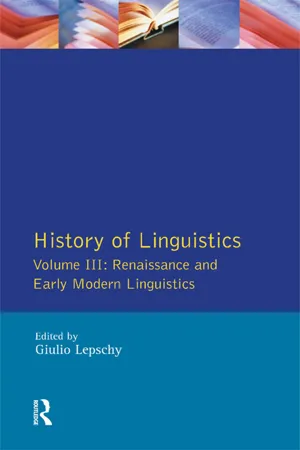
eBook - ePub
History of Linguistics Vol III
Renaissance and Early Modern Linguistics
- 288 pages
- English
- ePUB (mobile friendly)
- Available on iOS & Android
eBook - ePub
About this book
Information
1
Renaissance Linguistics
1.1 Introduction
Mirko Tavoni
The division of this chapter into three parts, corresponding to Western Europe, Roman Slavdom and Orthodox Slavdom, is justified by the different historical conditions in which linguistic thought developed, and by the different forms it took in the three areas.
The distinction between Roman Slavdom (linked to the Roman Church: Croats, Slovenians, Slovaks, Czechs and Poles) and Orthodox Slavdom (belonging to the spiritual jurisdiction of the Orthodox Church: Bulgarians, Serbs, Ruthenians and Russians) must be made because of the profound differences in the cultural tradition which characterize the two areas.1 First of all, most of the documents written by Slavs belonging to the Catholic faith, at least up to and including the Renaissance, are in Latin, while the official language of Orthodox Slavdom until the eighteenth century was Church Slavonic. Therefore linguistic thought developed independently in the two Slavic areas: in Roman Slavdom it felt the effect of the Western tradition, while in Orthodox Slavdom it was strongly influenced by the Byzantine grammatical tradition.
The label ‘Renaissance’ originates from and can be properly applied to that part of Europe which is united by the shared use of Latin as the language of culture, religion and science, and this is also true as far as the development of linguistic thought is concerned; this means Western Europe, filled for the most part by modern languages belonging to the Romance and Germanic families, and the western, Roman, area of the Slavic dominion, which maintains a fairly close cultural solidarity with the Latino-Germanic area. From the second half of the fifteenth century, the renewal in the study of Latin brought about by Italian Humanism spread through all this vast area of Europe, providing a renewed basis for its linguistic and cultural unity. In contrast to the Humanist, theoretical and pedagogic consideration of Latin in terms of its use (from the viewpoint of rhetoric rather than grammar) from about the middle of the sixteenth century one finds a new rationalistic and philosophical attitude coming from France and Spain, to which Italy was to remain essentially an outsider, marking the start of its relegation to a marginal position. In the sixteenth century all this part of Europe was crossed by parallel movements of emancipation and standardization of modern languages, supported by powerful factors such as the consolidation of the nation states and their administrative machinery, the Reformation, printing. Italy, depressed in politics but illustrious in literature, still exported literary themes and models in support of the vernacular, especially in the Romance area, while German became established on religious and national rather than literary grounds. During the same period, Eastern Slavdom, subject to the Orthodox Church, developed a wholly separate and different system, centred on the standardization of Church Slavonic, the supra-national religious language used not only in the vast context of the Slavic-Orthodox linguistic community, but also by Lithuanians and Romanians for long periods; here the question of national languages would arise two centuries later than in the rest of Europe.
Studies on linguistics in Western Europe at the time of the Renaissance are particularly marked by the division into national linguistic traditions. That is why this chapter has been organized primarily by themes or genres, and only within these by country. This is meant to facilitate an embryonic comparison between the different national experiences reacting to similar stimuli, and to suggest the desirability of comparative research, which is missing at present. The two Slavic parts, especially the Orthodox one, to which the time period based on the category ‘Renaissance’ least applies, freely exceed the chronological limits of the chapter in order to outline the long transition from the Middle Ages to the modern age.
Note
1. The introduction of the terms ‘Slavia Orthodoxa’ and ‘Slavia Romana’ is due to Riccardo Picchio. Although in the past they have met with some reservations among scholars, today they are widely accepted, see Picchio (1972, 11–13). In this chapter the English designations ‘Roman Slavdom’ and ‘Orthodox Slavdom’ are used.
1.2 Western Europe*
Mirko Tavoni
1.2.1 Latin grammar
The Christian West inherits from the preceding centuries the centrality of Latin as the foundation of its education system and as the language that continues to guarantee the production and the spread of a common culture.1 However crucial may have been the events that in the fifteenth and sixteenth centuries began to break down this cultural monolinguism, it is difficult to overestimate the importance of grammatica (i.e. of both grammar and the Latin language itself, according to the revealing identification of grammar and Latin which persisted from the vocabulary of middle Latin well into the vernacular cultures of the Renaissance) as the first and propaedeutic art of the Trivium and therefore as the foundation of the edifice of knowledge. The humanists attacked the traditional methods for the teaching of grammar, and the scholastic dialectics which represented at the same time its organic continuation in the curriculum and its theoretical foundation at the level of the philosophy of language. By doing this they were deliberately aiming at the foundations of a system for which they wished to offer a new basis. The historical significance of their grammars, with the views of language they imply and at times make manifest, cannot be assessed outside the educational field to which they clearly belong, and on the basis of which their militant nature can be appreciated.
There is some controversy about whether the earliest experiences of educational and grammatical reform brought about by the Humanists should be seen as developing or breaking from tradition. This tradition can be identified with Donatus’ Ars minor or Alexandre de Villedieu’s Doctrinale (the two textbooks which seem to have been most widely used, in lower schools and in universities respectively), and with a more or less established corpus of texts (such as the Auctores octo) and grammatical works (such as Eberhard de Béthune’s Graecismus), which together with the Doctrinale and the major middle Latin lexicons were to take the lead position in the ‘canon of nefarious grammarians’, which was attacked by the representatives of mature Humanism from Valla onwards.2 The champion of the generation before Valla, Guarino Veronese, certainly started an innovative teaching practice, characterized by the drastic reduction and simplification of the grammatical apparatus (an obvious characteristic of his Regulae gramaticales, written shortly before 1418, is their brevity) and by the encouragement to move on quickly to reading the classical texts directly. The basic idea was that the more constantly, carefully and in depth a student read good texts, the better he would learn Latin. Grammatical rules should not be set up as autonomous entities: they are not the true reality of language, but merely observations a posteriori on the way it functions, which are useful for taking the first steps and for allowing access to texts. This trend, which later would be expressed as a theory in terms of the greater value of usus as opposed to ratio, has a material foundation in the great discoveries of Latin manuscripts that characterize the first half of the fifteenth century:3 the number of new texts, and of new manuscripts for each text, increases and improves knowledge of ancient Latin, and creates the need for more sophisticated working aids, both in the field of textual philology and in the field of grammar.
If this innovative trend is clearly present in the method and organization of Guarino’s school, his grammar was described by Sabbadini (1896, 1902 and 1903) rather in terms of continuity with tradition, resulting from the combination of four components: the Italian grammatical tradition, exemplified by the texts by the Tuscan Francesco da Buti and by the Cremonese Folchino dei Borfoni (fourteenth century), the Doctrinale, the Ianua (an anonymous compilation from Donatus and Priscian on the eight parts of speech, probably dating from the thirteenth century) and Priscian. In addition to the difficulty in reaching definite conclusions while no critical edition of Guarino’s Regulae exists, and the widespread contamination in the medieval tradition, it should be mentioned that these sources (especially the real presence of the Ianua) have been questioned in part by Percival (1972a, 1976b and 1982),4 who points out significant changes introduced by Guarino into the syntactic theory he inherited. The abandoning of the terms suppositum (subject) and appositum (object); the abandoning of ‘explanatory concepts’ designating the kind of influence a verb has over the noun it governs, and justifying the case in which this governing occurs (ex natura relations derived from Aristotelian thought); the abandoning of terms and concepts derived from Modist ideas (all of them traits that did not belong to the grammar of late antiquity, but that became part of the tradition during the Middle Ages) show that a grammatical apparatus that depended in various ways on logic was being curtailed. But other characteristics remain: and among these the reference to a sort of natural order of constituent parts (such as Ego accuso Petrum furti, I accuse Peter of theft) has a particular air of continuity. So Guarino appears as the representative of a phase that was characterized by limited innovations but not by an explicit criticism of the medieval system of grammatical description.
The basic text in which the Humanist attack against medieval grammar takes place, and where in particular there is the awareness or the illusion of knowing how to rebuild the study of Latin on an entirely new basis, is undoubtedly the Elegantie by Lorenzo Valla, published in 1449 and printed for the first time in 1471.5 They are presented as an advanced manual for the purpose of learning fully the wealth of communicative possibilities within classical and post-classical Latin, which modern people can bring back to life and even perfect.6 The work takes its place in an intermediate area between grammar and rhetoric, in the sense that it presupposes elementary notions and deals extensively with stylistic questions, and in the sense that in the ideal curriculum which Valla, drawing on Quintilian, has in mind, this manual belongs to the school of the teacher of rhetoric, who continues the work of the teacher of grammar. The elegantia which provides the work’s title is not, however, an extrinsic formal quality (according to a misleading interpretation that was to become established from the end of the fifteenth century): it is rather the most accurate selection of the word or construction which expresses precisely the particular shade of meaning one is looking for. The Latin language as a whole, by combining a functional lexical richness with a similarly functional richness of morphological and syntactical distinctions, has an unequalled semantic power (in particular: unequalled by Greek). Valla’s keen interest in legal language is a good example of the way the restoration of correct Latinity is of fundamental importance, in his view, for the working of civil society in Europe, as well as for the development and even the existence of all the sciences. Since the purpose of the Elegantie is to bring to light again the exact, distinct semantic value of a large number of near-synonyms, of morphological allotropes and of apparently equivalent constructions, it is understandable that the work has seemed to be an accumulation of lexical, morphological and syntactic observations, without any clear structure. In actual fact the structure is clear: Book I analyses morphemes (desinences and suffixes) in the area of nouns and verbs; Book II analyses the other parts of speech; Book III deals with the semantic variations involved in the different grammatical or syntactic behaviour of word groups; Books IV and V distinguish supposed synonyms respectively among nouns and among verbs; Book VI is a critical review of wrong judgements repeated in the grammatical tradition. It is a clear, but wholly unusual, structure. If we take as reference the distinction, derived from Quintilian, which Valla takes as his banner, ...
Table of contents
- Cover
- Half Title
- Title Page
- Copyright Page
- Table of Contents
- Introduction
- Acknowledgements
- Notes on the contributors
- 1 Renaissance Linguistics
- 2 The Early Modern Period
- Index
Trusted by 375,005 students
Access to over 1.5 million titles for a fair monthly price.
Study more efficiently using our study tools.
Frequently asked questions
Yes, you can cancel anytime from the Subscription tab in your account settings on the Perlego website. Your subscription will stay active until the end of your current billing period. Learn how to cancel your subscription
No, books cannot be downloaded as external files, such as PDFs, for use outside of Perlego. However, you can download books within the Perlego app for offline reading on mobile or tablet. Learn how to download books offline
Perlego offers two plans: Essential and Complete
- Essential is ideal for learners and professionals who enjoy exploring a wide range of subjects. Access the Essential Library with 800,000+ trusted titles and best-sellers across business, personal growth, and the humanities. Includes unlimited reading time and Standard Read Aloud voice.
- Complete: Perfect for advanced learners and researchers needing full, unrestricted access. Unlock 1.5M+ books across hundreds of subjects, including academic and specialized titles. The Complete Plan also includes advanced features like Premium Read Aloud and Research Assistant.
We are an online textbook subscription service, where you can get access to an entire online library for less than the price of a single book per month. With over 1.5 million books across 990+ topics, we’ve got you covered! Learn about our mission
Look out for the read-aloud symbol on your next book to see if you can listen to it. The read-aloud tool reads text aloud for you, highlighting the text as it is being read. You can pause it, speed it up and slow it down. Learn more about Read Aloud
Yes! You can use the Perlego app on both iOS and Android devices to read anytime, anywhere — even offline. Perfect for commutes or when you’re on the go.
Please note we cannot support devices running on iOS 13 and Android 7 or earlier. Learn more about using the app
Please note we cannot support devices running on iOS 13 and Android 7 or earlier. Learn more about using the app
Yes, you can access History of Linguistics Vol III by Giulio C. Lepschy in PDF and/or ePUB format, as well as other popular books in Languages & Linguistics & Historical & Comparative Linguistics. We have over 1.5 million books available in our catalogue for you to explore.