- 256 pages
- English
- ePUB (mobile friendly)
- Available on iOS & Android
eBook - ePub
About this book
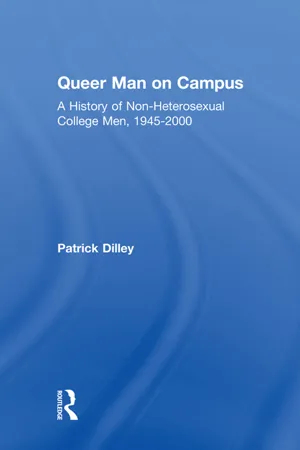
This book reveals the inadequacy of a unified "gay" identity in studying the lives of queer college men. Instead, seven types of identities are discernible in the lives of non-heterosexual college males, as the author shows.
Information
SECTION II
PATTERNS OF NON-HETEROSEXUAL LIVES
CHAPTER 3
Tearooms and No Sympathy: Homosexuals and the Closet
The earliest classifications of non-heterosexual student identities was evident by the 1940s and continued, perhaps surprisingly, at least through the 1980s: those who identify (or are identified by others) as “homosexual,” a clinical term denoting sexual activity as an (or the) indicator of identity (Greenberg, 1988; Katz, 1994), and those whose sexual and emotional lives are led secretly, “in the closet” (Signorile, 1993; Tierney, 1997). These labels are in direct opposition to what was considered the norm in American culture: the open and visible heterosexual who has no questions or qualms about his sexuality.
Homosexual
Although, as other scholars have noted (including, among others, D’Emilio, 1983; Howard, 1999; Loughery, 1998; Marcus, 1992; and Sears, 1997), homosexual as a collective social identity did not really resonate among many non-heterosexuals until the late 1960s, the term was nevertheless used as early as the 1940s to distinguish certain people (distinct from certain acts) from the norm. The U.S. Army’s use of questions pertaining to homosexual acts and “tendencies” to eliminate non-heterosexuals from military service, as mentioned in Sam’s narration in this chapter (and in Berube’s Coming Out Under Fire), focused on “tendencies,” not specific actions; indeed, the psychological rationale behind the question itself shows the clinical origins of the idea of what meaning must be connoted not in carnal activity but in “tendencies,” ideations, or preferences for those behaviors. Government officials were less concerned about whether a man got off with another man than to what extent he liked it (or thought he would like it).
Collegians in the mid-twentieth century held similar views: the actions could be overlooked if a man appeared to “like” girls. Despite this, social conformity to sexual roles did not prescribe the self-concepts of non-heterosexuals as it might have to their heterosexual peers. As Arnie Kantrowitz, who in 1970s New York City was on the one hand a gay activist and on the other a college English professor, wrote in his memoir of life in the closet:
Socially, I was a heterosexual. During the [high] school year I escorted the daughters of Newark to movies and bowling alleys and restaurants, to dances and hops and proms. Every date was ended with interminable tongue kissing in the back hallway. I don’t know if my attentions turned my dates on, but they didn’t do much for me. It was just that I knew everyone else did it, and there had to be something to brag about the next day; but I couldn’t escape the feeling that I wasn’t the only one for whom it was done out of obligation rather than desire. Whatever their reasons, everybody was pretending to have a good time. We were all afraid not to: it would have seemed un-American. (Kantrowitz, 1977, p. 48)
Although he continued to date women during his years at Rutgers University (which were his late teens, as he matriculated at an early age), Kantrowitz ultimately admitted his same-gender affections and desires. Beneath that revelation, however, was resentment of those who were, like him, feeling (if not necessarily living) outside of the norm.
I finally confessed to myself that I was a homosexual. I confessed to my best friend, Leslie, too. And he confessed to me. The same confession. We suffered the blow fate had dealt us in the years of prolonged telephonings of mutual self-pity. We referred to our common vice by the code name “Peanut Butter,” because there was a bar near school named Skippy’s that was reputedly gay, even though we were both afraid of being seen there. Although we commiserated, we really felt contempt for each other’s sexuality, because we saw disquieting reflections of ourselves in it. Ultimately I could no longer endure the waspiness we engendered in each other, and I asked him to stop calling …. He was the only homosexual friend I had until I was twenty-nine. (Kantrowitz, 1977, p. 57)
For Kantrowitz, his identity was formed as much by the dissonance he experienced between his desires and the cultural norms he perceived as it was by those desires. He was sure of this identity, and confided it to another, before he ever had a sexual encounter with another man (which happened at age 20, just after he graduated from Rutgers) (Kantrowitz, 1977, p. 58). As is true for other homosexual collegians, the intent, the emotional investment, of the desire to have sex with another man primarily determined the homosexual identity.
Other aspects were ascribed to the concept as well, although a preponderance of those traits was usually deemed necessary to be considered truly homosexual (as opposed to just temperamental or not conforming to social norms). Debauchery, effeminacy, and passivity were perceived traits of the homosexual male. Even if one displayed two of the three, a single trait could be enough to convince one’s self (or perhaps others) that one was not un-normal. A passage from the autobiography of noted Episcopalian priest and peace activist Malcolm Boyd conveys how one could separate the homosexual act from the actor:
Once when the four of us [high school friends, in Denver] were at a drive-in, somebody pointed out several truck drivers walking out of a parking-lot men’s room. They rubbed their crotches and laughed. A captive “queer” inside had “gone down” on them, we were made to understand. So, I thought, that was homosexuality. It would take a devastatingly long time before a concept of gay life as something furtive and melancholy would change for me into healthy, life giving realities. (Boyd, 1978, p. 44)
Consequently, homosexuality was equated not to the genital contact between two men but the importance and lack of enjoyment of the experience. The “furtive” and “melancholy” were not the boys who forced the homo-sex or enjoyed having their dicks sucked, nor those who displayed homo-expressive crotch rubbing. A homosexual was obviously someone who didn’t enjoy such things. As a teen, Boyd felt homo-erotic and homo-affectional stirrings but, while he recognized the difference between himself and most of his peers, Boyd’s sensibility was both hidden and not “homosexual.” He did not see the similarity between himself and the public definition of homosexuality he had observed.
The private definition, however, could expand to include others to whom one felt an affinity. Homosexual men gathered socially, if discretely, as Fellows’s (1996) narrators from the Midwest and Howard’s (1999) from Mississippi demonstrate; indeed, as early as the 1930s, non-heterosexuals formed social networks—including house parties, public gatherings, and scholarship—were evident (to those who knew or chose to look) at the University of Nebraska at Lincoln (Loughery, 1998, pp. 77–78). Throughout the twentieth century, in smaller towns as well as larger cities, homosexual men met for dinner, threw parties, and created webs of connections that stretched across states and social strata (Chauncey, 1994; Fellows, 1996; Howard, 1999; Loughery, 1998).
But these meetings were always at risk of being discovered, the men of being identified by those outside of the group as being a part of the group. The meanings students made from those experiences—and the definitions the men placed upon those meanings and actions—were placed in opposition to the norm of heterosexuality. As both of the following narrations from homosexual collegians convey, meeting and gathering with others who identified as homosexuals became a part of their collegiate experience (although it also took them both away from their campuses, in two distinctly different ways).
Walter
Adolescence. Walter grew up in Chicago, living with his mother and grandmother. “I was shy, didn’t know anybody.” He recognized his attraction to other males—and his dislike of females—at an early age; his emotions were apparent to his family: “My grandmother once, when I was about ten or eleven … gave me a bear hug and said, ‘You know, I hope someday when you grow up you find a nice man to live with and be happy. I know you hate women but I love you anyway.” I said, Yeah, I think you’re right, but I don’t know why.”
Early College. Walter received a Catholic education and completed two years of study at the University of Illinois—Navy Pier, in Chicago. In 1950, he enrolled at the University of Illinois in Urbana, living alone in an apartment off campus. From Walter’s studies of history he felt he was “born 200 years late. I knew I was gay, always would be…. [But thought] there aren’t many people like me. At the time, it was harder for me to study, to plan for my life” because of this.
“I didn’t have any [non-heterosexual] friends or any acquaintances. The only place I can vaguely remember is a sort of gay cruising area in a park, at night. I don’t recall any other places where gay people were congregating, although I did meet two or three professors. I’m trying to think of how I became acquainted with them; maybe at the library or on campus or something…. I would be at their apartment, and they would—I guess they had little, quiet parties, social gatherings, dinner parties occasionally. That was about it.
“They had what we would call an open relationship. After a while, it [Walter’s relationship to the professors] wasn’t sexual, it was social: we would discuss literature and all sorts of things. One of them eventually moved to New Jersey, and the other moved to Washington, D.C. They both had other lovers after that. We wrote over the years.
“At the time, this was about 1951, maybe, they [the University of Illinois] had what they called the ‘pogrom,’ like the Russian deal. One of the professors told me, You have to be very careful. He even had his telephone disconnected because they were investigating everybody, and they said the college at that time had a quota system. The college could have no more than five percent Jewish students, no more than two percent blacks, and zero tolerance for gays. These two people that I knew [the professors] were discovered in the investigation. Ultimately … they were given a transfer instead of just being fired. They were told to leave, and they [each] transferred to another university.”
During this time, Walter also came under the scrutiny of campus authorities. “I got a call one time from the security police, and they asked me if I knew somebody. I can’t even remember his name, either. I don’t know how I met him, but I did know him; I think I might have met him at one of the dinner parties. He was a rather outwardly gay person: promiscuous a little bit, I guess. So I just mentioned that I knew him and that was all. Then after that, I was being investigated. Over the Christmas holidays I might have been in a gay bar that was raided, in Chicago. It was on Division Street. And I don’t know whether that might have gone on my record. They [the Chicago police] asked what I was doing, and I had to admit that I was a student at the university. Without much of a hearing or a lawyer or anything, [the university] just sent me a letter. They had a regents’ meeting at the school; I was dismissed for conduct unbecoming a student. It was a civil rights matter then, as it is now, but that’s what happened.
“At that time, I made up my mind I was going to get my degrees, and I had to find out how. I didn’t get a lawyer, which people would have done now, I suppose. I had to tell my mother what happened; I had to come back home, give up my apartment. Then I went to a short time to a psychoanalyst in Chicago. This was maybe going to help me being dismissed, but it didn’t. The psychoanalyst said, Well, you certainly should go on with your college career, and he gave me a names of several colleges that would take gay people. There were only three or four that would ever let anybody in as a student in those circumstances, and one of them happened to be Roosevelt College, now Roosevelt University. They were more than happy to have somebody with a good academic background; whether they were gay or not had no effect whatsoever. So I managed in the next year or two to get my degree from there. After that, I went on and took a graduate program at Northwestern University in Chicago, and I went for my M.B.A. at that point.”
Recalling the other names on the list of schools accepting students after dismissal for homosexual conduct, Walter remembered, “Northwestern I think was one of them, and there was another university in Ohio (it might have been Oberlin), and it seems to me there was a journalism school at the University of Missouri, but I’m not certain of that.” But the list provided by the psychoanalyst proved to Walter that there were institutions of higher education at the time that were not averse to homosexual students.
Later College. After leaving the University of Illinois, Walter maintained a private, interior life: “I didn’t think there was any point in saying anything one way or another.” At Roosevelt, “they didn’t really have a gay and lesbian group there, either.” Nonetheless, Walter did not feel he had to be as discreet as he had been at Illinois and continued to have sex with men. “I was looking for a long-term relationship, but because of the nature of context … it didn’t crystallize into a long-term relationship.” Although he had a car, “I had a very limited social life. I didn’t know where to go, really. I just have vague remembrances of parks or places like that to meet people, and that was a rather limited encounter. There were certainly, as I recall, no gay bars or restaurants.”
Compounding Walter’s isolationism was his disconnection from his family. His father had moved away from Chicago when Walter was very young, and Walter did not seem to be emotionally close to his mother. They only discussed his sexuality, his “private matter,” once. “When I told my mother, Well, I have to come home, I’m being expelled, and I told her why, she said, You should have told me all those things. Why didn’t you tell me? And I said, It’s none of your business. She wasn’t upset, and she didn’t have any feelings about it. I never mentioned it to the rest of my family, and they never knew.”
Over time, Walter’s conception of how his sexuality impacted his self-concept changed. The physical acts were no longer paramount to his understanding of his identity: “Sex was very important, but the identity—social, intellectual—was the most important.” Being homosexual was “a private, personal matter—but the political aspect—political and social power” held forth as Walter went on to complete graduate work at Northwestern.
Duchess
Early College. Duchess enrolled at a large university in Los Angeles in 1979. Originally from the Tropics but from a Western-educated family, Duchess felt constrained by the reception he felt from his classmates. He “didn’t want to be just stereotyped with the ethnic population. I wanted them liking me as an individual, not as an ethnicity.” He recognized his interests and feelings for other boys before coming to the United States at age eighteen, but had neither the opportunity nor the inclination to act upon them. “For me, [homosexuality] wasn’t even real when I was growing up in the Tropics. It didn’t exist. I never could see that it actually existed in real life.”
Even after matriculating, Duchess found it difficult, if not impossible, to express himself. “I had a very limited number of friends, certainly nobody I could talk to. I was so naive, I didn’t even know that a community existed, that social places existed, that there were books about gay people.”
He also did not have a vocabulary to convey his desires or emotions, but that changed during his first year in college. In his second semester, Duchess answered a classified advertisement in the campus newspaper, from a photographer searching for male models, “all types, for print work and runway work. It was a legitimate ad, very short.” Duchess called the number listed, made an appointment, and then rode the bus to meet the photographer. “The bus happened to go through West Hollywood…. I remember looking down and seeing these guys, and thinking There’s something very—excuse the word—‘odd’ here. I guess it was a start to make me think that there’s an actual life that revolves around that.” The photographer became Duchess’s first non-heterosexual friend, who introduced him to gay social life in Los Angeles in the early 1980s.
Later College. Duchess stopped out of course work to explore his social life, choosing to explore cultural settings more accepting and to associate with others more akin to his burgeoning self-concept. When he returned to campus a few semesters later, he found it difficult to feel as comfortable in scholastic settings as in socially gay contexts. “I wanted to seek out what the university had as far as meeting other people, what kind of support or social programs. So I heard about the gay and lesbian student union. It was a very loosely-held organization. I think it received enough support from the student senate to make the student senate look politically correct, but nothing more than that. I wanted to be a part of something more, so I became more active.” He was executive director of the organization in 1986–1987, “but unfortunately it was more in title than anything else. I was still feeling very closeted in school, and finding it difficult to really be active and open at the same time.” Others on campus were displeased with Duchess because he was not open on campus or in classes about his sexual orientation; his involvement with the gay and lesbian student union dwindled.
Although he might have used the term gay at the time, and although he became increasingly involved in Los Angeles’ gay society (and less involved with campus life), Duchess’s sensibility—his understanding of the meaning of his actions and emotions—was more akin to the homosexual identity than to gay identity. “I guess back then, especially considering being nineteen, twenty years old, I think more than anything it was about the sex. It was the fact that I could have sex with another guy. But I don’t want to say that was what it was all about; I met my first lover when I was nineteen, and I had no idea that two men, I couldn’t fathom the idea that two men could live together like a married couple, like a heterosexual couple.”
Despite the changes this insight created for Duchess, his concept of who he was, and how that concept affected his behavior, was compartmentalized. His sexuality “was an attachment to my life. My life didn’t revolve around it. I think I still identified with having a heterosexual existence: work, professionally; the way I lived, socialized. Even when I was out with someone I liked, I became very straight-passing. That’s the way I lived back then. Even when I was out with someone I liked, with people who knew we were a couple, we would still behave very hetero: not hold hands, not show any signs of affection, not address each other in endearing terms.”
Closeted
While some students were cautiously open about their sexuality during college, others feared the social disapprobation more than the isolation necessary to avoid society’s stings of denigration. The term “living in the closet” served as a metaphor for denying, suppressing, or hiding one’s non-heterosexual feelings or activities (Signorile, 1993; Tierney, 1997). As the narrators in this section show, some closets were larger than others, some were deeper, and some appeared to have revolving doors. Closeted men felt distanced from classmates, despite their efforts at joining social and living organizations. Some dated and even married women, to prove (or to disprove) their sexuality to themselves and peers. Still others found sex, or at least symbolic...
Table of contents
- Cover
- Half Title
- Title Page
- Copyright Page
- Table of Contents
- Acknowledgments
- SECTION I: FINDING MY WAY
- SECTION II: PATTERNS OF NON-HETEROSEXUAL LIVES
- SECTION III: MAKING SENSE OF NON-HETEROSEXUAL IDENTITY
- Appendix
- Bibliography
- Index
Trusted by 375,005 students
Access to over 1.5 million titles for a fair monthly price.
Study more efficiently using our study tools.
Frequently asked questions
Yes, you can cancel anytime from the Subscription tab in your account settings on the Perlego website. Your subscription will stay active until the end of your current billing period. Learn how to cancel your subscription
No, books cannot be downloaded as external files, such as PDFs, for use outside of Perlego. However, you can download books within the Perlego app for offline reading on mobile or tablet. Learn how to download books offline
Perlego offers two plans: Essential and Complete
- Essential is ideal for learners and professionals who enjoy exploring a wide range of subjects. Access the Essential Library with 800,000+ trusted titles and best-sellers across business, personal growth, and the humanities. Includes unlimited reading time and Standard Read Aloud voice.
- Complete: Perfect for advanced learners and researchers needing full, unrestricted access. Unlock 1.5M+ books across hundreds of subjects, including academic and specialized titles. The Complete Plan also includes advanced features like Premium Read Aloud and Research Assistant.
We are an online textbook subscription service, where you can get access to an entire online library for less than the price of a single book per month. With over 1.5 million books across 990+ topics, we’ve got you covered! Learn about our mission
Look out for the read-aloud symbol on your next book to see if you can listen to it. The read-aloud tool reads text aloud for you, highlighting the text as it is being read. You can pause it, speed it up and slow it down. Learn more about Read Aloud
Yes! You can use the Perlego app on both iOS and Android devices to read anytime, anywhere — even offline. Perfect for commutes or when you’re on the go.
Please note we cannot support devices running on iOS 13 and Android 7 or earlier. Learn more about using the app
Please note we cannot support devices running on iOS 13 and Android 7 or earlier. Learn more about using the app
Yes, you can access Queer Man on Campus by Patrick Dilley in PDF and/or ePUB format, as well as other popular books in Education & Education General. We have over 1.5 million books available in our catalogue for you to explore.