First published in 1993. Routledge is an imprint of Taylor & Francis, an informa company.
- 208 pages
- English
- ePUB (mobile friendly)
- Available on iOS & Android
eBook - ePub
About this book
Information
UNIT II:
ANGER
LESSEON FIVE
THE DRAGON
OBJECTIVES
NOTES
Learners will demonstrate their comprehension of
1. how to apply the A, B, C’s of constructive emotional expression to anger as shown by giving examples from society and from their own lives;
2. the two paths of anger as revealed by class discussion and exercises that differentiate the two paths; and
3. verbal and physical expressions of anger in society and in their lives as demonstrated by sharing examples of those expressions.
MATERIALS
• Magic Wand
• Chalkboard or overhead projector
• Journals for learners
• Activity Sheets 5.1, “List of Anger Words” and 5.2, “The A Word”
CONTENT
1. Review
Collect carryover assignment. Review the last lesson.
• What is self-talk?
• Why do we say “self-talk” instead of “thoughts”?
• Did your self-talk talk you into trouble this week?
• Describe and explain the two parts of emotion.
• Describe some useful self-talk that may help us get a grip on powerful emotions.
• Explain why a felt emotion must be expressed.
• Why don’t emotions just evaporate?
• What is Before Self-talk? Why is it “magic”?
• What would you say if someone said, “I can’t help the way I feel?”
• What is After Self-talk?
• How does After Self-talk continue an emotion?
• How do people talk themselves into suicide? Into drug abuse? Into getting drunk?
• How have you used what you have learned?
• Close your eyes. What is on the bulletin board?
2. Anger: The Powerhouse Emotion
Begin with, “Now let’s look at one of our most challenging emotions, anger. Learning to constructively manage and channel anger transforms misery to magic. All magicians have ‘secrets,’ and I’m going to tell you one: Anger is the powerhouse Nature gave us. The positive use of anger is determination.
“We all need to be powerful sometimes. Inside all of us is the sleeping dragon of anger, and that dragon’s name is Determination. Your Magic Dragon is there to help you get what you want and need out of life.”
Continue to explore the positive and negative implications of anger. “If emotions in general are like water, can you think of something in nature that might be said to be like anger?” Pass the wand from learner to learner for answers. Accept any appropriate answer. In particular, from time immemorial in myths and folktales fire has been used as an image for anger.
Elicit from learners the positive and negative sides of fire. Fire under control may warm a home and cook food. Out of control it may burn down a house or forest. “So, is fire good or bad?” Lead learners to see that, obviously, it is neither. It depends on how it is used.
Continue the analogy, “What about anger? Is it good or bad?” Learners will see from the analogy that anger is neither good nor bad. It depends on how it is used.
3. The Two Paths of Anger
As you continue to lead the discussion, place the following diagram on the board.
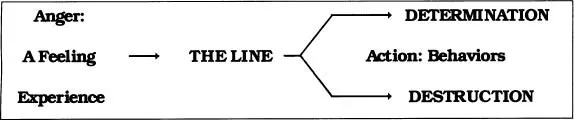
Explain that just as emotion has a thinking part and a feeling part and Before and After self-talk, we may also contrast experiencing the emotion with acting on it. At some point in the total encounter with the emotion, we cross over THE LINE between feeling and acting.
As you elicit learners’ input, circle the words, “THE LINE,” on the board. Continue, “There is all the difference in the world between feeling angry and acting on that anger. It all depends on how you cross THE LINE. Just feeling angry, even ragefully angry, is one thing. But destructively acting out anger is not acceptable. Feeling angry is okay. Acting with hostility is not.”
Lead learners in a discussion of the two ways to cross the line from feeling angry to action. The first is the constructive path of determination. The second is the destructive path of hostility. Hostility is animosity actively expressed. Hostility is destructive because hostility creates more hostility in a cycle that, quite literally, may be never ending.
But anger does not have to end in empty, futile acts that only succeed in creating more anger. Anger must have some long-term survival value or it would not be part of our make-up. The value of anger is that, rightly used and directed, anger creates determination.
Determination is resolute action of tenacious steadfastness. Determination is not solely an attitude. It is action. It is positive action taken up with conviction and pursued come what may. Anger directed to create positive, just, and equitable outcomes is sometimes called righteous anger. The organization Mothers Against Drunk Driving with its poignant acronym, M.A.D.D., is a perfect example of the constructive force of such anger.
4. The A, B, C’s and Anger
Now apply the key concepts learned in the first four lessons to anger exclusively. “Let’s consider some times we got angry in light of what we now know about emotions.”
Using examples supplied by learners, relate the A, B, C’s of constructive emotional expression to anger. Continue, “What are some verbal ways we express anger?”
a. Verbal Hostility
Allow learners to discuss the usual, familiar modes of verbal anger expression including cursing, swearing, and name-calling. These are common forms of verbal hostility.
Lead learners in understanding that all hostility builds walls. Verbal hostility does express the emotion, but it destroys communication, blocks logical thinking, and stimulates more angry words. Hostility is not okay.
b. Positive Verbal Expression
Ask learners, “What might be a more positive verbal means to express anger?” Lead learners to see that direct expression is best. However, most of us as children did not learn the language of positive, direct expression of anger. Constructive verbal expression of emotion is learned just as verbal hostility is a learned behavior.
Positive verbal expression of anger uses I language. I language is a statement that uses the word “I.” It is the opposite of blaming which uses the word “you.” A model statement of positive verbal anger expression is, “I am feeling very angry with you.”
As the wand moves around the classroom, engage learners in a role play of past encounters with anger. Direct learners to use I language to express the anger as two or three learners role play the incident. If a learner “slips” and uses “you,” be quick to point out how hard it is to be angry and not blame someone else.
Direct expression is not always possible, e.g., when a policeman stops you. However, talking it out with a friend is usually a possible and constructive expression of anger.
5. Constructive versus Destructive Physical Expressions
Continue, “What about physical expressions of anger?” These are legion. Allow learners to recite the catalog from pinching and biting all the way to murder. “Okay, we have to admit that’s how we human beings express our anger. What happens when we allow ourselves to indulge in such overt hostility?”
Accept all appropriate responses such as society is chaotic and belligerent, innocent people are hurt, no one is safe, and people go to jail. A society’s system of law is in good part a coll...
Table of contents
- Cover
- Title Page
- Copyright Page
- Dedication
- Table of Contents
- DEDICATION
- PREFACE
- INTRODUCTION
- LIST OF ACTIVITIES
- UNIT I: EMOTIONS
- UNIT II: ANGER
- UNIT III: FEAR
- UNIT IV: GRIEF
- UNIT V: GUILT
- UNIT VI: CONCLUSION
- INDEX
- ABOUT THE AUTHOR
Trusted by 375,005 students
Access to over 1.5 million titles for a fair monthly price.
Study more efficiently using our study tools.
Frequently asked questions
Yes, you can cancel anytime from the Subscription tab in your account settings on the Perlego website. Your subscription will stay active until the end of your current billing period. Learn how to cancel your subscription
No, books cannot be downloaded as external files, such as PDFs, for use outside of Perlego. However, you can download books within the Perlego app for offline reading on mobile or tablet. Learn how to download books offline
Perlego offers two plans: Essential and Complete
- Essential is ideal for learners and professionals who enjoy exploring a wide range of subjects. Access the Essential Library with 800,000+ trusted titles and best-sellers across business, personal growth, and the humanities. Includes unlimited reading time and Standard Read Aloud voice.
- Complete: Perfect for advanced learners and researchers needing full, unrestricted access. Unlock 1.5M+ books across hundreds of subjects, including academic and specialized titles. The Complete Plan also includes advanced features like Premium Read Aloud and Research Assistant.
We are an online textbook subscription service, where you can get access to an entire online library for less than the price of a single book per month. With over 1.5 million books across 990+ topics, we’ve got you covered! Learn about our mission
Look out for the read-aloud symbol on your next book to see if you can listen to it. The read-aloud tool reads text aloud for you, highlighting the text as it is being read. You can pause it, speed it up and slow it down. Learn more about Read Aloud
Yes! You can use the Perlego app on both iOS and Android devices to read anytime, anywhere — even offline. Perfect for commutes or when you’re on the go.
Please note we cannot support devices running on iOS 13 and Android 7 or earlier. Learn more about using the app
Please note we cannot support devices running on iOS 13 and Android 7 or earlier. Learn more about using the app
Yes, you can access Affective Self-Esteem by Katherine Krefft in PDF and/or ePUB format, as well as other popular books in Education & Educational Psychology. We have over 1.5 million books available in our catalogue for you to explore.