During the past fifty years few issues in British politics have generated such heated controversy as Britain's approach to European integration. Why has Europe had such an explosive impact on British politics? What impelled British policymakers to embrace a European destiny and why did they take such a cautious approach? These are some of the key issues addressed inThe Reluctant Europeans. This new study draws upon recently available source material providing a clear chronological account and covering events right up to Blair's first year in office and the launch of the Euro.
eBook - ePub
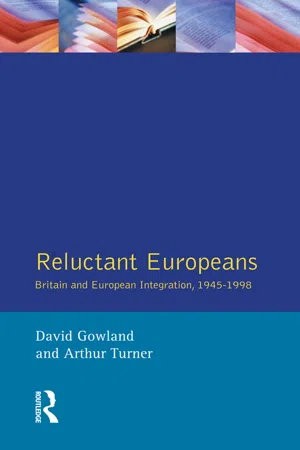
Reluctant Europeans
Britain and European Integration 1945-1998
- 404 pages
- English
- ePUB (mobile friendly)
- Available on iOS & Android
eBook - ePub
Chapter 1 Britain, Europe and the Audit of War
DOI: 10.4324/9781315839011-1
At the end of the Second World War in Europe in May 1945, Britain occupied a distinctive position in the world that reflected both long-standing interests as a global maritime power and the immediate mixed legacy of war. As one of the ‘Big Three’ along with the US and the USSR in the victorious alliance against the Axis powers, Britain confirmed its status as a great power. It also stood in marked contrast to the continental European states, with their wartime experience of occupation, division and defeat. At the same time, the price of victory was proportionately higher for Britain than for the other two major wartime allies, which had more power to shape the postwar world. In their response to these conditions, British policymakers subscribed to a particular set of priorities and views that governed their attitudes to early postwar interest in the idea of European unity and cooperation.
A key recurring feature of British policy towards European developments centred on the belief that Europe could not be separated from the global dimensions of British foreign policy. Nor could the European continent be viewed as the major, exclusive area of British strategic interest. Any European policy, and especially one involving a British contribution to the collective efforts of European states, had to be formulated in the light of British interests, connections and relations beyond Europe. This British presence in the wider world shaped the widespread perception of Britain as a great power. In 1954 Lord Franks, a leading British official throughout this period, succinctly summarised the deeply ingrained view of the British political establishment: ‘Britain is going to continue to be what she has been, a Great Power.’1
Some of the most obvious manifestations of British status during the course of the war were evident in the diplomatic, military and imperial fields. As one of the triumvirate of wartime allies, Britain had been at war with Germany longer than the other two. British leaders participated at the highest levels in the planning and prosecution of the war and in negotiations concerning a postwar settlement. They attended the wartime and postwar conferences of the ‘Big Three’ at Tehran (November–December 1943), Yalta (January–February 1945) and Potsdam (July–August 1945), and were closely involved in the conduct of inter-allied diplomacy. They also supervised British armed forces comprising some 5.1 million personnel stationed across Europe, the Middle East, Africa and the Far East at the end of the war. Such widespread military commitments were in themselves indicative of the vast, sprawling complex of worldwide commitments, interests and influence associated with the British Empire and Commonwealth. This principal expression of British great power status, which stretched across approximately one-quarter of the world’s land mass, was held together by a wide variety of strategic, political, economic and cultural ties. It consisted of diverse elements, ranging from the white self-governing dominions like Australia, Canada, New Zealand and South Africa to colonies in Africa, Asia, the Caribbean and the Mediterranean which were still under direct control.
This global presence and influence served to maintain the view of Britain as a great power whose policymakers had every intention of safeguarding such a position. It was thus almost a foregone conclusion that any new symbol of great power status and independence in the postwar world should also be possessed by Britain. This was particularly the case when, following the successful explosion and use of the atomic bomb by the US in July/August 1945, the Labour government took the decision in January 1947 to manufacture a British atomic bomb. Ernest Bevin, Foreign Secretary and one of the few members of the government privy to this decision, pressed the case for such a British device in characteristically colourful language: ‘We’ve got to have the bloody Union Jack flying on top of it.’2
Some later accounts of the conduct of Britain’s international role at this time have emphasised the extent to which the country emerged from the war not only as an overcommitted and overextended state in the international system, but also as one given to illusions of grandeur in peacetime and to a persistent failure to achieve a balance between resources and commitments.3 This inability or unwillingness to set aside the symbols of, and nostalgia for, past greatness and to fashion a strategy based on current reduced capabilities was occasionally questioned in the highest quarters. In 1944, for example, John Maynard Keynes, economic adviser to the Chancellor of the Exchequer, responded to arguments about the likelihood of a leading role for sterling in the postwar world by commenting: ‘All our reflex actions are those of a rich man.’4 Two years later the Prime Minister, Clement Attlee, unsuccessfully challenged Whitehall orthodoxy when he put the case for considering Britain as ‘an easterly extension of a strategic area the centre of which is the American continent rather than as a power looking eastwards through the Mediterranean to India and the East’.5 Certainly policymakers at the time were aware, if incompletely so, of the extent to which Britain had become a disabled great power, not least because of the cost of the war (see below) and the superior resources of the other two major allies. Few were more conscious of these grim realities than Winston Churchill who, as leader of the wartime coalition government, had seen at first hand British dependence on the US for wartime supplies and the extent of Soviet military power in Europe. At the Tehran conference in 1943 Churchill pictured himself as the poor little English donkey seated between the great Russian bear and the great American buffalo. The disparity in international weight conveyed by this simple image became even more pronounced as the war drew to a close, by which time Sir Alexander Cadogan, the Permanent Under-Secretary at the Foreign Office, judged that it was now more appropriate to speak of the ‘Big 3 (or 2½)’.6
It is nevertheless true to say that most British policymakers tended to view this relative decline in power as transient. As war gave way to peace, their central preoccupation was to restore Britain’s credentials as a world power on an equal footing with, and independent of, the US and the USSR. There was strong opposition to the view that the heavy strain on British resources should be relieved by an immediate, massive withdrawal from onerous overseas obligations. A policy of ‘splendid isolation’ was ruled out, partly on the grounds that it was not a viable option for an economy so dependent on international trade, and partly because it amounted to a grave loss of political prestige and influence in the highly interdependent network of the country’s overseas commitments and interests. The abandonment of any one obligation’, the Foreign Office warned in 1950, ‘may start a crumbling process which may destroy the whole fabric.’7 In their approach to the task of enhancing Britain’s strength as a world power, British policymakers demonstrated the global rather than European concerns that affected their definition of British interests in Europe. This global dimension was particularly apparent in several major spheres of British involvement in the international environment.
First, the evolution of British foreign policy was greatly influenced by relations between the three wartime allies. The idea of peacetime cooperation between these three was a central feature of British plans for developing a stable postwar international order. It was recognised that the wartime alliance was a marriage of convenience that would be severely tested as the allies competed for power and influence in the postwar world. As President Franklin D. Roosevelt told Congress in a message of 6 January 1945: ‘The nearer we come to vanquishing our enemies the more we inevitably become conscious of the differences among the victors.’8 There was also in British governing circles a clear appreciation of the extent to which the other two allies presented different types of threats to British interests. Furthermore, there was much concern about the possibility of US/USSR cooperation at Britain’s expense or of American abandonment of the ‘special’ Anglo-American wartime relationship for a mediatorial role in postwar Anglo-Soviet disputes. In these circumstances, British policymakers supported the principle of great power cooperation in order to reinforce Britain’s world power status, to reduce the risk of independent action against Britain by the other two major powers, and to provide a collective means for preventing threats to world peace. Whitehall viewed the developing institutional apparatus for giving expression to this principle – wartime gatherings of the ‘Big Three’, the formation of the Council of Foreign Ministers and the creation of the United Nations Organisation – as instruments for promoting great power cooperation in peacetime. The vital importance of this framework meant that British policy towards continental Europe was governed by British involvement in inter-allied relations. This emphasis was to be seen, for example, in an important Foreign Office paper of July 1945 entitled ‘Stocktaking after VE-day’. Its author, Orme Sargent, whose view was endorsed by Foreign Secretary Eden, advocated a British-led attempt to organise the west European states in order to counter American and Soviet impressions of Britain as a ‘secondary Power’ and to establish equality of status for Britain among the ‘Big Three’.9
Secondly, the Empire and Commonwealth also had an important impact on British policy towards postwar schemes for European unity and cooperation. This multi-faceted enterprise, with its mixture of tradition, sentiment and interest, symbolised British power and independence in the world. During the war it had served as a major source of economic and military assistance, including a global network of bases. Wartime and immediate postwar developments, however, raised doubts about the long-term future of this British-led formation. In the Far East Japanese expansion and the fall of Singapore in 1942 had dramatically exposed British weaknesses. On the Indian sub-continent the granting of independence to India and Pakistan in 1947 and to Burma and Ceylon in 1948 signified a notable change, foreshadowing a process of decolonisation that was to result in independence from British rule for some 49 countries over the next 30 years. In addition, the absence of a central political authority and the presence of centrifugal tendencies among the self-governing dominions greatly restricted the Commonwealth’s potential as a single power in peacetime. Nevertheless the Empire and Commonwealth had survived the war. The subsequent transition from ‘British Empire and Commonwealth’ into ‘The Commonwealth’, which was facilitated by the arrangements of the Commonwealth prime ministers’ conference of 1949 to keep a republican India within the fold, served to mask Britain’s declining power in the world. During the early postwar years at least Whitehall regarded the Commonwealth as a highly prized asset, not only in terms of strategic value and prestige, but also as an economic, commercial and financial enterprise. It provided access to scarce resources and, as the world’s largest trading bloc via the operation of the imperial preference system, offered an assured market for British goods. Furthermore, Britain acted as the central banker of the associated sterling area, which comprised the Empire and Commonwealth (except Canada) and also extended to a number of third countries including Burma, Iceland, Ireland, Iraq (from 1952), Egypt (until 1947), Jordan, Libya and the Persian Gulf Territories.10 The currencies in the sterling area were tied to the pound. By this means London played a prominent role in the world’s financial system at a time when some 50 per cent of all international payments were in sterling.
At the end of the war, the protection of these interests was considered more important by British policymakers than involvement in postwar European affairs. This order of priorities was particularly evident in efforts to counter what were perceived as the two main threats to British power beyond mainland Europe. One of these threats, clearly identified by the Cabinet’s Post-Hostilities Planning Committee in 1944, concerned Soviet military and political pressure against British positions in the eastern Mediterranean and the Middle East.11 This region was of such vital strategic importance to Britain, especially in terms of sea routes to the Empire via the Suez Canal – the Empire’s ‘jugular’ – and as a source of oil supplies, that it produced some of the earliest intimations of tension in postwar UK-USSR relations: over Turkey and the Straits, Iran and Tripolitania. It also attracted more attention than Europe because of the greater scale of British assets there. British defence policy in the early postwar years was formulated on the basis of these priorities, with its emphasis on three pillars – the defence of the UK, the sea lanes and the Middle East. The other major threat came from the US. American foreign economic policy was driven by a determination to move away from the highly protectionist, restrictive international economy of the inter-war period towards a more open, multilateral free-trading system. Here the chief concern of British policymakers was the accompanying American insistence on dismantling the discriminatory economic, financial and commercial controls of the imperial preference system and the sterling area. On the termination of Lend-Lease in August 1945, Washington informed the Attlee government that it expected all such controls to be eliminated in accordance with the terms of the Mutual Aid Agreement of 1942.
Thirdly, British plans for the reconstruction of the postwar international economy focused on the global rather than the European economy. The principal British effort in devising a new world economic system concentrated on the making of the Bretton Woods agreements of 1944. These agreements were mainly shaped by US-UK negotiations, although the US was in the driving seat. They aimed to create a stable, growth-oriented trading and monetary regime. Arrangements were made to assist states in balance of payments difficulties (through the International Monetary Fund), to finance long-term economic arrangements (through the World Bank), to reduce tariff barriers (the 1947 General Agreement on Tariffs and Trade), and to maintain a fixed exchange rate system in which the value of the dollar would be pegged to gold and all other national currencies tied to the value of the dollar. British involvement in the making and development of this system greatly influenced the UK’s response to the idea of participation in any exclusively European forms of economic cooperation. It was always the case that any British involvement in a European initiative covering trade and payments had to mesh with, and not mark a departure from, this wider global system – later known as the ‘one world’ approach to international trade. Expansion of multilateral world trade was given far greater priority by Britain than by the original member states of the European Community (EC), which were principally concerned to foster intra-European trade. Herein lay a difference of material interest and perspective that was to exercise a long-standing influence on commercial relations between Britain and the EC in the postwar period.
Fourthly, the nature and extent of British interest in, and commitment to, continental Europe in the early postwar period was greatly influenced by UK-US relations. In wartime the ‘special relationship’ between the two countries had taken a variety of forms. Most notably there was the close personal relationship between Churchill and Roosevelt that was cemented by regular consultations – occasionally in unusual circumstances: ‘The Prime Minister of Great Britain has nothing to conceal from the President of the United States’, declared Churchill, as he emerged from a White House bath to face a startled Roosevelt.12 Joint institutions like the Combined Chiefs of Staff reflected the collective purpose of the two countries in the prosecution of the war, as did the provision of US supplies to Britain under the Lend-Lease programme. The gross imbalance of power in this relationship became increasingly obvious, however, as American views, whether on military strategy or on plans for the postwar international economy, took precedence over British. On the British side, as exemplified in Churchill’s thinking about the postwar order, there was a growing recognition of the need...
Table of contents
- Cover Page
- Half Title Page
- Title Page
- Copyright Page
- Dedication
- Frontispiece
- Table of Contents
- Abbreviations Used in the Text
- Introduction
- 1. Britain, Europe and the Audit of War
- 2. Western Union and the Reconstruction of Western Europe
- 3. ‘We are not ready’: Britain and the Schuman Plan
- 4. The Case for Association
- 5. The ‘Special Relationship’ and European Unity
- 6. The Commonwealth Dimension
- 7. From Messina to Rome
- 8. On the Defensive
- 9. From Application to Veto
- 10. Ancient Rivalries
- 11. Labour’s Retreat into Europe
- 12. Mission Accomplished
- 13. Renegotiating ‘Tory Terms’
- 14. ‘Full-hearted Consent’: the 1975 Referendum
- 15. Semi-detached: the Callaghan Government and Europe
- 16. More U-turns: Labour and the EC in the 1980s
- 17. ‘Megaphone Diplomacy’: Thatcher and the EC, 1979–1984
- 18. Fatal Attraction: Thatcher and the Single European Act
- 19. ‘At the Heart of Europe’?
- 20. Opting out: the Maastricht Treaty Review
- 21. Eurosceptics versus Europhiles
- 22. ‘War at Last’: the Beef Crisis of 1996
- 23. Under New Management: the General Election of 1997
- 24. After Amsterdam: Enlargement, Employment and the Euro
- 25. New Labour, Old Problems: the British Presidency of 1998
- Suggestions for Further Reading
- Chronological Table
- Map: The enlargement of the European Community
- Index
Trusted by 375,005 students
Access to over 1.5 million titles for a fair monthly price.
Study more efficiently using our study tools.
Frequently asked questions
Yes, you can cancel anytime from the Subscription tab in your account settings on the Perlego website. Your subscription will stay active until the end of your current billing period. Learn how to cancel your subscription
No, books cannot be downloaded as external files, such as PDFs, for use outside of Perlego. However, you can download books within the Perlego app for offline reading on mobile or tablet. Learn how to download books offline
We are an online textbook subscription service, where you can get access to an entire online library for less than the price of a single book per month. With over 1.5 million books across 990+ topics, we’ve got you covered! Learn about our mission
Look out for the read-aloud symbol on your next book to see if you can listen to it. The read-aloud tool reads text aloud for you, highlighting the text as it is being read. You can pause it, speed it up and slow it down. Learn more about Read Aloud
Yes! You can use the Perlego app on both iOS and Android devices to read anytime, anywhere — even offline. Perfect for commutes or when you’re on the go.
Please note we cannot support devices running on iOS 13 and Android 7 or earlier. Learn more about using the app
Please note we cannot support devices running on iOS 13 and Android 7 or earlier. Learn more about using the app
Yes, you can access Reluctant Europeans by David Gowland,Arthur Turner in PDF and/or ePUB format, as well as other popular books in History & Modern British History. We have over 1.5 million books available in our catalogue for you to explore.