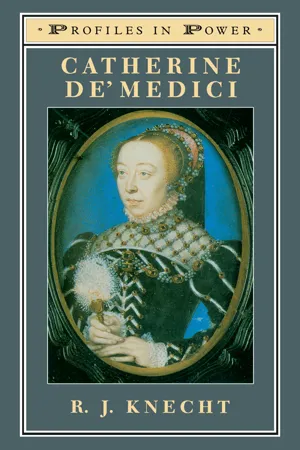
Catherine de' Medici (1519-89) was the wife of one king of France and the mother of three more - the last, sorry representatives of the Valois, who had ruled France since 1328. She herself is of preeminent importance to French history, and one of the most controversial of all historical figures. Despised until she was powerful enough to be hated, she was, in her own lifetime and since, the subject of a "Black Legend" that has made her a favourite subject of historical novelists (most notably Alexandre Dumas, whose Reine Margot has recently had new currency on film). Yet there is no recent biography of her in English. This new study, by a leading scholar of Renaissance France, is a major event.
Catherine, a neglected and insignificant member of the Florentine Medici, entered French history in 1533 when she married the son of Francis I for short-lived political reasons: her uncle was pope Clement VII, who died the following year. Now of no diplomatic value, Catherine was treated with contempt at the French court even after her husband's accession as Henry II in 1547. Even so, she gave him ten children before he was killed in a tournament in 1559. She was left with three young boys, who succeeded to the throne as Francis II (1559-60), Charles IX (1560-74) and Henry III (1574-89).
As regent and queen-mother, a woman and with no natural power-base of her own, she faced impossible odds. France was accelerating into chaos, with political faction at court and religious conflict throughout the land. As the country disintegrated, Catherine's overriding concern was for the interests of her children. She was tireless in her efforts to protect her sons' inheritance, and to settle her daughters in advantageous marriages.
But France needed more. Catherine herself was both peace-loving and, in an age of frenzied religious hatred, unbigoted. She tried to use the Huguenots to counterbalance the growing power of the ultra-Catholic Guises but extremism on all sides frustrated her. She was drawn into the violence. Her name is ineradicably associated with its culmination, the Massacre of St Bartholomew (24 August 1572), when thousands of Huguenots were slaughtered in Paris and elsewhere. To this day no-one knows for certain whether Catherine instigated the massacre or not, but here Robert Knecht explores the probabilities in a notably level-headed fashion.
His book is a gripping narrative in its own right. It offers both a lucid exposition of immensely complex events (with their profound imact on the future of France), and also a convincing portrait of its enigmatic central character. In going behind the familiar Black Legend, Professor Knecht does not make the mistake of whitewashing Catherine; but he shows how intractable was her world, and how shifty or intransigent the people with whom she had to deal. For all her flaws, she emerges as a more sympathetic - and, in her pragmatism, more modern - figure than most of her leading contemporaries.
- 352 pages
- English
- ePUB (mobile friendly)
- Available on iOS & Android
eBook - ePub
Catherine de'Medici
About this book
Chapter 1
DAUGHTER OF FLORENCE (1519–33)
Catherine de’ Medici owed her life and marriage to King Francis I of France. From the start of his reign in 1515, he planned to conquer the duchy of Milan, to which he had inherited a claim from his great-grandmother, Valentina Visconti. Within a few months he assembled an army, crossed the Alps and inflicted a crushing defeat at Marignano on the Swiss, who had been defending Milan. The duchy was conquered and its ruler, Lodovico Sforza, packed off to France. Having taken Milan, Francis set his sights on the kingdom of Naples. He hoped to replace its ruler, King Ferdinand of Aragon, who died in January 1516, by invoking an old Angevin claim. In order to reach Naples, however, Francis needed to gain the support of Pope Leo X, who was not only head of the church but also ruler of the Papal States, a band of territory stretching diagonally across central Italy. Leo belonged to the Florentine family of Medici and maintained a close interest in its fortunes.
. . .
FLORENCE AND THE MEDICI
Italy in the early sixteenth century was not yet a unified nation. Politically it was divided into many independent states of which the republic of Florence was among the most important. Others were the duchy of Milan, the republic of Venice, the Papal States and the kingdom of Naples. By modern standards Florence was not a large city. Its population was about 65,000; one could walk across it in twenty minutes. The most important organ of government was the Signoria, which comprised eight priors and a chairman, called the gonfalonier of justice. It met daily, usually with two other bodies – the twelve ‘goodmen’ and the sixteen ‘standard-bearers’, whose assent to any proposed legislation was mandatory. These three bodies were collectively called the tre maggiori. Ad hoc bodies of citizens were summoned from time to time to advise the Signoria on matters of great moment. Specific aspects of the administration, such as war or law and order, were supervised by various committees. Legislative powers were vested in the Council of the People and the Council of the Commune.
All officers of state in Florence (except for the Chancery staff) served for only a few months at a time. Most were chosen by lot, their names being drawn from a bag. To qualify for election to the three leading offices, a man had to be solvent, to have paid his taxes, to be over thirty and a member of one of seven major guilds or fourteen minor guilds. Although the Florentine constitution promoted political awareness among a large proportion of the population, it was not democratic. Only 5,000 or 6,000 people qualified for office.1
The Medici were one of many prominent Florentine families which rose through commerce. In the early fourteenth century, some of its members served on the chief council, but they were not yet important enough to advise the government in times of crisis. Other families, notably the Strozzi, were far wealthier. After 1343 some Medici held leading offices of state, but quarrels and litigation among the family’s nine branches may have damaged their political standing. By 1400 only two were allowed to hold public office. Eventually, the family of Averardo de’ Medici emerged as leader of the Medici clan. It was his son, Giovanni di Bicci, who founded the Medici fortune by his banking activities. He also built up a political party whose core was formed by the various branches of the family, and broadened by careful marriages with more prestigious families. The methods adopted by the party to advance its power were unspectacular yet effective.
Giovanni’s son, Cosimo, combined a devotion to learning with an active and conscientious concern for public affairs. He encouraged humanists, collected many books and founded the Laurentian library. Among the visual arts he was especially fond of sculpture, Donatello being his favourite artist; but it was architecture which really fired his enthusiasm. He chose Michelozzo to design the Medici palace in the Via Larga. Narrower than it is today, it served as both fortress and strongbox at a time when street-fighting was still rife in Florence. The palace’s austere style powerfully influenced other domestic buildings in the city, notably the Pitti and Strozzi palaces.
After 1429 the Medici bank expanded steadily. In addition to the head office in Florence, it threw out branches in Rome, Geneva (transferred to Lyon in 1464), Bruges, Ancona, Pisa, London, Avignon and Milan. Much initiative was left to the firm’s branches, which provided Cosimo with an unrivalled information service and contacts with influential men throughout western Europe. He was on terms of intimacy with popes and princes, and it was largely under his influence that Florence was chosen in 1439 as the venue for the general council of the church which proclaimed the short-lived reunion of the Roman and Byzantine churches. Not surprisingly, Cosimo came to be regarded as the republic’s effective ruler. When he died in August 1464 he was given the title of Pater patriae by public decree.2
Cosimo’s son, Piero, seemed destined to inherit his influence as well as his fortune. He was allowed by Louis XI of France to add the fleur-de-lis to one of the Medici’s palle (the coat of arms of the Medici, consisting of six balls on a gold field). His rule, though brief (he died in December 1464), left its mark on Florence’s heritage. Piero commissioned Gozzoli to decorate the chapel of the Medici palace and was an early patron of Andrea della Robbia and Verrocchio.3
The ‘golden age’ of Medicean Florence is associated with the rule of Piero’s son Lorenzo ‘the Magnificent’. Highly educated, the friend of humanists and a poet in his own right, he staged elaborate festivals and tournaments drawing on the skills of famous artists. He was drawn to a princely life-style, and his wife, Clarissa, who gave him eight children, belonged to the aristocratic Roman family of Orsini. Lorenzo, however, was not an enthusiastic builder. The villa at Poggio a Caiano is the only surviving building of note for which he was responsible. A keen huntsman, he often visited the Medici villas in Tuscany. At the time of his death he owned many paintings by famous Italian and Flemish artists, but he seldom ordered any for himself; preferring to collect ancient gems, cameos and objets d’art.
Lorenzo’s relations with other Italian powers depended on the Signoria, a situation which they did not always appreciate. His position was further hampered by a sharp decline in the fortunes of the Medici bank. He alienated Pope Sixtus IV by refusing him a loan, thereby precipitating the Pazzi conspiracy. This was a plot by a Florentine faction to assassinate Lorenzo and his brother. The latter was killed, but Lorenzo escaped. The plotters were rounded up and executed, and the Florentine constitution was made even less democratic: a Council of Seventy, whose members were carefully picked and not subject to rotation, was made responsible for electing the Signoria. Lorenzo was passionately devoted to his family. One of his earliest ambitions was to have one of his sons made a cardinal. In 1489 Innocent VIII agreed to give a red hat to Lorenzo’s second son, Giovanni, although he was only thirteen.4
After Lorenzo’s death, on 8 April 1492, his son Piero was admitted to the Council of Seventy. Although well educated, he lacked his father’s political judgment. In 1494 Charles VTII of France invaded Italy with the aim of conquering the kingdom of Naples. He had no designs on Florence as such but wanted to secure his communications. He requested some fortresses in Tuscany as well as the ports of Pisa and Leghorn. Acting on impulse, Piero agreed to his demands without first consulting the Signoria. When summoned by this body to explain his action, he came with an armed escort. The doors of the palace were barred against him and its bell called the people to the piazza. As a mob sacked the Medici palace, Piero and his brothers, Giovanni and Giuliano, fled.
Piero’s exile was followed in Florence by a new republican government headed by Piero Soderini, which lasted till 1512. He resisted pressure from Pope Julius II to join a league which had been formed to drive the French out of Italy. The French alliance was useful to Florentine trade, but it isolated her diplomatically. After the French had been driven out of Italy in 1513, the victorious pope decided to punish Florence. The League’s army invaded Tuscany, provoking an uprising in the city. As Soderini fled, the Medici – Giuliano and Cardinal Giovanni – returned to Florence in triumph. They were welcomed back with verses linking them to the days of Cosimo, Piero the Elder and Lorenzo the Magnificent, especially the latter, and his symbol, the laurel. The feast of SS. Cosmas and Damian, patron saints of the Medici, once more became a public festival.
. . .
POPE LEO X (1513–21)
On 11 March 1513 cardinal Giovanni de’ Medici, the son of Lorenzo the Magnificent, became Pope Leo X. This obliged him to find a suitable kinsman to represent him in Florence. While the pope’s brothers-in-law, Jacopo Salviati and Piero Ridolfi, acted as caretakers in the city, Leo discussed its future with relatives and ardent Mediceans who had come to Rome to congratulate him on his election. By August they had decided on a new regime. While Giuliano, Leo’s brother, became archbishop of Florence and a cardinal, the pope’s nephew, Lorenzo, was put in charge of state affairs. In May 1515 the Council of Seventy sanctioned his appointment as captain-general of the armed forces of Florence.5
This, roughly, was the situation in Florence when Francis I invaded Italy in 1515. Charles VIII’s invasion in 1494 had led to the overthrow of Piero de’ Medici, as we have seen. Leo was keen to avoid a repetition of that event. In fact, he had nothing to fear, for Francis had his own reasons for wanting his friendship. Recent history had shown that no French ruler could hope to establish his authority permanently in Italy without papal co-operation. Even after Marignano, the king’s position in the peninsula was precarious: the Emperor Maximilian and King Henry VIII of England seemed willing to join the Swiss cantons in a new offensive against France. The threat of such a coalition made it imperative for Francis to gain Leo’s friendship. What is more, the pope, as the suzerain of Naples, had its investiture in his gift. Thus a treaty was easily arranged: in exchange for Parma and Piacenza, Francis gave the duchy of Nemours and a large pension to Leo’s brother, Giuliano, and another pension to his nephew, Lorenzo. This, however, was only the first step towards closer union. In December 1515 the king and the pope met in Bologna. Their most important decision was to sign a concordat whereby the papacy recovered its authority over the French church, which had been curtailed in 1438, while the king was authorized to appoint to the chief benefices in his kingdom. More to the point, Leo promised to support Francis’s Neapolitan ambitions.6
When Giuliano de’ Medici died in 1516, Leo X secured Lorenzo’s recognition as head of the Florentine republic. He also appointed him captain-general of the church and gave him the duchy of Urbino. On 26 September 1517 Francis congratulated Lorenzo on his success, which, he hoped, would soon be followed by others. ‘For my part’, he said, ‘this is what I fervently desire and I intend to help you with all my power. I also wish to marry you off to some beautiful and good lady of noble birth and of my kin, so that the love which I bear you may grow and be strengthened.’7 As fairly recent parvenus, the Medici were bound to feel awed by the prospect of becoming associated with the royal house of France. Lorenzo, after all, was nothing more than a privileged citizen among Florentines. His predecessors had been content to marry into important Florentine or Roman families, such as the Orsini, Cibo, Salviati, Ridolfi and Strozzi.
Another result of the Franco-papal meeting in Bologna was the marriage of Lorenzo de’ Medici and Madeleine de La Tour d’Auvergne, comtesse de Boulogne. She was the daughter of Jean III de La Tour and of Jeanne de Bourbon-Vendome, a princess of royal blood, whose first husband had been Jean II, due de Bourbon. Jean III de La Tour, who died in 1501, owned, in central France, the counties of Clermont and Auvergne and the baronies of La Tour and La Chaise, and, in the Midi, the counties of Louraguais and Castres. He also h...
Table of contents
- Cover
- Half Title
- Title Page
- Copyright Page
- Table of Contents
- List of maps and genealogical tables
- Dedication
- List of abbreviations
- Preface
- Chapter 1 Daughter of Florence (1519–33)
- Chapter 2 Dauphine (1533–47)
- Chapter 3 Queen of France (1547–59)
- Chapter 4 Queen Mother (1559–62)
- Chapter 5 War and peace (1562–66)
- Chapter 6 The End of Compromise (1567–70)
- Chapter 7 The Phoney Peace (1570–72)
- Chapter 8 The Favourite Son (1573–77)
- Chapter 9 Peacemaker (1578–84)
- Chapter 10 The New Artemisia
- Chapter 11 Apocalypse (1584–89)
- Conclusion
- Bibliographical essay
- List of of main royal edicts concerning religion, and peace treaties
- List of dates
- Maps
- Index
Trusted by 375,005 students
Access to over 1.5 million titles for a fair monthly price.
Study more efficiently using our study tools.
Frequently asked questions
Yes, you can cancel anytime from the Subscription tab in your account settings on the Perlego website. Your subscription will stay active until the end of your current billing period. Learn how to cancel your subscription
No, books cannot be downloaded as external files, such as PDFs, for use outside of Perlego. However, you can download books within the Perlego app for offline reading on mobile or tablet. Learn how to download books offline
Perlego offers two plans: Essential and Complete
- Essential is ideal for learners and professionals who enjoy exploring a wide range of subjects. Access the Essential Library with 800,000+ trusted titles and best-sellers across business, personal growth, and the humanities. Includes unlimited reading time and Standard Read Aloud voice.
- Complete: Perfect for advanced learners and researchers needing full, unrestricted access. Unlock 1.5M+ books across hundreds of subjects, including academic and specialized titles. The Complete Plan also includes advanced features like Premium Read Aloud and Research Assistant.
We are an online textbook subscription service, where you can get access to an entire online library for less than the price of a single book per month. With over 1.5 million books across 990+ topics, we’ve got you covered! Learn about our mission
Look out for the read-aloud symbol on your next book to see if you can listen to it. The read-aloud tool reads text aloud for you, highlighting the text as it is being read. You can pause it, speed it up and slow it down. Learn more about Read Aloud
Yes! You can use the Perlego app on both iOS and Android devices to read anytime, anywhere — even offline. Perfect for commutes or when you’re on the go.
Please note we cannot support devices running on iOS 13 and Android 7 or earlier. Learn more about using the app
Please note we cannot support devices running on iOS 13 and Android 7 or earlier. Learn more about using the app
Yes, you can access Catherine de'Medici by R J Knecht in PDF and/or ePUB format, as well as other popular books in History & Historical Biographies. We have over 1.5 million books available in our catalogue for you to explore.