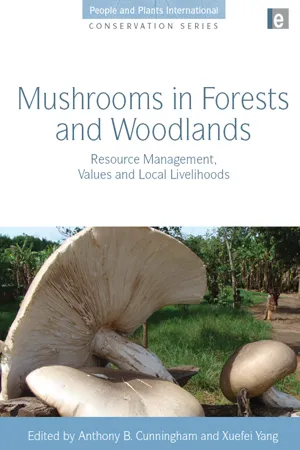
Mushrooms in Forests and Woodlands
Resource Management, Values and Local Livelihoods
- 240 pages
- English
- ePUB (mobile friendly)
- Available on iOS & Android
Mushrooms in Forests and Woodlands
Resource Management, Values and Local Livelihoods
About this book
Many mushrooms - or the 'fruits of fungi' - are extremely valuable, wild-gathered products which are utilised for both their medicinal properties and as food. In many of the world's tropical and temperate forests, they are the primary source of income for the people who live there.
These forests range from temperate woodlands and small forests to high altitude forests in the Himalaya and tropical miombo woodlands in south-central Africa. In south-west China, over 200 species of wild fungi in 64 genera are commercially traded while in Europe and North America, woodlands and small forests are the source of many highly-prized mushrooms and an essential resource for many small enterprises and collectors. Yet the increased demand for timber has resulted in the rapid expansion of forestry, which in turn has destroyed the natural habitat of many fungi, unbalancing both forest economics and ecology.
Despite the economic, social and cultural values of fungi, there is a general lack of understanding of their importance to local livelihoods and forest ecology. This book aims to fill this gap and extends the People and Plants Conservation Series beyond the plant kingdom into the related world of fungi and mushrooms. It demonstrates the crucial roles that fungi play in maintaining forest ecosystems and the livelihoods of rural people throughout the world while providing good practice guidelines for the sustainable management of this resource and an assessment of economic value. It brings together the perspectives of biologists, anthropologists and forest and woodland managers to provide a unique inter-disciplinary and international overview of the key issues.
Frequently asked questions
- Essential is ideal for learners and professionals who enjoy exploring a wide range of subjects. Access the Essential Library with 800,000+ trusted titles and best-sellers across business, personal growth, and the humanities. Includes unlimited reading time and Standard Read Aloud voice.
- Complete: Perfect for advanced learners and researchers needing full, unrestricted access. Unlock 1.4M+ books across hundreds of subjects, including academic and specialized titles. The Complete Plan also includes advanced features like Premium Read Aloud and Research Assistant.
Please note we cannot support devices running on iOS 13 and Android 7 or earlier. Learn more about using the app.
Information
Table of contents
- Cover Page
- Half Title page
- Title Page
- Copyright Page
- Contents
- Figures, Tables and Boxes
- Preface
- Acknowledgements
- Contributors
- Abbreviations
- Chapter 1 From Chipho to Msika: An Introduction to Mushrooms, Trees and Forests
- Chapter 2 How to Collect Fungal Specimens: Key Needs for Identification and the Importance of Good Taxonomy
- Chapter 3 A Primer on Ethnobiological Methods for Ethnomycological Research: Studying Folk Biological Classification Systems
- Chapter 4 Ethnobiological Methods for Ethnomycological Research: Quantitative Approaches
- Chapter 5 Challenges and Approaches to Assessing the Market Value of Wild Fungi
- Chapter 6 Hidden World, Crucial Role: The Ecology of Fungi and Mushrooms
- Chapter 7 Ensuring Sustainable Harvests of Wild Mushrooms
- Chapter 8 Mushrooms, Health and Nutrition
- Chapter 9 Fungi and the Future: Policy and Practice for Sustainable Production and Conservation
- Index