- 508 pages
- English
- ePUB (mobile friendly)
- Available on iOS & Android
eBook - ePub
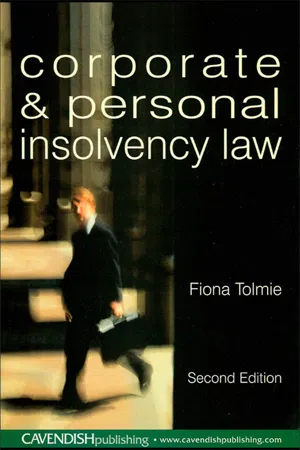
Corporate and Personal Insolvency Law
About this book
Corporate and Personal Insolvency Law provides a basic framework of knowledge of the current legal rules and a comprehensive introduction to the underlying issues. It will be ideal for those studying insolvency at undergraduate or postgraduate level and for those studying professional examinations and practising in the area.
Information
Publisher
Routledge-CavendishYear
2013Print ISBN
9781859417720
9781138165168
Edition
2eBook ISBN
9781135336226
PART I
GENERAL INTRODUCTION
CHAPTER 1
INTRODUCTION
1 INTRODUCTION TO INSOLVENCY LAW
Insolvency can be defined broadly as the inability to meet one’s debts either because of a lack of available cash at the relevant time1 or, more fundamentally, because total liabilities exceed the assets which can be made available to meet them. Insolvency is something which will have to be dealt with by any society which recognises the use of credit; as soon as society provides the ability to commit to the future performance of an obligation, it provides the chance that performance will not be possible at that future time. Even if society could prevent the voluntary incurring of future obligations, there would still be imposed obligations such as tort damages and tax which some might find impossible to meet.
As the Cork Committee2 recognised: ‘the roots of insolvency law are embedded deep in our legal, social and economic history. It has always been recognised that the topic is one which touches on most aspects of commercial law, in the sense that there is always a risk that all mercantile contracts may at one time or another fall to be investigated by the Bankruptcy Courts.’3
The Cork Report further observed4 that ‘the law of insolvency takes the form of a compact to which there are three parties: the debtor, his creditors and society’4. Any system which is to cope with the consequences of an insolvency has to bear in mind the interests of these three parties. The debtor is concerned to be relieved from the harassment of his or her creditors and to be able to make a fresh start, preferably without having to undergo the rigours of a formal insolvency regime. The creditors want to recoup as much as possible of what they are owed and will be concerned about the division between themselves of the available assets. This question of the distribution of the insolvent’s assets clearly raises fundamental issues of priority as between the various creditors and also, in the case of an individual insolvent, of the conflict between the debtor’s dependants and creditors. Society as a whole is concerned that commercial morality should be maintained; the system should not favour the debtor to such an extent that there is no incentive for debtors to meet their obligations. Insolvency law has always had to grapple with the question of the extent to which those unable to pay their debts should be treated as culpable or as merely unfortunate.
The balance between the interests of these three parties is a fundamental issue of policy. Where the insolvent is an individual, it is clear that rehabilitation of the debtor must be an aim of the law, although there is scope for debate about the extent to which the creditors must lose out in order to leave the debtor with sufficient assets to achieve that aim. In the case of a corporate debtor, there is not the same unarguable need toachieve a rescue of either the legal person or the business entity; this is demonstrated by a comparison of the differing degrees to which the ‘rescue culture’ has become embedded in insolvency laws throughout the world. In the United States, for example, the balance is in favour of the debtor at the expense of the creditors, whereas in the UK, the converse has traditionally been the case.
The Cork Committee stated5 the following extensive list of the aims of a good modern insolvency law:
- to recognise that the world in which we live and the creation of wealth depend upon a system founded on credit6 and that such a system requires, as a correlative, an insolvency procedure to cope with its casualties;
- to diagnose and treat an imminent insolvency at an early rather than a late stage;7
- to relieve and protect where necessary the insolvent, and in particular the individual insolvent, from any harassment and undue demands by his creditors,8 whilst taking into consideration the rights which the insolvent (and, where an individual, his family)9 should legitimately continue to enjoy; at the same time, to have regard to the rights of creditors whose own position may be at risk because of the insolvency;
- to prevent conflicts between individual creditors;10
- to realise the assets of the insolvent which should properly be taken to satisfy his debts, with the minimum of delay and expense;11
- to distribute the proceeds of the realisations amongst the creditors in a fair and equitable manner, returning any surplus to the debtor;12
- to ensure that the processes of realisation and distribution are administered in an honest and competent manner;13
- to ascertain the causes of the insolvent’s failure and, if and so far as his conduct or, in the case of a company, the conduct of its officers or agents, merits criticism or punishment, to decide what measures, if any, require to be taken against him or his associates, or such officers or agents;14
- to recognise that the effects of insolvency are not limited to the private interests of the insolvent and his creditors, but that other interests of society or other
- groups in society are vitally affected by the insolvency and its outcome, and to ensure that these public interests are recognised and safeguarded;15
- to provide means for the preservation of viable commercial enterprises capable of making a useful contribution to the economic life of the country;16
- to devise a framework of law for the governing of insolvency matters which commands universal respect and observance, and yet is sufficiently flexible to adapt to and deal with the rapidly changing conditions of our modern world;
- to ensure due recognition and respect abroad for English insolvency proceedings.17
There are those who would argue that such an ambitious list is doomed to failure and that insolvency law should restrict itself to dealing with the distribution of the assets of an insolvent. This is a debate which has largely taken place between American academics,18 with Professor Jackson19 as a leading proponent of the more restrictive view and Professor Warren20 advancing the case of those with other interests. Professor Jackson, who sees the purpose of insolvency law as debt collection, argues that the purpose of insolvency law is the co-ordination of the claims of creditors in order to enhance the value of the debtor’s assets for all claimants. He says that insolvency law should guarantee the claimants in total at least as much as they would in total have received by individual enforcement of their claims; this has been described as the ‘common pool’ philosophy. Professor Warren, on the other hand, advances the case for consideration of wider interests including those of employees, suppliers, customers, neighbours and government. She argues that the purpose of insolvency law is to provide a forum in which all interests can be heard. Professor Goode summarises and considers the debate from this side of Atlantic in the second edition of his Principles of Corporate Insolvency;21 he finds Professor Warren convincing and Professor Jackson’s arguments ultimately unpersuasive.
If insolvency law is to be concerned with all aspects of over-indebtedness rather than being narrowly focused on debt collection against those whose liabilities exceed their assets, then it could be argued that a further aim of providing discouragement to unreasonable or irresponsible risk-taking by both users and providers of credit should be added to the list set out by the Cork Committee. The stated aims of diagnosing and treating an imminent insolvency at an early rather than a late stage and ascertaining whether culpable behaviour has led to the insolvency (aims (b) and (h)) go some way in this direction, but are still in the ‘cure’ rather than the ‘prevention’ zone. It could perhaps be argued that such matters are the concern of those areas of the law relating to consumer credit, financial services and company law. Alternatively, this may simply illustrate the octopus-like nature of insolvency law with its tentacles penetrating into many apparently disparate areas of law; readers of this text will come across aspects of the law relating to real and personal property, companies and partnerships, contract, civil litigation, employment, family breakdown, trusts law, criminal law, human rights law and conflict of laws.
2 STRUCTURE OF THIS TEXT
The next chapter gives a brief outline of the history of English insolvency law, which goes back to Tudor times, since the current state of the law, particularly the separate treatment of personal and corporate insolvents, can only be fully understood in the light of this history. The historical outline concludes with a summary of the currently available insolvency regimes and the insolvency jurisdiction of the courts; statistics relating to current usage of the various procedures can be found at the end of the chapter. The rest of Part I considers the nature and role of credit in society, identifies the categories of creditor and then goes on to look at the categories of debtor and some of the reasons for their indebtedness. Chapters 5 and 6 consider methods of enforcement of debt outside the formal insolvency processes.
Part II considers the methods by which a debtor who is in fact insolvent, or nearly so, can attempt to avoid bankruptcy or liquidation both within and outside the procedures provided by the insolvency legislation. Part III considers the process and implications of subjection to either bankruptcy or liquidation. Part IV concentrates on the aspects of insolvency law intended to maintain public confidence in the legal framework governing the workings of the economy. Part V turns to the aspect which many would consider the core of insolvency law: the battle for the assets between the creditors. Part VI is an introduction to the problems of cross-border insolvency. The first chapter of each part provides a more detailed introduction to the theme of that part.
The text as a whole is intended to provide an explanation of the rules governing the current operation of the law relating to over-indebtedness together with an introduction to the policy issues underlying the law and its development.
Notes
1 This is often referred to as a cashflow or liquidity problem.
2 Report of the Review Committee on Insolvency Law and Practice, 1982, Cmnd 8558, hereinafter ‘the Cork Report’. See Chapter 2 for an explanation of the importance of this Report in shaping current insolvency legislation.
3At para 0.3
4 At para 192.
5 At para 198.
6 This is considered further in Chapter 3 below.
7 Part II of this text is concerned with ‘rescue’ procedures.
8 See Chapters 8 (relating to county court administration) and 9 (on individual voluntary arrangements) for the circumstances in which a debtor may be protected from creditors in the course of a ‘rescue’. See Chapter 25 for the stay on proceedings brought about by a l...
Table of contents
- COVER PAGE
- TITLE PAGE
- COPYRIGHT PAGE
- PREFACE
- TABLE OF CASES
- TABLE OF STATUTES
- TABLE OF STATUTORY INSTRUMENTS
- TABLE OF EUROPEAN LEGISLATION
- PART I: GENERAL INTRODUCTION
- PART II: AVOIDING BANKRUPTCY OR LIQUIDATION: THE ‘RESCUE CULTURE’
- PART III: BANKRUPTCY AND LIQUIDATION PROCEDURES
- PART IV MAINTAINING PUBLIC CONFIDENCE
- PART V: THE CREDITORS’ BATTLE FOR THE ASSETS
- PART VI: AN INTRODUCTION TO ISSUES OF CROSS-BORDER INSOLVENCY
- BIBLIOGRAPHY
Trusted by 375,005 students
Access to over 1.5 million titles for a fair monthly price.
Study more efficiently using our study tools.
Frequently asked questions
Yes, you can cancel anytime from the Subscription tab in your account settings on the Perlego website. Your subscription will stay active until the end of your current billing period. Learn how to cancel your subscription
No, books cannot be downloaded as external files, such as PDFs, for use outside of Perlego. However, you can download books within the Perlego app for offline reading on mobile or tablet. Learn how to download books offline
Perlego offers two plans: Essential and Complete
- Essential is ideal for learners and professionals who enjoy exploring a wide range of subjects. Access the Essential Library with 800,000+ trusted titles and best-sellers across business, personal growth, and the humanities. Includes unlimited reading time and Standard Read Aloud voice.
- Complete: Perfect for advanced learners and researchers needing full, unrestricted access. Unlock 1.5M+ books across hundreds of subjects, including academic and specialized titles. The Complete Plan also includes advanced features like Premium Read Aloud and Research Assistant.
We are an online textbook subscription service, where you can get access to an entire online library for less than the price of a single book per month. With over 1.5 million books across 990+ topics, we’ve got you covered! Learn about our mission
Look out for the read-aloud symbol on your next book to see if you can listen to it. The read-aloud tool reads text aloud for you, highlighting the text as it is being read. You can pause it, speed it up and slow it down. Learn more about Read Aloud
Yes! You can use the Perlego app on both iOS and Android devices to read anytime, anywhere — even offline. Perfect for commutes or when you’re on the go.
Please note we cannot support devices running on iOS 13 and Android 7 or earlier. Learn more about using the app
Please note we cannot support devices running on iOS 13 and Android 7 or earlier. Learn more about using the app
Yes, you can access Corporate and Personal Insolvency Law by Fiona Tolmie in PDF and/or ePUB format, as well as other popular books in Law & Bankruptcy & Insolvency Law. We have over 1.5 million books available in our catalogue for you to explore.