eBook - ePub
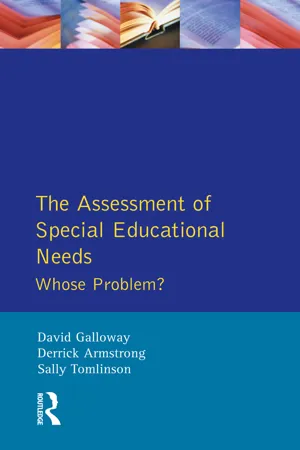
The Assessment of Special Educational Needs
Whose Problem?
- 208 pages
- English
- ePUB (mobile friendly)
- Available on iOS & Android
eBook - ePub
The Assessment of Special Educational Needs
Whose Problem?
About this book
The debate about special needs provision has increased dramatically over the last 15 years, however, despite the widespread concern over both learning and behavioural difficulties, there have been few attempts to analyse in detail the process of assessment by which children are being identified as having special educational needs.
Drawing upon research carried out by the authors, this book fills that gap by examining the process in detail. It considers the assessment process itself and how it affects and is affected by other areas of school policy - in some cases causing tension and conflict such as parental participation, the use and allocation of resources and multi-professional decision-making. A feature of the book is its analysis of the impact of the National Curriculum and the local management of schools (LMS) provision for special needs.
Information
Part I
The context for assessment
Chapter 1
The origins and meaning of special educational needs
Introduction
The 1980s witnessed a minor revolution in public and professional interest in special educational needs (SEN). This was reflected in the time allocated to SEN by schools, by HMI and by local education authority advisory and inspection services. In the 1970s it was unusual for HMI reports to allocate more than a brief paragraph to SEN. Today virtually every report allocates a substantial section to the resources provided and the effectiveness of the teaching. If children in the 1970s, were experiencing learning or behavioural difficulties in a mainstream school there was, in most LEAs, a straight choice: leave them in the school and hope that teachers would be able to give them some additional help without any additional resources, or recommend their transfer to a special school, at which they would almost certainly remain until they left school. In contrast today resources for SEN are based on a dual funding system:
(a) | Resources can be specified on the ‘Statement’ of a child’s SEN issued under provision of the 1981 Education Act. |
(b) | The 1988 Education Reform Act requires LEAs to allocate an annual budget to each school, as part of the Local Management of Schools (LMS), and the formula for determining the size of this budget must include provision for SEN. |
As a result, resources for SEN have become a matter of interest and concern to head teachers and LEA administrators. As the overall power of LEAs to influence policy and practice in schools has declined as a result of the Conservative Party’s antipathy to local government, the importance of SEN provision relative to all other functions performed by the LEA has increased. There are two principal reasons for the increasing importance of provision for SEN. First, the 1981 Education Act gave parents certain rights to request, and to participate in, the assessment of their children’s SEN and to appeal against LEA decisions. Second, and partially as a result of this, the associations representing specific interest groups have become better organised and more vocal. Parents of children with special needs now have greater access to reliable information and high-quality support from voluntary groups than at any time in the past. There are, however, certain notable exceptions, for reasons which we explain later in the book. Parents of children with generalised learning difficulties which are not associated with ‘dyslexia’, or with emotional and behavioural difficulties, still have limited access to independent advice.
Yet in spite of greater awareness of SEN and of the allocation of resources specifically for SEN in mainstream schools, dissatisfaction with SEN provision has probably never been greater, both from parents and from head teachers. The problem does not lie principally in their evaluation of the effectiveness of the resources that have been provided, though there are strong reasons for asking how much provision does actually ‘meet’ the special needs of the pupils for whom it is intended. Rather, dissatisfaction focuses on the processes of assessing special needs and of determining the resources to be made available.
Superficially, assessment might appear a straightforward process: a child either has a physical disability requiring special educational help or he or she does not; similarly, another child either has a learning or a behavioural problem requiring special provision, or he or she does not. In practice the process is anything but straightforward. There are three interrelated issues.
- Assessment provides the key to resources, and resources are never infinite; with some justification, parents and head teachers regard them as something to be fought for. LEA administrators often regard them as something to be fought over.
- Whether children are regarded as having SEN depends at least in part on the quality of the teaching and the resources their schools are able to provide. We shall return to this issue in Chapter 3. All we need to note here is that children’s progress, or lack of progress, and behaviour results from complex interactions in which the school plays an important part.
- Assessment is primarily a political and social process and, as in any political and social process, misunderstandings occur and polarised positions may be adopted.
The final point merits further discussion. The fact that teachers and educational psychologists use a variety of educational attainment tests and ‘intelligence’ tests in their assessment of learning difficulties does not make the process objective. The tests themselves have a substantial margin of error. The more important issue, though, concerns the differing, and sometimes conflicting, assumptions which provide the context in which they are used, and the differing expectations which determine how the results are interpreted. These assumptions and expectations may include beliefs about the causes of the child’s problems, about the adequacy of the teaching he or she is currently receiving, about the possibility of overcoming the difficulties in question, and about the best sort of provision for children with special needs. Throughout this book we shall be drawing on our research to illustrate the critical issues that lie behind a decision to carry out an assessment of SEN, as well as the critical issues in the process itself. The remainder of this chapter will examine how provision for SEN has developed since the 1944 Education Act. We shall then focus on assessment as a political and social process before analysing the meaning of the concept of SEN. Briefly, we shall consider why LEA and school policies for SEN provision so often appear arbitrary and inconsistent.
The development of SEN provision
Concern about a large minority of children with learning and/or behavioural difficulties has a long history which is both consistent and confused. The consistency lies in conclusions about the size of the ‘problem’. The Wood Committee regarded about 10 per cent of children as retarded, even though they did not technically fill the (rather vague) criteria for certification as feeble minded (BoE/BoC, 1929). Researching behaviour problems, McFie (1934) reported a remarkable 46 per cent of pupils as showing at least one ‘behaviour deviation’ while an even earlier American study reported undesirable behaviour in over 50 per cent of pupils (Haggerty, 1925). Clearly, neither learning nor behavioural difficulties are peculiar to the 1980s and 1990s.
We can interpret the concern about these children in several ways. Special provision, either in the mainstream or in a special school or unit, can be seen as a humanitarian response to the needs of children with problems. Yet special educational provision also reflects anxiety about the effect which the children concerned may have on other children. This concern can be seen from two perspectives. First, the eugenics movement was influential in promoting the view that people of inferior intelligence and/or morals – in practice these were often conflated – should be segregated from the rest of society, partly for their own good and partly to prevent them from passing on their allegedly degenerate characteristics to the next generation by breeding. Second, with large classes and, by today’s standards, hopelessly limited resources, mainstream teachers demanded action on behalf of children who at best were failing to learn, and at worst were seriously disrupting the other pupils.
The 1944 Education Act introduced universal secondary education, based on selection by ability at age 11. A major extension to the scope of special educational provision was perceived as necessary if the new secondary schools were to operate successfully. The justification, and the means of selecting children, was provided by evidence from psychologists, notably Cyril Burt (see Heamshaw, 1979). They claimed that children could be assessed at 11 as suitable for education in a grammar, technical or secondary modem school. Using similar procedures, they could be assessed as requiring special education.
The Act created categories of handicap, and if a child was ‘ascertained’ as ‘suffering’ from one of these categories, the LEA was required to provide special educational ‘treatment’ in a special school or class recognised for the purpose. Assessment was the responsibility of school medical officers, who were trained by leading psychologists to administer the Stanford Binet Intelligence Test. One reason for this was pragmatic: LEAs simply did not employ enough educational psychologists to carry out the necessary assessments. Another reason was that learning and behaviour problems were still seen essentially as medical rather than educational matters.
In the 30 years following the 1944 Act it gradually dawned on educationalists and on senior school health personnel that the categories of handicap told them nothing about a child’s educational needs. One of the Department of Education and Science’s senior school medical officers referred privately to the ‘crude, naive and lazy simplicity of terms like educationally sub-normal and maladjusted’. The categories gave teachers no guidance to help them in subsequent work with the child. Indeed, because they were based on quasi-medical criteria, it was not even clear that the child did in fact have special educational needs. At the same time training courses for educational psychologists were starting to meet a growing demand from LEAs. This resulted in tension between school doctors and educational psychologists as the latter challenged the doctors’ competence in educational assessment. Tomlinson (1981a) has described the competition for clients in which psychologists asserted their expertise in what had previously been a medical preserve.
The issue was largely resolved by 1974 when Margaret Thatcher, as Secretary of State for Education and Science, appointed Mary Warnock as Chair of a committee whose brief was:
to review educational provision in England, Scotland and Wales for children and young people handicapped by disabilities of body, or mind, taking account of the medical aspects of their needs, together with arrangements to prepare them for entering into employment; to consider the most effective use of resources; and to make recommendations. (DES, 1978, p. 1)
Membership of the committee reflected the dominance of professional views on the education of children with special needs. Of the 26 members, only one was the parent of a child with a handicap. No black person was invited to serve, nor was any person with a handicap. The only non-specialist outside the civil service, the teaching profession and the support services was Mary Warnock herself – at the time an Oxford philosophy don – and even she was a former head teacher. The message was clear: professionals would decide what was best; parents might be welcome as partners, but could not be expected to have the necessary knowledge or experience to make any substantial contributions to the committee’s work.
In 1975, three years before the committee submitted its report, the DES issued non-statutory guidelines to LEAs which radically changed the procedures for assessing SEN. These placed educational psychologists at the centre of the process, with a key role in advising the LEA about the child’s educational needs. Formal ascertainment was only to be used when the LEA considered that special school placement should be enforced against parental wishes.
The Warnock Report recommended abolition of the 1944 Act’s categories of handicap, and their replacement with the generic concept of special educational needs (DES, 1978). Drawing on a wide range of epidemiological and longitudinal research, the report recommended that services should be based on the assumption that up to 20 per cent of children would have some form of special educational needs at some stage in their school career, and up to 15 per cent at any one time. Thus, the scope of special educational provision was broadened from the 2 per cent who had received special educational treatment under the 1944 Act to include around 20 per cent of the population. The ‘problem’ of SEN thus became indistinguishable from the ‘problem’ of low achievement and pupil behaviour generally. In the same year an influential report by HMI in Scotland sought to extend the concept still further by arguing that up to 50 per cent of children had learning difficulties, and that mainstream teachers should be catering for them (SED, 1978).
The consequence of extending the concept of SEN was to stimulate debate and discussion in all mainstream schools. As an awareness-raising exercise this may have been useful. We shall argue, though, that in the long term it has had profound and unhelpful consequences for the assessment of SEN.
The government’s response to the Warnock Report was the 1981 Education Act. This had two essential functions: first, to provide a legislative framework for provision for SEN, based on those aspects of the Warnock Report with which the government agreed; and, second, to do so without providing any new resources from central funds. The 1944 Act categories were finally abolished, and replaced with the generic concept of special educational needs. Children with learning difficulties who were thought to require special provision beyond what was normally available in their mainstream schools should receive formal and multidisciplinary assessment to determine whether they did in fact have SEN. If the reports indicated that the child did have special needs, the LEA would issue a ‘statement’, specifying the nature of the needs, how and where they should be met, and the resources that should be made available. Parents were given the right to appeal against an LEA decision to carry out an assessment and against a decision not to issue a statement following an assessment. They were also given the right to discuss a ‘Proposed Statement’ with a named officer of the LEA before it was formally issued. Subsequently they could appeal against a formally issued Statement to a local appeals committee and, finally, to the Secretary of State. (Technically, the last resort is an appeal to the European Court of Human Rights, but the child will most probably have left school before the appeal is heard.) The assessment and appeal procedures both involve an intimidating amount of paper work which have been referred to cynically as ‘a bureaucrat’s dream’ and ‘a parent’s nightmare’ (Galloway, 1985).
The 1981 Act was essentially an enabling Act. Although the procedural requirements were specified in detail, it left LEAs with extensive autonomy in deciding what provision should be made. As with the Warnock Report, the 1981 Act was based on a professional consensus on what constituted good practice. It is widely assumed that the Act encouraged the integration of children with special needs into mainstream schools. In fact, the commitment to integration is remarkably weak, noting merely that children should be taught in ordinary schools subject to:
- parental wishes
- the possibility of meeting the child’s needs in an ordinary school
- ‘provision of efficient education for the children with whom he will be educated’
- the efficient use of resources.
Galloway and Goodwin (1987, p.21) note that:
the last two choices could have been invoked for every child ever placed in every special school in the country. Once an LEA has separate special schools it is obviously ‘inefficient’ not to use them. Further, many children with learning or adjustment problems are referred because of their effect on other children.
Swann (1985) analysed DES statistics from 1978 until 1982, the last full year before the 1981 Education Act came into force. The figures showed an increase in children placed in schools specialising in ‘moderate’ levels of intellectual handicap. The picture since the Act came into operation in April 1983 is confused as the DES has altered the way it collects statistics. Nevertheless, the Centre for Study of Integration in Education has argued that by no means are all LEAs adopting a policy of integration (Swann, 1992). In the case of children who present behavioural difficulties, it is likely that provision outside the mainstream continued to increase throughout the 1980s.
Emotional and behavioural difficulties (EBD) remained one of the most frequent reasons for referral to special schools. The 1981 Act abolished the 1944 Act’s category of maladjusted, and the concept of EBD merely reflected official recognition that the children concerned would have to be described, or categorised, in some other way. At the same time the amount of provision for children regarded as ‘disruptive’ was continuing to increase. As early as 1980 the Advisory Centre for Education published a survey in which just over half the LEAs cooperated. Places existed for 6791 pupils, or around half the number in schools for ‘maladjusted’ children. The distinction between children who were labelled ‘disruptive’ and children who were said to be ‘maladjusted’ is instructive. Prior to the 1981 Act, children ascertained as maladjusted had to be placed in a school recognised for that category. LEAs discovered in the 1960s and 197...
Table of contents
- Cover
- Half Title
- Title Page
- Copyright Page
- Table of Contents
- Editor’s Preface
- Authors’ Preface
- Note on Authorship
- Abbreviations
- Acknowledgements
- List of Figures and Tables
- Disclaimers
- The Effective Teacher Series List
- Part I: The context for assessment
- Part II: Children’s, parents’ and professional perspectives
- Part III: Looking beyond the data
- Bibliography
- Index
Trusted by 375,005 students
Access to over 1.5 million titles for a fair monthly price.
Study more efficiently using our study tools.
Frequently asked questions
Yes, you can cancel anytime from the Subscription tab in your account settings on the Perlego website. Your subscription will stay active until the end of your current billing period. Learn how to cancel your subscription
No, books cannot be downloaded as external files, such as PDFs, for use outside of Perlego. However, you can download books within the Perlego app for offline reading on mobile or tablet. Learn how to download books offline
Perlego offers two plans: Essential and Complete
- Essential is ideal for learners and professionals who enjoy exploring a wide range of subjects. Access the Essential Library with 800,000+ trusted titles and best-sellers across business, personal growth, and the humanities. Includes unlimited reading time and Standard Read Aloud voice.
- Complete: Perfect for advanced learners and researchers needing full, unrestricted access. Unlock 1.5M+ books across hundreds of subjects, including academic and specialized titles. The Complete Plan also includes advanced features like Premium Read Aloud and Research Assistant.
We are an online textbook subscription service, where you can get access to an entire online library for less than the price of a single book per month. With over 1.5 million books across 990+ topics, we’ve got you covered! Learn about our mission
Look out for the read-aloud symbol on your next book to see if you can listen to it. The read-aloud tool reads text aloud for you, highlighting the text as it is being read. You can pause it, speed it up and slow it down. Learn more about Read Aloud
Yes! You can use the Perlego app on both iOS and Android devices to read anytime, anywhere — even offline. Perfect for commutes or when you’re on the go.
Please note we cannot support devices running on iOS 13 and Android 7 or earlier. Learn more about using the app
Please note we cannot support devices running on iOS 13 and Android 7 or earlier. Learn more about using the app
Yes, you can access The Assessment of Special Educational Needs by David M Galloway,Derrick Armstrong,Sally Tomlinson,David M. Galloway in PDF and/or ePUB format, as well as other popular books in Education & Education General. We have over 1.5 million books available in our catalogue for you to explore.