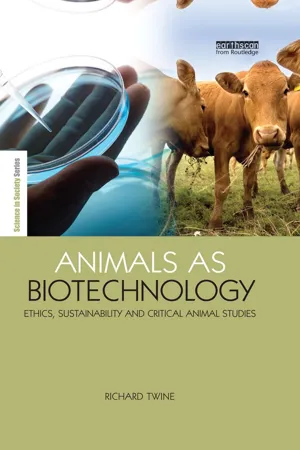
Animals as Biotechnology
eBook - ePub

Animals as Biotechnology

Ethics, Sustainability and Critical Animal Studies

  1. 232 pages
  2. English
  3. ePUB (mobile friendly)
  4. Available on iOS & Android
eBook - ePub

Animals as Biotechnology

Ethics, Sustainability and Critical Animal Studies

About this book

In Animals as Biotechnology sociologist Richard Twine places the question of human/animal relations at the heart of sustainability and climate change debates. The book is shaped by the emergence of two contradictory trends within our approach to nonhuman animals: the biotechnological turn in animal sciences, which aims to increase the efficiency and profitability of meat and dairy production; and the emerging field of critical animal studies - mostly in the humanities and social sciences - which works to question the nature of our relations with other animals.

The first part of the book focuses on ethics, examining critically the dominant paradigms of bioethics and power relations between human and non-human. The second part considers animal biotechnology and political economy, examining commercialisation and regulation. The final part of the book centres on discussions of sustainability, limits and an examination of the prospects for animal ethics if biotechnology becomes part of the dominant agricultural paradigm. Twine concludes by considering whether growing calls to reduce our consumption of meat/dairy products in the face of climate change threats are in fact complicit with an anthropocentric understanding of sustainability and that what is needed is a more fundamental ethical and political questioning of relations and distinctions between humans, animals and nature.

Frequently asked questions

Yes, you can cancel anytime from the Subscription tab in your account settings on the Perlego website. Your subscription will stay active until the end of your current billing period. Learn how to cancel your subscription.
No, books cannot be downloaded as external files, such as PDFs, for use outside of Perlego. However, you can download books within the Perlego app for offline reading on mobile or tablet. Learn more here.
Perlego offers two plans: Essential and Complete
  • Essential is ideal for learners and professionals who enjoy exploring a wide range of subjects. Access the Essential Library with 800,000+ trusted titles and best-sellers across business, personal growth, and the humanities. Includes unlimited reading time and Standard Read Aloud voice.
  • Complete: Perfect for advanced learners and researchers needing full, unrestricted access. Unlock 1.4M+ books across hundreds of subjects, including academic and specialized titles. The Complete Plan also includes advanced features like Premium Read Aloud and Research Assistant.
Both plans are available with monthly, semester, or annual billing cycles.
We are an online textbook subscription service, where you can get access to an entire online library for less than the price of a single book per month. With over 1 million books across 1000+ topics, we’ve got you covered! Learn more here.
Look out for the read-aloud symbol on your next book to see if you can listen to it. The read-aloud tool reads text aloud for you, highlighting the text as it is being read. You can pause it, speed it up and slow it down. Learn more here.
Yes! You can use the Perlego app on both iOS or Android devices to read anytime, anywhere — even offline. Perfect for commutes or when you’re on the go.
Please note we cannot support devices running on iOS 13 and Android 7 or earlier. Learn more about using the app.
Yes, you can access Animals as Biotechnology by Richard Twine in PDF and/or ePUB format, as well as other popular books in Physical Sciences & Ecology. We have over one million books available in our catalogue for you to explore.

Information

Year
2010
Print ISBN
9781138867000
eBook ISBN
9781136532702
Edition
1
Subtopic
Ecology

Table of contents

  1. Cover Page
  2. Half Title page
  3. Series
  4. Title Page
  5. Copyright Page
  6. Contents
  7. Acknowledgements
  8. Introduction: From the Sciences of Meat to Critical Animal Studies
  9. The Animal and the Ethical
  10. Undomesticating the Ethical
  11. Towards a Critical Bioethics
  12. Thinking Across Species in the Ethics of ‘Enhancement'
  13. Capitalizing on Animals
  14. Animal Biotechnology and Regulation
  15. Biopower and the Biotechnological Framing of the Animal Body
  16. Capitalizing on the Molecular Animal: Beyond Limits?
  17. Capturing Sustainability in the Genome
  18. Mobilizing the Promise of Sustainability
  19. Searching for the ‘Win–Win'? Animal Genomics and ‘Welfare'
  20. Conclusion: From the ‘Livestock' ‘Revolution' to a Revolution in Human—Animal Relations
  21. Notes
  22. References
  23. List of Abbreviations
  24. Index