eBook - ePub
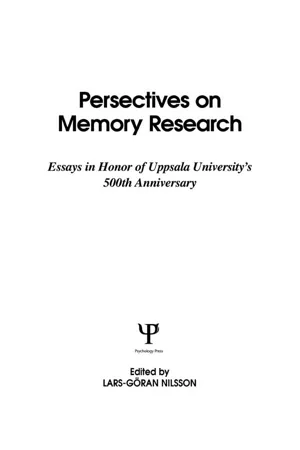
Perspectives on Memory Research
Essays in Honor of Uppsala University's 500th Anniversary
- 352 pages
- English
- ePUB (mobile friendly)
- Available on iOS & Android
eBook - ePub
Perspectives on Memory Research
Essays in Honor of Uppsala University's 500th Anniversary
About this book
First published in 1985. This conference on Perspectives on Memory Research was held at the University of Uppsala, June 20-24, 1977. A main purpose of it was to commemorate the birth of the University of Uppsala in 1477. This was also the purpose of more than 40 other conferences and symposia held in Uppsala during the year of 1977.
Information
I INTRODUCTION
| 1 | Functions of Memory |
Lars-Göran Nilsson
VIEWS ON PAST AND PRESENT
Ebbinghaus is usually considered the founder of memory research. This is somewhat misleading, for, despite the title of his now classic book Über das Gedächtnis (1885), his research was about learning and repetition rather than memory. Although learning and repetition are important aspects of memorization, they represent merely a small part of it.
The verbal learning approach initiated by Ebbinghaus was adopted by the behaviorists and became central to their thinking during the next three-quarters of a century. These students of verbal learning were more interested in studying how different tasks affect performance than in inferring what was going on in the minds of their subjects. Taking into consideration this reluctance to postulate any mental mechanisms intervening between stimulus and response and the complete dominance of behaviorism on the intellectual climate of the time, it is not surprising that memory research as understood today was dormant during this period.
Although there was essentially no memory research at this time, memory did mean something more than a simple acquisition of stimulus-response connections to some scholars. One such person was Freud (1915), who wrote about motivational aspects of memory along lines quite different from those of the behaviorists. According to Freud, memories repressed to an unconscious level could be brought to consciousness by psychoanalytic therapy. Thus, for Freud it was convenient to conceptualize the mind in terms of storage and retrieval of information available in an unconscious state. More “modern” ideas of memory had been put forward even earlier than this. James (1890), for instance, when discussing consciousness, distinguished between primary and secondary memory; and Bergson (1896) distinguished between bodily and mental memory. According to these views, it was possible through mental effort to retrieve information about past experience currently not in consciousness. Other “modern” views of memory appearing in the literature somewhat later included schools of thought that emphasized the productive nature of memory. This should of course be contrasted with the reproductive character so prevalent in the verbal learning tradition. Such a productive nature of memory was emphasized by the Gestalt psychologists. Katona (1940), for instance, demonstrated this productive nature of memory in several ingenious experiments that emphasized organization and understanding instead of the reproductive character of memory commonly shown in rote learning experiments of the time. Although the productive character of memory was demonstrated very nicely by Katona and other Gestalt psychologists, the most prominent among the early scientists who supported this viewpoint was Bartlett (1932). His use of schema as a central concept has influenced later memory research considerably, although it did not have much of an impact on other students of memory during the first half of this century.
All these different views on memory were indeed promising beginnings, but in no case did they initiate any particular memory research tradition. The simplest explanation of this is probably that of a wrong Zeitgeist for this type of work. The enormous dominance of behavioristically oriented verbal learning research was impossible to pierce for individual scholars having alternative views of the human mind.
Approximately 30 years after the publication of Bartlett's book, a new era started in this field of psychology. The concept of schema was brought back in the realm of the information-processing approach, as were most of the other ideas touched upon earlier. Nonetheless, it was not necessarily these ideas alone that determined the birth and later the development of modern memory research. In fact, the tradition for current memory research did not appear until the late 1950s, and it was brought about by two critical factors.
One factor was the particular way of conceptualizing information (e.g., Miller, Galanter, & Pribram, 1960). This view of information, which was based on cybernetics and communication theory, made inevitable the postulation of a memory system capable of holding information from one occasion to another. The cybernetic approach of Miller et al. takes for granted that currently presented information is mapped onto some general memory structure consisting of information stored earlier. The other factor that had a considerable impact on the development of memory research tradition was the application of computer terminology. Helped by this new conceptualization of information, Broadbent (1958) realized that it was possible to regard the flow of information through different subsystems within the organism in a way similar to that in which information is handled by a computer. The concept of memory was translated into computer language; and due to the growing popularity of the computer analogy, memory also became a central concept in human information processing. This led to a conceptualization of memory in spatial terms. Thus, memory was considered to be a location where information could be temporarily kept while appropriate processing was carried out and a location where information could be permanently stored.
The basic reason for distinguishing between a short-term and a long-term memory in such a fashion was that forgetting functions and capacity differed between the two systems. This conceptualization of memory in spatial terms might have been one of the most appealing aspects of the approach; but as was shown later, it created some of the main problems for the information-processing approach.
The computer analogy apparently appealed to a great many scientists in the area. They began working in completely new directions, many new questions were asked, and new methods were produced that opened up paths to new goals. Probably the two most important methodological contributions at this early stage were those put forward by Brown (1958) and by Peterson and Peterson (1959). As time went by, it became evident how easy it was to invent new methods that made sense for all the research questions generated. Most of these questions were inconceivable from a verbal learning point of view. One could easily envisage that the information-processing approach had a conspicuous advantage over the verbal learning terminology with respect to description and explanation of memory phenomena.
The computer analogy promised a great deal to scientists in the area who began to think that memory could be studied in a more meaningful and informative way. The approach gave rise to an enormous amount of research questions, producing empirical findings en masse; and the formulation of models and miniature theories became a major preoccupation of the time. Tests of all these theoretical notions in turn produced still more experiments, which required modifications of the theoretical concepts, which resulted in further tests, and so on. The inevitable outcome of all this active research work was a veritable explosion of scientific publications in the area. At first sight this gave an impression of progress and significance, and people saw obvious strategic advantages in this way of conducting research. One was the conviction that the highest degree of precision in description and explanation would be reached with such limited theory pursuits. Furthermore there was assumed to be a clear advantage in studying such a complex subject matter as human memory from different points of view, depending on which aspect of memory one was currently interested in. Because of these important principles, there was indeed important progress made during the early information-processing era. There is no question that research pursuits formulated within the information-processing framework have yielded significant facts of how memory works.
Despite all these epoch-making empirical results, models, and miniature theories, the information-processing approach was found to be dissatisfactory. One obvious reason for this was the lack of any real accumulation of knowledge. That is, although a mass of data and numerous theories had evolved, they existed for the most part as independent entities, incapable of being integrated by even the most clever of theorists. This whole state of affairs seemed to indicate the need for some kind of general theory whereby all or most previous contributions could be brought together. Once such a general theory was formulated, it was understood that it should also provide a basis in which to systematize new findings. Apparently, the original information-processing approach was unsuccessful in this respect, because very little or no accumulation of knowledge occurred in the area.
The work and effort needed to formulate such an overall theory may have had a discouraging effect upon people. There were so many new problems to study when the information-processing approach came along that any “miniature approach” was bound to be the most profitable one for each individual scientist. But besides these fads and fashions, were there any other reasons for scientists not to enter a “general-theory” enterprise? A general-theory notion seems attractive at first sight, but there might be good reasons to question its feasibility on other grounds. Could it possibly be the case that the whole notion constitutes a fundamental misconception of science? From the very beginning, one can readily see that it contained considerable problems. The approach requires that science be regarded as a complex puzzle, where scientists first discover the bits and pieces of knowledge and then insert them in their appropriate locations. If the pieces are put in their correct places, a certain pattern will eventually emerge. After a sufficient amount of time and effort, the pattern would ultimately be consummated for all time, and contentment would reign ever after.
According to Kuhn (1962), there are in fact periods of “normal science” for which it is appropriate to talk about an accumulation of knowledge. Such periods are, however, interrupted by other, “revolutionary” periods, where the pieces of knowledge are not considered to be additive in nature. If one were to decide whether modern memory research should be regarded as “normal” or “revolutionary,” the latter would definitely seem to be more appropriate. Apparently, there is no general theory in the making, and there are no single findings terminating any research pursuits. Certain discoveries may of course answer specific questions, but beyond those there are always still more challenging questions that require further study. Thus, as it now stands, there is no real hope for a final general theory in memory research.
The general-theory view of science is of course more common among people in general than among scientists. However, even scientists often hope for a general theory that will be the salvation for a given field; and one might wonder how this view has become so popular. One very likely reason is the way undergraduate courses are usually taught. When we teach these courses, we often seek to present the material in such a general and coherent form that it commonly violates scientific reality. If we would present the material in a way that more exactly reflects the diverging state of affairs in the memory area, it would probably leave the students in a state of bewilderment. Simplication and other pedagogical tricks may be necessary to avoid this state, but it is important to keep in mind that they are made for educational and not for scientific purposes.
Although a general-theory notion may be an effect of a confusion between education and science, there is no reason why we should abandon generality in principle. For instance, it is usually fruitful to look for generality whenever we try to integrate experimental results from different paradigms within a common framework. However, from the integration of data from a restricted number of studies to the incorporation of all knowledge, there is an enormous leap. For the more modest integrations of empirical findings and miniature theories, it is usually possible to formulate a testable theory; whereas for the general-theory approach this cannot be attained. The reason is that we will always find occasions to modify a theory as we proceed in testing its validity. The fact that theories of memory of, say, 50 years ago are not the same as those we are entertaining today is probably the best indication of this. It is also relatively safe to suggest that the theories of the next century will not be the same as those we are concerned with today.
VIEWS ON THE FUTURE
It is probably not a very useful exercise to try to build a general theory from available empirical findings, models, and miniature theories. But what should we do with the diverging empirical findings and theoretical concepts? This book seeks to make a modest start toward the solution of this problem by presenting an alternative to the traditional approach to memory research.
The point of departure is the simple assumption that to understand memory more fully, we have to abandon the idea that memory is some kind of object—a storehouse for holding information—or a process. Again, it is argued that education has played a crucial role in promoting such a view of memory. When trying to define memory for undergraduate students, it certainly makes sense to refer to memory as some kind of “thing” that can be studied in and of itself rather than some abstract quality. From this point of view, it is natural to isolate memory from other cognitive functions. This has actually been done, but in fact, it is not a particularly significant feature of the memory area only. It is a well-established way of scientific thinking used in most areas as a means of obtaining some order of their subject matters. Separation of specific areas in this way is regarded to be fundamental to scientific thinking and presentation of the areas in introductory textbooks. Simplicity and clarification are the main reasons for maintaining such a classification, and it might indeed be necessary to isolate the different subject areas in psychology so that introductory students are able to grasp the major ideas presented. Nonetheless, such a separation does not help clarify matters for established scholars acquainted with the area. Instead of seeking clarification in this “artificial” way, it might be more profitable to narrow research questions and educational enterprises on the basis of the kind of cognitive functions that subjects use in a given task. If, for instance, it is assumed that the subject will use some linguistic skill in an experiment, it would seem desirable to consider memory from that perspective. If some other function is involved, another perspective would be more appropriate. An important prerequisite for such an approach would be the spending of considerable time and effort to do more careful analyses of the tasks we give to our experimental subjects than is commonly done at present.
The example with psycholinguistics as a particular perspective was not chosen arbitrarily. The specific view proposed here has to some extent already been applied by students of memory working in this area. As shown in contemporary literature, this is an important approach to memory research and will probably continue to be a dominating force in the future. We will not deal with this approach as a separate topic in this volume, mainly because semantic and linguistic perspectives are already involved in most memory research anyway. Consequently, it will automatically be included in several contributions to this volume.
The ideas presented in the present chapter are not the basis for a theory of memory. Rather, one should regard the ideas as suggestive of how future memory research should be conducted. However, in order to talk about the research per se, a few words of how...
Table of contents
- Cover
- Half Title
- Title Page
- Copyright Page
- Table of Contents
- Preface
- Part I. Introduction
- Part II. Conceptual Perspectives
- Part III. Perceptual Perspectives
- Part IV. Biological Perspectives
- Part V. Reality Perspectives
- Author Index
- Subject Index
Trusted by 375,005 students
Access to over 1.5 million titles for a fair monthly price.
Study more efficiently using our study tools.
Frequently asked questions
Yes, you can cancel anytime from the Subscription tab in your account settings on the Perlego website. Your subscription will stay active until the end of your current billing period. Learn how to cancel your subscription
No, books cannot be downloaded as external files, such as PDFs, for use outside of Perlego. However, you can download books within the Perlego app for offline reading on mobile or tablet. Learn how to download books offline
Perlego offers two plans: Essential and Complete
- Essential is ideal for learners and professionals who enjoy exploring a wide range of subjects. Access the Essential Library with 800,000+ trusted titles and best-sellers across business, personal growth, and the humanities. Includes unlimited reading time and Standard Read Aloud voice.
- Complete: Perfect for advanced learners and researchers needing full, unrestricted access. Unlock 1.5M+ books across hundreds of subjects, including academic and specialized titles. The Complete Plan also includes advanced features like Premium Read Aloud and Research Assistant.
We are an online textbook subscription service, where you can get access to an entire online library for less than the price of a single book per month. With over 1.5 million books across 990+ topics, we’ve got you covered! Learn about our mission
Look out for the read-aloud symbol on your next book to see if you can listen to it. The read-aloud tool reads text aloud for you, highlighting the text as it is being read. You can pause it, speed it up and slow it down. Learn more about Read Aloud
Yes! You can use the Perlego app on both iOS and Android devices to read anytime, anywhere — even offline. Perfect for commutes or when you’re on the go.
Please note we cannot support devices running on iOS 13 and Android 7 or earlier. Learn more about using the app
Please note we cannot support devices running on iOS 13 and Android 7 or earlier. Learn more about using the app
Yes, you can access Perspectives on Memory Research by Lars-Goran Nilsson,L.-G. Nilsson,T. Archer in PDF and/or ePUB format, as well as other popular books in Psychology & Experimental Psychology. We have over 1.5 million books available in our catalogue for you to explore.