School-aged children in the U.S. and other Western nations spend almost half of their waking hours in leisure activities. For some, out-of-school time is perceived as inconsequential or even counterproductive to the health and well-being of young persons. Recently, however, there has been a growing recognition that--along with family, peers, and school--the organized activities in which some youth participate during these hours are important contexts of emotional, social, and civic development. They provide opportunities for young persons to learn and develop competencies that are largely neglected by schools. At the same time, communities and national governments are now channeling considerable resources into creating organized activities for young people's out-of-school time. This volume brings together a multidisciplinary, international group of experts to provide conceptual, empirical, and policy-relevant advances in research on children's and adolescents' participation in the developmental contexts represented by extracurricular activities, and after-school and community programs.
Organized Activities as Contexts of Development provides a handbook-like coverage of research in this new emerging field. It considers a broad developmental time-span from middle childhood through early adulthood, providing information on how motivation, participation, and developmental experiences change as youth get older. The contents cover one of the most salient topics in child and adolescent research, education, and social policy, placing consistent emphasis on developmental aspects and implications of organized activity participation for young persons. Representing contributors from several fields of study--psychology, criminal justice, leisure science, sociology, human development, education, prevention, and public policy--the book is designed to appeal to students and scholars in all these areas. Additionally, the volume is written to be of interest to professionals who administer programs and develop policy on youth.
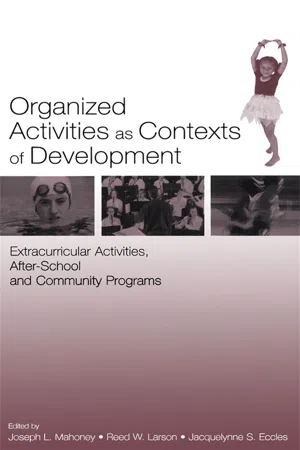
eBook - ePub
Organized Activities As Contexts of Development
Extracurricular Activities, After School and Community Programs
- 184 pages
- English
- ePUB (mobile friendly)
- Available on iOS & Android
eBook - ePub
Organized Activities As Contexts of Development
Extracurricular Activities, After School and Community Programs
About this book
Information
Publisher
Psychology PressYear
2005Print ISBN
9780805844313
9780805844306
Edition
1eBook ISBN
9781135628123
II
Developmental Processes and Outcomes
8
Everybody’s Gotta Give:
Development of Initiative
and Teamwork Within
a Youth Program
Reed Larson
David Hansen
Kathrin Walker
University of Illinois, Urbana-Champaign
After the last bell rings, a typical high school classroom is transformed into a meeting place as youth begin arriving. These members of the Clarkston High School FFA chapter seat themselves on top of desks and begin several excited conversations, generating ideas for planning a Day Camp for 4th graders in the middle of the summer.1 The youth’s goal for the camp is to interest children in agriculture, partly with the hope that they will want to become FFA members when they reach high school. As the cascade of conversations goes on, the adult advisor interrupts to ask who is leading the meeting, and the youth in unison point to Susan. In the minutes that follow, youth continue to throw out ideas in spontaneous and rapid succession. Many of these ideas are wildy unrealistic, which adds to the humor, and despite occasional entreaties from Susan and others to “focus,” their ideas fow for 45 minutes with little apparent or clear direction.
These youth are in the process of putting themselves into a tight spot. Shortly after this meeting, they recruited 20 children from the community to attend their camp for 2½ days in midsummer, only 2 months hence. Yet, although they are full of ideas, they face numerous hurdles in order to develop these ideas into workable shape. These youth are inexperienced in planning a large-scale event such as the day camp; they have little knowledge of how to coordinate the people and resources needed for such an event to occur; and several of these youth will encounter conficts in their schedule or will lose interest as the hard work of preparation turns out to be less fun that spinning out ideas. How do these teenagers organize themselves, individually, and as a team, to make this camp happen? What are the crucial strategies for planning this type of event that they must learn along the way?
This chapter focuses on the development of we have called initiative, the capacity to direct cumulative effort over time toward achievement of a long-term goal (Larson, 2000). We are interested in understanding the constellation of knowledge, dispositions, and skills that youth must learn to carry out a project, such as creating the day camp. This capacity to carry out a plan of action, both individually and as a team, is of increasing importance in the rapidly changing world of the 21st century (Brandstädter & Lerner, 1999; Larson, 2000). Within the occupational sphere, automation has reduced the market value of rote and manual labor, and more jobs require abilities to think and act with a plan, to carry out “initiatives” either individually or collaboratively. In other spheres of life as well, the erosion of traditional norms has made daily life less codifed, thus, individuals need the ability to deliberately shape their lives (Larson, Wilson, Broan, Furstenberg, & verma, 2002). For communities, too, it is essential that their members possess capabilities for “social entrepreneurship” in order to maintain and extend the communities’ values and goals (Frumkin, 2002; gauvain, 1999). So there is reason to contend that the capabilities these FFA members must learn to successfully organize the day camp are critical ones.
In this chapter we describe our current qualitative research on initiative, using the creation of the day camp by these FFA youth as a case example for in-depth analysis. Our first objective is to begin to understand the development of initiative within the context of organized youth programs. What did these teenagers need to learn to organize this day camp? Our second objective is to understand how the adult leaders of youth programs support this development. What role can or should they play in facilitating preparations for an event like this day camp? Effective, youth-serving practitioners give teens responsibility and ownership (McLaughlin, 2000), but they also provide support and guidance so that the youths’ efforts do not founder (Camino & zeldin, 2002)—in this case, so the camp does not “fop.” How do adults balance these competing imperatives?
BACKGROUND: DEVELOPMENTAL ANTECEDENTS OF INITIATIVE
The Capabilities of Children and Adolescents
A useful first step to understanding the development of initiative is to examine what is known about its antecedents in childhood. Research on children helps us think about the capabilities for planful action that they will bring into youth programs in adolescence. If we start with young children, Piaget (1954) demonstrated that their understanding of the world is limited in a number of ways that prevent them from exercising initiative. Among these constraints, they have little sense of future time as an arena for organizing their actions (Haith, 1997). They are, in a sense, trapped in the immediate world in front of them. But research shows that children gradually acquire abilities to plan actions and anticipate contingencies within a short-term future horizon. By age 5, children are capable of considering alternative courses of action and formulating a series of 5 to 6 steps toward reaching a short-term goal, such as building a tower from blocks. By late childhood, they are able to develop more elaborate sequences and plans that are fexible, take into account situational constraints, and include if–then contingencies (gauvain, 1999; gauvain & Perez, in press).
Even by adolescence, however, there remain limits to most young people’s capabilities for carrying out longer term initiatives, limits that refect lack of experience and cognitive tools. Youth at the outset of adolescence are typically not able to devise plans that involve long sequences of actions and include a large number of separate components and actors (gauvain & Perez, in press). Even older adolescents often have limited abilities to coordinate the multiple abstract levels and systems that might be involved in reaching a long-term goal (Mascolo, Fisher, & Neimeyer, 1999); in fact many adults remain ineffective in implementing long-term plans (gollwitzer, 1999). Another constraint is that teenagers are still developing abilities to understand emotions and use this knowledge to regulate their emotional states; thus, encounters with frustration, anxiety, and boredom can disrupt sustained attention to a long-term project (Larson, 1985).
These limits partly refect the fact that adolescents are just starting to learn to use and manipulate abstract concepts. Teenagers’ conception of future time is typically unelaborated (Nurmi, 1991), which may impair their ability to plan. They are only beginning to develop capabilities to think analytically about systems (Keating, 1980), emotional processes (Larson, Clore, & Wood, 1999), and the causal sequence among complex narrative events (Habermas & Bluck, 2000). Adolescents also are just gaining abilities for what cognitive psychologists call metacognition—the ability to “think about thinking.” This means they have limited abilities to think strategically; to think about the planning process itself as an object of thought. In short, adolescents’ internal tools for organizing a set of future interactions with a complex environment—as required for planning an event like the day camp—are at a nascent stage.
When we look at team projects with peers, other cognitive limitations are likely to affect adolescents’ exercise of initiative. Piaget (1929, 1954) found that young children are cognitively egocentric, they assume that other people experience the world exactly as they do. In a planning task, they see collaborators as instruments of their own intentions, rather than as individuals who may have intentions of their own (gauvain, 2001). Research shows that the abilities required to understand other people’s points of view are formidable, and their development is a long process stretching through adolescence, if not further. Early teens begin to acquire the capacity to understand other people as centers of thought and feeling, but they do not always use it (Selman, 1980). Adolescents are prone to assume that others are thinking about the same information that they are (Elkind, 1967). This adolescent egocentrism may handicap them in understanding and anticipating the differing point of view and intentions of collaborators (which is hard enough for experienced adults), thus making coordination of work on a team more diffcult.
The Role of Adults
What is important to know, however, is that children and adolescents are capable of functioning at a higher level of planfulness and initiative when they are assisted by others. When working in pairs, peers provide some degree of mutual assistance (Rogoff, 1998), despite the problem of egocentrism just discussed. However, research with 9to 11-year-olds indicates that peers rarely verbalize longer term strategies to each other, but rather work on one step at a time and focus on completion of the immediate task. They do not share ideas about a larger plan of action. As a result, youth in peer collaboration situations do less well on a posttest planning task than youth who have worked with adults—who are much more likely to verbalize long-term strategies (Radziszewska & Rogoff, 1988, 1991).
gauvain (1999) argued that, at least in Western culture, interactions with parents are the major context in which younger children develop abilities to formulate and carry out plans. In daily life, parents and children often engage in joint planning of activities for the child and the family, and parents often play a guiding role in these collaborations. Parents help children identify goals, determine steps to reach these goals, and monitor progress. Parents provide scaffolding; they structure, instruct, and model elements of the initiative process that children are not yet able to do on their own. Following the theories of vygotsky (1978), this process of working together appears to help expand children’s planning abilities; they gradually learn parts of the process that their parents are providing. Indeed, as they get older, children take on more of the tasks involved in joint planning with parents, such as organizing materials and contributing strategic information and ideas (gauvain, 1999; gauvain & Perez, in press).
How much children learn, of course, differs as a function of what parents do. Research by gauvain and Huard (1999) suggested that too much or too little guidance from parents is associated with slower development of planning capabilities. Authoritarian parents were found to be more directive in planning discussions, whereas permissive parents more often left planning in children’s hands. It was the authoritative parents who most often engaged their children in joint planning and most often used open-ended, non-directive, scaffolding techniques, like reminders and suggestions. Not surprisingly, when children in the research reached adolescence, those with authoritative parents made more contributions to joint family planning.
These findings about parents’ role are important to our discussion of youth programs in a couple of ways. First, they suggest that, to support development of initiative, adult leaders need to fnd a middle ground between being too directive and too laissez faire. But this is easier said than done, and we need to ask what it really means in the everyday situations that adult leaders face. Second, although research indicates that parents provide support for development of planning skills in childhood, parents are less involved in adolescents’ daily lives, and thus engage in less joint planning with them (gauvain, 1999; gauvain & Perez, in press). This creates a gap in opportunities for teenagers to continue developing their planning and initiative skills, a gap that might potentially be flled by good youth programs.
YOUTH PROGRAMS
Our interest in youth programs as contexts for the development of initiative emerged from our research in which adolescents carried pagers for one week and provided reports on their psychological states at random times when signaled by the pagers. We found across samples of hundreds of youth that, when teens were participating in extracurricular activities and other structured programs, they consistently reported both high motivation and engaged attention. This is a combination likely to provide optimal conditions for the development of self-directed action (Larson, 2000). We were also Influenced by the finding of Heath (1998, 1999) that adolescents in highly effective youth programs start using new types of language. New members in these programs showed dramatic increases in their use of what-if questions, scenario building, conditionals, and other linguistic tools for planning and executing plans—what we call initiative. This led us to ask what internal changes in youths’ thought processes underlie the increased used of these linguistic tools. What insights and new ways of thinking are related to the development of initiative?
Our first step to evaluating this prediction was to ask youth to tell us about their developmental experiences in these contexts. We conducted 10 focus groups with high-school students in which we asked them to describe what they were learning in youth programs (Dworkin, Larson, & Hansen, 2003). What struck us first was that these teens almost always portrayed themselves as the agents of their learning experiences within these contexts. These appeared to be contexts in which youth were “producers of their own development” (Lerner & Busch-Rossnagel, 1981; Silbereisen, Eyferth, & Rudinger, 1986). Among the types of development they described, these students readily identifed a set of competencies they were learning that related to initiative. These included skills involving management of one’s energies and resources: learning to set realistic goals, exert effort, manage time, and take responsibility. They also included skills related to working effectively in a team: learning communication skills, the giving and taking of feedback, and taking responsibility within a group.
It is important to ask, however, whether young people really have these learning experiences more often in youth programs than in other contexts? In a second study, we developed a survey that identifed different types of learning experiences, including those related to initiative, and we asked a high-school sample to rate how often they had had each of these experiences in youth programs, in their classwork, and during time “hanging out with friends” (Hansen, Larson, & Dworkin, 2003). These teenagers reported having all of the learning experiences related to initiative and teamwork skills at significantly higher rates within youth programs than in these comparison activities. For example, 40% of teens involved in youth programs reported that they had “learned to consider obstacles when making plans” in that context; whereas only 21% reported this experience in a school class and only 29% reported it in their interactions with friends. These findings supported our thesis that youth programs may be a particularly fertile context for the development of initiative.
The next step for us is to observe, close up, how this development takes place. Our goal is to use intensive observation to begin developing theory and practical knowledge about how initiative is fostered within youth programs. To achieve this, we chose to look at high-quality programs where there was a high likelihood of observing the development of initiative in process.
AN INTENSIVE STUDY
We chose an FFA chapter as one of the sites for our research because the FFA organization stresses the development of initiative skills. The motto of the National FFA Organization is “Learning to do, doing to learn, earning to live, living to serve” [italics added]. Over the course of a year, FFA clubs and members within those clubs have the opportunity to participate in a wide range of activities and competitions that involve working toward a goal. In the months before and during our research, the FFA chapter we studied was involved in an agricultural mechanics contest, ran a community toy show, took part in a parliamentary procedure contest, planned their annual banquet, and competed in a poultry judging contest, as well as planning the day camp and several other activities. In ...
Table of contents
- Cover Page
- Title Page
- Copyright Page
- Foreword Promoting Positive Youth Development Through Community and After-School Programs
- I: Social and Cultural Perspectives
- II: Developmental Processes and Outcomes
- III: Integrating Research, Practice, and Policy
- About the Editors
- About the Authors
Trusted by 375,005 students
Access to over 1.5 million titles for a fair monthly price.
Study more efficiently using our study tools.
Frequently asked questions
Yes, you can cancel anytime from the Subscription tab in your account settings on the Perlego website. Your subscription will stay active until the end of your current billing period. Learn how to cancel your subscription
No, books cannot be downloaded as external files, such as PDFs, for use outside of Perlego. However, you can download books within the Perlego app for offline reading on mobile or tablet. Learn how to download books offline
Perlego offers two plans: Essential and Complete
- Essential is ideal for learners and professionals who enjoy exploring a wide range of subjects. Access the Essential Library with 800,000+ trusted titles and best-sellers across business, personal growth, and the humanities. Includes unlimited reading time and Standard Read Aloud voice.
- Complete: Perfect for advanced learners and researchers needing full, unrestricted access. Unlock 1.5M+ books across hundreds of subjects, including academic and specialized titles. The Complete Plan also includes advanced features like Premium Read Aloud and Research Assistant.
We are an online textbook subscription service, where you can get access to an entire online library for less than the price of a single book per month. With over 1.5 million books across 990+ topics, we’ve got you covered! Learn about our mission
Look out for the read-aloud symbol on your next book to see if you can listen to it. The read-aloud tool reads text aloud for you, highlighting the text as it is being read. You can pause it, speed it up and slow it down. Learn more about Read Aloud
Yes! You can use the Perlego app on both iOS and Android devices to read anytime, anywhere — even offline. Perfect for commutes or when you’re on the go.
Please note we cannot support devices running on iOS 13 and Android 7 or earlier. Learn more about using the app
Please note we cannot support devices running on iOS 13 and Android 7 or earlier. Learn more about using the app
Yes, you can access Organized Activities As Contexts of Development by Joseph L. Mahoney,Reed W. Larson,Jacquelynne S. Eccles in PDF and/or ePUB format, as well as other popular books in Psychology & Applied Psychology. We have over 1.5 million books available in our catalogue for you to explore.