eBook - ePub
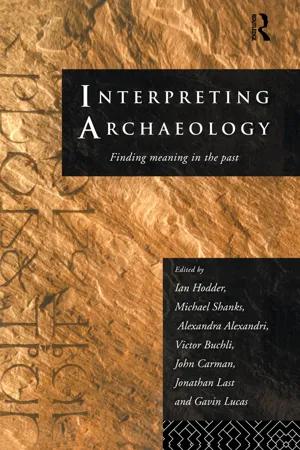
Interpreting Archaeology
Finding Meaning in the Past
- 288 pages
- English
- ePUB (mobile friendly)
- Available on iOS & Android
eBook - ePub
Interpreting Archaeology
Finding Meaning in the Past
About this book
This volume provides a forum for debate between varied approaches to the past. The authors, drawn from Europe, North America, Asia and Australasia, represent many different strands of archaeology. They address the philosophical issues involved in interpretation and a desire among archaeologists to come to terms with their own subjective approaches to the material they study, a recognition of how past researchers have also imposed their own value systems on the evidence which they presented.
Information
Chapter 1

Processual, postprocessual and interpretive archaeologies
The theme of this book is the character and scope of archaeologies which may be termed interpretive. However, in spite of the use of the word ‘interpretive’ in this way as a label, the authors are not proposing and outlining another ‘new’ archaeology. There have been many such gestures over the last three decades with programmatic statements of panaceas for archaeology’s perceived methodological maladies. We do not wish to add to the host of methods and approaches, but present here a general examination of current states of thinking in archaeology via the topic of interpretation. Our interest is interpretation in archaeology.
More particularly, it is proposed that ‘interpretation’ is a term which helps clarify current debates in Anglo-American archaeology between processual and postprocessual approaches (see, for example, Preucel (ed.) 1991, Norwegian Archaeological Review 22, 1989, Yoffee and Sherratt (eds) 1993).
Processual archaeology1 is the orthodoxy which emerged after the reaction, beginning in the 1960s and calling itself ‘new archaeology’, against traditional culture-historical and descriptive approaches to the material past. Its characteristics are as follows:
- Archaeology conceived as anthropological science rather than allied with history.
- Explanation of the past valued over description.
- Explanation via the incorporation of particular observations of the material past into cross-cultural generalisations pertaining to (natural and social) process (hence the term ‘processual’).
- Explanation via explicit methodologies modelled on the hard sciences.
- An earlier interest in laws of human behaviour has shifted to an interest in formation processes of the archaeological record – regularities which will allow inferences about processes to be made from material remains.
For many, and although it may not explicitly be described as such, processual archaeology is a good means, if not the best, of acquiring positive knowledge of the archaeological past. Positive archaeological knowledge is of the past, which means that it aspires to objectivity in the sense of being neutral and, indeed, timeless (the past happened in the way it did; that much at least will not change). Under a programme of positive knowledge, archaeologists aim to accumulate more knowledge of the past. The timeless and objective quality of knowledge is important if the aim is to accumulate and build on what is already known; it would be no good building on facts which cannot be relied upon, because they might change. The aspiration to timeless and value-free knowledge also enables high degrees of specialisation, knowledges isolated in their own field and disconnected from the present. The cultural politics of the 1990s does not affect what happened in prehistory, it is held. The archaeologist can live with one while quite separately gaining knowledge of the other.
To secure this timeless objectivity is the task of method(ology), and in processual archaeology this may be described as coming down to reason or rationality working objectively upon data or the facts. Reason is that cognitive processing which is divorced from superstition, ideology, emotion, subjectivity – indeed, anything which compromises the purity or neutrality of logical calculation. To attain objectivity means carefully relying on those faculties which allow access to the past – particularly observation, controlled perception of those empirical traces remaining of what happened. Theory-building may be involved in moving from the static archaeological record of the present to past social dynamics (Binford 1977), but to move beyond controlled observation is to speculate and to invite bias and subjectivity, contamination of the past by the present.
These aspirations to positive scientific knowledge, neutrality, and reliance on controlled observation of facts have led to processual archaeology being described as positivist and empiricist (see, among others, Shanks and Tilley 1987a).
Processual archaeology is anthropological in the sense of being informed by an interest in social reconstruction of the past. The following form the main outlines of processual conceptions of the social as they developed from the late 1960s.
- Society is essentially composed of patterned sets of behaviours.
- Material culture and material residues, the products of processes which form the archaeological record, reflect the patterned behaviours which are society, or they are the result of natural processes which can be defined scientifically (the decay of organic materials; the corrosion of metals).
- Society is a mode of human adaptation to the social and natural environment.
- Accordingly, explaining social process means focusing on those features of the society which most relate to adaptation to environments: resources, subsistence and economic strategies, trade and exchange, technology. Attention has, however and more recently, turned to symbolism and ritual.
- The interest in cross-cultural generalisation and patterning is expressed in societal typing (identifying a particular society as band, lineage-based, chiefdom, state, etc.) and schemes of cultural evolution.
Postprocessual archaeology, as the label implies, is something of a reaction and supercession of this processual framework (especially after Hodder, ed., 1982; see also Hodder 1985, 1986). Since the late 1970s issue has been taken with most of these tenets of processual archaeology: the character of science and aims of objective explanation; the character of society; and the place of values in archaeology, the sociopolitics of the discipline, its contemporary location as a mode of cultural production of knowledges.2
Doubt, from theoretical and empirical argument, has been thrown on the possibility of an anthropological science, based upon observation of residues of patterned behaviours, detached from the present and aspiring to value-freedom (as positive knowledge). So the processual-postprocessual debate has centred upon the forms of knowledge appropriate to a social science, how society may be conceived (reconciling both patterning or structure and individual action, intention and agency), and upon the workings of the discipline of archaeology, its ideologies and cultural politics, its place in the (post)modern present.
The debate has tended towards a polarisation of positions, and it is this which has led to an obscuring of the issues. Postprocessual has come to be seen by some as anti-science, celebrating subjectivity, the historical particular in place of generalisation: the cultural politics of the present displacing positive knowledge of the past. Above all, the authority of a scientific and professional knowledge of the past is posited against particular and subjective constructions, a pluralism of pasts appropriate each to their own contemporary constituency: science is pitted against relativism (Yoffee and Sherratt (eds) 1993, Trigger 1989b, Watson 1990).
We refer to an obscuring of the issues because this polarisation is unnecessary indeed, damaging. We are proposing that a consideration of the character and scope of interpretation may help overcome the polarisations. And, to begin, a renaming may be appropriate. The label ‘postprocessual’ says nothing about what it stands for, other than a relative position in respect of processual archaeology. If we are to use interpretation as an epithet, interpretive archaeologies may be used as a more positive label, perhaps, for many of those approaches which have been called postprocessual. These are archaeologies (the plural is important, as will become clear) which work through interpretation. And we hope it will become clear that a careful consideration of interpretation entails abandoning the caricatures of science versus relativism, generalisation versus the historical particular, and the objective past versus the subjective present.
The main aspects of archaeologies termed interpretive might be summarised as follows.
- Foregrounded is the person and work of the interpreter. Interpretation is practice which requires that the interpreter does not so much hide behind rules and procedures predefined elsewhere, but takes responsibility for their actions, their interpretations.
- Archaeology is hereby conceived as a material practice in the present, making things (knowledges, narratives, books, reports, etc.) from the material traces of the past – constructions which are no less real, truthful or authentic for being constructed.
- Social practices, archaeology included, are to do with meanings, making sense of things. Working, doing, acting, making are interpretive.
- The interpretive practice that is archaeology is an ongoing process: there is no final and definitive account of the past as it was.
- Interpretations of the social are less concerned with causal explanation (accounts such as ‘this is the way it was’ and ‘it happened because of this’) than with understanding or making sense of things which never were certain or sure.
- Interpretation is consequently multivocal: different interpretations of the same field are quite possible.
- We can therefore expect a plurality of archaeological interpretations suited to different purposes, needs, desires.
- Interpretation is thereby a creative but none the less critical attention and response to the interests, needs and desires of different constituencies (those people, groups or communities who have or express such interests in the material past).
To Interpret, the Act of Interpretation: What Do the Words Mean and Imply?
We particularly stress the active character of interpretation: one is an interpreter by virtue of performing the act or practice of interpreting. An interpreter is a translator, an interlocutor, guide or go-between.3
Meaning
To interpret something is to figure out what it means. A translator conveys the sense or meaning of something which is in a different language or medium. In this way interpretation is fundamentally about meaning. Note, however, that translation is not a simple and mechanical act but involves careful judgement as to appropriate shades of meaning, often taking account of context, idiom and gesture which can seriously affect the meaning of words taken on their own.
Dialogue
A translator may be an interlocutor or go-between. Interpretation contains the idea of mediation, of conveying meaning from one party to another. An interpreter aims to provide a reciprocity of understanding, overcoming the lack of understanding or semantic distance between two parties who speak different languages or belong to different cultures. Interpretation is concerned with dialogue, facilitating and making easier.
In a good dialogue or conversation one listens to what the other says and tries to work out what they mean, tries to understand, to make sense. Translation may be essential to this, performed either by a separate interpreter or by the parties of the dialogue themselves. Further questions might be asked and points put forward based on what has already been heard and understood. The idea is that dialogue moves forward to a consensus (of sorts) which is more than the sum of the initial positions. This fusion of horizons (a term taken from hermeneutics, the philosophy of interpretation, discussed below) is potentially a learning experience in which one takes account of the other, their objections and views, even if neither is won over.
It is not a good and open dialogue if one party simply imposes its previous ideas, categories and understandings upon the other. Preconceptions are simply confirmed. It is not good if the interpreter does not recognise the independence of the interpreted, their resistance to control and definition. A good conversation is one perhaps which never ends: there is always more to discover.
What might be a dialogue with the past? One where the outcome resides wholly in neither side but is a product of both the past and the present. Archaeological interpretation here resides in the gap between past and present. Such a dialogue is also ongoing. We will take up these points again below.
Uncertainty
Interpretation involves a perceived gap between the known and the unknown, desire and a result, which is to be bridged somehow. There is thus uncertainty, both at the outset of interpretation (what does this mean?) and at the end of the act of interpretation. It could always have been construed in a different way, with perhaps a different aspect stressed or disregarded. Although we might be quite convinced by an understanding we have managed to achieve, it is good to accept fallibility and not to become complacent. Is this not indeed the character of reason? Rationality is not an abstract absolute for which we can formulate rules and procedures, but is better conceived as the willingness to recognise our partiality, that our knowledge and reasoning are open to challenge and modification. Final and definitive interpretation is a closure which is to be avoided, suspected at the least.
Exploration and making connections
Interpretation implies an extension or building from what there is here to something beyond. We have already mentioned that interpretation should aspire to being open to change, exploring possibility. Exploration of meanings is often about making different connections.
Here can be mentioned the structuralist argument that meaning, if it is to be found at all, resides in the gaps between things, in their interrelationships. A lone signifier seems empty. But once connected through relations of similarity and difference with other signifiers it makes sense. In deciphering a code different permutations of connections between the particles of the code are explored until meaning is unlocked.
Judgement
A sculptor or woodcarver might examine their chosen material, interpret its form and substance, taking note of grain and knots of wood, flaws and patterning in stone, and then judge and choose how to work with or against the material. An archaeologist may examine a potsherd, pick out certain diagnostic traits and judge that these warrant an identification of the sherd as of a particular type: they choose an identification from various possibilities. Interpretation involves judgement and choice: drawing sense, meaning and possibility from what began as uncertainty.
Performance
In this way interpretation may refer to something like dramatic performance, where a particular interpretation of a dramatic text is offered according to the judgement of performers and director. The text is worked with and upon. Focus is drawn to certain connections within the characters and plot which are judged to be significant. Interpretation is here again reading for significance, where significance is literally making something a sign.4
Dramatic interpretation has further dimensions. A text is read for significance and courses of action inferred. A past work (the text of a play) is acted out and in so doing it is given intelligible life. Now, there is no need here to take a literal line and think that archaeological interpretation involves those experimental reconstructions of past ways of life that are familiar from television programmes and heritage parks (though there is here a serious argument for experimental archaeology). We would rather stress that interpretation is in performance an active apprehension.5 Something produced in the past is made a presence to us now. It is worked upon actively. If it were not, it would have no life. An unread and unperformed play is dead and gone. Analogously an archaeological site which is not actively apprehended, worked on, incorporated into archaeological projects, simply lies under the ground and decays. The questions facing the actor-interpreters are: How are the characters to be portrayed? What settings are to be used? What form of stage design? What lighting, sound and ambience? Simply, what is to be made of the play? (Pearson 1994).
Courses of action inferred, projects designed: these are conditions of interpretation.
Critique
Judgement here involves taking a position, choosing how to perform, what to do, which meanings to enact or incorporate. Involved is a commitment to one performance rather than another. Any interpretation is always thus immediately critical of other interpretations. Performance is both analytic commentary on its source, the written play, but also critical in its choice of some meanings and modes and not others.
The ubiquity of interp...
Table of contents
- Cover
- Half Title
- Title Page
- Copyright Page
- Table of Contents
- List of tables and figures
- Contributors
- Introduction
- 1. Processual, postprocessual and interpretive archaeologies
- 2. Interpretive archaeologies: some themes and questions
- Part 1: Philosophical issues of interpretation
- Part 2: The origins of meaning
- Part 3: Interpretation, writing and presenting the past
- Part 4: Archaeology and history
- Part 5: Material culture
- Appendix: further comment on interpretive archaeologies
- Glossary
- Bibliography
- Index
Trusted by 375,005 students
Access to over 1.5 million titles for a fair monthly price.
Study more efficiently using our study tools.
Frequently asked questions
Yes, you can cancel anytime from the Subscription tab in your account settings on the Perlego website. Your subscription will stay active until the end of your current billing period. Learn how to cancel your subscription
No, books cannot be downloaded as external files, such as PDFs, for use outside of Perlego. However, you can download books within the Perlego app for offline reading on mobile or tablet. Learn how to download books offline
Perlego offers two plans: Essential and Complete
- Essential is ideal for learners and professionals who enjoy exploring a wide range of subjects. Access the Essential Library with 800,000+ trusted titles and best-sellers across business, personal growth, and the humanities. Includes unlimited reading time and Standard Read Aloud voice.
- Complete: Perfect for advanced learners and researchers needing full, unrestricted access. Unlock 1.5M+ books across hundreds of subjects, including academic and specialized titles. The Complete Plan also includes advanced features like Premium Read Aloud and Research Assistant.
We are an online textbook subscription service, where you can get access to an entire online library for less than the price of a single book per month. With over 1.5 million books across 990+ topics, we’ve got you covered! Learn about our mission
Look out for the read-aloud symbol on your next book to see if you can listen to it. The read-aloud tool reads text aloud for you, highlighting the text as it is being read. You can pause it, speed it up and slow it down. Learn more about Read Aloud
Yes! You can use the Perlego app on both iOS and Android devices to read anytime, anywhere — even offline. Perfect for commutes or when you’re on the go.
Please note we cannot support devices running on iOS 13 and Android 7 or earlier. Learn more about using the app
Please note we cannot support devices running on iOS 13 and Android 7 or earlier. Learn more about using the app
Yes, you can access Interpreting Archaeology by Alexandra Alexandri,Victor Buchli,John Carman,Ian Hodder,Jonathan Last,Gavin Lucas,Michael Shanks in PDF and/or ePUB format, as well as other popular books in Social Sciences & Archaeology. We have over 1.5 million books available in our catalogue for you to explore.