eBook - ePub
Assessing and Teaching Reading Composition and Writing, 3-5, Vol. 4
- 208 pages
- English
- ePUB (mobile friendly)
- Available on iOS & Android
eBook - ePub
Assessing and Teaching Reading Composition and Writing, 3-5, Vol. 4
About this book
The performance tasks in this book are linked directly to instructional strategies and include holistic rubrics, analytic rubrics, and assessment lists. They can be photocopied and distributed to your students. Included in this series are 98 performance tasks, 196 assessment lists, 18 holistic rubrics, 30 analytic rubrics, and 88 graphic organizers.
Information
1

A Roadmap to This Book
Topics in This Chapter:
♦ An overview of this book.
♦ Connect the Standards for the Assessment of Reading and Writing by the National Council of Teachers of English (NCTE) and the International Reading Association (IRA) to the strategies presented in this book.
Reading is a complex behavior including decoding words, developing fluency, and improving comprehension. This book focuses on strategies to teach and assess reading comprehension. The reading comprehension/thinking skill framework used throughout this book is based on the approach to reading comprehension developed by the National Assessment of Educational Progress (NAEP). The materials and strategies presented here support the national English Language Arts Standards and will help teachers and administrators address the challenges of the No Child Left Behind legislation.
A Graphic Overview of This Book
When students use thinking skills and reading comprehension strategies to interact with texts in a variety of ways (text-to-text, text-to-self, and text-to-world), they increasingly become strategic readers and have a deeper understanding of what they read.
The authentic performance tasks presented in this book are created to engage students with fiction and nonfiction texts. These performance tasks use thinking skills such as sequencing, listing, describing, categorizing, inferring, predicting, comparing and contrasting, judging, and evaluating. the performance tasks also ask students to demonstrate their understanding of texts through speaking, drawing, graphic organizers, and writing for various purposes.
The assessment tools presented in this book help the teacher and student focus on the strengths and weaknesses of student performance, and help the teacher and student to set goals that drive instruction and improve teaching and learning.
Figure 1.1 shows that following classroom routines, following directions, working cooperatively with others, and self-assessment create a foundation for the improvement of teaching and learning. Student self-assessment is an essential part of the strategies presented in this book.
The Topics for Each Chapter
Figure 1.2 presents the topics for each chapter.
Standards for the Assessment of Reading and Writing
The standards for reading and writing as defined in Standards for the Assessment of Reading and Writing, 1994, International Reading Association (IRA) and the National Council of Teachers of English (NCTE), are presented in Volume 3, Chapter 1, of this series, Assessing and Teaching Reading Comprehension: Pre-Writing, 3–5. Also included in that chapter is a description of the connections between the IRA/NCTE standards and the materials and strategies presented in Volumes 3 and 4 of this series.
Figure 1.1. Revealing Reading Comprehension through Speaking, Drawing, Graphic Organizers, and Writing
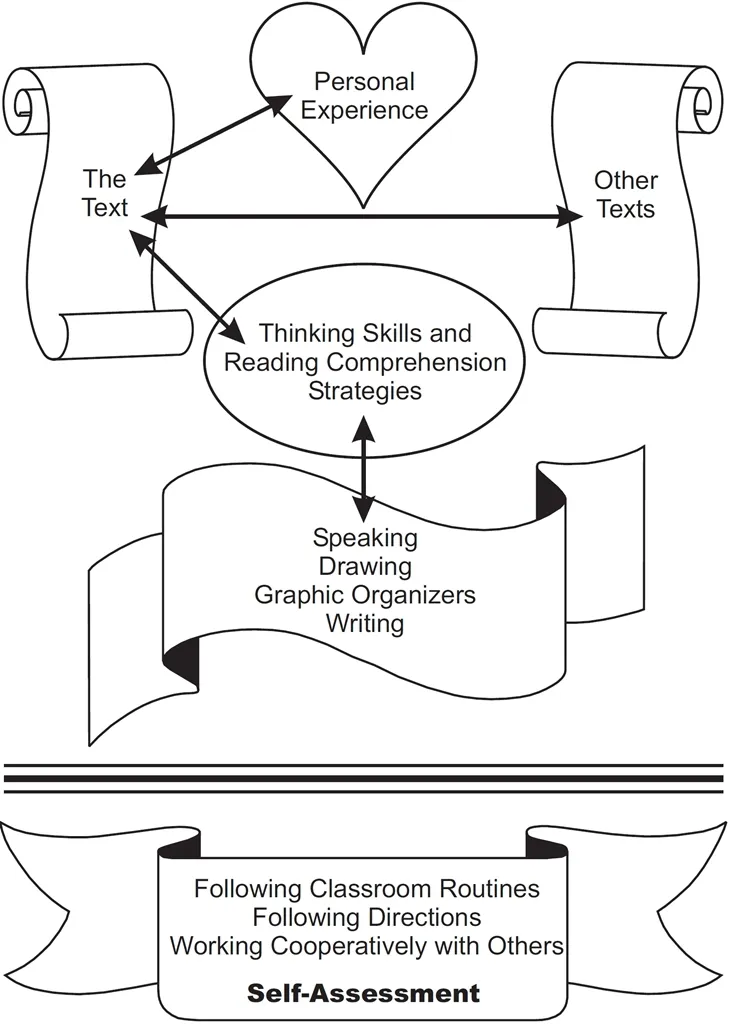
Figure 1.2. Topics for Each Chapter
| Chapter Number | Chapter Title | Topics |
| 1 | A Roadmap to This Book | • An overview of this book • Connections between the Standards for the Assessment of Reading and Writing by the National Council of Teachers of English (NCTE) and the International Reading Association (IRA), and the strategies presented in this book |
| 2 | Teaching and Assessing Reading Comprehension through Retelling | • Four levels of reading comprehension/thinking skills • Strategies to generate questions to engage students in retelling using all four levels of reading comprehension/thinking skills • Scoring tools for retelling |
| 3 | Assessment Tools for Writing | • Rubrics for narrative, expository, and persuasive writing • Strategies and tools for using analytic rubrics to create assessment lists that are used with performance tasks • Strategies to help students learn to accurately assess their own work, and then set and carry out goals to improve their own performance |
| 4 | The Process of Writing and the Four Levels of Comprehension | • The relationship between the four levels of reading comprehension/thinking skills, graphic organizers, and the writing process • Strategies to create performance tasks that use the four levels of reading comprehension/thinking skills and the writing process to teach and assess reading comprehension |
| 5 | Comprehension of Biographies, Fables, Fairy tales, Folktales and Myths through Retelling and Writing | • Assessing and teaching the four levels of reading comprehension/thinking skills of biographies, fables, fairy tales, folktales and myths through retell... |
Table of contents
- Cover
- Title Page
- Copyright Page
- Table of Contents
- 1 A Roadmap to This Book
- 2 Teaching and Assessing Reading Comprehension through Retelling
- 3 Assessment Tools for Writing
- 4 The Process of Writing and the Four Levels of Comprehension
- 5 Comprehension of Biographies, Fables, Fairy Tales, Folktales, and Myths through Retelling and Writing
- 6 Comprehension of Nonfiction Texts
- 7 Connecting Standards and Themes to Performance Tasks
- 8 Research Projects for Fiction and Nonfiction
- Appendix A
Trusted by 375,005 students
Access to over 1.5 million titles for a fair monthly price.
Study more efficiently using our study tools.
Frequently asked questions
Yes, you can cancel anytime from the Subscription tab in your account settings on the Perlego website. Your subscription will stay active until the end of your current billing period. Learn how to cancel your subscription
No, books cannot be downloaded as external files, such as PDFs, for use outside of Perlego. However, you can download books within the Perlego app for offline reading on mobile or tablet. Learn how to download books offline
Perlego offers two plans: Essential and Complete
- Essential is ideal for learners and professionals who enjoy exploring a wide range of subjects. Access the Essential Library with 800,000+ trusted titles and best-sellers across business, personal growth, and the humanities. Includes unlimited reading time and Standard Read Aloud voice.
- Complete: Perfect for advanced learners and researchers needing full, unrestricted access. Unlock 1.5M+ books across hundreds of subjects, including academic and specialized titles. The Complete Plan also includes advanced features like Premium Read Aloud and Research Assistant.
We are an online textbook subscription service, where you can get access to an entire online library for less than the price of a single book per month. With over 1.5 million books across 990+ topics, we’ve got you covered! Learn about our mission
Look out for the read-aloud symbol on your next book to see if you can listen to it. The read-aloud tool reads text aloud for you, highlighting the text as it is being read. You can pause it, speed it up and slow it down. Learn more about Read Aloud
Yes! You can use the Perlego app on both iOS and Android devices to read anytime, anywhere — even offline. Perfect for commutes or when you’re on the go.
Please note we cannot support devices running on iOS 13 and Android 7 or earlier. Learn more about using the app
Please note we cannot support devices running on iOS 13 and Android 7 or earlier. Learn more about using the app
Yes, you can access Assessing and Teaching Reading Composition and Writing, 3-5, Vol. 4 by K. Michael Hibbard,Elizabeth Wagner in PDF and/or ePUB format, as well as other popular books in Education & Education General. We have over 1.5 million books available in our catalogue for you to explore.