- 272 pages
- English
- ePUB (mobile friendly)
- Available on iOS & Android
eBook - ePub
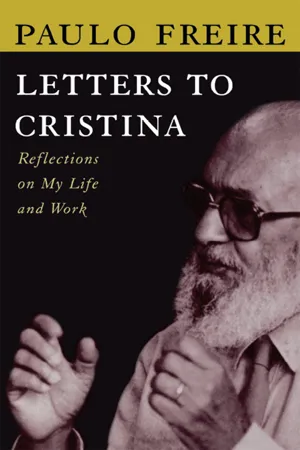
Letters to Cristina
About this book
Paulo Freire is regarded by many as the most significant educational thinker of the twentieth century. This volume offers Freire's own intimate retrospection of his life and work. These reflections, dedicated to his niece Cristina, provide a backdrop for a deeper understanding of how his experiences are linked to his philosophical and pedagogical work.
Information
Notes

Here I am, once again writing to Paulo Freire’s readers for strong, profound, and simple Paulo, who asked me to complement his work by writing the notes to this book, Letters to Cristina.
I thought the experience of being a note-taker would make me more concise. I was totally wrong. Stimulated by the letters, the reality in which they are immersed, and the knowledge that in writing about this reality, I am doing a little of what Paulo does a lot—analyzing, reflecting, denouncing, criticizing, and writing; in other words, reading the world and writing the word equivalent to the world he speaks of—I wrote a lot.
Paulo in his letters and I in my notes critically read the facts, situations, and people of our society, intentionally trying to be aware of the possibility and necessity for the transformation of the perverse, corrupt, and unjust Brazilian world into a new Brazil in which men, women, and children have equal space and time.
Given such important topics, I was not content with nor could I restrain myself from elaborating short and “objective” notes, while trying not to bore Paulo’s readers.
I continued building (although without being able to say it to the author of the book) a space for the notes, which could not help being themselves. They also had their own soul, a certain and needed autonomy.
I could not remain only the note-taker who neutrally explains and disappears so that the notes do not carry the sentiments and motives of the one who writes them. I did not want that.
I refused, but I also made sure that I did not invade Paulo’s text. I passed on detailed information (and my own reflections!) to his readers when he preferred, for various reasons, not to provide that information in the text.
I enjoyed discussing Northeast Brazilian culture, although I still owe the reader a few explanations, such as of bumba-meu-boi and the maracatu, which for lack of time and distance from the Northeast I could not research. I had to speak and write about the problems of Brazilian culture, which changed so much over the 1930s, 1940s, and 1950s, but which contradictorily remains the same.
It is interesting to report that when Paulo sensed that some of his readers misunderstood his system of theoretical, political-pedagogical thinking, he abandoned that system, which others associated with pretentiousness or formality.
He denied it by writing poetry, and he denied it by writing these “letters.” Both of these denials are visible ones. These forms of Paulo’s expression do not prevent or untwist the systematization of his theoretical yet practical way of thinking.
In reminiscing about his childhood—which Paulo exposes in the most intimate way, describing its most difficult moments—he did not idealize or romanticize those days. He described them because those were the years that fed the critical thought of his adulthood.
In writing letters instead of essays—which in their most traditional form are characterized by a sequence of logically unconnected ideas that begin, develop, and end in each letter, forming the totality of the text—Paulo did not follow tradition. In fact, he wrote essays, but the essays were in the format of letters. Without denying the value of traditional essays, he chose the less common form of letters, believing that texts composed this way are the most communicative. Each one speaks for itself.
Paulo’s painful childhood should be told and retold, not as a complaint, lament, or to torture the reader, but because it was not an isolated experience in the Brazilian context. It was an historically rooted way of living. His childhood translates the Brazilian moment.
Through letters it was easier and more profound for Paulo to analyze Brazil’s many problems metaphorically, using Lourdes’s piano, his father’s neckties, “Mr.” Armada’s ruthlessness, the cloth pads on the heads of the piano movers, the calungas of the trucks, the soldiers of the handkerchief gang, the houses of the working men, the ghosts, his mother’s hope of becoming the secretary of the Jaboatão High School, the premature death of his father, Olegário Mariano’s house, the scream of the painted faces, bean-soup, and many other instances. Using these images to talk about the experiences and frustrated dreams of the people, Paulo talks about the most distinct facets of Brazilian reality: the lack of hope; the presence of oppression, authoritarianism, exploitation, and domination; the dreams of what is possible; the striking social differences; the deficiencies of education and the schools; the poverty, hunger, unemployment, and underemployment; and, finally, the deprivation of the many and the opulence of the few.
The close relationship of these letters to Paulo’s life did not reduce them to subjective texts, but rather charged them heavily with subjectivity; they translate real moments of the objectivity of Brazilian history, a history that he participated in as a subject.
One more thing I should make explicitly clear to readers, especially foreigners: the presence of the profound and grave problems denounced in this book does not imply that they are sanctioned by the real citizens. Although many do not know how to change our society, they know that they should, want, and need to change our society. This book is dedicated to them.
Not just the organized institutions of civil society have been giving clear signals that it is necessary and possible to change Brazil. There is a wider political will. The population of Rio de Janeiro, the most violent city in our country, recently demonstrated conscience and the political will to change. The city stopped for five minutes.
Almost everyone dressed in white, and men, women, and children stopped doing what they were doing: eating; studying; teaching; driving a car, bus, or train; selling and buying; singing or playing ball at the beach; screaming on the floor of the stock exchange; or walking and praying at mass. Hand in hand, around the Church of Our Lady Candelaria, on the train, on the bus, at home, at the office, at the store, at the plaza, at the school, everywhere, wherever they were in this beautiful city, they stopped for five minutes of silence—disturbed only by the church bells—a time for reflection and brotherhood, solidarity and justice, hope and peace, in longing for a less violent, more just society in control of itself.
Although I respect other cities and peoples of other countries, I cannot see this event happening anywhere but in Brazil. In a country of impunity, corruption, and oppression is found, contradictorily, a country of relaxed joy, hard work, and creative power.
It is a daring, abundant, and vigorous creation of sounds and letters, colors and pictures, stories and novels, living carnival and dancing soccer, science and philosophy, universities and planned cities, and so on.
The organized institutions of civil Brazilian society, through acts of courageous resistance, have been mobilizing communitarian urban and rural movements by addressing issues from education to politics. In particular, students have organized for better education and ethical politics; the Catholic Church for children, prisoners, workers, and those without land; educators and parents for free, quality public schools for all; and the street children for themselves. Campaigns have been launched to distribute food and employ the poor; to end violence against women, Indians, homosexuals, blacks, and prostitutes; to reject the sexual exploitation of young girls; to prevent AIDS and assist those with AIDS; and to stop torture, censorship, and drugs. The varied agendas are ensuring sex education; supporting education at all levels and grades; ending illiteracy; preserving forests, rivers, oceans, fauna, and flora; improving public health, housing, transportation, prisons, and political systems; and, finally, enforcing the rights of all people, regardless of gender, class, race, religion, or age.
Thousands and millions of Brazilians daily think, discuss, and decide. They are instrumental in pressuring those in political power and the dominant classes by looking for feasible alternatives to better their families’ conditions with the positive consequences of the Brazilian social body.
Brazil is contradictory. Tactlessness and the abuses of the few have hit many cruelly, but the unknown efforts of so many, which have not yet totally materialized, have furthered progress even while setbacks have discouraged us. The flame of hope, based in the struggle and persistence of the great majority of oppressed people, remains lit, and undoubtedly changes the country day by day.
We are not just an irresponsible country with a high birthrate and high infant mortality rate, a major concentration of wealth, and a popular culture that only worries about samba, carnival, and soccer, as many in the North accuse.
We are a people full of vitality who value and spend much of our time in the samba, carnival, and soccer, but who also built, through hard work, the ninth largest economy in the world.
With joy and conviction, I present these notes—although they are accusations that show the ugliest face of Brazil, I have faith in the Brazilian people. They are capable of establishing a true democracy.
—Ana Maria Araújo Freire
Notes to the Foreword
1. The president in question, Fernando Collor de Mello, who won a second term in th...
Table of contents
- Cover
- Half Title
- Title Page
- Copyright Page
- Table of Contents
- Foreword
- Introduction
- First Letter
- Second Letter
- Third Letter
- Fourth Letter
- Fifth Letter
- Sixth Letter
- Seventh Letter
- Eighth Letter
- Ninth Letter
- Tenth Letter
- Eleventh Letter
- Twelfth Letter
- Thirteenth Letter
- Fourteenth Letter
- Fifteenth Letter
- Sixteenth Letter
- Seventeenth Letter
- Eighteenth Letter
- Notes by Ana Maria Araújo Freire
Trusted by 375,005 students
Access to over 1.5 million titles for a fair monthly price.
Study more efficiently using our study tools.
Frequently asked questions
Yes, you can cancel anytime from the Subscription tab in your account settings on the Perlego website. Your subscription will stay active until the end of your current billing period. Learn how to cancel your subscription
No, books cannot be downloaded as external files, such as PDFs, for use outside of Perlego. However, you can download books within the Perlego app for offline reading on mobile or tablet. Learn how to download books offline
Perlego offers two plans: Essential and Complete
- Essential is ideal for learners and professionals who enjoy exploring a wide range of subjects. Access the Essential Library with 800,000+ trusted titles and best-sellers across business, personal growth, and the humanities. Includes unlimited reading time and Standard Read Aloud voice.
- Complete: Perfect for advanced learners and researchers needing full, unrestricted access. Unlock 1.5M+ books across hundreds of subjects, including academic and specialized titles. The Complete Plan also includes advanced features like Premium Read Aloud and Research Assistant.
We are an online textbook subscription service, where you can get access to an entire online library for less than the price of a single book per month. With over 1.5 million books across 990+ topics, we’ve got you covered! Learn about our mission
Look out for the read-aloud symbol on your next book to see if you can listen to it. The read-aloud tool reads text aloud for you, highlighting the text as it is being read. You can pause it, speed it up and slow it down. Learn more about Read Aloud
Yes! You can use the Perlego app on both iOS and Android devices to read anytime, anywhere — even offline. Perfect for commutes or when you’re on the go.
Please note we cannot support devices running on iOS 13 and Android 7 or earlier. Learn more about using the app
Please note we cannot support devices running on iOS 13 and Android 7 or earlier. Learn more about using the app
Yes, you can access Letters to Cristina by Paulo Freire in PDF and/or ePUB format, as well as other popular books in Education & Education General. We have over 1.5 million books available in our catalogue for you to explore.