Writing: Texts, Processes and Practices offers an innovative and multidisciplinary approach to writing in a variety of academic and professional settings. The book is composed of a series of original research-based accounts by leading authorities from a range of disciplines. The papers are linked through a unifying perspective which emphasises the role of cultural and institutional practices in the construction and interpretation of written texts.
This important new book integrates different approaches to text analysis, different perspectives on writing processes, and the different methodologies used to research written texts. Throughout,an explicit link is made between research and practice illustrated with reference to a number of case studies drawn from professional and classroom contexts.
The book will be of considerable interest to those concerned with professional or academic writing and will be of particular value to students and lecturers in applied linguistics, communication studies, discourse analysis, and professional communications training.
The contributors to this volume are:
Robert J. Barrett
Vijay K. Bhatia
Christopher N. Candlin
Yu-Ying Chang
Sandra Gollin
Ken Hyland
Roz Ivanic
Mary R. Lea
Ian G. Malcolm
John Milton
Greg Myers
Guenter A. Plum
Brian Street
John M. Swales
Sue Weldon
Patricia Wright
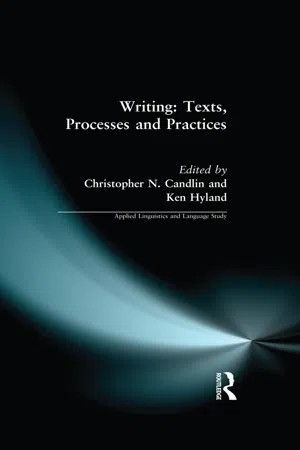
- 344 pages
- English
- ePUB (mobile friendly)
- Available on iOS & Android
eBook - ePub
Writing: Texts, Processes and Practices
About this book
Information
Part I
Expression: focus on text
1
Integrating products, processes, purposes and participants in professional writing
Overview
Analysing text as a genre, especially in institutionalised contexts, whether academic or professional, provides relevant and useful information about the way that particular genre is constructed, interpreted and used by the established members of the disciplinary community in the conduct of everyday business. Genres are invariably situated in the contexts of specific disciplinary cultures (Berkenkotter and Huckin, 1995) and are shaped by typical dis-cursive processes embedded within the disciplinary activities of the profession. The ultimate generic product also displays a recognisable integrity of its own (Bhatia, 1993). However, this generic integrity is often perceived in applied genre literature in terms of typical lexico-grammatical and discourse patterns, simply because these are the most obvious surface-level linguistic features of textual genres.
In applied linguistic studies, these linguistic patterns have often been used as a basis for many writing courses within English for Specific Purposes (ESP) paradigms for reproducing authentic-looking samples of professional genres. However, recent research on thicker descriptions of textual genres (Bhatia, 1993; Swales, 1990) has underpinned the importance of explanation in the act of discourse recognition, construction, interpretation and use, with the result that many genre-based innovations in the area of writing instruction in ESP and professional contexts have started considering factors other than the lexico-grammatical and discourse organisational to bring in the notions of flexibility, creativity and innovation in their writing exercises.
This chapter will argue for and illustrate a genre-based approach to writing which aims to integrate the discipline-specific discursive procedures and the communicative purposes which these generic constructs serve to help apprentice learners to maintain the generic integrity of their writing products on the one hand, and to manipulate their products to meet participant expectations on the other.
Professional writing differs significantly from academic writing often undertaken in the context of the classroom. Much of academie writing is an individual’s response to somewhat predictable rhetorical contexts, often meant to serve a given set of communicative purposes, for a specified single readership. Professional writing, on the other hand, is a complex, dynamic and multifunctional activity. Any pragmatically successful instance of a particular professional genre can be typically characterised in terms of its generic integrity, in the sense that members of the relevant professional community can identify and interpret it in terms of not only the socially recognised communicative purpose (s) it often is intended to serve, but also the private intentions, if any, the author (s) might have intended to convey. Most professional genres also display, and expert readers can identify, the complex intertextual and interdiscursive relationships the genre might have with other forms of discourse, spoken or written. Besides, the whole process of genre construction might be, and often is, the result of a combination of a number of discursive practices that professionals are routinely engaged in, all or some of which might contribute to the construction of the generic artefact it shapes. It will therefore not be inaccurate to say that professional genres are increasingly becoming co-operative endeavours rather than individually undertaken discursive activities (cf. Gollin, this volume).
Genre as artefact
One can identify four major elements of, or contributors to, any suecessful construction, interpretation and use of a professional genre.
1 Generic integrity
The most important element is that it should look like a professional genre, in that the members of the professional community with which it is often associated should recognise it as a valid instance of the genre in question. Most successful constructions of professional textual artefacts have recognisable generic integrity (Bhatia, 1993). It may be complex, in that it may reflect a specific form of mixing and/or embedding of two or more generic forms, or even dynamic, in the sense that it may reflect a gradual development over a period of time in response to subtle changes in the rhetorical contexts that it responds to; but it will certainly have a recognisable generic character. This generic character is more easily accessible to the established members of the professional community rather than to those who have a peripheral involvement in the affairs of the professional community in question (Swales, 1990).
Generic integrity is a reflection of the form-function relationship that so often characterises a generic construct. On the one hand, this relationship between formal and functional aspects of language use reflects a specific cognitive structuring to the genre, on the other hand, it also reflects the communicative purpose (s) that the genre tends to serve (Bhatia, 1993). There are three major indicators of generic integrity: the rhetorical context in which the genre is situated, the communicative purpose (s) it tends to serve, and the cognitive structure that it is meant to represent. If, on the one hand, the communicative purpose of a generic construct is embedded in the rhetorical context in which the genre is often used, on the other hand, it is also transparently reflected in the cognitive patterning of the genre. It is hardly surprising that all the major frameworks for the analysis of genre are based on one of these indicators or a combination of them.
2 Discursive processes and genre
The second most typical characteristic of professional genres is that they often are the products of a set of established procedures that form an important part of the disciplinary culture within a profession. A generic artefact often acquires its typical identity as a result of a set of conventionalised discursive practices, both written and spoken, that professionals routinely engage in as part of their daily work (see also Chapters 3, 9, 11). Many of these discursive practices have distinct stages, with identifiable inputs and outputs. These discursive practices are often characterised by the involvement of more than one participant, which, to a large extent, assigns multiple authorship to the resulting artefact and reflects interaction with the reader (cf. Hyland, this volume). This also gives the resultant document a distinctly rich inter-textual and inter-discursive patterning.
A business client’s request for a loan to fund a specific business proposition, for example, is part of a larger business activity, which can be characterised by several discursive processes and stages. A typical funding request made at the front-desk banking counter initiates a series of discursive activities, some of which may in-elude detailed client consultation with a banking official, either in person or in writing, followed by a report by the banking official to the appropriate department for further consideration. The department may, if it decides to take the request further, involve the risk-evaluation department in the further evaluation of the request. On the basis of the report from the risk-evaluation team, the loan department may decide to proceed further, which might involve further negotiation within the bank or with the client, before any final decision is taken, either to grant the request or to turn it down; whichever way it finally goes, it is the result of a series of discursive procedures which are routinely undertaken by the professionals in the conduct of their business.
Although neither the final textual artefact(s), nor the intervening textual outputs (e.g. reports by the front-desk banking official to his superior, or those by the risk-management department, etc.), may directly reflect the involvement or contribution made by these discursive processes and procedures, these are very much part of the whole business activity. The emerging textual products, whichever generic form(s) they may finally take, are the outcomes of a range of diverse discursive processes and consultations engaged in by several professionals, rather than just the person who ultimately has the privilege or authority to claim the sole authorship. That may be one of the reasons why so many of these professional genres have a somewhat predominant impersonal quality.
3 Generic purposes and intentions
A genre is identified by reference to the typicality of the communicative purpose that it tends to serve. However, unlike academic genres, professional genres serve a variety of real corporate purposes, often associated with novel, flexible and changing contexts. Although many of the genres employed in well-established professional contexts serve a recognisable and somewhat standardised set of communicative purposes, they rarely, if ever, serve a single purpose. If nothing else, they almost always combine the more immediate single purpose with the more standardised ones of maintenance and continuance of goodwill and a mutually beneficial professional relationship.
In addition to the socially recognised communicative purposes associated with a specific genre, expert writers also make sure that the intended readers construe and interpret these purposes in the way the writer originally intended. In the case of news reporting, for instance, experienced news reporters make sure that their readers see the events of the outside world in a manner they want them to. This is often achieved by giving what in journalism is known as a slant to the news story. In many other cases, especially in corporate discourse, it is becoming almost a standard practice to mix promotional elements within more information-giving genres. Company annual reports, for instance, are increasingly being used for promotional purposes, including the promotion of corporate image, and even for fund-raising purposes (see Bhatia, 1997; Hyland, 1998b).
It is not simply the promotional intentions that find expression within the established boundaries of informative genres; often, one may find other less compatible communicative intentions mixed to give expression to conflicting generic forms (see Bhatia, 1997). Instances of such tendencies to mix conflicting purposes may be found in the case of diplomatic genres, especially the memorandum of understanding or what is also known as joint declarations, where one is encouraged to mix legally binding provisions with more popular and promotional intentions (Wodak, 1996). This mixing becomes almost inevitable because the signing parties wish to signal mutual understanding and agreement, on the one hand, and maintain a sufficient degree of flexibility for any future manipulation within the terms of agreement, on the other (for a detailed discussion of this, see Bhatia, 1998).
4 Genre participants
Practising genre is almost like playing a game, with its own rules and conventions. Established genre participants, both writers and readers, are like skilful players, who succeed by their manipulation and exploitation of, rather than a strict compliance with, the rules of the game. This is what gives expert professional writers some freedom to exploit the tactical space available within the boundaries of conventional behaviour, pushing out the boundaries of the genre. As Bhatia (1993) points out, they often use this tactical space to mix private intentions with socially recognised communicative purposes, often giving rise to mixed genres. In a similar manner, genre readership may well be multiple or corporate, rather than individually identifiable, which tends to make the game rather unpredictable and interestingly complex.
Learning to write professional genres is more like being initiated into professional or disciplinary practices than like learning to write in the academy. It is not simply a matter of learning the language, or even learning the rules of the game, it is more like acquiring the rules of the game in order to be able to exploit and manipulate them to fulfil professional and disciplinary goals within well-defined and established contexts. The professional writing activity is thus inextricably embedded within the disciplinary culture it tends to serve. Acquisition of professional writing competenee therefore requires a certain degree of pre-knowledge of the discursive procedures and practices of the professional community that the writer wishes to join.
An important aspect of genre construction is the awareness of other participants in the process, not only the other contributors and writers within the professional organisation, but also the multiple and varied audience the genre is likely to be aimed at. Audience characteristics in professional contexts can hardly be over-emphasised. It makes a good deal of difference if the document is written for subordinates rather than for superiors. It makes a lot more crucial difference if it is written for outside clients rather than for insiders. It is an entirely different matter if one were to write to an established corporate client as against an individual non-specialist client, especially in the extent to which one can afford to be explicit and detailed in transmitting technical and specialist information in the context of suggesting alternative solutions or options in client advising. Expert and established genre writers are well aware of the constraints that the nature, background knowledge, disciplinary expertise or immediate concerns of the intended readership may impose on the process of genre construction.
Generic versatility
In addition to these four important aspects of genre writing, which assign specific genres their essential generic identity, there are others which make them dynamic, creative and versatile rather than static or formulaic. These factors include the following:
- Corporate and organisational differences: Genres, in spite of being overwhelmingly conventional in many aspects, show considerable freedom in the way different institutions and corporations construct and realise individual generic artefacts. Many of the established organisations have their own preferred ways not only of conducting business but also of achieving communicative goals. Individual players within the organisation must learn to play the game according to such established organisational preferences. Any trained journalist, for instance, may be required to adapt his or her communicative strategies in the light of prevailing ideological constraints imposed by a particular news corporation.
- Strategies to achieve similar generic goals: Although genres are instances of conventionalised and somewhat standardised communicative behaviour, in that they often display regularities of discourse organisation (Swales, 1990), consistency of cognitive structuring (Bhatia, 1993), typical generic structure potential (Hasan, 1985), or stages of communicative activity (Martin, 1985), they are often flexible in terms of the strategies the individual writers may employ to achieve similar generic goals. Some of the prime examples of this communicative behaviour may often be found in the area of advertising and promotional discourse, where it is not very uncommon to find the same product or service being advertised using a number of different strategies, depending upon the target audience characteristics, medium, the immediate concerns of the advertisers, the competition the product or the service may be facing, or even the time when the advertisement appears. The use of different strategies also results in significant variation in the use of linguistic resources.
- Specialist knowledge: Two kinds of audience characteristics offer variation within a genre in professional settings: level of specialist knowledge and single or multiple readership. Level of accessible specialist knowledge is likely to influence two kinds of decision: firstly as to the technicality of the written content, that is, whether the genre should be encoded in predominantly plain language or in technical language; and, secondly, as to the degree of detailed specification of information necessary in a particular case. These influences may be most characteristically observed in unequal interactions, particularly between lawyers and clients (Candlin et al., 1995), doctors and patients, civil servants and members of the public, and police and lay persons. Besides, knowledge of audience characteristics also helps the writer to use appropriately effective communicative strategies to influence the reader, especially in the case of persuasive genres where various kinds of appeals are chosen depending upon the analysis of audience characteristics.The other readership factor, i.e. whether the reader is an individual or a gro...
Table of contents
- Cover
- Half Title
- Series Page
- Title
- Copyright
- Contents
- List of contributors
- Editors’ acknowledgements
- Publisher’s acknowledgements
- Introduction: Integrating approaches to the study of writing
- Part I Expression: focus on text
- Part II Interpretation: focus on process
- Part III Explanation: focus on research
- Part IV Realisation: focus on praxis
- Bibliography
- Author index
- Subject index
Trusted by 375,005 students
Access to over 1.5 million titles for a fair monthly price.
Study more efficiently using our study tools.
Frequently asked questions
Yes, you can cancel anytime from the Subscription tab in your account settings on the Perlego website. Your subscription will stay active until the end of your current billing period. Learn how to cancel your subscription
No, books cannot be downloaded as external files, such as PDFs, for use outside of Perlego. However, you can download books within the Perlego app for offline reading on mobile or tablet. Learn how to download books offline
Perlego offers two plans: Essential and Complete
- Essential is ideal for learners and professionals who enjoy exploring a wide range of subjects. Access the Essential Library with 800,000+ trusted titles and best-sellers across business, personal growth, and the humanities. Includes unlimited reading time and Standard Read Aloud voice.
- Complete: Perfect for advanced learners and researchers needing full, unrestricted access. Unlock 1.5M+ books across hundreds of subjects, including academic and specialized titles. The Complete Plan also includes advanced features like Premium Read Aloud and Research Assistant.
We are an online textbook subscription service, where you can get access to an entire online library for less than the price of a single book per month. With over 1.5 million books across 990+ topics, we’ve got you covered! Learn about our mission
Look out for the read-aloud symbol on your next book to see if you can listen to it. The read-aloud tool reads text aloud for you, highlighting the text as it is being read. You can pause it, speed it up and slow it down. Learn more about Read Aloud
Yes! You can use the Perlego app on both iOS and Android devices to read anytime, anywhere — even offline. Perfect for commutes or when you’re on the go.
Please note we cannot support devices running on iOS 13 and Android 7 or earlier. Learn more about using the app
Please note we cannot support devices running on iOS 13 and Android 7 or earlier. Learn more about using the app
Yes, you can access Writing: Texts, Processes and Practices by Christopher N. Candlin,Ken Hyland in PDF and/or ePUB format, as well as other popular books in Languages & Linguistics & Communication Studies. We have over 1.5 million books available in our catalogue for you to explore.