Routledge Handbook of Agricultural Biodiversity
  1. 692 pages
  2. English
  3. ePUB (mobile friendly)
  4. Available on iOS & Android
eBook - ePub

About this book

The world relies on very few crop and animal species for agriculture and to supply its food needs. In recent decades, there has been increased appreciation of the risk this implies for food security and quality, especially in times of environmental change. As a result, agricultural biodiversity has moved to the top of research and policy agendas.

This Handbook presents a comprehensive overview of our current knowledge of agricultural biodiversity in a series of specially commissioned chapters. It draws on multiple disciplines including plant and animal genetics, ecology, crop and animal science, food studies and nutrition, as well as social science subjects which explore the socio-economic, cultural, institutional, legal and policy aspects of agricultural biodiversity. It focuses not only on the core requirements to deliver a sustainable agriculture and food supply, but also highlights the additional ecosystem services provided by a diverse and resilient agricultural landscape and farming practices. The book provides an indispensable reference textbook for a wide range of courses in agriculture, ecology, biodiversity conservation and environmental studies.

Frequently asked questions

Yes, you can cancel anytime from the Subscription tab in your account settings on the Perlego website. Your subscription will stay active until the end of your current billing period. Learn how to cancel your subscription.
No, books cannot be downloaded as external files, such as PDFs, for use outside of Perlego. However, you can download books within the Perlego app for offline reading on mobile or tablet. Learn more here.
Perlego offers two plans: Essential and Complete
  • Essential is ideal for learners and professionals who enjoy exploring a wide range of subjects. Access the Essential Library with 800,000+ trusted titles and best-sellers across business, personal growth, and the humanities. Includes unlimited reading time and Standard Read Aloud voice.
  • Complete: Perfect for advanced learners and researchers needing full, unrestricted access. Unlock 1.4M+ books across hundreds of subjects, including academic and specialized titles. The Complete Plan also includes advanced features like Premium Read Aloud and Research Assistant.
Both plans are available with monthly, semester, or annual billing cycles.
We are an online textbook subscription service, where you can get access to an entire online library for less than the price of a single book per month. With over 1 million books across 1000+ topics, we’ve got you covered! Learn more here.
Look out for the read-aloud symbol on your next book to see if you can listen to it. The read-aloud tool reads text aloud for you, highlighting the text as it is being read. You can pause it, speed it up and slow it down. Learn more here.
Yes! You can use the Perlego app on both iOS or Android devices to read anytime, anywhere — even offline. Perfect for commutes or when you’re on the go.
Please note we cannot support devices running on iOS 13 and Android 7 or earlier. Learn more about using the app.
Yes, you can access Routledge Handbook of Agricultural Biodiversity by Danny Hunter, Luigi Guarino, Charles Spillane, Peter C. McKeown, Danny Hunter,Luigi Guarino,Charles Spillane,Peter C. McKeown in PDF and/or ePUB format, as well as other popular books in Biological Sciences & Ecology. We have over one million books available in our catalogue for you to explore.

Information

Publisher
Routledge
Year
2017
eBook ISBN
9781317753285
Edition
1

Part 1
Biological resources for agricultural biodiversity

1
Plant Genetic Resources

Robert Henry

Introduction

Plant biodiversity provides the genetic resource base for agriculture, underpinning crop and pasture selection and breeding. Molecular tools have improved understanding of the relationships between plants and provided insights into their potential use in agriculture. Agriculture utilizes a diverse group of plant species, but we rely heavily on a very small number of species for the bulk of our food. Crop wild relatives represent key genetic resources for food and agriculture. Advancing technologies allow access to genes from more diverse plants and facilitate the domestication of new species for agriculture. Plant genetic resources are found in farmers’ fields, gene and seed banks and wild populations, and conservation in situ and ex situ is essential for agricultural sustainability. Productivity gains required to satisfy the growth in food demand will rely on utilization of these resources. Changing global food consumption patterns may influence the utilization of plant genetic resources. Diversification of diet with new crop options may be desirable to ensure food security and address trends towards homogenization of diets globally. Plant genetic resources may also hold the key to sources of genetic variation that can contribute to supporting healthier human populations and provide essential options in adapting agriculture to climate change.

Global plant diversity

Plant diversity supports agriculture by providing the genetic resources from which agricultural crop and pasture species are derived. Plants are our primary source of foods, with most foods being directly derived from plants or from animals that in turn rely on plants for food. Plants are also essential for a wide range of non-food uses, being used for construction, clothing, energy and medicine. Increased productivity is required to keep pace with increased demand for agricultural products (Ray et al., 2013). This demand is driven by growth in human populations and changes in diet associated with factors such as economic development and increased awareness of food options. The amount and type of food being consumed is changing. Growing affluence results in greater consumption, and related changes in food preferences also increase pressure on food resources.
The diversity of plants can be considered at many levels. There are probably more than 300,000 species of flowering plants on earth. To utilize this diversity effectively in agriculture, we also need to understand diversity between and within species. Within species diversity is widely exploited in agriculture in the breeding of improved crop varieties. The diversity of plants at higher taxonomic levels is also important in defining the potential to use more diverse genetic resources in the development of agricultural genotypes. Close relatives of crop plants have long been used as resource for plant breeding. Technology advances enable more distant relatives of crop plants to become options for use in crop improvement.
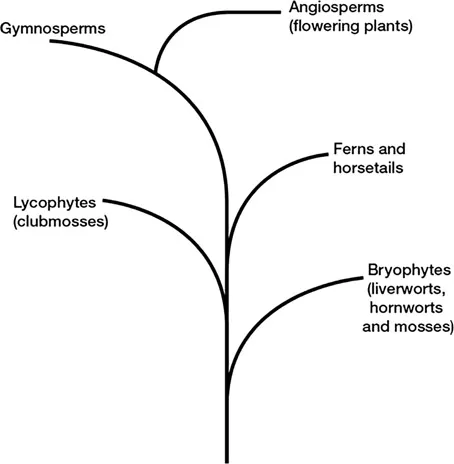
Figure 1.1 Phylogenetic relationships between plants
Note: The flowering plants (angiosperms) are the main group of importance in agriculture. Some gymnosperms are also used in agriculture.
Source: Based on Henry (2005a).
Plants are a very diverse group of organisms. Figure 1.1 Phylogenetic relationships between plants shows the evolutionary relationships of the major groups of plants. Agriculture relies mainly on the seed plants. These can be divided into two groups: the gymnosperms and the angiosperms. The gymnosperms, such as conifers, are mainly exploited in forestry, with limited use in food production or agriculture (e.g. pine nuts). This group is unlikely to be monophyletic, that is, to all share a common ancestor (Hill, 2005). The angiosperms, or flowering plants, are the largest and most important group of plants for agriculture. Flowering plants are classified into several hundred families (Chase, 2005). Humans have found ways of using plants from many angiosperm plant families in agriculture, but we rely most heavily on species from a smaller number of families, with the most important for agriculture probably being the Poaceae, or grass family, that includes the major cereal food species and pasture grasses.
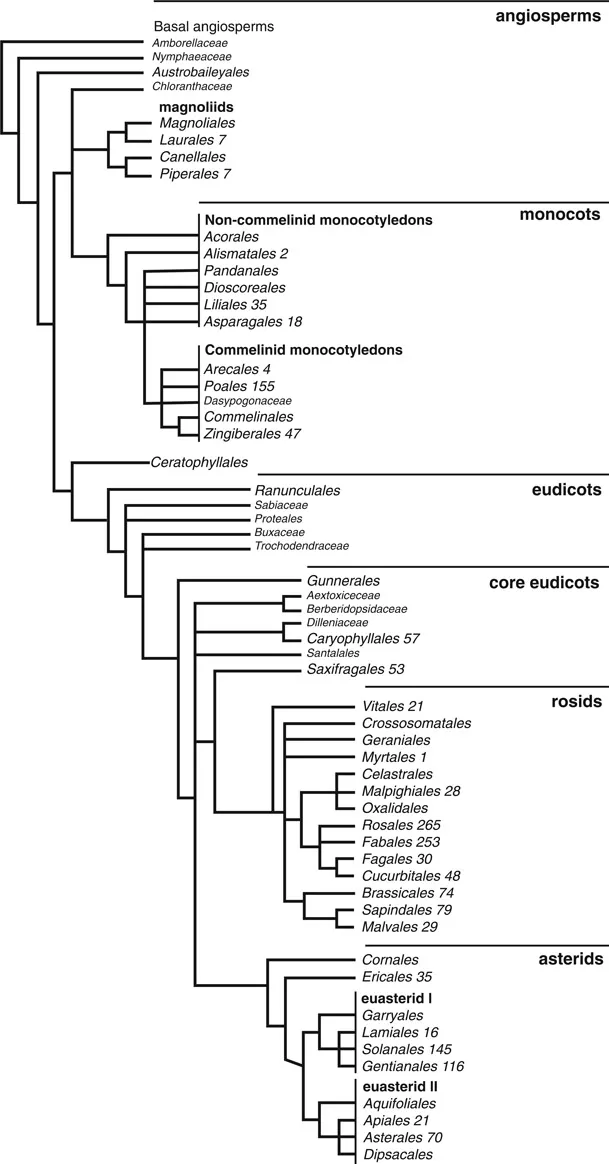
Plant species have been traditionally classified using morphological characteristics, but advances in molecular tools have provided new insights into plant diversity, allowing relationships between plants to be better understood. The relationships among the major groups of angiosperms are depicted in Figure 1.2 Phylogenetic relationships between flowering plants. Most agricultural species are monocots or eudicots. Dicotyledonous plants are not monophyletic with a basal dicotyledonous group of flowering plants and a large distinct dicotyledonous group, the eudicots. The two main groups within the eudicots, the rosids and the asterids, are important in agriculture. Examples of agricultural species from these plant groups are listed in Table 1.1 The uses of seed plants.
Figure 1.2 Phylogenetic relationships between flowering plants
Note: The relationships between the major groups of flowering plants continue to be refined by DNA analysis, providing a guide to the most appropriate resources for use in agricultural crop improvement. This ‘big picture’ perspective is importance in searching for diversity that might be used in crop improvement.
Source: Based on Furtado et al. (2014).
Table 1.1 The uses of seed plants
Plants Uses

Gymnosperms Food: pine nuts, bunya nuts
Construction: pine
Angiosperms
Amborellaceae Amborella (only New Caledonia)
Nymphaeaceae Ornamental: water lilies
Food: (seeds and rhizomes)
Cosmopolitan: (fresh water)
Austrobaileyales One genus, two species only in Australia, no known uses
Chloranthaceae Ornament: (Chloranthus glaberi)
Beverage: (Chloranthus officinalis)
Medicine: (Hedyosmum brasiliense)
Magnoliales Food: nutmeg (Myristica fragrans), custard apple (Annona)
Ornament: Magnolia
Construction
Laurales Food: avocado (Persea americana) cinnamon, bay leaves
Ornament
Construction
Other: perfume (Doryphora sassafras)
Medicine
Canellales Ornament
Food: white cinnamon (Canella winterana)
Medicine
Piperales Food: pepper (Piper nigrum)
Beverage: kava (Piper methysticum)
Ornament
Medicine
Alismatales Ornament
Food: Sagittaria sagittifolia (tubers)
Pandanales Food: (starchy fruits)
Ornament: Pandanus
Other: perfume, baskets
Dioscoreales Food
Medicine
Liliales Beverage: sarsaparilla
Ornament: Lilium, Tulipa (tulip)
Medicine
Asparagales Food: onions, garlic, lee, vanilla, asparagus
Ornament: Gladiolus, Iris, Freesia, Daffodils, Orchids
Medicine
Other: saffron (Crocus sativus)
Arecales Food: coconuts, copra, dates, sago, palm oil
Fibre: coir, raffia
Ornament
Poales Food: rice, wheat, maize, barley, sorghum, millet, sugarcane, bamboo, pineapple
Animal Feed: pastures
Ornament: lawns, water plants
Other: baskets, brooms, thatching
Plants Uses
Dasypogonaceae Ornament: Xanthorrhoea
Other: varnishes
Commelinales Ornament: wandering Jew, water hyacinth
Zingiberales Food: banana, ginger, cardamom, turmeric, arrowroot
Fibre: manila, hemp
Ornament: Strelitzia, Canna
Other: perfume
Ceratophyllales Other: protects fish in fresh water
Ranunculales Food: fruits
Ornament: Clematis, Ranunculus (buttercups)
Medicine: opium (Papaver somniferum)
Sabieaceae Ornament
Proteales Food: Macadamia integrifolia
Ornament: Banksia, Grevillea, Telopea, Protea, Leucadendron, planes
Construction: timber
Buxaceae Ornament
Construction
Dilleniaceae Ornament: Hibbertia, Dillenia
Caryophyllales Food: Arraranthus
Ornament: cockscombs (Celosia cristata), Ptilotus
Santalales Medicine
Saxifragales Food: grapes (Vitis vinifera), gooseberries, currants (Ribes)
Ornament: Hydrangeas, Kalanchoe
Construction: timber
Other: perfume
Crossosomatales Ornament
Construction
Medicine
Gereniales Ornament: Geranium, Pelargonium
Construction: timber
Medicine
Other: perfume
Myrtales Food: cloves (Syzygium aromaticum), lilly pilly
Ornament: bottlebrushes, Tibouchina, Fuchsias
Construction: Eucalyptus
Medicine
Other: essential oils
Celastrales Beverage: Arabia tea (Catha edulis)
Medicine
Other: essential oils
Malpighiales Food: cassava (Manihot glaziovii), passionfruit (Passiflora)
Ornament: Poinsettia (Euphorbia), violets
Industry: castor oil (Ricinus communis)
Other: rubber (Hevea brasiliensis)
Oxalidales Ornament: flycatcher plant (Cephalotus follicularis)
Construction: timber
Plants Uses
Rosales Food: fruits (apple, plum, pear, cherry, mulberries, fig, raspberries, strawberries)
Fibre: hemp (Cannabis sativa)
Ornament: roses
Beverage: hops (Humulus lupulus)
Construction: elms
Fabales Food: peas, beans, groundnut (peanut), soybean
Animal Feed: clover, lucerne
Other: nitrogen fixing
Construction: timber
Ornament: Acacia
Fagales Food: chestnut (Castanea sativa), walnut, pecan
Construction: beeches, oaks, birches
Cucurbitales Food: cucumber, pumpkin, melon
Ornament: Begonia
Brassicales Food: oilseed rape, mustard, vegetables, (cabbage, cauliflower), papaya (Carica papaya)
Animal Feed: fodder
Sapindales Food: orange, lemon, lime, mango, cashew, pistachio, lychee (Litchi chinensis), maple sugar
Ornament: maples
Medicine
Construction: mahoganies
Other: perfume, posion ivy
Malavales Fibre: cotton (Gossypium)
Ornament: Hibiscus
Construction
Other: chocolate
Cornales Ornament: dogwoods
Ericales Beverage: tea (Camellia sinensis)
Ornament: Camellia
Construction
Garryales Medicine
Lamiales Food: olives (Olea europaca)
Solanales Food: potato, aubergine, tomato, pepper, sweet potato
Ornament: morning glory (Ipomoea purpurea)
Medicine
Other: tobacco
Gentianales Beverage: coffee (Coffea)
Ornament: Gentian, oleandeas (Nerium), Gardenia
Medicine: quinine (Cinchona)
Aquifoliales Ornament: holly
Construction
Apiales Food: carrot, celery, parley, fennel, dill
Medicine
Other: perfume
Asterales Food: sunflower, lettuce, chicory, Jerusalem artichoke
Ornament: Dahlia, Gerbera
Dipsacales Beverage: elderberry (wine)
Ornament: honeysuckles (Lonicera)
Medicine
Source: Adapted from Henry (2005b).
The relationships between plants may be assessed by analysis of their DNA. The nuclear and maternal (chloroplast and mitochondria) genomes may show different relationships. Reticulate evolution, found in many plant groups, including agriculturally important species, allows chloroplast transfer or ‘capture’ between species.
The importance of the diversity of micro-organisms in the environment of plants is increasingly being revealed as an important contributor to plant performance. This genetic resource is much less well known than the plants themselves but is also important for agriculture (see also Beed et al., Chapter 8 of this Handbook).

Diversity of species

Reliance on key species in agriculture

Despite the use of many different plants by humans, a relatively small number account for a large proportion of global agricultural production and food ...

Table of contents

  1. Cover
  2. Title
  3. Copyright
  4. Dedication
  5. CONTENTS
  6. Contributors
  7. Introduction: agricultural biodiversity, the key to sustainable food systems in the 21st century
  8. PART 1 Biological resources for agricultural biodiversity
  9. PART 2 The origins and history of agricultural biodiversity
  10. PART 3 The value of agricultural biodiversity
  11. PART 4 Agricultural biodiversity: human health and well-being
  12. PART 5 The drivers of agricultural biodiversity
  13. PART 6 Safeguarding agricultural biodiversity
  14. Index