![]()
1
What is the Nexus? Meeting the Energy, Water and Food Needs of 9 Billion People
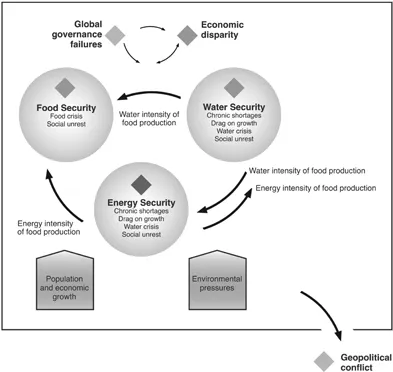
THE ENERGY–WATER–FOOD NEXUS is really a collision of systems creating a more complex set of relationships, challenges and opportunities (Figure 1). Each of these systems is complex on its own, and the linkages between them make the nexus significantly more intricate still.
The food system consists of the activities, resources and people involved in bringing food from the farm to the table, including but not limited to the following:
- Growing and harvesting crops.
- Breeding, housing, feeding and slaughtering animals for food.
- Catching and harvesting aquatic plants and animals for food.
- Processing raw plant and animal materials into retail products.
- Transporting feed, animals, produce and other goods.
- Storing and selling products at retail outlets.
- Preparing and eating food.
- The land, labor, soil, energy, animals, seeds and other resources involved in making the aforementioned activities possible.
Figure 1.
The energy–water–food nexus.
Source: World Economic Forum, 2011.
The water system provides water for human use as well as for ecosystems as a whole. Water is a local issue, with the watershed or catchment the local “unit.” Watersheds are numerous: according to the US Geological Survey
(USGS) there are over 2,264 watersheds in the continental United States alone.3 This water is often moved around within and between watersheds in order to meet the needs of individuals and communities; and in some cases we dramatically alter water systems to better meet our agricultural, municipal, commercial, industrial and energy production needs.
The overarching energy system includes not only the systems required to generate, transmit and distribute electricity, but also the systems needed to produce and distribute transportation fuels. Electricity is generated either at a power plant fueled by fossil fuels or nuclear fission, or by lower-impact sources, including hydropower, wind, solar and geothermal. The aspects of the energy system involved in producing transportation fuels include producing, refining and distributing oil and natural gas, as well as producing and processing feedstocks for biofuels, for example the maize used to produce ethanol.
As noted above, while each of these systems is complex on its own, the interactions among them are where the larger stresses arise.
Food and water
Food production and processing is an immense source of water consumption, with crop irrigation alone accounting for about 40% of all of the water withdrawals in the United States (and in states such as California as much as 80% cent of water use).4 Irrigation competes with other major water uses such as manufacturing, power plant cooling, municipal drinking water and fossil fuel production. These water resources can be additionally strained during droughts, causing problems for farmers who rely on irrigation of their crops. Agricultural water use can also negatively affect watersheds through runoff from fertilizers, pesticides and manure from farms and feedlots polluting local water resources.
Water and energy
Generating energy from fossil fuels requires large amounts of water, primarily for cooling – although once-through generation processes actually consume only small amounts, recycling water through cooling towers for reuse. Nearly half of all water withdrawals in the United States are used for power plant cooling.5 The hundreds of large-scale power plants across the United States together withdraw 58 billion gallons of water from the ocean and 143 billion gallons of freshwater each day.6 This dependence is why most power plants are located near rivers, lakes or the ocean.
As with food and water, droughts and other water shortages also affect power plants. When surface water levels drop, they can lose their access to cooling water and have to reduce or shut down operations. When the weather is warmer or drier, the bodies of water that supply power plants may face temperature increases that hamper cooling processes or harm the ecology of that water system.
Food and energy
The connection between food and water is clear, but the ties between food and energy became much stronger with the ‘‘green revolution’’ in farming between the 1940s and 1970s. The technology and industrialization underlying the green revolution have increased the energy needs of farming and food production along the entire process of getting food from farm to table. Among the energy-intensive activities of modern agriculture are fertilizer production, water pumping, farm equipment operation, food processing and packaging and food and livestock transportation.
Population growth and associated problems are increasing the stresses upon each of the elements of the energy–water–food nexus, as well as the connections between them. Statistics compiled by the United Nations indicate that these stresses are only going to increase as the global population grows:7
- The global population is expected to increase to about 9.1 billion by 2050.
- The average growth rate per year from 2006 to 2050 is projected to be 0.75%.
- In sub-Saharan Africa and Near East Africa growth is projected to be respectively 1.92% and 1.19% per year.
![]()
2
Global Trends in Energy, Water and Food
THE DEMANDS FOR WATER, ENERGY AND FOOD are growing unabated. To understand the solutions to the threats to the energy–water–food nexus we need to first understand these global demands in greater detail.
2.1 Energy
The demand for energy has been increasing and is projected to continue for the foreseeable future. This should come as no surprise, since the need for energy is driven by the same factors that are driving the demand for water and food. Like water and food, the energy sector is being transformed through technology innovation, led to a large degree by a need to meet demand and to reduce greenhouse gas emissions from fossil fuel energy sources.
As with water and food, population and income growth are the key factors behind growing demand for energy. By 2030, world population is projected to reach 8.3 billion, which means an additional 1.3 billion people will need energy; and world income in 2030 is expected to be roughly double the 2011 level in real terms. In response, global primary energy consumption is projected to grow by 1.6% per annum (p.a.) from 2011 to 2030, adding 36% to global consumption by 2030. The growth rate itself declines, from 2.5% p.a. from 2000 to 2010, to 2.1% p.a. for 2010 to 2020, and 1.3% p.a. from 2020 to 2030.8
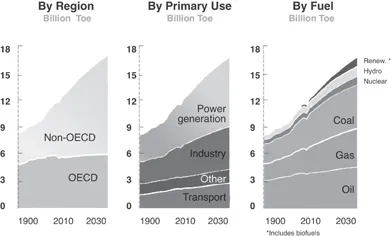
Demand for energy will not be evenly distributed. Low- and medium-income economies outside the Organization for Economic Co-operation and Development (OECD) account for over 90% of population growth to 2030, and as a result of their rapid industrialization, urbanization and motorization, these economies will also contribute 70% of the global GDP growth and over 90% of the growth in global energy demand (Figure 2).
Figure 2. Projected energy demand growth by region, industry sector and fuel type to 2030, in tons of oil equivalent (toe). 8
Some key takeaways from this chart:
- Almost all (93%) of the growth in energy consumption will be in non-OECD countries, with energy consumption in 2030 61% above the 2011 level, growing by an average of 2.5% p.a. (or 1.5% p.a. per capita).
- Non-OECD countries account for 65% of world consumption in 2030, compared to 53% in 2011. OECD energy consumption in 2030 is just 6% higher than in 2011 (0.3 energy – water – food % p.a.), and will decline by about 0.2% p.a. per capita from 2011 to 2030.
- Energy used for power generation will grow by 49% (2.1% p.a.) from 2011 to 2030, and will account for 57% of global primary energy growth. The primary energy used directly in industry will grow by 31% (1.4% p.a.), accounting for 25% of the growth of primary energy consumption.
- The fastest growing fuels will be renewable (including biofuels), averaging 7.6% p.a. 2011 to 2030. Nuclear and hydro both grow faster than total energy (2.6 and 2.0% p.a., respectively). Among fossil fuels, gas grows the fastest (2.0% p.a.), followed by coal (1.2% p.a.), and oil (0.8% p.a.).
2.2 Water
As mentioned above, almost 1 billion people don’t have access to safe water and over 2.5 billion don’t have access to sanitation and hygiene. Why is it that there are so many globally that don’t have access to safe water and sanitation?
Let’s first examine the issue of water scarcity and access to safe water. JP Morgan Global Equity Research framed the reasons for water scarcity in a report titled ‘‘Watching Water’’ published in 2008:
- Population growth and increasing food needs (the rise of the middle class). The current global population recently crossed 7 billion (at the time...