![]()
Part I.
The Resiliency Cornerstone: Creating an Optimistic Philosophy of Life
![]()
Theoretical Orientation: Cognitive-Behavioral
When I was a young man, I vowed never to marry until I found the ideal woman. Well, I found her—but alas, she was waiting for the ideal man.
Robert Schuman
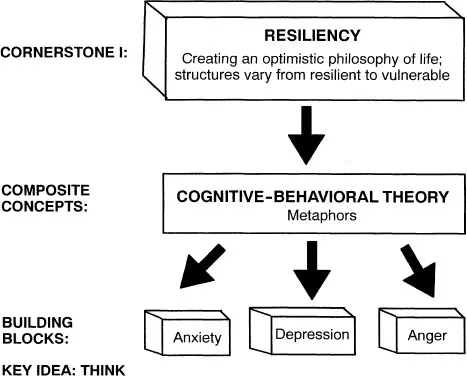
The resiliency cornerstone is built on the coping skills and philosophy-of life that one uses to deal with adversity and stress both within and outside of the couple relationship. Analysis of this cornerstone reveals the type of schemas or guiding philosophies each partner uses to make sense of interpersonal encounters. Most important, the philosophy of life modulates one’s affective experiences. With a positive philosophical outlook, a person remains emotionally available to constructively work on problems and attend to the partner’s needs and points of view. This cornerstone assesses how thinking affects the couple experience.
Although personal resiliency examines positive philosophical strategies that strengthen the relationship, the cornerstone also harbors those personal vulnerabilities related to self-defeating, irrational, and counterproductive modes of thinking. These personal vulnerabilities in thinking lead to extremely destructive emotions—such as outbursts of anger or abuse, debilitating fears and insecurities that paralyze the relationship, and extreme depression and dysphoria. By carefully assessing and treating this cornerstone, couples therapists acknowledge that individual pathology and resiliency can greatly influence the couple relationship.
When did therapists realize the power of thought over emotions and behavior? Freud revolutionized our worldview when he proclaimed that neurotic symptoms were the result of human thought (Freud, 1916–1917). Before that, psychopathology was viewed as a disorder caused by demented mental processes that were not present in “normal” people. Freud showed that all people are subject to the same general rules that govern behavior and mental operations. When people are tormented by conflicting, unresolved, anxiety-provoking thoughts, their interpersonal behavior becomes disrupted and they act in seemingly irrational ways. The power of human thought to create irrational and abnormal behavior had been noted by the Greeks of antiquity, but its modern-day reintroduction by Freud permanently changed the way the everyday man or woman understands his or her own peculiar deviancies.
Although the basic premise, that thought affects human disturbance, continues to guide psychologists today, the type of thoughts that cause problems for people has been greatly expanded. No longer are taboo sexual fantasies the only thoughts that lead to trouble. All types of conscious and unconscious philosophies of human relationships can interfere with effective interpersonal relationships. Marital relationships are commonly disrupted by ways of thinking.
Cognitive theory provides a theoretically distinct approach for understanding and treating marital cognitions. The most effective theoretical elaborations and techniques derived from cognitive theory include rational emotive psychotherapy, restructuring and reframing skills, and the power of metaphoric devices. Rational emotive psychotherapy explores the power of thinking rationally and empirically; restructuring and reframing skills demonstrate the power of thinking from multiple perspectives and viewpoints; and metaphoric devices remind us that creative thought processes often unleash the most profound changes and insights. A brief discussion of each follows.
Rational Emotive Psychotherapy
By all means marry: If you get a good wife, you’ll become happy; if you get a bad one, you’ll become a philosopher.
Socrates
Albert Ellis has been a leading force for over fifty years in explicating how irrational thoughts can lead to behavioral and emotional dysfunction in a marriage. Ellis began his career as a marriage therapist in the early 1940s. He soon became convinced that much marital discord occurred because individuals had deeply dysfunctional ways of thinking and could not live peacefully with themselves, much less anyone else. Ellis did not think that disgruntled partners, by and large, had interpersonal skill deficits. They most often justified not using the positive, pleasant social behaviors at their disposal by referring to intense, irrational feelings and unproductive philosophies of how their mates “should be” or “must be.” They chose to act out their meanness, hurt, and anger because they felt such acting out was justified by the reality of the situation. They felt that the other person was “causing” their own poor behavior (Ellis and Harper, 1961).
Ellis began working with individuals, alone, without their spouses. He tried to teach partners that they were disturbed not by the actual behaviors or verbalizations of their mates but by their own biased, judgmental interpretation of those events. For Ellis, the “truth” of a situation is impossible to find. There is simply the wife’s interpretation and the husband’s interpretation. The key to marital happiness and personal fulfillment is to find and develop ways of thinking that embrace the relative nature of what is “true” in a flexible, self-affirming manner. Absolute, rigid philosophies block feelings of empathy and creative problem solving. Rigid thinking makes all conflicts an “I’m right and you’re wrong” issue—an impasse.
Windy Dryden (1991) offers an excellent summary of rational-emotive couples therapy in his book Reason and Therapeutic Change. Most of the following discussion is based on that review. Within the rational emotive model, to resolve conflicts or live peacefully, each spouse needs to learn to avoid absolute judgments of “good” or “bad.” People can learn to do this if they develop and accept rational philosophies that respect the autonomy and freedom of their spouses, the fallibility inherent in all human beings, and the daily unfairness of life as unavoidable givens in any marriage. So if a husband is ready to scream at his wife because she did not clean up the bathroom as promised, destructive conflict will be avoided if he consciously works to successfully convince himself of any of the following:
- His wife is a free person and no law of the universe states that she must do what he wants her to do.
- It is unfortunate and frustrating that she broke an agreement, but as humans, we are often unable to keep the promises we have made. It does not mean that she is a terrible person; it simply shows she is human.
- Even though it is unfair that the husband has to do the bathroom when he has already washed the clothes as he had agreed to, no one on earth lives a life in which things are always fair.
The outcome of this type of convincing self-talk is that the husband becomes emotionally ready to constructively negotiate with the wife, making her more likely to comply the next time such an agreement is sought.
Rational emotive couples therapists make a large distinction between couple disturbance and couple dissatisfaction. According to Dryden (1991),
Couple dissatisfaction occurs when one or both partners are not getting enough of what they want from their partner and/or from being in an intimate relationship. Couple disturbance arises when one or both partners become emotionally disturbed about these dissatisfactions. Thus, they may make themselves anxious, angry, hostile, hurt, depressed, ashamed, guilty and jealous—emotions that usually interfere with the solution of couple dissatisfaction problems. In addition, when one or both partners are emotionally disturbed, they generally act in a self- and relationship-defeating manner, thus perpetuating couple disturbance. Rational emotive couples theory states that, assuming they have the necessary constructive communication, problem solving and negotiation skills, couples are likely to solve their dissatisfaction problems on their own. However, once couples are disturbed about their relationship, unless their emotional problems are dealt with, relationship problems usually remain, no matter how skillful one or both partners are in communicating, solving problems and negotiating workable compromises. (p. 183)
There are two main reasons for couple dissatisfaction: relationship myths and valid incompatibilities. Among the more popular myths that American couples grow up with are the following eight fairy tale truisms:
- Romantic love should last forever in a good marriage
- My partner should be able to understand what I want and need without my having to tell him or her
- For sex to be good, it has to be spontaneous and full of emotional abandonment
- If my partner is good enough to me, it will make up for other feelings of inferiority or inadequacy that I have
- My partner will always be on my side in an argument or conflict
- If our sex life isn’t satisfying, that is proof that there isn’t enough love in the relationship
- In a good marriage, the partners will never disagree
- Marriage will enhance my life without any great penalties, costs, or deprivations
Irrational thinking processes based on these myths are usually present when either partner makes absolute demands and commands. Couple disturbances occur when objectively unsatisfying marital interactions or actions occur and the spouse starts saying to himself or herself that (1) the other partner must not act that way, that it is awful and horrible if he or she continues to act that way. (2) one cannot stand it if the situation remains unchanged, and (3) the spouse is bad and worthless if he or she refuses to change. All of these thoughts are treated as devout personal religious tenets. Unfortunately, such thinking serves only to aggravate the spouse and increase the likelihood that he or she will intensify the noxious behaviors causing the marital dissatisfactions in the first place.
Learning to think rationally involves acknowledging that it is valid to have expectations of and desires for one’s spouse. It is not appropriate or useful to escalate these desires into demands or to transform expectations into orders. By making irrational demands on one’s partner, one is guaranteed to feel irrational anger. When both partners base their anger on the narcissistic belief that the other is the one who is wrong and who is a terrible person, couple disturbance gets perpetuated and exacerbated in a vicious cycle. Both partners are so busy damning each other that they have no energy to take responsibility for their own thoughts, expectations, and judgments.
For psychologically rich marriages, couples must take responsibility for creating a philosophy of marriage that allows them to tolerate and appreciate their partners, while expressing themselves and their own needs for personal growth.
When it becomes apparent that both husband and wife are locked into couple disturbances, it is very important to see them separately and terminate joint sessions. When one spouse cannot speak freely in front of the other or can do nothing but blame the other and demand that he or she change, individual sessions are mandatory. In the individual sessions, it is vital to flesh out a rational philosophy of marriage, one that is based on individuals’ taking responsibility for what is in their control, accepting what is not under their control, and learning to tell the difference. Like the alcoholic who has lost all control over drinking, the maritally disturbed person has lost all control over thinking patterns. But thinking patterns can be changed and molded by self-choice. It is one of the few things, ultimately, that is truly under our personal control and will. After the blaming and demands are under control, joint sessions should be resumed.
The first step in developing a rational philosophy is to learn to monitor the effects that different types of self-talk have in distressing situations. The ABCs of rational emotive counseling are well known to most clinicians:
“A” refers to the activating event that causes an argument or gets one angry.
“B” refers to the self-talk or beliefs that the person has concerning that event.
“C” refers to the emotional and behavioral consequences of the particular beliefs that were embraced.
Such accepting, nonjudgmental thinking could lead clients to accept all different types of abusive relationships. Therapists should always be wary of conveying a conservative “learn to accept whatever life gives you” attitude. Instead, the goal should be to evaluate many different interpretations of the situation to see which ones carry equal emotional or rational validity.
Restructuring and Reframing Marital Perceptions
It is man that makes truth great, not truth that makes man great.
Confucius
Despite the utility of learning to make rational, nondamning judgments, most distressed couples must also discover more creative ways to think about their marital quandaries. They need to “reframe” the problems so that they no longer seem to be insolvable problems. That is, they need to learn how to reach more optimistic conclusions from any one particular “take” on a situation. So instead of blaming partners for bad intentions, individuals need to come up with theories to explain why things are the way they are, presuming that the spouse has the best of intentions. These new theories invariably include the limitations imposed by the environment or by the “victimized” spouse who is building the new, nonblaming theories.
To stop jumping to black-and-white, dichotomous conclusions, couples need to entertain new information or ideas that will naturally change their perceptions. Just as a person suddenly sees the three-dimensional characters pop out of a computer-generated image, seeing a situation from a totally different perspective automatically leads to different feelings and judgments. Thus, couples need to cast their conflict in a different mold so it appears in a novel shape with new meanings that automatically elicit new emotions and different beliefs. Simple rational emotive brainwashing needs to be complemented by a change in perceptual consciousness—a different way of understanding the drives, stressors, frustrations, and rewards operating within the relationship. The husband whose wife is uninterested in sex may learn to reframe the situation from one in which he is being ...