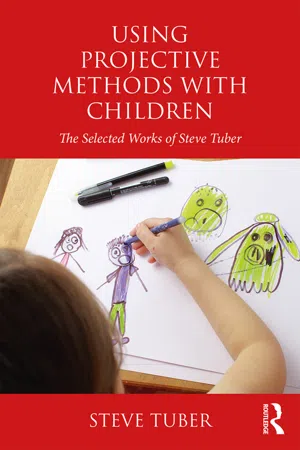
Nominated for a 2018 Gradiva Award for Best Book by the National Association for the Advancement of Psychoanalysis, Using Projective Methods with Children is an enhanced synthesis of Steve Tuber's previously published research on the study of projective methods to assess the representations of self and others, as well as the actual interpersonal experiences children internalize in the form of these representations. Integrating conceptual and empirical work, with an emphasis on the Rorschach Inkblot Method (RIM), the book offers unique, evidence-based information on the importance of assessing particular aspects of a child's inner self. The studies cover a broad range of topics such as dreams, anxiety disorders, political oppression, homelessness, and multiculturalism, and each is supplemented with an analytical introduction. A section that discusses future areas of research is also included.
- 272 pages
- English
- ePUB (mobile friendly)
- Available on iOS & Android
eBook - ePub
About this book
Information
Section Five
Using Projective Methods in N of 1 Case Studies
The next section will focus on a number of case studies that used either intensive studies of entire RIM and/or TAT protocols (the Cases of “Lisa” and “Jim”) or summarized/partial records (the six vignettes described in Chapter 19). Such idiographic studies have long been the mainstay of psychodynamically informed uses of projective methods, often to the great chagrin of researchers who focus on nomothetic analyses with larger samples. It is almost a cliché to note that both approaches are not only viable means of empirical study, but that each type of work enhances the other. The often provocative, if idiosyncratic, nature of findings from idiographic research naturally warrant follow-up with larger samples to track down these “leads” to possible refinements to theory and practice. The suggestive correlations among variables in larger studies often warrant closer examination “on the ground” to best capture the actual experience (Escalona, 1968) or phenomenology of the correlations reported.
In the cases of Lisa and Jim reported next, we have an added advantage rarely given to idiographic works. The Children’s Apperception Test (CAT) protocol of Lisa and the RIM protocol of Jim, both taken when they were children, were linked to their treatment as adults. Such longitudinal data are a treasured commodity in the field and give the idiographic assessments of their protocols an added vitality.
In Chapter 18, we provide two briefer case studies of children with ADHD.
16
Using the Children’s Apperception Task as an Idiographic Indicator of Treatment Themes Over Time
Primary paper: Tuber, S. (2004). Projective testing as a heuristic “snapshot” of themes in child and adult psychoanalysis: The Case of Lisa. Journal of Infant, Child and Adolescent Psychotherapy, 3, 486–508.1
There is a rich tradition of comparison between projective tests and psychoanalytic case material. Rapaport and his colleagues (Holt, 1968), in their seminal work in the 1930s and 1940s, linked psychological test data with psychodynamic conceptualizations in a way that gave more credibility to applied psychodynamic theory. Looking back, these developments served as important rationale for the use of projective testing by psychologists in psychiatric and Veterans Administration hospitals in the 1950s. At that time, psychodynamically informed projective test analysis became intimately intertwined with the treatment of severe psychopathology in private psychiatric hospitals (e.g., Menninger Clinic, Austen Riggs Center, Chestnut Lodge). Psychological testing of each patient shortly after admission at these institutions was common, if not required. Patients were tested at various times during their inpatient stay and frequently tested as part of their discharge process. Later, as some of these institutions began to embark on follow-up studies of former patients, they often referred back to projective test data as a way to reflect on the original treatment predictions (Blatt and Ford, 1994).
More recently, there has been a growing preponderance of nomothetic assessments of inpatient progress and outcome that utilize projective testing with increasing sophistication. Blatt and Ford (1994), for example, who compared Rorschach and Thematic Apperception Test (TAT) protocols of patients at the Austen Riggs Center at admission and again 15 months after treatment, began with a variety of behavioral and clinical measures of patient progress. These test data were meaningfully linked with changes in the quality of interpersonal relationships and the lessening of clinical symptomatology. Similar nomothetic comparisons were derived from an analysis of the data from the Menninger Psychotherapy Research Project. In that study, the Krohn and Mayman (1974) Object Representation Scale proved effective in predicting follow-up two years after discharge for 40 patients selected from the Menninger study (Frieswyk and Colson, 1980). Menninger testing protocols were also used in a later study that reclassified patients as having anaclitic or introjective personality configurations (Blatt, 1992). In comparing the two types, Blatt reported that introjective patients experienced less symptomatology and more adaptive functioning in a psychoanalytically oriented treatment, whereas anaclitic patients were more successful in supportive psychotherapy.
Heinicke (1990) compared children in three-times-per-week psychoanalytic treatment with those in once-weekly treatment. Rorschach data were collected pretreatment and posttreatment for both groups. Improved Rorschach performance was found more commonly in the intensively treated child group. Tuber (1983) assessed the quality of children’s Rorschach Mutuality of Autonomy (MOA) object representation scores and effectively used them as a predictor of their later re-hospitalization as adults. He reported that children whose Rorschach tests showed an absence of benign object representations at admission to a child residential facility were more likely to be re-hospitalized than a group of matched cohorts treated at the same facility (please refer to Chapter 11 for a fuller description of this study).
Idiographic or case study use of projective test data in child and adult psychoanalytically informed treatment has had an equally long, and perhaps more extensive tradition than the nomothetic comparisons. For example, Diamond and colleagues (1990) applied the Object Representation Inventory (ORI), a measure used to operationalize concepts from separation-individuation theory, to the Rorschach at the beginning and end of four one-and-a-half to two-and-a-half-year treatments of borderline adolescents. These authors were able to trace shifts in descriptions of self and other to Rorschach shifts in organization and representation. Tuber (2000) studied the Rorschach protocol of Jim, an eight-year-old seen in both child analysis and later in adult treatment with the same therapist. This post hoc analysis revealed profound impairments in the quality of Jim’s object representations that presaged his relatively poor outcome as an adult (see Chapter 17).
It is no coincidence that studies of this kind converged conceptually with the emergence of object relations theory as a core paradigm in understanding personality development from a psychoanalytically informed perspective (Greenberg and Mitchell, 1983). The focus of this theory on the conceptions of self and other in interaction and the affects generated by the internalizations of these interactions have been concomitant with the development of a similar framework in projective testing. The cognitive imagoes of these affect-laden interactions form mental object representations or templates of inner experience. These representations, in turn, become manifest in future interactions within the self as well as with others. In treatment, they form the basis of both “real” and transferential configurations. In projective testing, these representations imbue the visual stimuli of inkblots and/or ambiguous pictures with personally meaningful content and process. The object representational measures (e.g., ORI, MOA) just described are among the most commonly employed instruments of this paradigm in the field of projective testing (Stricker and Healey, 1990).
The ability of projective test data to take a heuristically helpful “snapshot” of personality organization at a given point in time and to integrate this snapshot into an overall assessment of personality functioning is intrinsic to the projective hypothesis from which projective testing was first developed. Projective test material is viewed here first and foremost as providing another, somewhat standardized realm of data from which to test a given view of personality theory. The studies cited earlier regarding projective testing and psychoanalysis suggest that it is viable to leap from testing as a snapshot to testing as a potential enduring marker of personality over time. If projective test performance can usefully identify themes as well as limitations and problems in treatment, it may provide cross-validation of the utility of certain key psychodynamically informed explanations of personality organization and growth. The study of the following projective test protocol, albeit a post hoc predictor of a treatment experience, offers another view of the dynamic relation between testing and treatment data.
The Case of Lisa
At age eight, Lisa entered a five-session-per-week analytic treatment with a female analyst that lasted two years. After a nine-year break, she resumed analysis with a different analyst, also a woman, from the same clinic (Hampstead). In this sense, the continuity of her treatment had a direct institutional, but not personal, link. Lisa’s second treatment as a young adult was more extensive, lasting a total of six years. Before Lisa began her first treatment, she was given the CAT as part of the routine initial consultation process. By reviewing her verbatim responses on a card-by-card basis, the reader is afforded a catalog of some of the conscious and unconscious conflicts at work simultaneously. As I try to demonstrate, certain key themes emerge from her words that would later prove crucial during both analyses. This examination offers us the chance to revisit material that may have been more valuable than might have been guessed at the time. I intersperse Lisa’s actual response to each card with an analysis of her response.
Let me add a word about my method of CAT analysis. In most respects, it is comparable to the process of understanding case material from a therapy session. Inasmuch as each CAT card presents its own interpersonal dilemma to be solved, the salient questions asked of each response are to what extent can Lisa acknowledge each dilemma and create a response that “solves” the interpersonal “problem” depicted. The degree to which her “solution” invokes a developmentally appropriate richness and aliveness is the means by which Lisa’s potential capacity for adaptive handling of actual interpersonal and intrapsychic dilemmas is assessed.
Lisa’s CAT Card Responses and Analyses
Card 1: Three Chickens Around Meal Table and Shadowy Figure of Hen or Rooster in Background
Once upon a time … once upon a time there were three chickens and they had … they had some porridge one morning. One day they went out and when they came back they found that somebody had eaten all their porridge so they went to the store and they bought more and they bought two packets of it and their pot was full and they eat it all up.
Lisa begins with a well-defended version of the “Goldilocks” story. Interestingly, however, when the chickens return to find their oral supplies gone in her version, they competently double their supplies and fill their pots. Lisa then makes a point of saying that they eat it all. Thus, not only do the chickens double their compensation for this oral lo...
Table of contents
- Cover
- Half Title
- Title Page
- Copyright Page
- Contents
- Acknowledgments
- Introduction
- About This Book
- Section One: The Conceptual Links Between an Object Relational Approach to Normal and Pathological Development and Projective Methods
- Section Two: The Projective Tasks Used in This Book
- Section Three: Assessing the Object Relations of Varying Child Populations
- Section Four: Assessing Object Relations With Child Populations Under Extreme Duress
- Section Five: Using Projective Methods in N of 1 Case Studies
- Section Six: More Recent Research, Including Future Possibilities
- References
- Index
Trusted by 375,005 students
Access to over 1.5 million titles for a fair monthly price.
Study more efficiently using our study tools.
Frequently asked questions
Yes, you can cancel anytime from the Subscription tab in your account settings on the Perlego website. Your subscription will stay active until the end of your current billing period. Learn how to cancel your subscription
No, books cannot be downloaded as external files, such as PDFs, for use outside of Perlego. However, you can download books within the Perlego app for offline reading on mobile or tablet. Learn how to download books offline
Perlego offers two plans: Essential and Complete
- Essential is ideal for learners and professionals who enjoy exploring a wide range of subjects. Access the Essential Library with 800,000+ trusted titles and best-sellers across business, personal growth, and the humanities. Includes unlimited reading time and Standard Read Aloud voice.
- Complete: Perfect for advanced learners and researchers needing full, unrestricted access. Unlock 1.5M+ books across hundreds of subjects, including academic and specialized titles. The Complete Plan also includes advanced features like Premium Read Aloud and Research Assistant.
We are an online textbook subscription service, where you can get access to an entire online library for less than the price of a single book per month. With over 1.5 million books across 990+ topics, we’ve got you covered! Learn about our mission
Look out for the read-aloud symbol on your next book to see if you can listen to it. The read-aloud tool reads text aloud for you, highlighting the text as it is being read. You can pause it, speed it up and slow it down. Learn more about Read Aloud
Yes! You can use the Perlego app on both iOS and Android devices to read anytime, anywhere — even offline. Perfect for commutes or when you’re on the go.
Please note we cannot support devices running on iOS 13 and Android 7 or earlier. Learn more about using the app
Please note we cannot support devices running on iOS 13 and Android 7 or earlier. Learn more about using the app
Yes, you can access Using Projective Methods with Children by Steve Tuber in PDF and/or ePUB format, as well as other popular books in Psicologia & Psicologia clinica. We have over 1.5 million books available in our catalogue for you to explore.