- 264 pages
- English
- ePUB (mobile friendly)
- Available on iOS & Android
eBook - ePub
About this book
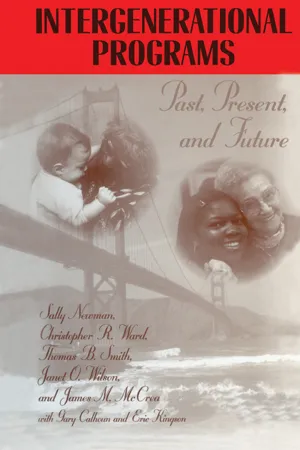
First published in 1997. This work describes the relationship between intergenerational practice and theory by combining details about current programmes with developmental and societal information. It presents the components for intergenerational programs that impact on the field's history, current status, and future, the book introduces the basic theoretical information for this human service initiative.
Information
Publisher
Taylor & FrancisYear
2014Print ISBN
9781560324218
9781560324201
Edition
1eBook ISBN
9781317711551
II
BACKGROUND AND DESCRIPTIONS OF INTERGENERATIONAL PROGRAMS
4
History and Evolution of Intergenerational Programs
When you know where you came from—you know where you are going.
—Navajo Proverb
During the past 30 years, professionals in human service fields concerned with the well-being of children, youth, and older adults have been systematically reporting on the impact of a changing society on these generations. Gerontologists reported on the status of older adults, their increase in numbers, the emphasis on early retirement, the change in life expectancy, the change in their roles in the family and in the community, the geographic separation from their families, and their lack of adequate support systems. Child and adolescent development professionals reported on the status of children and youth; inadequate child care and lack of appropriate support systems for young children; and an increase in school drop out, gang involvement, drug abuse, and teen pregnancy for school-age children and youth.
These reports prompted discussions among human service providers for both generations on the common social issues affecting these two populations. They also resulted in the development of spontaneous programs that could address some issues of the young and old. The discussions occurred within small and large groups informally and formally at the local, regional, and national levels. They involved practitioners, direct service providers, and administrators in grass roots and large system programs; developmental specialists working in early childhood, adolescence, and aging; educators concerned with education across the life span; academics in child development, psychology, family studies, and gerontology; and policy strategists concerned with understanding the multigenerational issues confronting American society. In the process of examining the common problems of the young and old, a concept unfolded that could simultaneously address issues and problems of both populations (Tice, 1982; White House Conference on Aging, 1981c). The concept was already being reflected in the spontaneous local programs that were evidenced in some communities.
Intergenerational programs—the emerging concept—would promote sharing of skills, knowledge, or experience between the old and young; and would provide ongoing and planned interactions designed to benefit both populations (Newman, 1986; Ventura-Merkel & Lidoff, 1983).
Intergenerational programs are based on developmental and historical evidence that positive mutually beneficial effects do occur as a result of interactions among older and younger persons. Though traditionally these benefits occur among elder and younger family members, we believe that they can also occur between nonbio-logically linked older and younger persons. The challenge to the intergenerational movement, therefore, is: How can intergenerational programs replicate between non-biologically linked older and younger persons the positive outcomes historically evidenced in familial intergenerational exchange?
During the past several decades, intergenerational programs have accepted this challenge and have become a social movement that involves millions of the United States’ oldest and youngest persons. Today, working with these populations are thousands of professionals who are practitioners, administrators, scholars, and policymakers, moving and shaping the direction of intergenerational programs and participating in the emergence of an intergenerational human service field.
This chapter offers an historical perspective of the intergenerational field, its development, its focus over time, its current status, and its projection for the future. It includes an overview of the several components that undergird the past, present, and future of the intergenerational field and that are integral to its growth and development. These components are intergenerational programs, publications, networking, professionalism, and funding. The chapter then presents a chronology of historical events that have helped to shape the intergenerational field. These events parallel the development of the components during the past several decades. Although public policy is a key component and is essential to the history of intergenerational programs, it has had a unique influence on the development of intergenerational programs and is addressed in a separate chapter.
INTERGENERATIONAL PROGRAMS
The intergenerational field is historically grounded in intergenerational programs that bring together both the young and the old to share experiences that benefit both populations. These programs provide a structure on which the field is built.
Intergenerational programs are designed to engage nonbiologically linked older and younger persons in interactions that encourage cross-generational bonding, promote cultural exchange, and provide positive support systems that help to maintain the well-being and security of the younger and older generations.
The historical development of intergenerational programs is divided into two phases; the first phase occurred in the late 1960s and 1970s with programs addressing issues related to generational separation. The second phase, in the 1980s and 1990s, addressed societal problems that emerged in response to the social forces discussed in chapter 2.
The creation of intergenerational programs was motivated by a growing awareness that geographic separation of older and younger family members in many of America’s families, a consequence of family mobility, was having negative effects on both generations. Geographic separation of many families resulted in a lack of consistent intergenerational contact and a growth of misperceptions and misunderstanding between the young and old. In some communities, emerging myths, stereotypes, and negative attitudes and behaviors were evidenced between these generations (Kalish, 1969). Lack of contact within families increased feelings of isolation and purposelessness among many older adults, who reported loss of meaningful roles in their families. Lack of contact affected children and youth, who missed the nurturing and positive role models of their grandparents. Caregivers and teachers working with children and youth referred to a disconnection between children and their elderly family members that often resulted in a lack of family continuity (Newman, 1992).
Intergenerational programs in the 1960s and 1970s were created to address issues of generational separation and perceived negative outcomes for both generations. Programs were designed to fill a familial intergenerational void created by the geographic separation that was the norm in 30–40% of American families (Newman, 1980). Intergenerational programs become a vehicle used by human service agencies and systems serving elderly and children to recreate some of the cross-generational interactions absent in families (Thorp, 1985).
The second phase of intergenerational programs, in the 1980s and 1990s, was in response to an increasing number of social issues affecting the old and young. Intergenerational programs in these 2 decades have focused on specific social issues affecting these two vulnerable populations. For youth, intergenerational programs address issues of low self-esteem, school dropout, drug and alcohol abuse, gang involvement, poor school achievement, inadequate child-care support systems, teen pregnancy, and literacy. For the elderly, intergenerational programs address issues of isolation and loneliness, drug and alcohol abuse, low self-esteem, inadequate support systems, literacy, and unemployment. For both young and old, intergenerational programs address the disconnectedness from family and society experienced by both generations (Phillips, 1992).
The shift in focus from generational issues during the 1960s and 1970s to social issues in the 1980s and 1990s resulted in an increased national awareness of the social value of intergenerational programs. Identifying intergenerational programs as a vehicle to address social issues enabled people to see their relevance and importance in communities. The outcome of this awareness is their expansion into many areas and systems. Intergenerational programs are operational throughout the United States in a variety of systems concerned with the education, health, and welfare of the young and the old. They are in urban, suburban, and rural communities across the country and involve children and youth and older adults with diverse backgrounds and needs. Intergenerational programs are in K–12 schools, colleges, adult and child day-care centers, Head Start centers, senior centers and senior high rises, homeless shelters, and long-term care and residential communities.
PUBLICATIONS
Related to the growth of intergenerational programs and a direct outcome of their development is a body of print materials prepared for professionals and the general public. These materials reflect the changes and the evolution of intergenerational programs. They include instructional manuals, papers, and newsletters that present program information and implementation procedures; technical reports that describe program development and outcomes; and research articles that address some fundamental questions related to the issues, impact, and future of intergenerational programs.
Instructional materials, both print and audiovisual, are created to support the maintenance and replication of intergenerational program efforts across the country. They encompass all aspects of program development and maintenance needed to implement and sustain programs over time and reflect the shift in focus and changing structure of intergenerational programs. These materials have become more complex and more detailed as programmers have become more knowledgeable and able to describe program implementation procedures in greater detail. Instructional materials are the tools used to develop and maintain international programs by intergenerational professionals at various job levels, for example, direct service providers, administrators, coordinators, and program developers.
Technical reports serve a different function in this growing field. They inform professionals and the community at large of the effects and implications of these programs. As programs are sustained and replicated, documentation of their effectiveness is reported through these documents. The reports available in the 1970s typically described the development, evaluation, and outcomes of individual local programs. In the 1980s and 1990s, as intergenerational program models expanded nationally, these reports have become more complex, with multiple sections and more elaborate evaluations. Diverse programs focusing on social issues produce technical reports that are comparative and examine similarities and differences among programmatic structure and outcomes. They often examine the effect of national demonstration models in multiple sites across the country. Multisite reports have generated valuable information used to determine the effectiveness of individual and groups of programs and have become a database of information on successful models.
Research articles describing findings in the field examine intergenerational programs from the perspective of understanding the social, behavioral, and attitudinal effects of intergenerational programs. These articles give credence to and reinforce the rationale for further examination of this emerging human service field, which can have a significant effect on U.S. society.
NETWORKING
As intergenerational programs expand across the country, there is an increasing need to share ideas and information. The creation of formal and informal networks beyond the immediate community in which a program is developed has created a dynamic communication system that reinforces and supports intergenerational program initiatives across the country (Newman, 1989a).
During the late 1960s and the 1970s, networking activities began to facilitate informal local agency or interagency communication. Networking expanded as a crossagency and statewide initiative in the early 1980s and in 1986 became a formal structured national initiative.
In the 1960s and 1970s, with the creation of the Retired Senior Volunteer Program (RSVP), the Foster Grandparents Program (FGP), and schools-based intergenerational programs, networking strategies included local and regional system-sponsored training workshops, informal discussions at agency-sponsored conferences, and system-initiated networking newsletters. ACTION funded the RSVP Intergenerational Clearinghouse Newsletter to disseminate information on intergenerational programs and issues to the ACTION-sponsored organizations (RSVP, FGP, and VISTA [Volunteers in Service to America]). The clearinghouse newsletter became a forum for information dissemination beyond the ACTION network.
In the 1980s, increased public and private funding for statewide and cross-agency intergenerational programs prompted additional networking activities. The following states created internal networks to share information on intergenerational activities: California, Illinois, Kansas, Massachusetts, New Jersey, New Mexico, Wisconsin, and New York. State and local intergenerational leadership convened statewide training workshops, meetings, and conferences to provide support for existing intergenerational programs and to encourage the creation of additional models within the state. The statewide networks promoted the partnering of social service agencies and participated in public and private funding activities to support the expansion of intergenerational activities within these states.
In 1986, four national organizations, the National Council on the Aging, the Child Welfare League of America, the American Association of Retired People (AARP), and the Children’s Defense Fund collaborated in the creation of Generations United, a formal national networking and advocacy agency. This agency promotes statewide and national linkages of systems involved in intergenerational activities and provides a forum for cross-state, regional, and national dialogue. Generations United advocates for intergenerational cross-system linkages and for federal legislation to encourage state and local collaboration of agencies supporting children, youth, and older adults. Generations United has become the catalyst for the expansion of networks in the 1990s.
PROFESSIONALISM
With the development and expansion of intergenerational programs has come an increasing number of professionals working in intergenerational settings. Programmers, planners, administrators, and direct service providers in human service fields are interested in learning about intergenerational program development, management, and evaluation. They are interested in achieving skills that lead to success in this work and in understanding program standards that enable them to measure their success.
In addition to the professional in the intergenerational workplace, academics and students are interested in learning about the concepts, issues, and premises that have given rise to and continue to guide the intergenerational field. Multidisciplinary professionals and academics trained in human service fields and working in intergenerational settings recognize the importance of gaining skills and acquiring knowledge to become competent in this new specialty.
Preparation for professionalizing an emerging field began in the 1980s through intergenerational tracks offered in national conferences such as the American Society on Aging, the National Council on the Aging, the National Association for the Education of Young Children, and Generations United. In addition, state networks in Illinois, Kansas, Massachusetts, and Texas convened specialized skill-building intergenerational workshops for the growing number of persons working in intergenerational settings.
During the 1990s, there has been a consistent increase in the number of persons who do intergenerational work in a variety of human service and educational environments. It is estimated that several thousand people are involved in intergenerational activities as part of their professional responsibilit...
Table of contents
- Cover
- Half Title
- Title Page
- Copyright Page
- Table of Contents
- Acknowledgments
- Preface
- I RATIONALE FOR INTERGENERATIONAL PROGRAMS
- II BACKGROUND AND DESCRIPTIONS OF INTERGENERATIONAL PROGRAMS
- III RESEARCH AND EVALUATION OF INTERGENERATIONAL PROGRAMS
- IV PUBLIC POLICY AND THE FUTURE OF INTERGENERATIONAL PROGRAMS
- References
- Appendix
- Index
Trusted by 375,005 students
Access to over 1.5 million titles for a fair monthly price.
Study more efficiently using our study tools.
Frequently asked questions
Yes, you can cancel anytime from the Subscription tab in your account settings on the Perlego website. Your subscription will stay active until the end of your current billing period. Learn how to cancel your subscription
No, books cannot be downloaded as external files, such as PDFs, for use outside of Perlego. However, you can download books within the Perlego app for offline reading on mobile or tablet. Learn how to download books offline
Perlego offers two plans: Essential and Complete
- Essential is ideal for learners and professionals who enjoy exploring a wide range of subjects. Access the Essential Library with 800,000+ trusted titles and best-sellers across business, personal growth, and the humanities. Includes unlimited reading time and Standard Read Aloud voice.
- Complete: Perfect for advanced learners and researchers needing full, unrestricted access. Unlock 1.5M+ books across hundreds of subjects, including academic and specialized titles. The Complete Plan also includes advanced features like Premium Read Aloud and Research Assistant.
We are an online textbook subscription service, where you can get access to an entire online library for less than the price of a single book per month. With over 1.5 million books across 990+ topics, we’ve got you covered! Learn about our mission
Look out for the read-aloud symbol on your next book to see if you can listen to it. The read-aloud tool reads text aloud for you, highlighting the text as it is being read. You can pause it, speed it up and slow it down. Learn more about Read Aloud
Yes! You can use the Perlego app on both iOS and Android devices to read anytime, anywhere — even offline. Perfect for commutes or when you’re on the go.
Please note we cannot support devices running on iOS 13 and Android 7 or earlier. Learn more about using the app
Please note we cannot support devices running on iOS 13 and Android 7 or earlier. Learn more about using the app
Yes, you can access Intergenerational Programs by Sally Newman in PDF and/or ePUB format, as well as other popular books in Psychology & History & Theory in Psychology. We have over 1.5 million books available in our catalogue for you to explore.