After decades of focusing on the mother's role in parenting, family studies researchers have turned their attention to the role of the father in parenting and family development. The results shed new light on childhood development and question conventional wisdom by showing that beyond providing the more traditional economic support of the family, fathers do indeed matter when it comes to raising a child.
Stemming from a series of workshops and publications sponsored by the Family and Child Well-Being Network, under the federal fatherhood initiative of the National Institute of Child Health and Development, this comprehensive volume focuses on ways of measuring the efficacy of father involvement in different scenarios, using different methods of assessment and different populations. In the process, new research strategies and new parental paradigms have been formulated to include paternal involvement. Moreover, this volume contains articles from a variety of influences while addressing the task of finding the missing pieces of the fatherhood construct that would work for new age, as well as traditional and minority fathers. The scope of this discussion offers topics of interest to basic researchers, as well as public policy analysts.
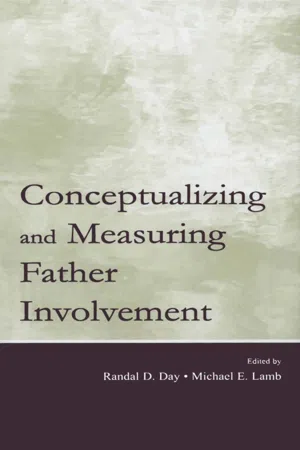
eBook - ePub
Conceptualizing and Measuring Father Involvement
- 474 pages
- English
- ePUB (mobile friendly)
- Available on iOS & Android
eBook - ePub
Conceptualizing and Measuring Father Involvement
About this book
Information
1
Conceptualizing and Measuring Father Involvement: Pathways, Problems, and Progress
Randal D.Day
Brigham Young University
Michael E.Lamb
National institute of Child Health and Human Development
Brigham Young University
Michael E.Lamb
National institute of Child Health and Human Development
This volume is the result of an invited conference of scholars studying father involvement (see Foreword) who were asked to reflect on the conceptualization and measurement of father involvement within the academic and policymaking communities. Our central motivation for organizing this workshop and the resulting volume was a belief that family scholars and policymakers could enhance their insight and impact, respectively, if they achieved greater conceptual clarity and developed more refined measures of men’s roles in family life.
By design, we brought together a broad multidisciplinary group. Represented at the conference were scholars from the disciplines of child development, family studies, sociology, demography, psychology, anthropology, and economics. Researchers who examine extensive national data sets as well as those who analyze smaller but more intensive ethnographic data sets or employ observational data collection techniques were all encouraged to share their work and ideas. As a result, the chapters in this volume sharpen our collective focus while setting an agenda for future research on the important and changing roles of men in families.
CONCEPTUALIZING FATHERHOOD
A few organizing ideas frequently surfaced during the conference and subsequent writing process. Those ideas helped to structure and organize many of the chapters that follow and thus merit articulation at this point. Most important, it is clear that how we conceptualize and assess father involvement reflects historical and social trends that, in turn, shape men’s beliefs about their family identities as well as other family members’ beliefs and views about men’s roles in family life. As a result, those beliefs that influence behavior within the family, as well as assessments of men’s activities and attitudes about those activities, constitute something of a moving target. In other words, at least from a research viewpoint, understanding men in families involves a dynamic process in which research agendas need to change as the protean nature of family life changes.
Not only have the cultural definitions of manhood and fatherhood shifted historically, but so too have men’s identities and their self-definitions of performance and fulfillment within their families changed over time (Pleck & Pleck, 1997). Furthermore, as we enter this new millennium, men’s identities within their families seem generally less certain than ever before, and researchers and opinion makers are discussing and questioning the roles men play in families to an unprecedented extent. Much of this public discourse is driven by the growing awareness that men’s involvement in their families can directly and indirectly affect the economic, physical, and psychological well-being of children. The authors of several chapters in this volume address the idea that family members (fathers in particular) create meaning within the context of their family activities. In several places, contributors focus on what it means to be involved, and how those meanings, morals, and ideals are transmitted from one generation to the next.
Most researchers, policymakers, and practitioners believe that when fathers are actively involved in family life (Doherty, 1997), family members are more likely to achieve their individual and family goals (Day, Gavazzi, & Acock, 2001). Although men can and do play special roles in family life, we do not subscribe to the notion that men’s influence in family life is “essential” and irreplaceable per se (see Silverstein & Auerbach, 1999, for a discussion of this idea). Instead, the scholars represented in this volume align with those researchers and practitioners who suggest that men’s behavior can powerfully affect the lives of others within the family units to which they belong. Within the subculture of the family, fathers play a key role in shaping the creation and communication of these practices and shared familial understandings. Therefore, we suggest that father involvement (like maternal involvement) is a compelling family process (Day et al., 2001) that helps us understand the inner workings of families and advances our insights about “relationship science” (Gottman, Levenson, & Woodin, 2002).
Several of the contributors also speak directly to the idea that broad political, economic, and social changes have effected significant changes in the inner life of family units and that the dynamics of how men interact with their spouses/partners, former spouses partners, children, and other family members must be explored in our quest to understand family life. These forces include changes in political ideology, cultural trends, and economic functioning. For example, economic changes have influenced the ways in which families organize their daily lives and how they cope with short-term changes of fortune as they encounter times of economic plenty or restriction, whether of national or individual origin.
Additionally, shifts in economic fortunes have realigned the intersection of men’s and women’s roles. When families were locked into economic production as a means of survival, cooperation and interdependence were essential. As Americans continue to embrace economic and psychological independence, the interdependence and necessity for cooperation are no longer necessary.
Rather dramatic shifts in family structure that have occurred over the last several decades have also attracted the attention of researchers, policymakers, and contributors to this book. In particular, the high rates of divorce, remarriage, and births to single mothers have all significantly affected our ideas about men in families, their expressed and understood responsibilities, and even their access to children.
Many contributors are also concerned with the effects of international and national political climates on men and, consequently, on their families. Two examples of the impact of global political events on family life are the century of war we just experienced and the war on vterrorism currently being waged following the events of September 11,2001. Millions of men, in a multitude of countries, and for years at a time were (and are) temporarily (or permanently) separated from their families because of war, threat of war, or the aftermath of conflict. At the national level, political decisions, such as the government policies and rules attendant to various welfare initiatives, have moved men away from or toward other family members.
As the role and texture of men’s lives change, federal and state governments have become more aware of the need to understand better what men do in their families. They have begun to realize the value of understanding how men contribute to family life because that contribution, in the final analysis, influences family economics and thus broad government policy. For example, policymakers know that it is critical to understand men’s economic roles in the family if they are to reduce welfare dependency.
Men’s ability and/or motivations to become and remain involved in family life, especially when children are involved, are often a function of economic conditions and cultural expectations. These conditions, expectations, and climates have shifted, changed, and oscillated dramatically during the last 350 years of American/Western history. For example, the shift from a self-sustaining, small-farm, agricultural economic structure to one that has evolved into first industrial, then technological, and now informational economic systems dramatically influenced the relationships among family members. In previous times, men wielded substantial economic power as they directed their resources to specific family members upon their death. In contemporary American society, by contrast, farm families struggle to encourage children to remain on the farm (Keating & Munro, 1989). Such changes in economic well-being have shifted men’s primary role from one of authority (i.e., control of land, resources, and production) to one of both economic support (in a more general way) and affection and emotional support (in a much more child-specific way) (Greven, 1970).
Any conceptualization and/or measurement of men in family life forces us to examine their power, control, and influence. By definition, power is linked to the control of resources, and most fathers have typically had such control (Mintz, 1998). The connection between financial and social capital as the basis of men’s power within family life has received considerable attention (Furstenberg, 1998; Furstenberg & Hughes, 1995), and those connections are mentioned several times in the chapters that follow. Several authors observe that men create social capital within the family context, consider how that capital is or can be distributed, and evaluate whether family members are willing to receive transfers of social and financial capital from fathers,
The cultural redefinition of fatherhood has also forced researchers to measure how power is formed and ultimately employed in families when men are restrained from using physical force. Several contributors illuminate how men can and do choose to be powerful forces for good within their families. Clearly, the source of influence with regard to economic well-being has changed but not vanished.
Overall, contemporary perspectives on fatherhood clearly underscore that the roles that fathers play in the lives of their own, their partners’, and their ex-partners’ children as well as in the lives of their partners and ex-partners are not only complexly multifaceted but also continuously shaped by a panoply of changing economic, ideological, sociological, and cultural factors and circumstances. The roles, their impact, and the factors that shape them are all explored in the chapters that follow.
CONCEPTUALIZING, MEASURING, AND ASSESSING FATHER INVOLVEMENT
Variations in men’s contributions to family life were not systematically studied until the last half—and especially the last 25 years—of the 20th century (Lamb, 1997). Within the most recent decade, however, this line of inquiry has blossomed and various researchers and practitioners have become interested in men’s lives within families, particularly the intensity of their involvement. For example, researchers have sought to define and assess the extent of men’s contributions to their families, whether and how the time that men and women spend in household duties and child care should or can be equalized, and how variations in men’s family commitments affect women’s ability to realize their personal potential in extrafamilial settings. Other researchers have searched for linkages between father involvement and child outcomes, while social commentators such as David Popenoe (1996) have begun to see the analysis of men’s roles in families as a leverage point for specific agendas that are simultaneously ideological, political, and economic. The professional landscape today is dotted with scholars and commentators focused on men’s lives, their interactions with women and children, and the distributive resource equality within the family and with clarion calls for more and better involvement with children. In this section, we briefly describe three of the most popular approaches to the study of father involvement and its impact.
The Binary Approach
Those who study men in families have taken a variety of approaches. At the end of World War II, for example, a few child psychologists began to wonder about the effects of men’s long-term absence on the psychological well-being of their children. Lois Stolz (1954) authored a book entitled Father Relations of War-Born Children in which she described a study of families in which the fathers were armed participants in World War II and were thus absent during the first year (at least) following the birth of the target children. Stolz used interviews with the fathers and mothers as a starting point and coded the children’s behavior during projective play evaluations. The responses of the father-absent children were compared with those of children in a control group, thereby providing an early example of the “binary” approach to the study of paternal influences in which conclusions about paternal roles and influences are determined by comparing the status of children raised with and without resident fathers (Lamb, 2000). Stolz’ work represents an important conceptual starting point because it is one of the few early studies in which fathers were not blamed for their absence. The geopolitical climate justified their absence, although it was still considered a significant event in the children’s lives.
Conceptually, Stolz’ research approach was simple: She considered whether fathers (including stepfathers, adoptive fathers, or live-in partners) were present in the children’s lives. In addition, with very few exceptions, what fathers did within the home was rarely examined. As Biller (1974) later declared, “In our society, men have been judged to be good fathers if they provide for their family economically, but the quality of father-child interactions has not been given enough attention” (p. 3). Indeed, Stolz was hesitant to speculate what fathers might contribute to their children’s overall well-being; The positive contribution made by their presence was simply assumed. Stolz mentioned the benefits of role identification, bread-winning, and family stability, but she did not explore the mechanisms of influence.
The binary approach to research remained popular into the 1970s (Lamb, 2000), although the reasons for paternal absence changed over time from war-related service to divorce; policymakers and politicians began to express concern about the rise in teen problem behaviors in the late 1950s and early 1960s. Driven by psychoanalytic thinking, much of the research until the late 1970s reflected the notion that men’s absence affected children’s sex role development, parental attachments, and psychological adjustment. In one of the first books written about men in families, for example, Biller (1974) proposed that “paternal deprivation, including patterns of inadequate fathering as well as father absence, is a highly significant factor in the development of serious psychological and social problems” (p. 1). Biller further argued that “paternal deprivation is a term that can be used to include various inadequacies in a child’s experience with his father” (p. 5). This approach has been labeled the deficit model in father research (Hawkins & Dollahite, 1997) because it focused primarily on the negative effects of father absence. During this era, few if any researchers systematically examined the ways in which men positively contribute to their children’s well-being.
Separation and Divorce
During the 1980s, many researchers began to explore how divorce (or any transition to father-lessness) influences child well-being. As Lamb (1986, 1997, 2000) summarized, five problems can arise when men are absent from families. First, the absence of one parent creates a “staffing” problem because the work within a home (e.g., child care, housework, leisure activities) can be done more effectively when two parents are available to participate. Second, divorce and other types of father absence (such as incarceration) often produce economic distress. Third, economic distress and the other pressures of single parenthood often create added levels of depression and emotional stress for single parents. Fourth, children are affected psychologically by actual and/or perceived abandonment when parents exit the home, Last, a still growing body of evidence confirms that marital and post-divorce interparental conflict has a “cancerous” effect on children’s well-being (Kelly, 2000; Stone, Buehler, & Barber, 2002).
Our understanding of the roles men play in the lives of their children took a conceptual leap forward during this period as researchers began to catalogue the processes that describe more accurately how father absence (and presence) affects family life and child development. Instead of asking only whether fathers were present or absent, researchers began to consider the many ways in which they might contribute or fail to contribute to their children’s development and adjustment.
Fathers, Mothers, and Children
Almost simultaneously, researchers began studying interactions among fathers, mothers, and children in the late 1970s. Like the second generation of studies concerned with variably absent fathers, these studies involved recognition that fathers could be present in varying ways and degrees. Researchers thus focused on what activities fathers actually performed with their children and partners and began to document associations between the type and extent of involvement, on the one hand, and variations in children’s characteristics and adjustment on the other. As a result, the father present-absent dichotomy became first an implicit continuum and then a variety of continua, as many of the chapters that follow make clear.
MEASUREMENT STRATEGIES
Researchers seeking to explore facets of father involvement and their diverse impacts on child development have exploited a variety of research strategies and data sets. In the 1990s, many students of fatherhood began to exploit large longitudinal and nationally representative data sets. Among the more prominent was the National Longitudinal Survey of Youth-1979 (NLSY-79) that has, for more than 20 years, been trackin...
Table of contents
- Cover Page
- Title Page
- Copyright Page
- Foreword
- Acknowledgments
- Contributors
- 1
- 2
- 3
- 4
- 5
- 6
- 7
- 8
- 9
- 10
- 11
- 12
- 13
- 14
- 15
- 16
- 17
- 18
Trusted by 375,005 students
Access to over 1.5 million titles for a fair monthly price.
Study more efficiently using our study tools.
Frequently asked questions
Yes, you can cancel anytime from the Subscription tab in your account settings on the Perlego website. Your subscription will stay active until the end of your current billing period. Learn how to cancel your subscription
No, books cannot be downloaded as external files, such as PDFs, for use outside of Perlego. However, you can download books within the Perlego app for offline reading on mobile or tablet. Learn how to download books offline
Perlego offers two plans: Essential and Complete
- Essential is ideal for learners and professionals who enjoy exploring a wide range of subjects. Access the Essential Library with 800,000+ trusted titles and best-sellers across business, personal growth, and the humanities. Includes unlimited reading time and Standard Read Aloud voice.
- Complete: Perfect for advanced learners and researchers needing full, unrestricted access. Unlock 1.5M+ books across hundreds of subjects, including academic and specialized titles. The Complete Plan also includes advanced features like Premium Read Aloud and Research Assistant.
We are an online textbook subscription service, where you can get access to an entire online library for less than the price of a single book per month. With over 1.5 million books across 990+ topics, we’ve got you covered! Learn about our mission
Look out for the read-aloud symbol on your next book to see if you can listen to it. The read-aloud tool reads text aloud for you, highlighting the text as it is being read. You can pause it, speed it up and slow it down. Learn more about Read Aloud
Yes! You can use the Perlego app on both iOS and Android devices to read anytime, anywhere — even offline. Perfect for commutes or when you’re on the go.
Please note we cannot support devices running on iOS 13 and Android 7 or earlier. Learn more about using the app
Please note we cannot support devices running on iOS 13 and Android 7 or earlier. Learn more about using the app
Yes, you can access Conceptualizing and Measuring Father Involvement by Randal D. Day, Michael E. Lamb, Randal D. Day,Michael E. Lamb in PDF and/or ePUB format, as well as other popular books in Psychology & Developmental Psychology. We have over 1.5 million books available in our catalogue for you to explore.