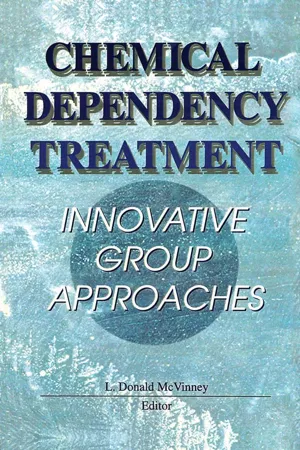
Chemical Dependency Treatment
eBook - ePub

Chemical Dependency Treatment

Innovative Group Approaches

  1. 132 pages
  2. English
  3. ePUB (mobile friendly)
  4. Available on iOS & Android
eBook - ePub

Chemical Dependency Treatment

Innovative Group Approaches

About this book

The most revolutionary, humanistic guide to counteracting chemical dependency on the market, Chemical Dependency Treatment: Innovative Group Approaches presents group models of intervention with substance using and chemically dependent clients across the continuum of care. In it, you'll find strategies that will help you engineer your own effective group interventions at different stages of the treatment process. Taking into account the ravaging nature of addiction and the rampant spread of AIDS, this book gives you the sensitivity and skills necessary to seek out the earliest possible healing for your beloved family and friends. In Chemical Dependency Treatment, you'll build upon existing literature on the subject of group work within the chemical dependency field. In doing so, you'll glean your own individualized expertise from this excellent collection of essays and qualify yourself to orchestrate compassionate and holistic chemical dependency interventions. You'll get detailed information about:

  • early community-based intervention for injected drug use (IDU)
  • the transition from inpatient to outpatient status for chemically dependent clients
  • psychoeducational help for chemically dependent gays and lesbians
  • strategies for hospital-based early recovery groups for HIV-infected inner-city clients
  • treatment during the early phases of outpatient therapy
  • outpatient group psychotherapy with cluster-B personality disordered men
  • multiple oppression in group psychotherapyIf you know someone who is chemically dependent, or if you're interested in becoming more informed about what your family or community can do to quell the epidemic of chemical dependency, Chemical Dependency Treatment will put you on the sure pathway to a more caring, more immediate group intervention.

Frequently asked questions

Yes, you can cancel anytime from the Subscription tab in your account settings on the Perlego website. Your subscription will stay active until the end of your current billing period. Learn how to cancel your subscription.
No, books cannot be downloaded as external files, such as PDFs, for use outside of Perlego. However, you can download books within the Perlego app for offline reading on mobile or tablet. Learn more here.
Perlego offers two plans: Essential and Complete
  • Essential is ideal for learners and professionals who enjoy exploring a wide range of subjects. Access the Essential Library with 800,000+ trusted titles and best-sellers across business, personal growth, and the humanities. Includes unlimited reading time and Standard Read Aloud voice.
  • Complete: Perfect for advanced learners and researchers needing full, unrestricted access. Unlock 1.4M+ books across hundreds of subjects, including academic and specialized titles. The Complete Plan also includes advanced features like Premium Read Aloud and Research Assistant.
Both plans are available with monthly, semester, or annual billing cycles.
We are an online textbook subscription service, where you can get access to an entire online library for less than the price of a single book per month. With over 1 million books across 1000+ topics, we’ve got you covered! Learn more here.
Look out for the read-aloud symbol on your next book to see if you can listen to it. The read-aloud tool reads text aloud for you, highlighting the text as it is being read. You can pause it, speed it up and slow it down. Learn more here.
Yes! You can use the Perlego app on both iOS or Android devices to read anytime, anywhere — even offline. Perfect for commutes or when you’re on the go.
Please note we cannot support devices running on iOS 13 and Android 7 or earlier. Learn more about using the app.
Yes, you can access Chemical Dependency Treatment by L Donald Mcvinney in PDF and/or ePUB format, as well as other popular books in Psychology & Addiction in Psychology. We have over one million books available in our catalogue for you to explore.

Information

Index

AA (Alcoholics Anonymous), 30-31, 71, 73
Abstinence
harm-reduction objective of, 10
HIV management and, 59
Action addictive behavior change stage, 8
Addiction
heterosexism connection to, 41-42
sociocultural explanations for, 39
ADHD (attention deficit hyperactivity disorder), 83-84
Affective support, 76
Affirmation, client motivation built upon, 15, 17, 18
African Americans. See Multiple oppression group psychotherapy model, for HIV clients
Alcohol abuse
changing perspectives on, 39-40
interventions for. See Inpatient psychoeducational group model, for gay men and lesbian women; Transition group model of outpatient care
personality disorders and, 82-83
See also Substance abuse
Alcoholics Anonymous (AA), 30-31, 71, 73
Alexithymia, 76
Ambivalence
of contemplation stage of addictive behavior change, 7, 14, 18
vs. denial, 15
positive perceptions of substance use and, 14-15
Antecedent-Behavior-Consequence paradigm, 16
Antisocial personality disorder
ADHD and, 83-84
belief systems of, 88, 89
group threat of, 91-92
over vs. underdeveloped strategies of, 92-93
risk-taking behavior and, 83
Attention deficit hyperactivity disorder (ADHD), 83-84
Behavioral support, 76, 77
Borderline personality disorder, 55
belief systems of, 88, 89
group anxiety of, 91
over vs. underdeveloped strategies of, 92-93
Case studies, of multiple oppression layers, 97-99
of African Americans, 98-99, 106-107, 108, 111-113, 114-115
of Latinos, 97-98, 104-105, 105-106, 110, 114
societal gender role discrimination, 106-107
Cognitive dissonance, group therapy technique of, 16-17
Cognitive support, 76
Cognitive-behavioral intervention strategies, 2
self-efficacy perception and, 26
Community-based agency setting model, for HIV/AIDS clients
action addictive behavior change stage and, 8
active abusers and, 1-2
conclusions regarding, 18-19
contemplation addictive behavior change stage and, 7, 14-15, 18
harm reduction model program development and, 9-10
client-centered principle of, 11
principles of, 10
social context deficiency of, 11-12
introduction to, 5-6
maintenance addicti...

Table of contents

  1. Cover
  2. Title Page
  3. Copyright Page
  4. Table of Contents
  5. About the Author
  6. Introduction
  7. Early Intervention with Active Drug and Alcohol Users in Community-Based Settings
  8. The Transition Group: Linking Clients with Alcohol Problems to Outpatient Care
  9. An Inpatient Psychoeducational Group Model for Gay Men and Lesbians with Alcohol and Drug Abuse Problems
  10. A Hospital-Based Early Recovery Group Program for HIV-infected Inner-City Clients: Engagement Strategies
  11. Group Treatment with Substance Abusing Clients: A Model of Treatment During the Early Phases of Outpatient Group Therapy
  12. Outpatient Group Psychotherapy with Chemically Dependent and Cluster-B Personality Disordered Male Clients
  13. The Model of Multiple Oppression in Group Psychotherapy with HIV-infected Injecting Drug Users
  14. Index