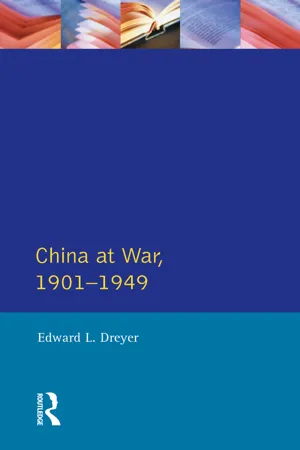
- 432 pages
- English
- ePUB (mobile friendly)
- Available on iOS & Android
eBook - ePub
China at War 1901-1949
About this book
Few phases of history were as heavy with implications for the world at large than the turbulent years through which China moved from the overthrow of the last imperial dynasty in 1911, through anarchy, civil war and invasion, to the final triumph of the Communists in 1949 - yet few periods are as little known by the wider world, and so little understood. Professor Dreyer's impressive account of China at war is both an important contribution to this new series of studies of modern wars in their full political, social and ideological contexts, and also a valuable introduction to the birth- confused, bloody and painful as it was - of the future superpower.
1 Military Reform and Revolution, 1901–11
Empress Dowager Tz’u-hsi, who had been the de facto ruler of China since 1862, concluded in 1901 that comprehensive reform and modernization were necessary to preserve Manchu-ruled China from partition. This belated conclusion followed her return to Peking in 1901, after her forced flight from the expeditionary force sent by the Great Powers to suppress the Boxer Rebellion, a nativist attack on foreign influence that she had originally supported. The moment was not propitious; among other things, the Boxer Rebellion had resulted in a huge reparations debt to the Great Powers, so that funding for any new projects was precarious. Nevertheless, the years down to the death of Tz’u-hsi in 1908 saw the creation of a powerful and Western-appearing military force, the Peiyang Army, which in turn was the centrepiece of a general reconstruction of China’s military system. The price of reform, however, was the destruction of the traditional institutions that had maintained the Manchu Ch’ing dynasty for over two centuries. In the revolution of 1911, the modern army turned against the dynasty, while the remnants of the old-style forces fought in its defence. By turning against its creators the modern army made the 1911 revolution possible, and by dividing into warring factions the army caused the failure of the republican experiment. The civil wars that lasted until 1949 were thus an unforeseen legacy of military modernization.
Traditional Military Forces and Nineteenth-Century Regionalism
In 1644 the native Chinese Ming dynasty, which had ruled since 1368, was overthrown by the Manchus, whose pretensions to empire dated to 1616 and who had adopted the Chinese-style dynastic name Ta Ch’ing (Great Pure). The Manchus were a people related to the Mongols, like them nomadic and speaking a language of the Ural-Altaic group, with no affinities to Chinese. They were native to the region now constituting the three northeastern provinces of China, known to the Chinese simply as the northeast (tung-pei), but often called Manchuria by foreigners. The first two Manchu emperors created a state in Manchuria in which Mongol and Chinese collaborators participated on equal terms with the Manchus. In 1644 Manchu rule seemed preferable, to many in the Ming dynasty elite, to the rule of the peasant rebels who had undermined the Ming. In the following decades the Ch’ing dynasty conquered all of the rest of China, and imposed the Manchu hairstyle (‘queue’: the front of the head is shaved, and the hair grows long in the back and is braided into a pigtail) on the Chinese as a visible symbol of submission.1
In the mature Ch’ing dynasty system, Manchu and Chinese personnel and civil and military elements checked and balanced one another, leaving all important initiative to the throne. Coupled with the general acceptance of the Manchu claim to be the legitimate protectors of Chinese civilization, the resulting system proved highly durable.2 Its military expression was a dual army: the Eight Banners (pa-ch’i) and the Army of the Green Standard (lü-ying).
The Eight Banners were the descendants of the original Manchu conquerors, and of certain Mongols and Chinese who had joined the Manchus before 1644. Each of the twenty-four Banner units (eight for each of the three national divisions) was divided into regiments and companies. Membership in each company was hereditary, with fathers required to serve until their sons were grown, and expeditionary forces were often constituted by drafting a stated number of men from each company. In the earlier phase of the dynasty, Banner forces usually fought on horseback, with artillerists coming from the Chinese bannermen. However, after the fall of Peking, most of the Banner forces were moved there, to constitute the dynasty’s ultimate military reserve. Small Banner garrisons were also placed in a few important cities, most of which were also capitals of governors-general. Despite imperial exhortations, the fighting qualities of the Banner forces gradually deteriorated, and by the time of the White Lotus rebellion (1796–1804) the Banner forces no longer had much fighting value.3
The original Green Standard troops were the soldiers of the Chinese military commanders who surrendered to the Ch’ing in 1644 and after. Their troops enlisted voluntarily and for long terms of service; they usually came from the socially disadvantaged, and remained segregated from Chinese society, partly because of the latter’s deep anti-military bias, and partly because they were paid too poorly and irregularly to marry and support a family. The contempt in which soldiers were held, expressed in the often repeated ditty ‘good iron is not made into nails, good men are not made into soldiers’, extended to their officers as well, since most Green Standard officers were promoted from the ranks, and this attitude has greatly hindered China’s efforts at military modernization. Typically, Green Standard troops outnumbered bannermen by about two to one (approximately 600,000 to 300,000), but from the eighteenth century on the Green Standard army was divided into garrisons of battalion size, reporting through regional brigade generals (tsung-ping) to commanders-in-chief (t’i-tu) in each province, who nominally were on the same level of authority as the Banner generals and the civilian governors-general and governors.
During most of the Ch’ing dynasty, the eighteen provinces of China proper were ruled over by sixteen governors (hsun-fu), most of whom were subordinated in pairs to one of the eight governors-general (tsung-tu). These high officials represented the civilian element in the system of checks and balances, and originally most governorships went to Chinese and most governor-generalships to Manchus, thus preserving the ethnic balance also found in the two armies and in the major organs of government in Peking. Governors-general and governors each had a battalion of Green Standard troops under their personal command, but their primary duties as civil administrators lay in the judicial and revenue areas; coping with invasion or rebellion was the duty of Banner generals and Green Standard commanders-in-chief.
By 1800 both the Banner forces and the Green Standard armies had declined to a low level of military effectiveness, as was shown in both the Opium War (1839–42) and the Taiping rebellion (1851–66).
The Opium War was provoked by Britain in order to open China to trade. It inaugurated the period of the Unequal Treaties (lasting in law until 1943), during which China lost her tariff autonomy and submitted to the creation of numerous enclaves (treaty ports, of which Shanghai was the most important) characterized by foreign legal jurisdiction (extraterritoriality) and military control. The Opium War also indicated the extreme vulnerability of China to sea power, since China gave up when the British fleet sailed up the Yangtze to Nanking, thus interdicting the Grand Canal route from the lower Yangtze on which Peking depended. Nevertheless, and in stark contrast to Japan, defeat by a much more advanced foreign power actually had little impact on Chinese society prior to 1900. The technology of steamships, rifled cannon and exploding shells was so advanced and alien that it seemed like magic. Chinese modernizers afterwards viewed such things essentially as icons, whose mere possession was a guarantee of efficacy. As Chinese officials came to understand the rivalries among the Western powers, the venerable Chinese diplomatic tradition of ‘using barbarians to control barbarians’ (yi-yi chih-yi) came into play. The combination of purchasing advanced technology and ‘barbarian management’, in other words, kept the impact of the West decisively marginalized until 1900. This was so despite Chinese defeats in the Arrow War (1856–60, including the Anglo-French occupation of Peking and destruction of the Summer Palace in 1860), the Sino-French War (1884–5) and the First Sino-Japanese War (1894–5).4
The Taiping rebellion, on the other hand, mobilized millions of Chinese in opposition to the Ch’ing dynasty and to the Confucian intellectual foundations of Chinese civilization. Such a profound threat to Manchu rule, affecting the most heavily populated areas of China, obviously had to be suppressed, even if the price was institutional reform. The solution that ultimately emerged was the creation of the so-called ‘militia armies’. Unlike the Green Standard forces, these were recruited from the more prosperous peasantry by means of clan and family ties. They were officered by the lower ranks of the degree holding ‘gentry’ (shen-shih) – a class that normally held aloof from military service – and commanded at the higher levels by governors and governors-general who in turn had been appointed because of their ability to raise and lead troops. The most important militia armies were the Hunan Army of Tseng Kuo-fan (d. 1872), the Fukien Army of Tso Tsung-t’ang (d. 1885) and the Anhwei Army of Li Hung-chang (d. 1901). Funding of these armies was precarious, depending heavily on the internal transit duties (likin) that had sprung up in the wake of the rebellion.5
The militia armies remained in existence after the effective end of the Taiping rebellion (1864). Parts of them were sent elsewhere in the empire to suppress other rebellions. Since the chain of command in the militia armies depended heavily on personal, rather than institutional, loyalties, transferring an army to a new area effectively ceded civil authority there to the army’s commander. The militia armies were equipped with a mixture of traditional and modern weapons, and their commanders advocated military modernization. During the ‘self-strengthening’ period of the 1860s, the militia army leaders had some success, sponsoring the translation of Western works, the purchase of foreign steamships and weapons, and the creation of two major installations – the Kiangnan Arsenal and the Foochow Shipyard – with military importance. The self-strengtheners were able to suppress the other local rebellions, essentially through traditional techniques of Chinese statecraft. Tso Tsung-t’ang reconquered Sinkiang and bluffed Russia into withdrawing in the 1880s. In the Sino-French War the Chinese actually won the land battles, even though her naval defeat in Foochow harbour meant the loss of the war.
In effect, the Taiping rebellion had demonstrated the obsolescence of the traditional military forces and had placed effective military authority in the provinces in the hands of the civil governors. This meant the destruction of the traditional checks and balances, which was acceptable since the official class headed by those governors had demonstrated its loyalty to the dynasty during the rebellion. The resulting pattern of political-military power is usually called ‘regionalism’. Anhwei Army creator Li Hung-chang was its most important exemplar. At the height of his influence in the 1880s and 1890s he usually controlled five major provinces: Chihli (later renamed Hopei) directly as governor-general, Shantung through a colleague, and the three Yangtze provinces of Kiangsu, Anhwei and Kiangsi often through his brother Li Han-chang as governor-general at Nanking. Li used the customs and tax revenues of the provinces under his control to modernize segments of the Anhwei Army, and to build a modern navy (the Peiyang Fleet), which was destroyed in the course of the first Sino-Japanese War (Peiyang, meaning literally ‘Northern Ocean’, refers to the customs revenues collected in North China, which were used to fund first the Peiyang Fleet and later the Peiyang Army).
Devolution of military power to the provinces, military authority resting on personal loyalties, and irregular local funding of military forces all were characteristics of the warlord period (and of periods of dynastic breakdown in previous Chinese history). Regionalism was thus in a certain sense the precursor of warlordism. The important difference was that the regionalist governors remained civil officials, no matter how much military authority they wielded, or for how long. For over two thousand years Chinese civil officials had been the products of an educational system based on the classical books of Confucianism. In both the Ming and the Ch’ing, civil official status depended on written examinations that tested not only knowledge of the classics but also the composition of poetry and prose. The regional leaders remained products of this education and examination system, which internalized the Confucian values, including both loyalty to the throne and disdain for soldiers. The throne itself was manipulated by the Empress Dowager, who had seized power in 1862 as regent for her son Emperor T’ung-chih (r. 1862–74) following the death of her husband Emperor Hsien-feng (r. 1851–61). She was embittered all her life against the West and its works because of the sack of Peking and the burning of the Summer Palace that followed the Ch’ing defeat in the Arrow War (1856–60). For her, regionalism was a way of adopting what was absolutely needed from the West while keeping the West at a distance.
Unfortunately, regionalism prevented the systematic modernization of China’s military and naval forces. Instead of a single army and a single navy, China entered the Sino-Japanese War with four navies, of which only the Peiyang Fleet had modern ships, and numerous different armies. The war was fought by Li Hung-chang’s forces, unsupported by the forces of other provinces, just as Li Hung-chang had kept his forces out of the Sino-French War. In the war the Peiyang Fleet, which included two pre-Dreadnought battleships, was overwhelmed by the well-served quick-firing guns of a lighter Japanese fleet that included no battleships.6 On land similarly Japan’s German-inspired conscript army, led by academy-trained professional officers, defeated China’s best regionalist troops.7 China’s defeat surprised the world and suggested that China was ripe for partitioning, which the Japanese inaugurated by annexing Taiwan. From 1895 on, the creation of a modern, unified national state as the basis for military power was high on the agenda of Chinese political reformers. In fact the legacy of regionalism prevented this before 1949, and the Empress Dowager was not converted to the necessity of reform until 1901.
Between 1895 and 1901, the pattern of regionalism persisted, despite growing pressures for reform from the Confucian literati class. K’ang Yu-wei (d. 1927), a brilliant intellectual who attempted to create a revisionist Confucianism to serve as the basis for the systematic reform of Chinese society, emerged as the leader of the reform movement. He and his followers were briefly in power in the summer of 1898, with the support of Emperor Kuang-hsu (r. 1875–1908), the cousin of T’ung-chih whom the Empress Dowager had adopted as her son. They envisaged a comprehensive overhaul of Ch’ing institutions, modelled on the career of Peter the Great of Russia (1689–1725). The Empress Dowager’s coup (22 September 1898) against the Emperor ended these plans. The reformers fled or were executed...
Table of contents
- Cover
- Half Title
- Title Page
- Copyright Page
- Table of Contents
- List of maps
- Dedication
- Introduction
- 1. Military reform and revolution, 1901–11
- 2. Peiyang Army ascendancy, 1911–19
- 3. High Warlordism, 1919–25
- 4. The Northern Expedition, 1925–31
- 5. Diseases of skin and heart, 1931–7
- 6. The Sino-Japanese War, 1937–41
- 7. China and the Second World War, 1941–5
- 8. The Chinese Civil War, 1945–9
- Conclusion
- Chronology
- Bibliography
- Index
Trusted by 375,005 students
Access to over 1.5 million titles for a fair monthly price.
Study more efficiently using our study tools.
Frequently asked questions
Yes, you can cancel anytime from the Subscription tab in your account settings on the Perlego website. Your subscription will stay active until the end of your current billing period. Learn how to cancel your subscription
No, books cannot be downloaded as external files, such as PDFs, for use outside of Perlego. However, you can download books within the Perlego app for offline reading on mobile or tablet. Learn how to download books offline
Perlego offers two plans: Essential and Complete
- Essential is ideal for learners and professionals who enjoy exploring a wide range of subjects. Access the Essential Library with 800,000+ trusted titles and best-sellers across business, personal growth, and the humanities. Includes unlimited reading time and Standard Read Aloud voice.
- Complete: Perfect for advanced learners and researchers needing full, unrestricted access. Unlock 1.5M+ books across hundreds of subjects, including academic and specialized titles. The Complete Plan also includes advanced features like Premium Read Aloud and Research Assistant.
We are an online textbook subscription service, where you can get access to an entire online library for less than the price of a single book per month. With over 1.5 million books across 990+ topics, we’ve got you covered! Learn about our mission
Look out for the read-aloud symbol on your next book to see if you can listen to it. The read-aloud tool reads text aloud for you, highlighting the text as it is being read. You can pause it, speed it up and slow it down. Learn more about Read Aloud
Yes! You can use the Perlego app on both iOS and Android devices to read anytime, anywhere — even offline. Perfect for commutes or when you’re on the go.
Please note we cannot support devices running on iOS 13 and Android 7 or earlier. Learn more about using the app
Please note we cannot support devices running on iOS 13 and Android 7 or earlier. Learn more about using the app
Yes, you can access China at War 1901-1949 by Edward L. Dreyer in PDF and/or ePUB format, as well as other popular books in History & Chinese History. We have over 1.5 million books available in our catalogue for you to explore.