- 106 pages
- English
- ePUB (mobile friendly)
- Available on iOS & Android
eBook - ePub
Solar Photovoltaics Business Briefing
About this book
This book explains, for a UK business audience, the technical, scientific and economic aspects of solar photovoltaics (PV) technologies. It is useful to anyone considering a business use of solar PV, whether an investor, potential purchaser, or thinking of setting up a company in the sector.It succinctly examines: their applications and how to assess them; the prospects and drivers for cost reductions and implementation; the role of PV in carbon offsetting; and the business case for and against investment.It will arm the reader with sufficient knowledge to talk to contractors or to compile a business investment case for senior management.PV is the sunrise sector for electricity generation; the renewable technology whose time has come. Clean, and with no moving parts to wear out, it interfaces neatly with other technologies, both digital and analogue. Cost curves are decreasing and installation curves exponentially rising. Although silicon-based cells are well-known, due to the feed-in tariff support they receive, within the next five to eight years, lowering production costs and technological innovations will mean that solar electricity will be poised to find even more widespread applications.
Chapter 1
About This Book
THIS PUBLICATION OUTLINES, for a UK business audience: the technical and scientific basis of PV technologies; their applications and how to assess them; the prospects and drivers for cost reductions and implementation; and the business case for and against investment.
1.1 Who it is for
This report should be useful to anyone considering a business use of solar PV. This might be an investor; someone considering installing a system; someone considering PV for carbon offset purposes; or someone considering setting up a solar PV business. It should enable the reader to have sufficient knowledge to, for example, either talk to contractors, or to set about making a business case for investment to senior management.

1.2 Introduction
Solar photovoltaics (PV) is the sunrise sector for electricity generation – the renewable technology whose time has come. Clean and with no moving parts to wear out, they interface neatly with other technologies in our digital world. Cost curves are decreasing and installation curves exponentially rising over a three-decade timescale.
Although silicon-based cells are already well-known, due to the Feed-in Tariffs support they receive, within the next five to eight years lowering production costs and technological innovations will mean that solar electricity will be poised to find even more widespread applications. Some of these will be distributed grid-feeding installations on many new and retrofit buildings in the business sector in the UK, others will be niche applications; at a utility scale, most will be in the sunniest parts of the world.
1.3 Energy basics
It’s helpful to have a basic understanding on energy and power.
- The amount of electricity in a circuit is measured in volts.
- The force of the electrical flow, or current, is measured in amps.
- The power in a circuit is defined by volts times amps, and called a watt. W = V x A.
- A watt (W) is therefore the unit of power or the rate at which work is done when one ampere (A) of current flows through an electrical potential difference of one volt (V).
- 1000 watts is a kilowatt (kW).
- Energy is the amount of power produced by a generator or consumed by an appliance or over a period of time. Its unit is the watt-hour (Wh).
- 1000 watt-hours is a kilowatt-hour (kWh), commonly a unit of electricity on an electricity bill. It is the rate of generation or consumption of power.
- An alternative unit for this is the joule (J). 3600 joules = 1 Wh. A joule is also one watt per second, since there are 3600 seconds in an hour; or 3.6 megajoules (MJ) = 1kWh.
For example:
- One PV solar panel producing 80W for two hours, or two panels producing 80 W for one hour would produce 2 x 80 = 160 Wh.
- Three panels producing 90 W for five hours will produce 3 x 90 x 5 = 1350 Wh or 1.35 kWh.
Chapter 2
What is Solar Power?
ALL LIFE ON EARTH owes its existence to the energy coming from the sun. It powers the weather and hence all forms of renewable energy. Plants convert its energy using photosynthesis into biomass, and all fossil fuels are derived from prehistoric biomass.
2.1 How much energy is there?
Books on solar energy often say something like: ‘In less than two hours, enough energy reaches the Earth’s surface from the sun to satisfy humanity’s current energy needs for a whole year.’ But of course we can’t use all that solar energy. The real question is: how much can we use, and where?
The answer is highly site-specific, to do with the latitude, climate and much more. The edge of the Earth’s atmosphere receives 174 petawatts (PW) of solar radiation (or insolation), otherwise written as 1.74 x 10¹⁷ W. This figure is called the ‘solar constant’. About half of this reaches the Earth’s surface; 5800 times humanity’s average energy consumption rate of 15 terawatts (1.5 x 10¹³ W).
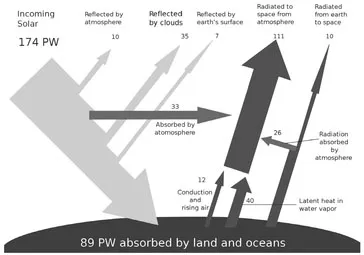
FIGURE 2.1a. Solar irradiation and where it goes within the Earth’s ecosystem.
How much each location receives varies over the year because of the tilt of the Earth’s axis. This gives rise to the seasons, as first one hemisphere and then the other receives more solar energy.
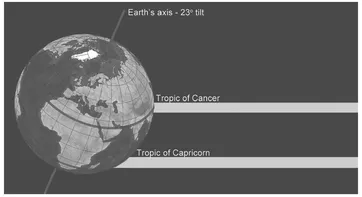
FIGURE 2.1b. The effect of the Earth’s tilt on surface insolation.
Arid and hot areas, known as the ‘sun belt’, are best suited to many forms of solar power, because of the direct, year-long sunlight and little cloud cover.
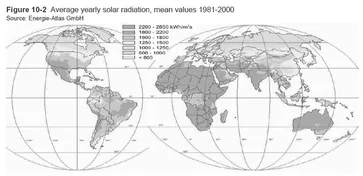
FIGURE 2.1C. Global insolation averages. SOURCE: Energie-Atlas GmbH.
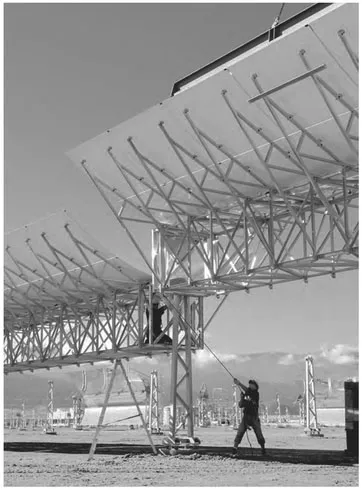
FIGURE 2.1d: Andasol solar thermal power station, Spain.
Higher altitude also has advantages because less energy has been lost in the atmosphere. For example, the new €350 million Andasol solar thermal farm in Spain, with 600,000 parabolic sun-tracking mirrors, is located on the Guadix plateau 1100 meters above sea level because it receives 2000 hours of sunlight per year.
Electricity is not the only way to use the energy of the sunshine. It can also be used:
- to heat or cool water (solar thermal)
- to heat or cool buildings (solar architecture, sometimes known as passive solar design)
- or indirectly by exploiting wind power, hydroelectric power, marine energy such as wave and tidal power, burning biomass or using heat pumps. All of these are indirectly driven by the sun’s heat either causing thermal currents or being stored in plants or the Earth’s mass.
2.2 Solar electricity
Electricity is the most versatile form of power that we know of. There are several ways of turning sunshine into electricity as well as PV, some of which use the sun’s light wavelengths and some of which use its heat (thermal wavelengths). The principal technologies are:
- photovoltaic (PV) (using its light);
- concentrating solar thermal power (CSP) (using its heat);
- solar towers (using its heat);
- ther...
Table of contents
- Cover
- Title
- Copyright
- Contents
- 1 About This Book
- 2 What is Solar Power?
- 3 The Photovoltaic Effect
- 4 Applications
- 5 The Cost of PV Systems
- 6 Planning a Solar Installation
- 7 Investing in PV
- 8 Sources of Information
- Decision Tree
- About the Author
Trusted by 375,005 students
Access to over 1.5 million titles for a fair monthly price.
Study more efficiently using our study tools.
Frequently asked questions
Yes, you can cancel anytime from the Subscription tab in your account settings on the Perlego website. Your subscription will stay active until the end of your current billing period. Learn how to cancel your subscription
No, books cannot be downloaded as external files, such as PDFs, for use outside of Perlego. However, you can download books within the Perlego app for offline reading on mobile or tablet. Learn how to download books offline
Perlego offers two plans: Essential and Complete
- Essential is ideal for learners and professionals who enjoy exploring a wide range of subjects. Access the Essential Library with 800,000+ trusted titles and best-sellers across business, personal growth, and the humanities. Includes unlimited reading time and Standard Read Aloud voice.
- Complete: Perfect for advanced learners and researchers needing full, unrestricted access. Unlock 1.5M+ books across hundreds of subjects, including academic and specialized titles. The Complete Plan also includes advanced features like Premium Read Aloud and Research Assistant.
We are an online textbook subscription service, where you can get access to an entire online library for less than the price of a single book per month. With over 1.5 million books across 990+ topics, we’ve got you covered! Learn about our mission
Look out for the read-aloud symbol on your next book to see if you can listen to it. The read-aloud tool reads text aloud for you, highlighting the text as it is being read. You can pause it, speed it up and slow it down. Learn more about Read Aloud
Yes! You can use the Perlego app on both iOS and Android devices to read anytime, anywhere — even offline. Perfect for commutes or when you’re on the go.
Please note we cannot support devices running on iOS 13 and Android 7 or earlier. Learn more about using the app
Please note we cannot support devices running on iOS 13 and Android 7 or earlier. Learn more about using the app
Yes, you can access Solar Photovoltaics Business Briefing by David Thorpe in PDF and/or ePUB format, as well as other popular books in Business & Business Ethics. We have over 1.5 million books available in our catalogue for you to explore.