Despite the messages we hear from social scientists, policymakers, and the media, black Americans do in fact get married—and many of these marriages last for decades. Marriage in Black offers a progressive perspective on black marriage that rejects talk of black relationship "pathology" in order to provide an understanding of enduring black marriage that is richly lived. The authors offer an in-depth investigation of details and contexts of black married life, and seek to empower black married couples whose intimate relationships run contrary to common—but often inaccurate—stereotypes. Considering historical influences from Antebellum slavery onward, this book investigates contemporary married life among more than 60 couples born after the passage of the Civil Rights Act. Husbands and wives tell their stories, from how they met, to how they decided to marry, to what their life is like five years after the wedding and beyond. Their stories reveal the experiences of the American-born and of black immigrants from Africa or the Caribbean, with explorations of the "ideal" marriage, parenting, finances, work, conflict, the criminal justice system, religion, and race. These couples show us that black family life has richness that belies common stereotypes, with substantial variation in couples' experiences based on social class, country of origin, gender, religiosity, and family characteristics.
eBook - ePub
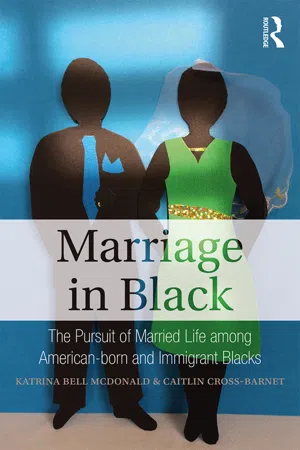
Marriage in Black
The Pursuit of Married Life among American-born and Immigrant Blacks
- 198 pages
- English
- ePUB (mobile friendly)
- Available on iOS & Android
eBook - ePub
Marriage in Black
The Pursuit of Married Life among American-born and Immigrant Blacks
About this book
Trusted by 375,005 students
Access to over 1.5 million titles for a fair monthly price.
Study more efficiently using our study tools.
Information
Subtopic
African American StudiesIndex
Social Sciences1
THE SOCIO-HISTORICAL UNSHACKLING OF AFRICAN-AMERICAN RELATIONSHIPS
Marvin and Jennifer Johnson, an American-born black couple, met at a local college, where they both studied areas of social work and justice. They now have three healthy daughters, and Jennifer is pregnant again with a boy. They have just a bought a new house in the city where they can raise their growing family. Although they fought frequently before they married, Jennifer said, “It just feels like God has moved in our marriage.” Now they rarely argue. Jennifer believes female submission is essential to a successful marriage, and that women prioritizing work or school over family responsibilities are selfish. She said that black women in particular need to give up the role of the “power woman.” Jennifer runs a small business from their home and occasionally takes a substitute teaching shift, but Marvin is the primary breadwinner, working two jobs. While Jennifer extolled submission, Marvin spoke of their marriage as a partnership and said it is important for spouses to have an equal role in everything. Jennifer agreed that “we always end up coming together” on resolving problems and making decisions. Especially now that Jennifer is at the end of her pregnancy, Marvin cleans, does laundry, bathes the children, and goes shopping, and said he loves doing it. Marvin said, “I wouldn’t trade being married to Jennifer and raising a family together for anything in the world.”
When Anthony and Ava Tompkins first met, Ava said, God told her that Anthony was to be her husband. Now, married for about eight years and raising two daughters in a spacious house in the suburbs, the Tompkins said that marriage has gotten better every year since the wedding. Ava, born and raised in Bermuda, remains devoted to “family first.” Anthony, who has Caribbean parents but was born and raised in the United States, agreed he was self-centered in the early years, but he has come to embrace Ava’s family values, especially now that they are parents. He believes they play similar roles in the marriage and that’s how it should be. His younger daughter attends daycare at the university where he coaches, and he picks up his older daughter from school on his way home. Ava, who arrives home first and cooks dinner, believes in traditional roles for women in general, but not for herself. She loves her job teaching high school, and she loves being the family’s primary breadwinner. “If Anthony makes more, I’m like, I will make more,” she said. “I will fight hard to make more.” When it comes to marriage, she said, “My ideal is the man should lead,” then added, “[but] I’m to be his advisor if there’s a decision to be made. I’m there to give my opinion whether it’s wanted or not.”
Danny and Alena Chebet met at their church in Kenya when Alena was 17 years old, five years before their marriage. Under pressure from their families, the two married about six months after their first child was born and soon after Alena finished college. Two more children followed. Alena explained that children complete their marital picture and help with the “gloomy days”; there is a strong sense that their marriage is inseparable from the children and their parenting roles. They moved to the United States, where Danny had family members and where he felt he could pursue his dreams. Alena has her master’s and a steady income, but Danny’s work schedule and income fluctuate. He tries to work more so that he will earn more than Alena. Danny said that if they had remained in Kenya, there would be a lot of family pressure for Alena not to work, and he thinks this would be unpleasant. He does, however, wish that she could stay home in the United States so that she could raise their children with better “moral values” that those he sees in American families. Alena said that she tends to have more of an ideal regarding marriage. She thinks more in terms of “don’ts” and sometimes compares Danny to her father, whose authoritarian marriage style she did not like: “I want to have some say in getting that final word.”
Andrew and Michelle Waller, a white couple, laugh at couples with traditional values and see the average marriage as boring and routine. Michelle works the night shift three days a week as a nurse for an inner-city hospital. Andrew does bookkeeping full time and is taking classes to advance his career. Michelle became pregnant shortly after they met. Neither had attended college when they married, and their older daughter was born shortly after their wedding, when Michelle was 19 and Andrew was 20. Their second daughter was born four years later. Michelle wanted to be home with the girls when they were small, and Andrew was worried when she began nursing school that she would no longer need him as a provider. They earn similar incomes now even though Michelle does not work full-time, and they were able to purchase a tiny, well-kept house outside the city. Although they profess to split responsibilities in half, Michelle seems to do the bulk of the cooking, cleaning, and management of the girls’ lives; Andrew talked about grilling. Andrew is focused on increasing his earning power so that Michelle will not bring in the bigger paycheck when she switches to full-time work in the next couple of years. They said they fight a lot—it’s in their “nature”—and often don’t see each other for days at a time because of their work schedules. At the same time, they agreed that they are each other’s best friend and would never leave each other because they are very happy.
This will not be your typical journey through the analysis of dismal statistics on the status of black1 marriages in America. Neither will it be a purely celebratory tale steeped in Afrocentrism that ignores what underlies black marital trends, especially the trends of non-marriage and divorce. There is no denying that black married couples are at greater risk of divorce than couples from other racial-ethnic groups2 and that currently only about 31% of blacks are married (versus 48% for Hispanics and 55% for whites).3 It is also a fact, however, that black marriage has survived—through the transatlantic slave trade, Reconstruction, lynching, political disenfranchisement, and fierce racial segregation that persists to the present day in the United States. And despite all of these barriers, blacks are just as intent as other groups on marrying at some point in their lives.4 The black couples introduced above offer the kind of heterosexual marriage stories we seek to illuminate.
We wish to flip the script. Virtually all discussions of contemporary black heterosexual marriage focus on the failure to marry, the negative consequences of relationship instability, or marital dissolution. The literature explores such subjects as why black women choose single motherhood, why black fathers do not stick around for the long haul, why black couples who cohabit don’t marry, and how extended kin networks operate in lieu of the nuclear family arrangement and with less success. Numerous examples of such research and commentary abound.5 In 2001, Bachand and Caron wrote, “[w]hile an abundance of literature exists on the marital relationship, most focuses on divorce and the consequences of divorce in our society” (161);6 this is all the more true in literature that considers black marriages. The intense focus on difficulties in getting or staying married has precluded direct investigation into determining what may provide for black marital longevity or for black marital contentment. This leaves us with a limited understanding of the world of black marriage and desensitizes us to the world of black couples who remain married despite their struggles. Thus, Marriage in Black contributes to a shift in sociological research towards examining contemporary black marriages currently in place.
Public policy has been focused on promoting “healthy” marriage, beginning with the enactment of the 1996 welfare reform law,7 a law directed largely at poor black women. Child outcomes have often been central to considering the health of black marriages, though the focus is most commonly on how parents negatively impact the health and welfare of their children.8 Despite the interest in promoting marriage among black Americans, definitions of healthy marriage have not considered that the concept of marital “health” may not be universal. There has been little attention given to the diversity of black marital life, primarily because few scholars acknowledge the diversity of black origins and black experience in the United States, neglecting immigration, integration, and inequality within the black population.9 Much of this is due to an abundance of scholarship on marriage across socioeconomic or class lines where poverty and child outcomes tend to take a front seat.10 In almost all of these cases, blacks are generally treated as a monolithic cultural population.
So, in this book we make an attempt at balance—a vision of contemporary, heterosexual black marital life that ebbs and flows. We proceed from the progressive perspective on black marriage that suggests that we would do best to move away from talk of black relationship “pathology” in order to offer greater understanding of how personal decisions and structural social forces can lead to black marriage that is richly lived.
We strongly argue that the experience of black marriage is not only culturally different from marriages among other racial-ethnic groups in America, but also among black couples with different ethnic origins. Blacks are most commonly discussed as though they are a homogenous racial mass with no variation in ethnic and cultural substance. Yet historical and contemporary immigration patterns dictate that the study of black marital life in the United States must at least incorporate those African- and Caribbean-born, the two largest black immigrant groups in the United States. Recent migration from Africa has resulted in the fastest growth in the African-born population of the United States in the past four decades.11 According to the New York Times, “more (Africans) have arrived voluntarily than the total who disembarked in chains before the United States outlawed international slave trafficking in 1807.”12 Still, half of black immigrants hail from the countries of the Caribbean.13
Demographic changes in African-American marriage and in ...
Table of contents
- Cover
- Half-Title
- Title
- Copyright
- Dedication
- Contents
- ACKNOWLEDGEMENTS
- Chapter 1 The Socio-Historical Unshackling of African-American Relationships
- Chapter 2 A Long View of Black Marriage
- Chapter 3 Black Marital Beginnings
- Chapter 4 Men and Women, Husbands and Wives: New Perspectives on Egalitarianism
- Chapter 5 Contemporary Black Marriage and Parenting
- Chapter 6 Is Marriage for Black People? Ethnic Perceptions of Blacks and the Institution of Marriage
- Chapter 7 Sex, Money, and Beyond: Conflict in Contemporary Black Marriages
- Chapter 8 A New Lens on Black Marriage
- APPENDIX A: THE STUDY COUPLES
- APPENDIX B: CONTEMPORARY BLACK MARRIAGE STUDY RESEARCH METHODOLOGY
- APPENDIX C: INTERVIEW FIELD GUIDE: THE CONTEMPORARY BLACK MARRIAGE STUDY
- AUTHOR INDEX
- SUBJECT INDEX
Frequently asked questions
Yes, you can cancel anytime from the Subscription tab in your account settings on the Perlego website. Your subscription will stay active until the end of your current billing period. Learn how to cancel your subscription
No, books cannot be downloaded as external files, such as PDFs, for use outside of Perlego. However, you can download books within the Perlego app for offline reading on mobile or tablet. Learn how to download books offline
Perlego offers two plans: Essential and Complete
- Essential is ideal for learners and professionals who enjoy exploring a wide range of subjects. Access the Essential Library with 800,000+ trusted titles and best-sellers across business, personal growth, and the humanities. Includes unlimited reading time and Standard Read Aloud voice.
- Complete: Perfect for advanced learners and researchers needing full, unrestricted access. Unlock 1.5M+ books across hundreds of subjects, including academic and specialized titles. The Complete Plan also includes advanced features like Premium Read Aloud and Research Assistant.
We are an online textbook subscription service, where you can get access to an entire online library for less than the price of a single book per month. With over 1.5 million books across 990+ topics, we’ve got you covered! Learn about our mission
Look out for the read-aloud symbol on your next book to see if you can listen to it. The read-aloud tool reads text aloud for you, highlighting the text as it is being read. You can pause it, speed it up and slow it down. Learn more about Read Aloud
Yes! You can use the Perlego app on both iOS and Android devices to read anytime, anywhere — even offline. Perfect for commutes or when you’re on the go.
Please note we cannot support devices running on iOS 13 and Android 7 or earlier. Learn more about using the app
Please note we cannot support devices running on iOS 13 and Android 7 or earlier. Learn more about using the app
Yes, you can access Marriage in Black by Katrina Bell McDonald,Caitlin Cross-Barnet in PDF and/or ePUB format, as well as other popular books in Social Sciences & African American Studies. We have over 1.5 million books available in our catalogue for you to explore.