- 384 pages
- English
- ePUB (mobile friendly)
- Available on iOS & Android
eBook - ePub
About this book
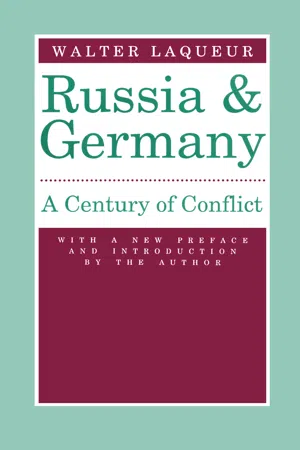
Despite changes in the international constellation since Russia and Germany initially appeared in 1965, the relationship between these two nations remains the most important single issue in European politics and East-West affairs. This study of what Russians and Germans have thought of each other and the fateful consequences of their interacting ideas is of lasting significance.The fact that Russia and Germany have embodied extreme manifestations of the totalitarian plague in the twentieth century. After briefly exploring the historical origins of Russophobia in Germany and of anti-Germanism in Russia, Laqueur reviews in detail the confrontation of Nazism and Bolshevism that culminated in World War II. He deals with the Russian origins of National Socialism and the ideology of the Russian far right from the days of the "Black Hundred" to its recent revival.This edition includes a major new introduction by the author, reviewing developments in the relationship between Russia and Germany in the last 25 years, and speculating about its future. Long out of print, Russia and Germany will be again welcomed by political scientists, students of international relations, and all those with an interest in recent history and current events.
Information
Chapter 1
RUSSIAN-GERMAN ATTITUDES
‘I SAY, AS VOLTAIRE SAID of God, that if there were no Germans we should have to invent them, since nothing so successfully unites the Slavs as a rooted hatred of Germans.’ Thus Bakunin, exactly one hundred years ago, in a letter to his sister-in-law. A love-hate relationship unique perhaps in history has prevailed between Russia and Germany over many centuries; every now and then, from the time when Alexander Nevsky defeated the Teutonic Knights on Lake Peipus to the days of the Warsaw Pact, Germany has been branded as the enemy par excellence.
But there was no nation the Russians admired more; the Germans were the masters, the teachers, the ideal to be imitated by successive generations of young Russian intellectuals. The romantic hero of the Russian novel was often more German than Russian in character. Of Lensky (in Eugene Onegin) it is said that he studied in Germany, that he was an admirer of Kant, and grew up as a poet under the skies of Schiller and Goethe. From distant Germany he brought home the fruits of scholarship, dreams of freedom, a burning and questioning spirit, a passionate language, and long dark locks of hair. German influence extended from the far left to the extreme right; even pronounced Germanophobes like Bakunin and Herzen had been shaped by it in their formative years. Pobedonostsev, we are reliably told, always carried around with him a copy of Goethe’s Faust.
There was a similar ambivalence in German attitudes: a traditional fear of Russia mixed with contempt. Friedrich II was afraid of the Russians who (he wrote to his brother in 1769) ‘dans un demi siècle feront trembler tout l’Europe’ (which did not prevent him from using Russian assistance at the most critical turning point in his war). Ranke taught that there was a great and unbridgeable divide between West and East, and he has had his followers. Marx and Engels were very much children of their time in their negative judgments on Russian history – not just on the Tsarist government. But this was by no means the only trend in German public opinion; the conservatives who regarded Russia as a bulwark against revolutionary movements (the Russian alliance is our last refuge, King Friedrich Wilhelm IV told the brothers Gerlach); Bismarck and the other Real-Politiker who regarded Russia as Germany’s natural ally; Nietzsche, for whom Russia was the very antithesis of ‘European particularism and nervousness’, and who regarded the integration of the Germanic and Slavic races as the most desirable prospect for the future. The ideological proponents of a German–Russian alliance were by no means to be found only on the extreme right – there is a whole chain of thinkers, from Bruno Bauer, an early friend of Marx, to Thomas Mann (during the First World War) and the National Bolsheviks of Weimar Germany, who regarded the common rejection of the West as a firm basis for such an alliance. ‘Are the Russian and the German attitudes towards Europe, Western civilization, and politics not closely akin? Haven’t we Germans also our Slavophiles and Westerners?’ Thus Thomas Mann in 1917.
The pro-Russian tradition in German politics goes back to the eighteenth century. Russia’s struggle against Napoleon in alliance with Prussia and Austria made it Germany’s saviour; Tauroggen, the little place in East Prussia where General York reached an agreement with the Russians in 1812 without authorization from his king, has ever since been a catchword in German politics; together with Rapallo it is now frequently used by the East German communists – but not only by them. From Tauroggen there is a direct line to Bismarck’s coalition with Russia. There is an influential school of German historians which maintains that the day when the alliance with Russia was permitted to lapse was the most fateful day in German history.
There was a school of thought, too, which from the time of the wars against Napoleon, and particularly after 1850, favoured an Ostorientierung. The inclination towards close collaboration between Russians and Germans was to be found over the entire political spectrum, from the extreme right to the radical left. The organs of the extreme right in Wilhelmian Germany, such as the Staatsbürgerzeitung (and even the Kreuzzeitung) used to take much of their ideological fare, and even much of their news, from the Russian Novoe Vremya, and vice versa; collaboration between Russian and German anti-Semites was particularly close. ‘We are proud to have provided ideological weapons to our friends in the neighbouring country,’ wrote one of the racialist German newspapers around the turn of the century. The ‘ideological weapon’ was the famous ‘Chief Rabbi’ speech at the Jewish cemetery in Prague, which in a more accomplished and embellished form returned to Germany in 1919 as the even more famous Protocols of the Elders of Zion and began their triumphal travels throughout the world from Berlin. During the First World War Dubronin, head of the ‘Black Hundreds’, declared that the victory of the Hohenzollerns would be a far lesser evil than the victory of democracy in Russia.
Collaboration on the left was even closer. The Russian socialists looked up to their German comrades as their guides and mentors and frequently as the arbiters in their internal quarrels. Russian was the language into which some of the works of Marx and Engels were first translated. Nowhere were they more avidly read or their prescriptions more zealously observed. Right up to the outbreak of the First World War Berlin was the main source of inspiration for the various Russian socialist factions; many a Soviet historian has been in trouble for recalling that there was no basic quarrel between Lenin and Kautsky before 1914, and it is well known what exclusive importance the Russian Bolsheviks attached after 1917 to the outbreak of the German revolution, which they regarded as of greater significance than their own.
Not all Russians thought the Germans were demi-gods. The very fact that successive Tsars introduced so many innovations from Germany produced a hostile reaction. As far back as the seventeenth century Yuri Krizhanich, the precursor of Panslavism, opposed the introduction of the ‘crazy’ customs and manners of the Germans that were to replace the time-honoured and praiseworthy customs and institutions of Russia. The Petrine reforms brought many more Germans to Russia; Ernst Johann Buehren, Duke of Courland, better known as Biron, gave his name to a whole period in Russian history – the reign of a small group of unscrupulous German courtiers around the Empress Anna Ivanovna. Biron’s reign, it is true, did not last long, but those who overthrew him were named Muennich and Ostermann; the German influence was there to stay. The appointment of so many Germans to leading positions provoked great resentment, but the practice was continued, for the class of educated Russians was too small to fill the growing number of posts. Many Russian aristocrats, moreover, looked with disdain on the state service as an occupation not fit for gentlemen. For Germans, on the other hand, the question of double loyalties did not really arise; until well into the nineteenth century foreigners served in both the Russian administration and the army without being required to take an oath of allegiance.
Leading diplomatic posts in the Russian foreign service were held almost exclusively by Germans : Meyendorff and Budberg in Berlin ; Lieven and Brunnow in London; Stackelberg in Vienna; von Schroeder in Dresden; Nesselrode and Giers and von Pahlen. The only exception at the time was the envoy in Paris, Pozzo di Borgo. General Ermolaev’s reply when Alexander I asked him to name his own reward for his services is well remembered: ‘Sire, do make me a German …’
Nicholas I trusted only two men : one was Benckendorff, head of the famous third department (and, incidentally, Countess Lieven’s brother). The other was von Rochow, the Prussian envoy at his court, to whom he told things that even his own foreign minister did not know. About his own subjects he said: ‘Ces Russes me font toujours de guignon …’ But the foreign service was not the only German domain: the Wrangels and Kleinmichels, Plehves and Neidharts, Rennenkampfs and Kauffmanns had an unassailable position in the civil administration and the army, and infiltrated even the Holy Synod. So strong was the position of the Germans in Russian public life that even the anti-German movement could not manage without them. F. F. Vigel (Wiegel) was the author of a tract published in 1844 entitled La Russie envahie par les Allemands. And when the Panslavist movement came to the fore in the sixties, two of its main ideologists were Miller and Hilferding. The libretto to Russia’s national opera A Life for the Tsar (or Ivan Susanin since the Revolution) was provided by yet another German, Gustav von Rosen. But Germans were not only diplomats, generals, and professors. At a lower social level there were the Swabian settlers and the many artisans in the cities. Before the First World War there were some fifty thousand Germans in St Petersburg, twenty thousand each in Moscow and Saratov, and at least ten thousand in Odessa. These Germans had their own churches (St Peter and St Anne in the capital), their own theatre (the only permanent German theatre outside Germany), and of course their own newspapers and clubs. The businessmen went to the Schusterklub, the artisans to Die Palme.
The contempt of the Russian nobleman for the petit-bourgeois German whose orderly, pedantic ways were so diametrically opposed to his own shirokaya natura, is admirably expressed in Gogol’s Nevsky Prospekt : ‘Schiller (at the age of twenty) had already planned his future in a most thorough and methodical way and never, in any circumstances, did he deviate from the course he had set himself. He resolved to get up at seven, to lunch at two, to be punctual in everything, and to get drunk every Sunday. He resolved to save a capital sum of fifty thousand and this was as certain and irrevocable as fate itself … In no circumstances did he increase his expenses and if the price of potatoes went up, he did not spend a penny more on them but merely bought less potatoes … His exactness was such that he made it a rule never to kiss his wife more than twice in twenty-four hours and to make sure he did not kiss her three times he never put more than one teaspoonful of pepper in his soup.’ Such judgments were fairly typical in Russian nineteenth-century literature. The practical, efficient, and energetic Stolz in Oblomov is at the same time hopelessly uninteresting and flat – very much in contrast to the hero of the book. Perhaps the most savage attack on the Russkie Nemtsy was made by Herzen (in a series of articles in Kolokol, starting October 1859), in which they were described as arrogant, brutal, evil, and unwilling and unable to understand Russia and the Russians. This German upper class was convinced that ’s nashim bratom nichevo bez palki ne sdelaesh’; ‘Man muss der Bestie den Russen herausschlagen.’
From the time of Fonvizin, the German private tutor had become the laughing stock of Russian literature. Turgenev describes how his father threw his German tutor bodily from the second floor window of their mansion after the miscreant had dared to administer corporal punishment to his pupils, who seem to have more than deserved it. The German tutor was philistine and petty, he was in brief, like all other Germans, a meshchanin, and there was nothing the Russian upper class despised more. For the Germans were essentially a middle-class people. They lacked the arrogance of the British, the elegance and intellectual facility of the French, the natural grace of the Italians. Since Russia had never possessed a middle class of any numerical or political significance, bourgeois virtues and bourgeois social ideals were utterly strange to them. The Germans were industrious and clean, but basically they appeared quite stupid to the Russians, for they had sold their soul to the devil for a penny, as described in some detail in Saltykov-Shchedrin’s story of the ‘Boy with his Pants on and the Boy without Pants’.
The Boy with his Pants on, filled with compassion, tries to persuade The Boy without Pants to stay behind in Germany, to become a defector, as we now say. ‘Herr Hecht,’ he says, ‘would take you on as a labourer. Just think, how do you sleep, how do you eat at home? Here you’d get a good piece of felt to sleep on and peas and bacon even on weekdays.’
‘Not bad,’ answers the Russian, ‘but is it true, German, that you have sold your soul for a penny?’
‘You have in mind Herr Hecht? But my parents receive a fixed wage from him.’
‘That’s what I say; you have sold your soul for a penny.’
The German boy, understandably, gets rather indignant: ‘But excuse me, worse things are told of you; it is said that you have given away your soul for nothing.’
‘Yes,’ says The Boy without Pants with pride, ‘yes, we have. But for nothing, not for a penny; that is the point. And what I have given away for nothing, I can take back again. You are a dolt, kolbasik, aren’t you?’*
This contempt never extended to German culture. If Tolstoy and Dostoevsky were more widely read in Germany than in any other Western country, the impact in Russia of German philosophy, literature, and the arts (from Schelling to Johann Strauss) was unique. The Russian Academy of Sciences was a German institution, its mouthpiece, the St Petersburger Zeitung, a German newspaper. Under Peter I, Russian students began to appear in increasing numbers at German universities, German scientists laid the foundations of the study of the natural sciences in Russia, and Schloezer and Mueller were the precursors of a Russian national school of historiography. More and more Russian travellers appeared in Weimar and Stuttgart where Russian Grand Duchesses resided; later on Baden Baden, Bad Homburg, and Karlsbad became the most fashionable meeting points for these visitors from the East. German writers and philosophers were even more admired than in their own country; every Russian traveller wanted to meet them and to talk to them. When Karamzin was interrogated at the gates of Weimar as to the purpose of his visit he countered by impatiently asking the sentry: ‘Is Goethe here ? Is Herder here ? Is Wieland here ?’
Schiller’s influence on the Russians was greater than that of any other contemporary writer, while Hegel’s impact went deeper there than in Germany. That the Russian Westerners were strongly influenced by German thought we know from Herzen and many other contemporaries. But even those who had serious political reservations about the Germans, the Slavophiles and those who later adopted Pora domoi as their watchword, received their main impulses from German culture. Samarin, for instance, wrote: ‘To every Russian who has studied there, at least in my time, Germany is also a kind of motherland whose milk has long nourished them.’ The Russian intelligentsia was more alert to all that was new and progressive and fashionable in Germany than the German intellectuals themselves. There was a Psychoanalytical Institute in Moscow before there was one in Berlin; important new German books were almost immediately translated into Russian, occasionally in larger editions than the original. German belles-lettres around the turn of the century had no great achievements to their credit, nor was Germany at that time the centre of modern painting. Yet German literature continued to be the main formative influence for leading Russian poets such as Bely and Pasternak. Russian painters such as Kandinsky or Yavlensky preferred to settle in Munich rather than Paris. It was said at the time that the Russians had always preferred to import from France fashionable dressing gowns, chocolates, cheap novels, and mistresses; but from Germany they imported ideas.
The cultural traffic was not one way. Leibniz was fascinated by Russia, a country which he compared to a tabula rasa, and in which he thought more good could be achieved than in the West. Herder believed that the Russians were more peaceful than the Germans; the Slavs had been the stepchildren of history, but this would change in the course of time, and the Ukraine might become one day a new Hellas. About himself, Herder wrote that during his stay in Riga he had become a ‘real Russian patriot’. (Many years later, in the Nazi period, this eighteenth-century Russophilia was severely condemned.) Klinger and Lenz, two prominent members of the group that entered German literary history under the name ‘Storm and Stress’, lived for many years in Russia though neither was very happy there. The enormous impact of the Russian realist novel in Germany has been noted. The names of two remarkable women should be mentioned in this context: Malwida von Meysenburg helped Wagner and Nietzsche to know and understand the great Russian writers; Wagner had some first-hand knowledge of the country, having served as director of the Riga Orchestra in 1837. Lou Andreas Salomé travelled with Rilke to Russia. After two extensive trips Rilke began to write poems in Russian and wrote to her: ‘That Russia is my homeland is one of the great and mysterious certainties of my life.’ Similar sentiments were expressed by Morgenstern; and the greatest German novelist of the twentieth century concluded that never had humanity found a deeper expression than in Russian literature, by which he and all his contemporaries had been profoundly impressed beyond all political argument.
Then came the war and the revolution. Nicky and Willie, who had written each other so many and such affectionate letters, disappeared. But the Eastern orientation remained a very important factor in German policies, both domestic and foreign. In Soviet thinking, too, a special place was reserved for Germany from the very beginning. The German proletariat, Lenin wrote in his farewell letter to the Swiss workers in April 1917, was the ‘most faithful and reliable ally of the Russian and international proletarian revolution’. Radek in Berlin in 1919 did not find it difficult to make converts to his thesis that Russia and Germany now had more common interests than ever, and that the logic of history compelled them to work together – not against each other. The Western Allies wanted to keep them apart. At the Versailles peace conference Lloyd George had circulated a confidential memorandum:
The greatest danger that I see in the present situation is that Germany may throw in her lot with Bolshevism and place her resources, her brains, her vast organizing power at the disposal of the revolutionary fanatics whose dream is to conquer the world for Bolshevism by force of arms. This danger is no mere chimera.
Clemenceau was not impressed, but Rathenau was, though he did not take the revolutionary nonsense very seriously. Prussia, after all, was the kernel of Germany, and Prussia had always gravitated towards the East; this pull towards the East had been tempered only by the fear of being overwhelmed by the Russian colossus. But as the result of the war and the civil war Russia had been very much weakened and there was no immediate danger. True, there was the fear of Communism. ‘We are on the eve of the German October’, Pravda# had written in December 1917. ‘History is repeating itself; Berlin streets look like Petrograd streets on the eve of the revolution.’ But history did not repeat itself. The Spartakist revolt failed and thus the way was opened to Rapallo, to German–Soviet economic exchanges, and to military collaboration between the Reichswehr and the Red Army. Rathenau and Brockdorff-Rantzau, Seeckt and Krupp (who was one of the first to supply machines to Russia), all reached the conclusion that a revision of the Versailles treaty could be achieved only through collaboration with Russia. This was not the policy of the Social Democrats, but among some of the centre parties and in particular those on the extreme right, Russia became very fashionable indeed. When Lenin wrote ‘Even the blackest reactionaries and monarchists in Germany said that the Red Army would save them’, he was reporting fairly accurately the state of affairs at the time of the Soviet–Polish War.
This re-orientation in foreign policy had its ideological and cultural parallels. There was a Dostoevsky boom, the like of which had not been witnessed before, and some shrewd observers realized that it had something to do with current politics. Moeller van den Bruck developed his theories about the right of the young peoples and their coming victorious struggle against the decadent West; Moeller by a strange coincidence was the German translator of Dostoevsky. Ernst Niekisch, mentor of the National Bolsheviks, preached a synthesis between the spirit of Potsdam and the spirit of Moscow, and declared war on Rome, Paris, and places west.
For Spengler, Russia was the only coun...
Table of contents
- Cover
- Half Title
- Title Page
- Copyright Page
- Contents
- Introduction to the Transaction Edition
- Preface
- 1 Russian–German Attitudes
- 2 ‘De Morebus Ruthenorum’
- 3 ‘We are Bigger People Than the Germans’
- 4 The Rise of National Socialism Part I: Hitler’s Mentors
- 5 The Rise of National Socialism Part II: The Elders of Zion
- 6 The Rise of National Socialism Part III: Prologue to the Final Solution
- 7 Between Moscow and Weimar
- 8 Hitler And Russia 1923–33
- 9 Nazi Policy and the Soviet Union 1933–38
- 10 Anti-Komintern
- 11 Nazism in the Soviet Mirror
- 12 Days of Wrath 1939–63
- 13 Stalin and Hitler
- 14 Russia, Germany, and the Future
- Appendix: The Hidden Hand
- Bibliography
- Notes
- Index
Trusted by 375,005 students
Access to over 1.5 million titles for a fair monthly price.
Study more efficiently using our study tools.
Frequently asked questions
Yes, you can cancel anytime from the Subscription tab in your account settings on the Perlego website. Your subscription will stay active until the end of your current billing period. Learn how to cancel your subscription
No, books cannot be downloaded as external files, such as PDFs, for use outside of Perlego. However, you can download books within the Perlego app for offline reading on mobile or tablet. Learn how to download books offline
Perlego offers two plans: Essential and Complete
- Essential is ideal for learners and professionals who enjoy exploring a wide range of subjects. Access the Essential Library with 800,000+ trusted titles and best-sellers across business, personal growth, and the humanities. Includes unlimited reading time and Standard Read Aloud voice.
- Complete: Perfect for advanced learners and researchers needing full, unrestricted access. Unlock 1.5M+ books across hundreds of subjects, including academic and specialized titles. The Complete Plan also includes advanced features like Premium Read Aloud and Research Assistant.
We are an online textbook subscription service, where you can get access to an entire online library for less than the price of a single book per month. With over 1.5 million books across 990+ topics, we’ve got you covered! Learn about our mission
Look out for the read-aloud symbol on your next book to see if you can listen to it. The read-aloud tool reads text aloud for you, highlighting the text as it is being read. You can pause it, speed it up and slow it down. Learn more about Read Aloud
Yes! You can use the Perlego app on both iOS and Android devices to read anytime, anywhere — even offline. Perfect for commutes or when you’re on the go.
Please note we cannot support devices running on iOS 13 and Android 7 or earlier. Learn more about using the app
Please note we cannot support devices running on iOS 13 and Android 7 or earlier. Learn more about using the app
Yes, you can access Russia and Germany by Walter Laqueur in PDF and/or ePUB format, as well as other popular books in Politics & International Relations & German History. We have over 1.5 million books available in our catalogue for you to explore.