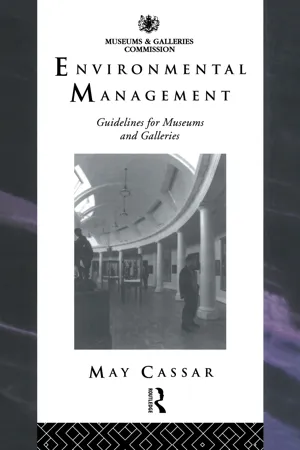
The key to the survival of museum collections is a stable indoor environment and vital to this is a well-maintained building with effective environmental services. Environmental Management sets out clearly the theory and practice of achieving an appropriate museum environment for both collections and people.
The book emphasises the need for planning and places the environmental needs of museum collections at the forefront of the responsibilities of museum managers. May Cassar stresses the role of the building as the first line of defence against environmental instability, recognising the importance of regular environmental monitoring and control, and the division of museum spaces into critical areas housing collections and non-critical areas accommodating offices, cafes and communal spaces.
Environmental Management presents a strategic approach to environmental management, in contrast to the piecemeal approach to environmental monitoring and control still practised by many museums. However, rather than providing ready solutions and rigid rules, the book introduces principles and ideas on which to base decisions about creating the appropriate environment.
- 180 pages
- English
- ePUB (mobile friendly)
- Available on iOS & Android
eBook - ePub
About this book
Information
Part 1
The principles of museum
environmental management
1

Managing resources
Management, then, is the job of organising resources to achieve satisfactory performance; to produce an enterprise from material and human resources.
Peter F. Drucker, in Pugh, Hickson and Hinings,
Writers on Organisations in Society, Penguin, 1983
There is now a great public awareness of the essential fragility of even the most robust-seeming archaeological and historic objects. Disappearing Italian frescos and crumbling Egyptian antiquities will be familiar themes for most of the museum-going public, though these are only the most dramatic examples of a problem that can exist on a smaller scale in every museum in the world.
Coupled with this new awareness are two other realisations: that there is something called ‘conservation’, which can minimise the damage caused to cultural objects; and that the public funding of museums and galleries is declining, to be replaced by hard-to-find commercial and private finance. In short, the museum-going public is becoming aware that museums have a serious long-term problem on their hands.
The public view of conservation is probably still overwhelmingly that of restoration, in particular the painstaking reassembly of artefacts from fragments. The less obvious face of conservation, at least from the public’s point of view, is preventive conservation management – the creation and maintenance of an environment that limits the decay of museum objects to the absolute minimum consistent with public access.
This public view is important, and not just because museums need to maintain a healthy influx of visitors. It is this ‘lay’ opinion of a museum’s work that is now vital for some aspects of financing. Commercial sponsorship and private donations are likely to be founded on the donor’s belief that the museum still has an informative and custodial role in contemporary society – and the associated belief that museum managements ‘know what they are doing’ when it comes to protecting the objects in their care.
Managing preventive conservation
Preventive conservation management within museums has two distinct yet complementary aspects: the technical and the organisational. Technical information enables those who monitor and control the museum environment to work effectively, to create the physical environment that is of such fundamental importance to the survival of the collection. In many museums, conservators are the staff responsible for the physical environment of objects, and the relationship here is usually simple and direct – the aim is to preserve the collection by controlling the environment.
The institutional context
But collections also exist within an institutional context. Problems with the physical environment of collections are better understood – and are certainly more likely to be resolved – if they are debated and discussed in the context of the institution’s operational framework. This wider setting brings in different people with different ideas for collection use, and introduces broader and more complex issues. The collection can no longer exist in the separate, central position it normally occupies in the minds of conservators and curators. The questions of what to do, and how to do it, cease to be simply reducible to technical problems of the discovery of environmental defects and the search for appropriate remedies.
Getting involved
Preventive conservation staff – who will often be experienced conservators – cannot remain aloof either from wider management issues or indeed from the public world beyond the museum doors. And the relationship must be more than a one-sided series of demands from the conservation department to the museum management: preventive conservation staff should strive to participate in the development of museum policies, to be part of the decisions that contribute to a well-run museum and not just those that affect the collection. It is as important to know the size of the museum and who the decision-makers are as it is to know the size and location of a collection.
Change: threat or opportunity?
Change is sometimes difficult to accept, and to those responsible for the care of the collection change can often appear as a threat to its security. Loans, special exhibitions, increased visitor access, may expose objects to new hazards. There is an ever-present temptation to intervene, to say ‘no’ on behalf of one’s collection.
Exhibitions and increased access
But without the public, a museum dies. At best, it becomes a hidden repository, a vault of treasures locked against the world; at worst, in these days of rising costs and falling subsidies, the museum dies literally and closes. There can be no greater threat to a collection than its dispersal following the closure of a museum.
Greater access to the collection improves public goodwill, raises a museum‘s profile, and increases the sales from its shop – all of which contribute to the survival of the collection. Conservation staff who oppose such a move without good reason may win the day, but will lose goodwill in the long term; they will be increasingly isolated from the decision-making process, and will be seen by their colleagues as a kind of unhelpful, obstructive internal police force.
Instead, access to collections should be carefully managed so that a balance is found between greater accessibility and the minimum risk of damage. Far from being isolated, conservation staff must be key participants in the attainment of this delicate balance. Change should be seen as a glorious opportunity to instil preventive conservation procedures within a museum; everybody, throughout the museum, is forced to think in terms of conservation whenever there is a major change – whether temporary or permanent – in the use of museum space.
Large exhibitions present the same opportunities – and the same kind of conservation challenge. Conservation staff will need to liaise with marketing and publicity staff to identify the spaces that can be used for events and to advise on safe types of activities. Compromises can often be found: for example, the public can be allowed access to stores housing less environmentally sensitive collections, or objects duplicated elsewhere.
Events which are organised around an exhibition should be managed to minimise the impact on objects on display. This will mean wide discussions resulting in guidelines for the maximum number of persons that can be accommodated, and numbers and controls on outside agencies like caterers, florists, photographers, and film units. Greater access does not mean that ‘anything goes’, or that well-established environmental principles can simply be abandoned; but it does mean that preventive conservation staff have to strike a sensitive balance between sticking to principles and knowing when to compromise.
Acquisitions
The development of a museum‘s acquisitions policy is another sensitive area for conservation staff. At first sight, the rate of growth of a museum collection seems to have little to do with preventive conservation. However, new acquisitions demand space and staff time, and may require special protection; unless there are unlimited resources to satisfy these demands – which is highly unlikely – the new objects will increase the pressure on the care of the existing collection. The implications for conservation staff are clear: they will have to be involved at an early stage in any discussions – should the museum be collecting what it cannot adequately care for; and if an acquisition is deemed vital to the collection, where can additional resources be obtained for its care?
Here again there is a conservation balancing act: new acquisitions may attract visitors, and can improve the quality of a museum’s collection; against this stands the grim reality of limited resources, which severely constrain the level of care that can be given to a collection.
Preventive conservation: everybody’s responsibility
The necessarily pragmatic approach to preventive conservation involves the management of human resources as well as the physical environment. Training in preventive conservation across the museum staff structure is vital, fostering an awareness of collection needs, and involving and empowering other museum staff. Preventive conservation becomes everybody’s responsibility, and is no longer the exclusive preserve of the one person or department representing the ‘conservation police’.
Collections are assets with many potential uses: study, loans, display, storage. Once collection care is accepted as a collective responsibility, any conflicts that may arise between preservation and use can be reconciled. This may mean that conservators will have to reappraise their role within the museum; they need to recognise and create opportunities for preventive conservation. By accepting a changed role, preventive conservation staff become problem-solvers, gaining eyes and ears throughout the museum – not the people who say ‘no’, but those who help find solutions.
See the section on training at the end of this chapter (p. 10).
Principles, priorities, and purchasing power
Making the case for conservation
Museums in the United Kingdom depend heavily on grants to fund environmental improvements, using them to cover the purchase of monitoring and control equipment or to support capital improvements to museum buildings. However, grants often have to be supplemented by financial contributions from local sources and/or sponsorship – an often difficult process because environmental measures, though essential to the preservation of a museum collection, are intrinsically unglamorous and their results hard to demonstrate in the short term. Tighter financial resources demand more convincing arguments – not to satisfy those working in museums of the need for environmental monitoring and control, but to reassure administrators and sponsors that money spent in this field is wisely spent.
There are several ways of demonstrating a museum’s commitment to environmental care, its wise use of resources in this direction, and the benefits of a sound environmental policy. These include:
- Evidence of a sound environmental policy. A museum should be able to demonstrate that it already has a comprehensive environmental strategy, and that it has the right procedures in place to achieve as much environmental control as possible given its present resources.
- A list of quantifiable benefits. Environmental management brings many unquantifiable benefits to the collection, but it does no harm to emphasise measurable benefits such as savings in the cost of conservation treatments. It is financial good sense to invest money in curing the causes rather than the effects of environmental problems.
- Intelligent financial management. For example, it may be possible to draw on the staff training budget to commit funds regularly to raise environmental awareness and knowledge among staff. Certain costs may need to be charged to budgets which may not be directly conservation-related.
- Evidence that the museum is not underselling itself. For example, a charge could be made to outside hirers for their use of staff time to inspect objects after an event.
Planning expenditure
There is no guarantee that large sums of money spent on environmental monitoring and control systems will produce an efficient and effective museum environment; but it is equally true that panic buying of equipment, or a ‘patch-and-make-do’ attitude, must be avoided at all costs. There must be a strategy for the purchase o...
Table of contents
- Cover Page
- Half Title page
- Title Page
- Copyright Page
- Contents
- List of plates
- List of figures
- List of boxes
- Foreword by Garry Thomson
- Preface
- Acknowledgements
- Part 1 The principles of museum environmental management
- Part 2 Managing and monitoring the built environment
- Part 3 Controlling the display environment
- Part 4 Storage and transportation: managing hidden stresses
- Datasheets
- Glossary
- Select bibliography
- Sources of other information
- Index
Trusted by 375,005 students
Access to over 1.5 million titles for a fair monthly price.
Study more efficiently using our study tools.
Frequently asked questions
Yes, you can cancel anytime from the Subscription tab in your account settings on the Perlego website. Your subscription will stay active until the end of your current billing period. Learn how to cancel your subscription
No, books cannot be downloaded as external files, such as PDFs, for use outside of Perlego. However, you can download books within the Perlego app for offline reading on mobile or tablet. Learn how to download books offline
Perlego offers two plans: Essential and Complete
- Essential is ideal for learners and professionals who enjoy exploring a wide range of subjects. Access the Essential Library with 800,000+ trusted titles and best-sellers across business, personal growth, and the humanities. Includes unlimited reading time and Standard Read Aloud voice.
- Complete: Perfect for advanced learners and researchers needing full, unrestricted access. Unlock 1.5M+ books across hundreds of subjects, including academic and specialized titles. The Complete Plan also includes advanced features like Premium Read Aloud and Research Assistant.
We are an online textbook subscription service, where you can get access to an entire online library for less than the price of a single book per month. With over 1.5 million books across 990+ topics, we’ve got you covered! Learn about our mission
Look out for the read-aloud symbol on your next book to see if you can listen to it. The read-aloud tool reads text aloud for you, highlighting the text as it is being read. You can pause it, speed it up and slow it down. Learn more about Read Aloud
Yes! You can use the Perlego app on both iOS and Android devices to read anytime, anywhere — even offline. Perfect for commutes or when you’re on the go.
Please note we cannot support devices running on iOS 13 and Android 7 or earlier. Learn more about using the app
Please note we cannot support devices running on iOS 13 and Android 7 or earlier. Learn more about using the app
Yes, you can access Environmental Management by May Cassar in PDF and/or ePUB format, as well as other popular books in Art & Art General. We have over 1.5 million books available in our catalogue for you to explore.