- 232 pages
- English
- ePUB (mobile friendly)
- Available on iOS & Android
eBook - ePub
Atlas of Nazi Germany
About this book
Originally published in hardback only in 1987, Michael Freeman's valuable guide to the history of Nazi Germany now returns to print in a substantially revised Second Edition. Dealing with all aspects of the Nazi regime, it is far more than just an atlas: the integration of the maps themselves with charts and other visually-displayed data, and an extensive and authoritative commentary, makes this a book to read as well as to refer to.
Prelude
1 The Weimar Republic
The Weimar Republic came into being in the midst of the German war defeat in the autumn of 1918. Rising popular disaffection with the military and the monarchy precipitated a revolutionary movement beginning with naval mutinies at Kiel in late October and followed by the rapid establishment of soldiers’ and workers’ councils throughout most German cities in much the same mould as had occurred in Russia that year. By the second week of November, a reformist socialist government was in place, a republic had been declared, the Kaiser had abdicated and was in exile in Holland, and the army’s war leaders had been forced from the centre stage.
The new government proved hardly revolutionary in mould. It was dominated by moderate socialists (SPD) who still clung to elements of the pre-war political scene; indeed, the administrative continuity with the past proved to be one of the most remarkable features of the German revolution. One result was that more revolutionary but minor socialist groups were quickly alienated and, later, were subject to violent suppression, with the help of newly formed army units. The threads of political continuity were reinforced, moreover, when in the first parliamentary election in January 1919, the socialists (SPD and USPD) were able to form a government only with the support of the Catholic Centre Party (Zentrum) and the German Democratic Party (DDP).
The ‘Weimar constitution’ was adopted by the Reichstag, or Parliament, in August 1919. It was exceptionally democratic in that it gave the vote to all men and women at the age of 20, embraced proportional representation in elections and, more widely, sought to specify the basic rights of citizens in a democratic state. The latter encompassed, for example, the protection of religious freedoms, the facility with which workers could combine, as well as laying out the critical elements of a modern welfare state. Governments were responsible to Parliament and there was to be a strong popularly elected President. Provisions were also made for popular referenda. The relationship between the central government and the sovereign states of Bismarck’s Reich was redefined to give much greater control at the centre. The states henceforward became Länder, their powers of self-administration confined to the police, the judiciary and education. In the second parliamentary chamber set up under the Weimar constitution, the Reichsrat, the Länder supposedly gained a broader measure of influence on government. But, in practice, the Reichsrat was subservient to the Reichstag, which was in turn somewhat overshadowed by the Reich government. For many later commentators, the fatal flaw in the Weimar constitution was the way that it laid out administrative machinery which could be given definition and substance only through subsequent legislative and political decision. In defence, one may say that the constitution was so formed because of the way it sought to reflect competing political pressures. In modern parlance, it allowed for multiple solutions.
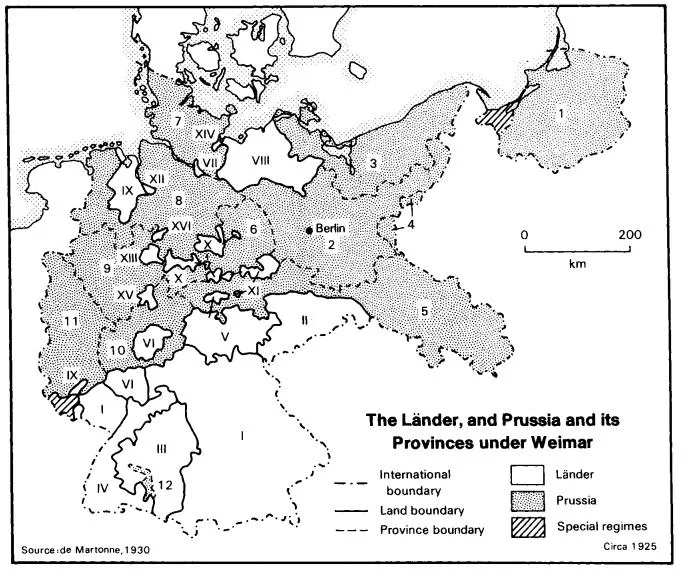
Fig. 0.1 The Länder, and Prussia and its Provinces under Weimar
Länder
I Bavaria
II Saxony
III Württemberg
IV Baden
V Thuringia
VI Hesse
VII Hamburg
VIII Mecklenburg-Schwerin
IX Oldenburg
X Brunswick
XI Anhalt
XII Bremen
XIII Lippe
XIV Lübeck
XV Waldeck
XVI Schaumburg-Lippe
XVII (Prussia)
Prussian Provinces
1 East Prussia
2 Brandenburg
3 Pomerania
4 Grenzmark Posen Westpreussen
5 Silesia
6 Saxony
7 Schleswig-Holstein
8 Hanover
9 Westphalia
10 Hessen-Nassau
11 Rhine Province
12 Hohenzollern
The internal political geography of Germany under the Weimar regime was among the most complicated of all contemporary European countries. (Fig. 0.1) Before the birth of Hitler’s state, Germany was divided into no less than 17 Länder, the largest of which was Prussia, covering some 60 per cent of the country’s land area and embracing some 60 per cent of its population. Prussia was itself divided into separate provinces. The remaining Länder varied wildly in size and population. Bavaria, for instance, had an area of 78,000 square kilometres and a population of some 8 million, while Schaumburg-Lippe had corresponding figures of 340 and 50,000. The resulting geographical mosaic was predictably very confused. While Prussia was the dominant force across the northern half of the country and Bavaria, by virtue of its large size, likewise in the south, the small German Länder were distributed across the face of western Germany, many of them also having detached territorial outliers to add further to the confusion.
Assessments of the Weimar Republic must necessarily consider the various historical exigencies within which it was framed. Few could deny that it was a remarkable experiment in democracy; but it fell victim to both internal antagonisms and those on the wider historical stage, the Versailles peace treaty among them.
2 Versailles and the Weimar Republic
The Treaty of Versailles of 1919 redrew the political map of Europe on an unprecedented scale. (Fig. 0.2) For Germany, however, the territorial adjustments required by the Treaty were limited. Alsace-Lorraine was restored to France (having been taken from France in 1871). Minor frontier adjustments were made at Germany’s expense in favour of Belgium, Czechoslovakia and Denmark. Territory was lost in the east to the recreated state of Poland, much of it land which had been seized by Prussia in the eighteenth century. But, in total, Germany had to relinquish only 13 per cent of its territory, containing approximately 10 per cent of its population. Alongside the consequences of the Treaties of St Germain and Trianon for the Austro-Hungarian Empire, or compared with the humiliating territorial losses imposed by Ger...
Table of contents
- Cover
- Half Title
- Title Page
- Copyright Page
- Table of Contents
- Foreword to first edition
- Preface to first edition
- Preface to second edition
- Acknowledgements
- Abbreviations
- Introduction
- Prelude
- 1 The Weimar Republic
- 2 Versailles and the Weimar Republic
- Part One: The rise of the Nazi Party
- Part Two: Administrative and political structure
- Part Three: Society
- Part Four: Population and economy
- Part Five: The search for living space: the Third Reich at war
- Part Six: The War Machine
- Epilogue
- Epilogue
- References for maps and diagrams
- Select bibliographical guide
- Glossary
- Index
Trusted by 375,005 students
Access to over 1.5 million titles for a fair monthly price.
Study more efficiently using our study tools.
Frequently asked questions
Yes, you can cancel anytime from the Subscription tab in your account settings on the Perlego website. Your subscription will stay active until the end of your current billing period. Learn how to cancel your subscription
No, books cannot be downloaded as external files, such as PDFs, for use outside of Perlego. However, you can download books within the Perlego app for offline reading on mobile or tablet. Learn how to download books offline
Perlego offers two plans: Essential and Complete
- Essential is ideal for learners and professionals who enjoy exploring a wide range of subjects. Access the Essential Library with 800,000+ trusted titles and best-sellers across business, personal growth, and the humanities. Includes unlimited reading time and Standard Read Aloud voice.
- Complete: Perfect for advanced learners and researchers needing full, unrestricted access. Unlock 1.5M+ books across hundreds of subjects, including academic and specialized titles. The Complete Plan also includes advanced features like Premium Read Aloud and Research Assistant.
We are an online textbook subscription service, where you can get access to an entire online library for less than the price of a single book per month. With over 1.5 million books across 990+ topics, we’ve got you covered! Learn about our mission
Look out for the read-aloud symbol on your next book to see if you can listen to it. The read-aloud tool reads text aloud for you, highlighting the text as it is being read. You can pause it, speed it up and slow it down. Learn more about Read Aloud
Yes! You can use the Perlego app on both iOS and Android devices to read anytime, anywhere — even offline. Perfect for commutes or when you’re on the go.
Please note we cannot support devices running on iOS 13 and Android 7 or earlier. Learn more about using the app
Please note we cannot support devices running on iOS 13 and Android 7 or earlier. Learn more about using the app
Yes, you can access Atlas of Nazi Germany by Michael Freeman,Jayne Lewin,Tim Mason in PDF and/or ePUB format, as well as other popular books in History & European History. We have over 1.5 million books available in our catalogue for you to explore.