![]()
Chapter 1
Introduction
Why any one of us can make a difference
Right at the outset, I want people to realise that this book is for them, whether they respond at a personal, community or corporate level. The goals apply everywhere and to everyone and even seemingly small personal actions add up. They also begin to set trends that others follow. This chapter is set to inspire and engage.
This is a book of action from everyone
The whole essence of this book is that we can all participate in one of the greatest adventures known to man, that of making the world a better place for everyone to enjoy and pass to future generations. Participation is a key thread that will run through the pages that follow. It is my intention to provide you, the reader, with numerous activities that will take you beyond the pages of the book and into a world of inquiry and of possibility. I trust you will find the activities thought-provoking and inspiring.
Activity 1.1: The world we want
Close your eyes for just a few minutes and take some time to reflect before you begin reading this book. I want you to put yourself into the year 2030 and imagine the world you would like to see. Imagine a world you would be happy to pass to future generations. Without me guiding or prompting you too much, take time to explore the world at this time horizon. Feel free to explore the planet and visit places near and far.
Now, in the space below, make as many notes as you are able of what you saw in your mind’s eye.
I have tried this exercise many times, with myself, with other people aged from 7 to 70 and with groups of people numbering from five to 500 at workshops and conferences around the world. These have mainly been young people in schools, universities and youth groups but I’ve also engaged with retirees and people in a variety of businesses and professional institutions.
We are aligned
Curiously enough, what people see is consistent. With very few exceptions, people see a world that is identical to the one world leaders have already signed up to deliver. And the amazing thing is that about 90% of the people I have engaged with had no idea that such a promise had been made. Even when I ask them what significant world event happened in New York in September 2015, most don’t know that world leaders signed up to a set of seventeen Sustainable Development Goals (SDGs), with a target date of 2030, that promise to transform our world in a manner that is unprecedented.
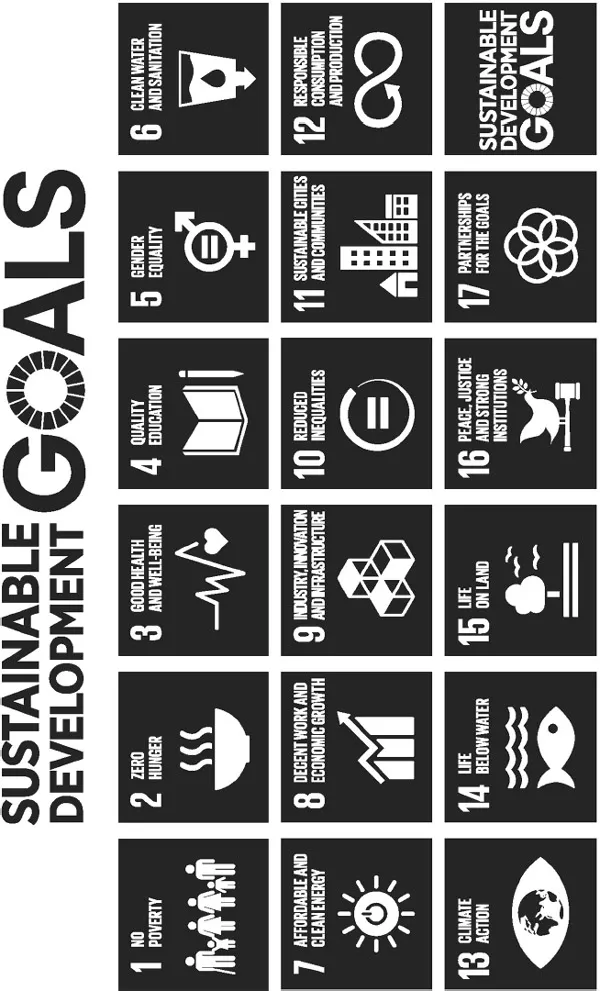
The goals are represented in Figure 1.1 below or alternatively, feel free to read the full descriptions of the seventeen goals which you can find on the United Nations Sustainable Development Knowledge Platform (sustainabledevelopment.un.org). This Knowledge Platform is, by the way, a wonderful resource for information relating to the SDGs.
Now, of course, it isn’t that we all see exactly the same world when we imagine what things could be like in 2030. But from my experience of engaging with thousands of people, I can confidently affirm that the vast majority of us see something that aligns to some aspects of the SDGs.
The future of our world is written on our hearts
The wonder of this, which I see as nothing short of a miracle, is that we actually don’t need to be taught about the goals. It’s as if they are already placed on our hearts. However, as I have indeed learnt more about this amazing set of goals, I have found myself becoming more and more inspired.
Figure 1.1The Sustainable Development Goals
Activity 1.2: My personal inspiration
I have a second activity for you now. I want you to scan the seventeen goals one by one, long enough just to get a sense of what they are. You can do this by looking at Figure 1.1, or the more detailed images and descriptions on the UN Sustainable Development Knowledge Platform. But don’t spend too long over-thinking them. Just notice how you are drawn to some goals more than others. Make a note of your top goal (or goals) in the space below and ask yourself in what way you are attracted to that goal. Add your thoughts to your notes. Perhaps even make a note of anything you already feel inclined to do. Write that down.
A global commitment
Now let’s turn our attention to the world leaders that met in New York in September 2015. The fact that almost all the heads of state across our planet came to together and agreed to transform our world is no small accomplishment. A great deal of commendation must also go to the members of the working party who drafted the goals on their behalf.
I guess they were inspired by the significant accomplishments that the world made in response to the Millennium Development Goals or MDGs that leaders committed to in 2000 and which had a target date of 2015. For example, 43 million more children now go to school; new HIV infections are reduced by 40%; 2 billion more people have clean drinking water; and extreme poverty has been halved.
Activity 1.3: No point going halfway
It’s time for another activity if you have access to the Internet. Go to YouTube and search for “no point going half way”. This inspiring video is only two and a half minutes long and quickly convinces us that we are on a journey, with more distance to travel. Record your thoughts below.
How do you feel about the commitment our world leaders have made? The reactions of people I meet vary considerably. Most people are pleased, many are inspired. However, some are rightly sceptical, reminded of so many promises that leaders make that get broken.
Look at it this way. Even if you have your doubts that world leaders will deliver on the SDGs, at least the goals have been set. And the goals are supported by measurable targets that will track progress year-on-year. So our leaders can hold each other to account. And we can also hold them to account through the political processes of our world.
We can all play our part
The wonderful thing about the goals is what I said earlier on. The goals are written on our hearts. So, if a few billion, or even a few million people simply follow their hearts, I reckon, we can and will do this together.
As I will demonstrate later in this book, the way to achieve anything in this life is through a sense of purpose. Being conscious of purpose allows a vision to arise and, if we know how, we can create the conditions in which the vision (and hence the purpose) is manifest or allowed to happen.
Because we are all different and inhabit different contexts, we will each have different purposes. That is why we are each drawn to certain SDGs. Even two people who are drawn to the same goal could well be drawn in different ways.
Take for example two men who attended (different) workshops I ran in universities. Both were attracted to SDG 14: life below water. One enjoyed scuba diving in his leisure time and became inspired to make his career cleaning up plastic from the oceans. The other began thinking about fish stocks and how his purchasing choices could make a difference in preserving bio-diversity in our seas.
Every action counts
The point is this: every commitment that we feel inclined to make does indeed make a difference. None is too small or insignificant. This is not a competition. This is not something we need to lecture people on. All we have to do is raise awareness of the SDGs and provide space in which people can make new commitments, however small they may seem to be.
None of us has to deliver the SDGs on our own. We just have to listen to our hearts and act accordingly. Every time we take even the smallest, humblest of actions in support of the SDGs, we move the world closer to delivering the greatest vision humankind has ever had.
The power of a ripple
I alone cannot change the world,
But I can cast a stone across the waters to create many ripples.
—Mother Teresa
My experience has also taught me the power of the ripple effect. Actions have reactions, in ourselves and in others. Let me give you a personal example. A few years ago, my son’s teacher decided to take up a position running an infant home in Malawi. As a professional speaker, I decided to donate some of my speaking fees to support the home. At that time I had never been to Africa. But this one act of faith set up a chain of events that would take me personally to nine countries in this amazing continent. I have spoken at conferences, run workshops and even helped to establish a consultancy dedicated to supporting the agencies of the United Nations and other organisations who are actively working to deliver the SDGs. Such was the ripple effect working for me.
As an example of the ripple effect working in others, I learned of an attendee at one of my workshops who had been inspired by SDG 4: education. She wrote to tell me that, after much thought and planning, she was heading for Zambia to set up a much needed school there. I wonder what subsequent ripples she will cause to flow from her actions.
Perhaps now is a good time to look back to your notes on the exercises above. Is there anything you need to add to the thoughts and commitments you have noted? Maybe a deadline or the name of someone to consult with?
The power of social media
So, as we have seen, each and every one of us can do something to deliver the SDGs. With the power of social media, we can spread the word to encourage others. Being very aware of the power of the Internet, I have set up a Facebook page called SDGs (the full page title is SDG2030). You’re very welcome to join me there. I use it to encourage and celebrate positive action in support of the goals. The number of people following this page is rising exponentially. I expect that, by the time this book is published we will be a community of over ten thousand people. Feel free to like and share this page to spread the word about the greatest commitment ever made by humanity.
The energy of youth
One of the reasons I have delivered the majority of my workshops in schools, universities and forums for young people is that they have so much energy and enthusiasm to change the world. Of course, they have a significant vested interest, for this is the world they must inhabit!
Young people can use the SDGs as inspiration for their education and career choices. So, this is probably a good time for me to mention an important feature of the goals. They apply to the whole world. In this way I believe they go significantly beyond the Millennium Development Goals which were predominantly aimed at the so-called developing world.
Therefore, becoming a doctor, nurse or sports instructor in Europe is absolutely in line with SDG 3: good health. And being a teacher in Australia is absolutely contributing to SDG 4: education, as, I would suggest, is being a good parent or guardian.
Because engaging young people is so important, one of the first actions I took in 2015 was to begin visiting schools, universities and youth groups to share the SDGs. The ripple effect of this was being invited to facilitate at the Youth Action Summit of December 2015 at the United Nations in New York. The event had been organised by AIESEC International, the world’s largest youth-led youth movement comprising around 100,000 young members in their early 20s who seek leadership development in organisations around the world. Just search the Internet for more about the work of AIESEC.
At the Youth Action Summit, I was honoured to share my simple method for engaging young people and I was humbled when AIESEC subsequently made the commitment to “reach every young person everywhere” and inspire them with the SDGs. To aid them in their quest, I shared my slide deck and drafted a set of facilitator notes to help them deliver powerful workshops in just an hour. You too can have these materials by contacting me directly.
Case study 1.1: Young people are determined to change the world
Keen to check on the progress made by the young people at AIESEC, I caught up with Federico Restrepo Sierra who had been one of their enthusiastic leaders for the SDG work. He reminded me of the quote from Margaret Mead below and gave me his version of events during and following the Youth Action Summit:
Never doubt that a small group of thoughtful, committed citizens can change the world; indeed, it’s the only thing that ever has.
Few times in history, humanity has come together to dream of a better tomorrow for everyone. One of those times was in 2015 when, in the United Nations Headquarters in New York, the world came together to announce a Global Agenda, seventeen bold goals that are integrated and indivisible, balancing the three dimensions of Sustainable Development: economic, social and enviro...