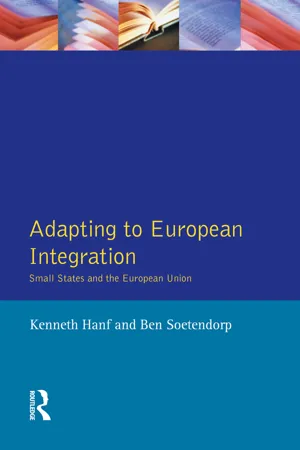
Adapting to European Integration describes how the political institutions in eight small member states and two non-members responded to the internal and external demands springing from the process of European integration in general and EC/EU membership in particular. The study makes a distinction between governmental/administrative adaptation, political adaptation and strategic adaptation. The chapters focus, in the first instance, on the governmental/administrative responses at the level of central government, the organisational adjustments and the changes in institutional capacity to meet the new challenges. The authors also look at the willingness of the political decision-makers to internalise the EC/EU dimension in domestic policy making and the way in which the country's own history as well as the attitude towards European integration facilitate or hinder adaptation and change.
eBook - ePub
Adapting to European Integration
Small States and the European Union
- 216 pages
- English
- ePUB (mobile friendly)
- Available on iOS & Android
eBook - ePub
About this book
Information
Chapter 1
Small States and the Europeanization of Public Policy
Introduction: the Europeanization of public policy
Decision-making in the western European states is becoming more Europeanized in the sense that what happens now at the level of the European Union (EU) penetrates more and more areas of national policy-making. Interactions with Brussels as well as bilateral contacts with partners in the member-states lead to a Europeanization of public policy-making within the different countries. The Europeanization in and through the EU, as Wessels (1995) has pointed out, is an ‘essential tendency’ of the evolution of the post-war state in western Europe. The term ‘Europeanization’ is understood as a process in which Europe, and especially the EU, become an increasingly more relevant and important point of political reference for the actors at the level of the member-states. Laffan and Tannam note in Chapter 5 that more and more decisions with regard to different policy sectors are taken through ‘intergovernmental and transgovernmental policy networks that reach from Brussels into subnational government in the member-states’. Consequently, they observe further, politicians and officials participate now in an evolving polity which provides opportunities for political action but also imposes constraints on their freedom of action. Therefore, if they are to respond effectively to the needs and demands of the citizens of their countries, they will need to learn to work in a system of public policy-making that involves complex games in multiple arenas.
Still, member-states have not been inclined to give up their central position. Even in those policy sectors where this process has proceeded the farthest, the member-states are still the central actors, although they are now deeply embedded in the Euro-level policy-making process (Richardson, 1996: x). In the coming years, through both the constitutional decisions based on the work on the pending intergovernmental conference and the legislative decisions through which these are worked out, a balance will be sought between ‘continued integration and continued national sovereignty’ (ibid.: xi). Wessels notes that up until now this has meant trading de facto sovereignty for access to and influence on the policy decisions made jointly through the policy process of the EU. By means of the Council working groups and other familiar consultative committees, national representatives sit on the committees that control the formation of EU policy (Wessels, 1995).
Most frequently these developments are examined in terms of how policy-making is organized at the EU level, and how the interaction of national and European-level actors affects the definition of national interest, the resources available for pursuing it, the exercise of influence and the legitimacy of the decisions reached at the EU level. Likewise, interest is focused on the organizational alternatives for organizing the relations between the different institutional actors of the EU. But equally important are the kinds of adjustments made at national level – in the way that politics is organized and policy is made – in order to accommodate new situations and participate effectively in EU-level game. This Europeanization has had, as Richardson has pointed out, ‘a major impact on the policy processes at the national level, on the behaviour of different policy actors, both public and private, and on the institutions of the member states’ (Richardson, 1996: x). As a result of the intermingling of EU and national levels, ‘the national political system will become progressively permeated by environmental inputs from "outside" which, over time, become internalized in politics and policy making’ (Ladrech, 1994). Therefore, while the result at the macro European level may well be some kind of ‘co-operative federalism without a state’ (Richardson, 1996), important changes will be introduced at the level of the individual member-states themselves as well. Laffan and Tannam also remind us that ‘EU membership is not just about involvement in Brussels-level decision-making because the EU can and does act as an agent of change in the member-states’. Viewed in these terms, Europeanization involves ‘an incremental process reorienting the direction and shape of politics to the degree that EC political and economic dynamics become part of the organisational logic of national politics and policy-making’ (Ladrech, 1994: 69).
In this connection we can also refer to the observation of Albert Weale that ‘Participation in international regimes of environmental protection cannot be understood without examining the changing patterns of domestic politics’ (Weale, 1992: 200). In our view, this applies to other policy areas as well. As Weale further points out, ‘[t]he internationalisation of political life does not simply mean that domestic policy is constrained by international factors; it also means that foreign policy-making is constrained by domestic factors’ (ibid.: 200). However, this mutual restraint does not occur in the form of two levels of action confronting each other but rather in the form of interrelated actors in a multi-level set of linked games, where some of the interactions are ‘mediated’ through a more ‘central’ actor that aggregates inputs from other participants. In turn, these other actors can themselves, either directly or again via another intermediary actor ‘specialized’ in their interest sector (at both national and international levels), seek to gain access to and influence over authoritative decision-makers with regard to a particular phase of the policy process.
Each member-state tries to ensure that European outcomes are as close as possible to the national interest, yet these national interests themselves are now defined in the context of the EU. In this sense, national interests are not formed in a (domestic) vacuum and ‘brought to Brussels’ to be ‘defended’ or ‘realized’. Again, we have here to do with nested games: the outcomes of the games in national capitals are influenced by what is decided in Brussels; at the same time, however, what is decided in Brussels depends on or is influenced by the outcomes of the games within each member-state. This does not only occur sequentially, but simultaneously through the various structures and processes that join national and EU actors in the formulation and implementation of policy decisions.
Of course, the role of domestic institutional structures in the formulation and implementation of EU policies has long been recognized. Quite often, however, the analysts have been more interested in the emergence of transnational subsystems in the EU than in the relationships between existing sectoral arrangements at national-level and EU policy-making. For example, Bulmer states that ‘the pattern of negotiations in each policy sub-structure sets the key in which the relevant national ministers (and interest groups) will behave in the upper decisional tier’ (Bulmer, 1983). In trying to account for the way in which national interests are defended in Brussels, it can be argued that the characteristics of domestic policy networks will constrain the ways in which national interests are promoted in the negotiation of a European directive or other decisions. In this sense, the leeway for action at the European level will be determined by the constellation of political forces on the issue at home. Other studies also stress the relationship between the behaviour of the member-state in the EU and the degree of its domestic adaptation to the external environment of the EU. In their study of the Federal Republic of Germany and the EU, Bulmer and Paterson argued that the internal policy-making style and the priority given by political parties, public opinion and socio-economic interest groups to domestic issues over European integration, were significant barriers to a leading role by Germany in the EC (Bulmer and Paterson, 1987). George and his colleagues propose that the position of Britain as a semi-detached member is a result of the gap between steady governmental adjustment to working within the EU on the one hand and slow political adaptation on the other (George, 1992).
What we want to examine is the extent to which there has been, as a result of the impact of Europeanization of public policy and, more specifically, as a result of membership in the EU, a reorientation of ‘the organisational logic of national politics and policy-making’, as Ladrech calls it (Ladrech, 1994: 69). This means that the country studies that follow seek to describe and understand the ‘redefinition of political activity’ as a result of EC membership – the ‘reorientation of national politics by way of organisational change’ (ibid.). It is assumed, therefore, that joining the EC has affected the political and administrative institutions of the member-states of the EC/EU in many ways, as the political leadership and the bureaucracy seek to cope with a considerably larger and more complex political environment.
The focus on small states
But why look at smaller states? A simple answer would be that the literature on the relationship between the EU and its member-states is most concerned with explaining the role of the larger states: France, Germany and Britain. Few scholars have focused on the relationship between the behaviour of the smaller members in the EU and the degree of their domestic adaptation to the external environment of the Union. This granted, what is a ‘small state’? People seem to have an intuitively accurate idea about the nature of small states. For example, we almost automatically think of such characteristics as small territory, small population, little military strength, limited raw materials or resources, etc. Nevertheless, it remains difficult to come up with some kind of clear-cut definition of smallness. The observations made by Amstrup and Handel in their survey of research efforts on small states some years ago, saying that no definition of a small state is completely satisfactory, is still valid (Amstrup, 1976; Handel, 1981). Since a great part of the literature on small states deals with security problems, they have taken as their point of departure the perceptions of the state itself with regard to its capabilities for defending its security and asserting its national interests. In this sense a small state, or a weak state as some authors refer to it, is one that itself recognizes that it cannot obtain security primarily by use of its own capabilities. However, small states may have a problem of survival not only in their security policy but also in their trade policy. Handel therefore argues that weak states may be defined in economic terms as well. A small state may be defined as one that depends comparatively heavily upon foreign trade, both for supplies and sales markets (cf. Handel, 1981: 46).
In light of the difficulties encountered with the development of a concrete, scientific definition of a small state, some scholars who work on small-states theory avoid the entire problem of definition, either because it seems irrelevant to them or because it seems impossible to solve. Smallness is, in this conception, a comparative and not an absolute idea. ‘Whatever scales of magnitude are employed seem arbitrary and it is difficult to pick out on them where smallness begins or ends’ (Amstrup, 1976: 165–6). We are inclined, for the reasons mentioned, to follow the same approach to the problem of a definition. In our view, irrespective of the difference in their relative size, both Spain and the Netherlands are treated in this volume as small states. Spain forms a kind of hybrid in this regard: while it is formally counted under the large-state category (the number of votes, Commissioners), in many ways it is still in the category of a small state (cf. Handel, 1981: 31). The case of Spain underlines how problematic such distinctions of role and weight are in terms of physical size, i.e. land mass and population. With regard to some ‘objective’ criteria of economic development, the Netherlands is larger than other countries that surpass it in the usual measures of ‘largeness’. It is not our intention to make a contribution to this discussion, nor do we necessarily take it as our point of departure. We feel that it is justification enough for a focus on these states that there is, relatively speaking, an information gap since discussions of the member-states within the EU usually focus on the larger member-states. Ironically, there are at present more smaller member-states than there are large ones; further expansion of the EU eastward will also increase the number of small states.
Since, in any case, small states can only be ‘effective’ at the international level if they are well organized in preparing and presenting their position on issues – relying on the ‘force’ of persuasion and argument – we would expect to find a self-conscious and systematic effort to ensure that institutional adjustments are appropriate, are carried out and function as intended. In this sense, efforts to adapt governmental and administrative structures and procedures to changes in the international environment would be centralized to ensure a well-functioning system of management with regard to EU affairs. Furthermore, and in this connection, it would seem plausible to assume that the political leadership in the smaller states, at least the cabinet and in particular the prime minister, would take direct interest in these adjustments and in European affairs. Therefore, in the chapters that follow, we will be interested in seeing to what extent explicit adaptation was sought in setting up EU-specific structures and processes, and to what extent countries built further on already existing structures or absorbed EU affairs into the ‘normal order’ of governmental business in other ways.
The countries discussed in the following chapters have been selected in ‘historical pairs’, that is couples of member-states which can be located at different points in the process of enlargement and deepening of the EU. The first pair consists of Belgium and the Netherlands, two of the original six members of the European Economic Community (EEC). These countries have participated in the initial efforts to design and put into operation the institutions and processes for joint decision-making. Denmark and Ireland entered an ongoing policy game. Instead of gradually growing with the EC, there was already something to which these two countries had to adjust upon becoming members. This was, of course, even more so the case with the accession of Greece (1981) and Spain (1986). Not only were numerous policies already in place, to which national legislation had to be harmonized, but also the very definite procedural moves, negotiating traditions and policy style of the EC had to be learned. The abrupt immersion into the realities of a highly developed and self-conscious political system was even more abrupt and dislocating for the most recent member pair in our sample, Austria and Sweden. Norway and Switzerland have been included as two countries where the political leadership had begun the preparations for membership only to see their efforts frustrated by the rejection of this membership by the broader public. Nevertheless, both foreign and domestic policy of these countries continue to be affected by developments within the EU. In this sense, these countries will also have to adjust to the impacts of this form of indirect Europeanization.
Irrespective of size, it could be argued that the impact of EU membership will depend on the point in time, with regard to the stage or degree of integration, at which a country becomes a member. Normally, international cooperation is an extended process which moves from an initial general commitment to deal jointly with a particular problem to the gradual expanding of the scope of the obligations and the filling in of the broad programmatic agreement with more concrete obligations. Under such conditions, there is a chance, over time, to become accustomed to working with other countries and, in some cases, through an international bureaucracy; to having national policy and policy-making processes ‘interfered’ with by actors and decisions from ‘outside’. At the same time, regular contacts and interactions lead to familiarity, which in turn can breed trust and confidence in one’s partners, mutual understanding of one another’s situation and appreciation of new possibilities for action. In particular, Greece, Portugal and Spain and, most recently, Sweden, Finland and Austria, are countries that entered into an advanced form of cooperation and integration and had to swallow the whole ball of wax in one gulp. They were forced to move from a situation of relatively limited effects or impacts from European integration on domestic policy and politics (even though we will see that the EU had consequences for non-members long before they formally applied for membership) to a position where they were expected to take on a full set of obligations and to adjust quickly to the way in which things are done at the EU level.
What are we looking at?
In this book we examine the process of Europeanization of the smaller member-states of the EU, that is the impact of their membership on the domestic politics and institutions of these countries. Our aim is to describe and analyse how the political institutions in eight small member-states and two non-members responded to the internal and external demands springing from EC/EU membership. Most recently, two significant events in the recent history of European integration have occurred: the signing of the Single European Act (SEA) in 1986 and of the Treaty on European Union (TEU) in 1992, which at first glance could be expected to have had significant institutional implications for the member-states. The SEA and TEU extended EC/EU policy-making to new policy areas and established the more frequent use of qualified majority voting. At the same time, the most recent expansion of membership has brought new member-states into the fold, while further enlargement is on the agenda. As a consequence, the volume of EC/EU regulations that the member-states have had to deal with has increased, and the number of actors involved in the European policy-making process has enlarged. The intensification of the decision-making process, in terms of both deepening and extending the range of European policy, has confronted the member-states with the necessity to respond to the changes in the European environment.
The drawn-out political battles preceding the ratification of the TEU in several member-states made it obvious that while institutional adjustment to the additional European level of decision-making has taken place at the level of central government, there appears to be a wide variety of ways in which the various political actors in the different countries have internalized EC membership. Yet there are also similarities in the general strategies of response.
The analysis starts from the assumption that the policy and institutional consequences of the SEA and the Maastricht Treaty, for heuristic purposes, can be translated into a number of ‘functional imperatives’ regarding the capacities of the member-states to manage their ‘European affairs’ both in Brussels and at home. In the first place, member-states are required to engage in a wider range of activity with regard to the EU and at the European level....
Table of contents
- Cover
- Half Title
- Title Page
- Copyright Page
- Table of Contents
- Contributors
- Preface
- Abbreviations
- Chapter 1 Small States and the Europeanization of Public Policy
- Chapter 2 Belgium: The Dilemma between Cohesion and Autonomy
- Chapter 3 The Netherlands: Growing Doubts of a Loyal Member
- Chapter 4 Denmark: The Testing of a Hesitant Membership
- Chapter 5 Ireland: The Rewards of Pragmatism
- Chapter 6 Greece: Competing Regional Priorities
- Chapter 7 Spain: Modernization through Integration
- Chapter 8 Austria: Adaptation through Anticipation
- Chapter 9 Sweden: The State Joins the European Union
- Chapter 10 Norway: An Adaptive Non-Member
- Chapter 11 Switzerland: Adjustment Despite Deadlock
- Chapter 12 Conclusion: The Nature of National Adaptation to European Integration
- Index
Trusted by 375,005 students
Access to over 1.5 million titles for a fair monthly price.
Study more efficiently using our study tools.
Frequently asked questions
Yes, you can cancel anytime from the Subscription tab in your account settings on the Perlego website. Your subscription will stay active until the end of your current billing period. Learn how to cancel your subscription
No, books cannot be downloaded as external files, such as PDFs, for use outside of Perlego. However, you can download books within the Perlego app for offline reading on mobile or tablet. Learn how to download books offline
Perlego offers two plans: Essential and Complete
- Essential is ideal for learners and professionals who enjoy exploring a wide range of subjects. Access the Essential Library with 800,000+ trusted titles and best-sellers across business, personal growth, and the humanities. Includes unlimited reading time and Standard Read Aloud voice.
- Complete: Perfect for advanced learners and researchers needing full, unrestricted access. Unlock 1.5M+ books across hundreds of subjects, including academic and specialized titles. The Complete Plan also includes advanced features like Premium Read Aloud and Research Assistant.
We are an online textbook subscription service, where you can get access to an entire online library for less than the price of a single book per month. With over 1.5 million books across 990+ topics, we’ve got you covered! Learn about our mission
Look out for the read-aloud symbol on your next book to see if you can listen to it. The read-aloud tool reads text aloud for you, highlighting the text as it is being read. You can pause it, speed it up and slow it down. Learn more about Read Aloud
Yes! You can use the Perlego app on both iOS and Android devices to read anytime, anywhere — even offline. Perfect for commutes or when you’re on the go.
Please note we cannot support devices running on iOS 13 and Android 7 or earlier. Learn more about using the app
Please note we cannot support devices running on iOS 13 and Android 7 or earlier. Learn more about using the app
Yes, you can access Adapting to European Integration by Kenneth Hanf,Ben Soetendorp in PDF and/or ePUB format, as well as other popular books in Politics & International Relations & Comparative Politics. We have over 1.5 million books available in our catalogue for you to explore.