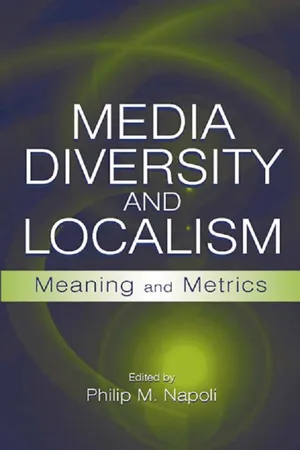
Questions concerning the quality of media performance and the effectiveness of media policymaking often revolve around the extent to which the media system fulfills the values inherent in diversity and localism principles. This edited volume addresses challenges and issues relating to diversity in local media markets from a media law and policy perspective. Editor Philip M. Napoli provides a conceptual and empirical framework for assessing the success/failure of media markets and media outlets in fulfilling diversity and localism objectives.
Featuring well-known contributors from a variety of disciplines, including media, law, political science, and economics, Media Diversity and Localism explores the following topics:
*media ownership and media diversity and localism;
*conceptual and methodological issues in assessing media diversity and localism;
*minorities, media, and diversity; and
*contextualizing media diversity and localism: audience behavior and new technologies.
This substantive and timely volume speaks to scholars and researchers in the areas of media law and policy, political science, and all others interested in media regulation. It can also be used in a graduate seminar on media policy topics.
- 424 pages
- English
- ePUB (mobile friendly)
- Available on iOS & Android
eBook - ePub
About this book
Information
II
Conceptual and Methodological Issues in Assessing Media Diversity and Localism
6
Mediation, Mediators, and New Intermediaries: Implications for the Design of New Communications Policies
Stefaan G. Verhulst
It is a truism today to say that we live in a period of unprecedented technological upheaval. The rise of the Internet, the emergence of wireless technologies, the arrival of digital convergence, the proliferation of iPods and other portable devices: these are but some of the technological changes sweeping through our economic, social, and political landscape. As with any such period of innovation, the changes we are witnessing present both opportunities and challenges. The line between “creative destruction”1 (McKnight, Vaaler, & Katz, 2002; Schumpeter, 1975) and “disruption”2 (Christensen, 1997) is often a fine one.
Media policymakers are not, of course, the only ones grappling with these changes. But in many respects, they are on the frontlines: more than many other sectors, the mass media has been utterly (perhaps unrecognizably) transformed by technological innovation (Currie, 2004). Finding the right framework to manage that transformation poses a genuine difficulty for communications policymakers and regulators. How should the communications industry be governed? Must we discard our existing communications policy toolbox, which is often technologically specific (Longstaff, 2002), or does it continue to have validity in a new landscape where the lines between television, telecommunications, and information technologies are increasingly blurred? Around the world, policymakers confront the very real difficulty of “translating” (Goldberg, Prosser, & Verhulst, 1998; Hitchens, 1997) existing principles and lessons for a drastically new technological and market environment.
This chapter presents ideas and options on how to conduct such translation. It offers a different lens for looking at existing media policy, and suggests analytical continuities between today’s rationales for policy intervention and the new methods required to adapt to technological change and innovation. We argue that many of the rationales behind current media and communications policy are based indirectly (and often without acknowledgment) on a concept of “mediation.”3 “Mediation,” we suggest, can (and should) be used as an analytical tool to better understand how to update our current communications policy toolbox. Furthermore, we show, technology-led challenges to existing policies can be seen, in large part, as arising from changes to the nature and functioning of media intermediaries or “mediators.” We therefore suggest that any attempt to design communications policies in a new information environment could benefit from a closer look at the concept of mediation.
In the next section, we explain the concept and importance of mediation, showing how it applies across a range of sectors in society and to a range of different intermediaries. The following section discusses media intermediaries in particular: we explain why mediation is such a powerful force in the mass media, especially when combined with scarcity, and show how it provides a conceptual rationale for our existing policy toolbox. The next section shows how technological change is transforming existing notions of mediation, altering both the nature and the functioning of media intermediaries. The precise nature of these changes is sometimes unexpected—the widely touted process of disintermediation, for example, has led instead to a process of reintermediation. Nonetheless, the changes have been real enough to suggest that we need a new approach to mediation, and in the last section, we begin outlining a “new mediation ecology” for policymakers.
Here, we only sketch the outlines of this new mediating ecology. Much further and ongoing analysis will be required to develop specific policy mechanisms, and these mechanisms, moreover, will vary depending on the particular context and application. The main purpose of this chapter, however, is not to develop an elaborate new framework for policymaking but rather to show some potential continuity between existing policy rationales and new policies. The concept of mediation, we suggest, can serve as an organizing principle for policymaking: it can help link the old to the new, and it can help us apply principles across hitherto separate sectors.
CONCEPT OF MEDIATION
Before turning specifically to the media, it is helpful to begin by considering the notion of mediation more generally. Mediation, according to Silverstone (2005), is a “fundamentally dialectical notion, which requires us to address the processes of communication as both institutionally and technologically driven and embedded” (p.3). Yet what does a mediator or an intermediary do? In fact, multiple functions can be associated with mediation, and the concept will vary depending on the context and who (or what) is doing the mediation.
In one of the most common interpretations, we can say that an intermediary filters our perceptions of the world, acting as a gatekeeper (Lewin, 1947; White, 1950) and sifting through the masses of information that help us determine reality. Intermediaries can also play the somewhat more passive role of a mirror or even a hologram (Baudrillard, 1983), presenting some “reflective” version of reality. Various other functions can be attributed to intermediaries. According to McQuail (2000), mediators can also act as a guide or provide a forum or platform; or, in the case of journalism, operate as an interlocutor and informed interpreter (p.66).
One particularly useful way of understanding the role of intermediaries is to consider the concept of “framing” (Entman, 1993). “Frame analysis,” of course, has a long pedigree in media studies, going back to the classic work of Erving Goffman (1974). In his widely quoted definition (which built on Goffman’s work), Todd Gitlin (1980) defined a frame as follows: “Frames are principles of selection, emphasis and presentation composed of little tacit theories about what exists, what happens, and what matters” (p.6).
Frames, in other words, determine which parts of reality we notice; at a more fundamental level, they shape our perceptions of reality. They provide a way to “understand” events, building on existing “frames of reference” or embedded knowledge (Cappella &Jamieson, 1997, p.46).4 This is precisely one of the important functions performed by intermediaries in society, especially if one acknowledges that our perceptions of reality or our “frames of mind” ultimately directly or indirectly determine how we respond and behave in any given situation (Gladwell, 2005).
It is, however, important to understand, at the outset, that the media are not the only intermediary in society. Educational, religious, and political establishments, for example, frame reality in much the same way as do traditional media. Librarians filter and navigate information; school textbooks offer a particular (and often biased) view of reality 5 (Fitz Gerald,1979; Ravitch, 2003), artists represent humankind in a mediated fashion, and religious leaders offer a particular interpretation on our world (and beyond).6 Indeed, the influence of religion, and the profusion of religious rhetoric in U.S. policymaking is a powerful example of the way in which a nonmedia intermediary determines and shapes our world.7
The framing function performedby the media (and other intermediaries) is essential to understand because of another characteristic shared by all intermediaries: they are inherently subjective. In framing the world, they are also presenting a particular version of the world. In truth, intermediaries are never value-neutral or objective; they always present a certain perspective of the world. As we shall see, this property, which is common to all intermediaries, is particularly important when it comes to the mass media: it is one of the underlying reasons, in fact, that much policymaking is based (albeit often with acknowledgment) on a concept of mediation.
MEDIA AND MEDIATION
To understand why and how this is so, however, we first need to understand some features that distinguish the media from the various other intermediaries discussed earlier. These features, three of which are discussed in this section, help us see how much current media policy is based on the media’s role as an intermediary.
The first reason the media are unique (or at any rate special) is because they combine all the various functions that can be assumed by an intermediary. Although literature from the field of media studies (Severin & Tankard, 1992) generally emphasizes the media’s role as “gatekeeper,” in fact, the media perform many of the other functions discussed earlier. For example, newspapers do not only sift through information (i.e., act as gatekeepers), but also offer a window or mirror onto reality. Likewise, with the rise of 24_hr news programs, the media increasingly perform the role of interlocutor or informed discussion partner. The point is simply that different kinds of media, on different occasions, mediate differently; as we see later, the precise manner of mediation can have an effect on communications policymaking.
A second, and perhaps more important, differentiating factor is the media’s pervasiveness in society. Although mediation is performed by multiple mediators in society and has been going on for centuries, the arrival of mass media, with its unparalleled reach, provided for steep increase in the variety and the intensity of mediation (De Zengotita, 2005, p.47). Given its wide diffusion, the media have the power to shape the public imagination and to determine the terms of discourse in what Jurgen Habermas (who himself drew attention to the role of the media) has famously called “the public sphere” (1962). Indeed, in Imagined Communities: Reflections on the Origin and Spread of Nationalism, Benedict Anderson’s (1991) classic work on nationalism, he shows how the modern nation-state and national identity was itself brought into existence by what Anderson calls “print capitalism.” Today, as Cass Sunstein (2001) and others have shown, notions of citizenhood and nationalism are in much the same way sustained by the modern media.
Mediation and Power
This unique potency begins to show why the media’s role as an intermediary is relevant to policymakers. But it is when this potency is combined with a third distinguishing feature of the media that we truly begin to understand how much of our current communication policy toolbox is based on a concept of mediation. This third characteristic is the inherent scarcity in the media marketplace—the fact that (traditionally at least) there existed only a limited number of media intermediaries.8
This scarcity can arise from many sources. It can be a result of (perceived) technical limitations, for example in the electromagnetic spectrum, where (until recently) shortages and the threat for interference have constrained the number of broadcasters. Or it can be economic, for example in the form of high barriers to entry or costs of content production, or limited market size. Scarcity can also be imposed artificially through government regulation—license requirements can limit the number of television broadcasters or telephone operators; ownership caps or other restrictions can have a similar effect, making the state itself a mediator in affecting (and selecting) other mediators. In addition, scarcity can result from the de facto adoption of proprietary standards.9 It is, for instance, now well understood and documented (Laven, 2004) that the development of TV in Europe, in the 1950s and 1960s, was hampered by arguments over proprietary standards. Each member state considered it a sovereign right to choose technical standards that were different from its neighbors, resulting in a confused mixture of incompatible TV standards (e.g. 405, 819, and 625 lines, PAL and SECAM, analogue stereo and digital stereo). In many ways, this can also be seen as a form of market- or even state-induced scarcity.
Whatever the source, and whatever the layer—the physical, logical, or content layer 10—the important point is that the fact of scarcity imposes power. Because of scarcity, those intermediaries that do enter the market are in a pr...
Table of contents
- Cover
- Half Title
- Leas Communication Series
- Full Title
- Copyright
- Contents
- List of Contributors
- Preface
- Introduction: Media Diversity and Localism—Meaning, Metrics, and Policy
- I: MEDIA OWNERSHIP ANDMEDIA DIVERSITY AND LOCALISM
- II: CONCEPTUAL AND METHODOLOGICAL ISSUES IN ASSESSING MEDIA DIVERSITY AND LOCALISM
- III: MINORITIES, MEDIA, AND DIVERSITY
- IV: CONTEXTUALIZING MEDIA DIVERSITY AND LOCALISM: AUDIENCE BEHAVIOR AND NEW TECHNOLOGIES
- Author Index
- Subject Index
Trusted by 375,005 students
Access to over 1.5 million titles for a fair monthly price.
Study more efficiently using our study tools.
Frequently asked questions
Yes, you can cancel anytime from the Subscription tab in your account settings on the Perlego website. Your subscription will stay active until the end of your current billing period. Learn how to cancel your subscription
No, books cannot be downloaded as external files, such as PDFs, for use outside of Perlego. However, you can download books within the Perlego app for offline reading on mobile or tablet. Learn how to download books offline
Perlego offers two plans: Essential and Complete
- Essential is ideal for learners and professionals who enjoy exploring a wide range of subjects. Access the Essential Library with 800,000+ trusted titles and best-sellers across business, personal growth, and the humanities. Includes unlimited reading time and Standard Read Aloud voice.
- Complete: Perfect for advanced learners and researchers needing full, unrestricted access. Unlock 1.5M+ books across hundreds of subjects, including academic and specialized titles. The Complete Plan also includes advanced features like Premium Read Aloud and Research Assistant.
We are an online textbook subscription service, where you can get access to an entire online library for less than the price of a single book per month. With over 1.5 million books across 990+ topics, we’ve got you covered! Learn about our mission
Look out for the read-aloud symbol on your next book to see if you can listen to it. The read-aloud tool reads text aloud for you, highlighting the text as it is being read. You can pause it, speed it up and slow it down. Learn more about Read Aloud
Yes! You can use the Perlego app on both iOS and Android devices to read anytime, anywhere — even offline. Perfect for commutes or when you’re on the go.
Please note we cannot support devices running on iOS 13 and Android 7 or earlier. Learn more about using the app
Please note we cannot support devices running on iOS 13 and Android 7 or earlier. Learn more about using the app
Yes, you can access Media Diversity and Localism by Philip M. Napoli in PDF and/or ePUB format, as well as other popular books in Politics & International Relations & Communication Studies. We have over 1.5 million books available in our catalogue for you to explore.