Leadership and Coherence investigates how leaders justify their decisions, and how they bring about coherence amongst followers. Taking a cognitive approach, it builds on the work of Hannah Arendt to attempt a phenomenology of judgment, examining how the moral imperative experienced by leaders can be shared by their community so both leader and led are guided by a mutual purpose.
Through biographical case studies of historical leaders, this book illustrates how successful leaders operate in a turbulent world, not only making their own decisions but also gathering likeminded followers to share in a common vision and shared sense of purpose.
Two things fill the mind with ever new and increasing awe and admiration: the starred heaven above me and the moral law within.
(Immanuel Kant)
Painting Rouen Cathedral
The resolution to any problem often begins with new ways to think about it. The capacity to think in new ways includes both expanding and contracting one's frame of reference.
Imagine an oil painter such as Claude Monet wanting to portray Rouen Cathedral in France. Where exactly would he stand? From what angle would he show it? That is one of the choices he will have had to make. Here is another. Is his purpose to depict the cathedral as an object in its own right? Or does he want to include the cathedral as only a part of the skyline or cityscape (expanding the frame of reference)? Or for that matter does he want to depict some small part of its façade—maybe a few large stones behind the bough of a tree (contracting the frame of reference)? The artist's eye can shift outward or inward, not unlike the pupil's capacity in the eye to focus either far away or near. Think for example of a camera zooming out and in. For convenience, let us call this capacity to expand and contract “conceptual elasticity.”
This capacity for shifting out and in can certainly lead to confusion, if not fatigue. Nevertheless, the artist must eventually choose a frame, even though it would have helped to weigh all of the options before making a selection.
Elasticity is not restricted to moving along a single dimension, expanding and contracting. Instead, it applies to nearly any dimension one can imagine. Go back to our oil painter, Monet. He portrayed the cathedral at different times of the day and night. He also relied on different colors, such that he painted a bluish cathedral one time and a golden cathedral the next, in nearly any hue or tint. In other words, not only can the human mind move conceptually along a single dimension by infinite degrees, from one end of the spectrum to the other, there is (conceivably) an infinite number of these dimensions. (See Jonas, 1966, p. 165)
The study of any object or phenomenon ultimately requires such conceptual elasticity. You can study water in its various states as a solid, liquid, or gas. You can also study the whole water cycle, from rain falling into the river and then evaporating up into the clouds. Again, that is an example of expanding the frame of reference. Or you can study the elements that constitute water, i.e. hydrogen and oxygen. That is an example of contracting the frame of reference. In either case, a thorough understanding of water would require both. In like manner, the field of biology has been subdivided into organismal biology, including ecology (expand), and molecular biology, including chemistry (contract). We also notice in physics that classical mechanics progressed from the parts to the whole, whereas quantum mechanics moves in the other direction. (Capra, 1996, ch. 2) Again, expanding and contracting.
Leadership as a phenomenon is no different. What has happened is that some people who tend to expand the frame of reference rarely speak to the people who tend to contract the frame of reference. Over time, they have developed entirely different methods with entirely different terminology. They have cited different experts and have often worked in entirely different academic disciplines, writing for different journals and going to different academic conferences. It would probably be more accurate to say that they began their careers from within their different frames of reference in graduate school and only accidentally discovered years later they had been talking about the same thing—although by that time they are tempted to believe the other frame was simply wrong or so alien as to be beyond comprehension. The field of sociology, for instance, looks at leadership in a way that is different from psychology, and so forth. For some people, their powers of elasticity had simply never before been tested in this way. As a result, the study of leadership has suffered—not because there is such a multiplicity of frames (which, in my opinion, is a good thing), but because the multiplicity has been inadequately integrated in any coherent fashion. (See e.g. Goethals & Sorenson, 2006; Rousseau, 1985)
Each frame of reference, as we have been calling it, has its own integrity. There is no use choosing only one of them to be declared the winner, as though this were a beauty pageant, nor is there any use collapsing them entirely somehow or treating them exactly the same. Each has its merits. (Voegelin, 1974/1990, ch. 10)1 To be honest, it is usually best for an investigator to pick only one frame of reference and stick with it, at least for the duration of a project. Denise Rousseau calls the chosen frame the “focal unit.” (1985, p. 4) Sliding promiscuously back and forth without a focal unit can ruin good scholarship … unless, that is, elasticity is itself the object of investigation. And in this book, elasticity is absolutely required. Here is why.
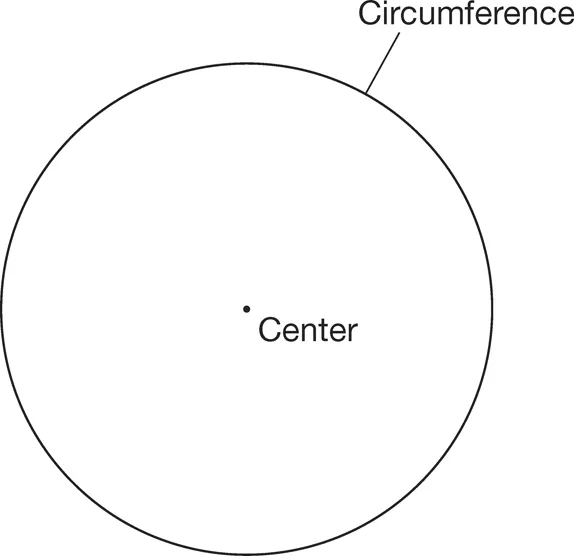
In this first chapter, I will expand the frame of reference, moving outward, becoming more and more inclusive or holistic as I consider this phenomenon of leadership as though from a wide-angle lens. That is why I titled the first chapter “circumscribing the field”. I am seeking the most expansive circle possible. If we can imagine the field of leadership as a circle, this first section of the book tries to find its circumference.
In the second chapter, I will contract the frame of reference radically, moving inward. If the first chapter uses a wide-angle lens, in the second I go in for a close-up. That is why I am titling the second chapter “locating the center.” The center of a circle, if you recall from geometry, is an infinitesimal point. So, just as the circumference can be thought of as the outward limit of a circle, the center can be thought of as the inward limit, beyond which you cannot go (see Figure 1.1).
Figure1.1
The third section of the book will be quite different, as it introduces three historical figures and investigates their leadership. The purpose of the third section is to illustrate how the first two sections of the book can be seen to apply to real-world exemplars.
Perhaps by the conclusion of this book other investigators into leadership will be inspired to demonstrate their elasticity in their own studies and also teach their students to develop these powers of elasticity. Long before you and I get to that point, however, we must do as I had suggested and circumscribe the field.
A History of Leadership Studies
It is more than convenient that the history of formal leadership studies can be depicted as a gradual expansion of the frame of reference. Looking back, that version makes a lot of sense, even though it had not happened that way by design. Nobody set forth from the beginning to work outward along a particular dimension. Initially, investigators simply wanted to understand leaders. Leaders by their very nature attract attention, like lightning against darkened skies. Investigators had wanted to study leaders in the same sense that Monet wanted to paint Rouen Cathedral.
Why did leadership studies begin with this tendency? Gestalt psychologists have explained this tendency by means of figure-ground differentiation. (Rock, 1995, p. 114, citing Rubin, 1921) What this means is that our perceptual process tends to notice only part of the field of vision; we pay attention to only a fraction of what we might possibly perceive. The rest is regarded as background. You and I are selective about where we devote our attention. Not surprisingly, for example, history concentrates on dramatic or colorful episodes from the past such as rebellions and plagues and battles, and as a result has tended to ignore the daily operations of ordinary life.
Consider for a moment how many Americans still remember where they were on 9–11 as they watched the World Trade Center towers collapse; do any of them remember what they had for lunch the next day?2
John Lewis Gaddis addresses this tendency in historical studies when he distinguishes a reductionist approach from what he calls an ecological approach. (Gaddis, 2002, p. 54f) Reductionist approaches concentrate on the parts, i.e. the salient causal factors that would have led to a discernible outcome. Ordinarily, that “causal factor” is the individual social actor as an independent variable, as though all the rest of the world at that time can be held constant. What causes an upheaval? Or, what prevents upheaval? The first thing we might notice, looking backwards, is the extraordinary individual who appears to have led others toward the final outcome. We ask: who was the spokesperson, the guy in charge, the symbolic figure at the barricades, the hero? Historians often looked here first for answers. Gaddis is relieved to say that historians know better now, but that wasn't always the case. At the same time, however, he also confirms the basic assertion that even today historians seek out “the point at which [historical processes] took a distinctive, or abnormal, or unforeseen course.” (Gaddis, 2002, p. 99) That is the reason historians tend to study certain events and activities while ignoring others.
History is not the only field of study where figure-ground differentiation occurs. Michael Polanyi wrote in 1966 about the tendency among natural scientists to examine only one aspect of a larger phenomenon, emphasizing details of particulars (as he called them), without appreciating that at the same time they were tending to ignore the tacit dimension. Oftentimes, breakthroughs in science occur when an investigator sees something that had been otherwise overlooked because it was “tacitly” understood. Polanyi went on to argue that the same thing happens when we are introduced to another person: we select certain features about them to help us figure out who they are while at the same time overlooking other, subsidiary aspects. We can process only so much information at one time, he admitted. Productive science, however, routinely brings what had been in the background, relatively unnoticed, into the foreground, and this would include paying attention to the context within which the object of investigation takes place. (Polanyi, 1966) That is, scientists also have been expanding their frame of reference.
Fritjof Capra wrote a book published in 1996 titled The Web of Life, in which he argued at some length for a broader conceptual vision about the phenomenon of life. While dismissing smaller frames of reference (like Gaddis) as “reductionism,” Capra showed how the sciences in particular have been increasingly widening. To illustrate, he alluded to Gestalt psychology and ecology before bringing it all under the rubric of systems thinking. For biology, he credited Lawrence Henderson with insisting on using systems thinking as a method for understanding the networks crucial to life. Capra wrote that biology shifted from a consideration of the parts to a consideration of the whole, requiring scholars to move back and forth among the various magnitudes, which in turn led to shifting attention away from objects (such as organisms) and toward relationships. Here we see a direct appeal to what we have been calling conceptual elasticity.
Let us go back then to the history of leadership studies. Investigators interested in leadership readily noticed the kings and commanders, the prophets and patriarchs, hoping to learn about them as agents, as social actors, as individuals who appear to have made a difference. What set them apart? And how might we identify the good leaders, as opposed to bad ones? How might we even develop likely candidates to become better leaders? These were very real and practical questions. And they still are. Thinkers as widely separated as Plato in ancient Greece (c. 429–347 bce) and Xunzi in ancient China (c. 313–238 bce) each tried to explain a method for locating and training prospective leaders.3 Every generation is still, to this day, rightly concerned with this project.
Today, we would say the original focus was probably too leader-centric. Investigators tended to valorize leaders, treating everybody else as background. In the earliest days of leadership studies, we saw precursors in hero-worship and what has come to be known as the Great Man Theory. (Harter, 2008a) Regardless whether scholars examined a leader's traits, behaviors, or style, they tended to restrict their frame of reference to the leader alone. And this is not entirely wrong, so far as frames go. There is still a tremendous need to conduct investigations at this magnitude. Brad Jackson and Ken Parry (2011) recently published A Very Short, Fairly Interesting and Reasonably Cheap Book about Studying Leadership, in which they devote the entire second chapter to leader-centered perspectives on leadership. Nevertheless, investigators increasingly recognized that in order to understand leadership fully, they had to understand the relationship a leader enjoys with his or her followers. Leader-ship, as wi...
Table of contents
Cover Page
Half Title Page
Series Page
Title Page
Copyright Page
Contents
Series Editors' Foreword
Preface
Acknowledgments
1 Circumscribing the Field
2 Locating the Center
3 The Framework for this Investigation
4 From “It” to “You” to “Us”
5 Cameron Finds Himself Transfixed by “A Sunday Afternoon on the Island of La Grande Jatte”
6 The Shattering
7 The Persuasions of Socrates
8 The Purposes of Abraham Lincoln1
9 Jan Patočka and Pneumopathology
10 Transcendence or a Romantic Delusion … or Worse?
Appendices
Index
Trusted by 375,005 students
Access to over 1.5 million titles for a fair monthly price.
Study more efficiently using our study tools.
Frequently asked questions
Yes, you can cancel anytime from the Subscription tab in your account settings on the Perlego website. Your subscription will stay active until the end of your current billing period. Learn how to cancel your subscription
No, books cannot be downloaded as external files, such as PDFs, for use outside of Perlego. However, you can download books within the Perlego app for offline reading on mobile or tablet. Learn how to download books offline
Perlego offers two plans: Essential and Complete
Essential is ideal for learners and professionals who enjoy exploring a wide range of subjects. Access the Essential Library with 800,000+ trusted titles and best-sellers across business, personal growth, and the humanities. Includes unlimited reading time and Standard Read Aloud voice.
Complete: Perfect for advanced learners and researchers needing full, unrestricted access. Unlock 1.5M+ books across hundreds of subjects, including academic and specialized titles. The Complete Plan also includes advanced features like Premium Read Aloud and Research Assistant.
Both plans are available with monthly, semester, or annual billing cycles.
We are an online textbook subscription service, where you can get access to an entire online library for less than the price of a single book per month. With over 1.5 million books across 990+ topics, we’ve got you covered! Learn about our mission
Look out for the read-aloud symbol on your next book to see if you can listen to it. The read-aloud tool reads text aloud for you, highlighting the text as it is being read. You can pause it, speed it up and slow it down. Learn more about Read Aloud
Yes! You can use the Perlego app on both iOS and Android devices to read anytime, anywhere — even offline. Perfect for commutes or when you’re on the go. Please note we cannot support devices running on iOS 13 and Android 7 or earlier. Learn more about using the app
Yes, you can access Leadership and Coherence by Nathan Harter,Nathan W. Harter in PDF and/or ePUB format, as well as other popular books in Psychology & Applied Psychology. We have over 1.5 million books available in our catalogue for you to explore.