- 176 pages
- English
- ePUB (mobile friendly)
- Available on iOS & Android
eBook - ePub
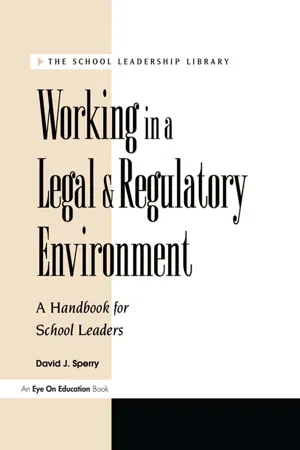
Working in a Legal & Regulatory Environment
About this book
The books in this series describe what successful principals must know and be able to do. Written by teams of nationally recognized experts and accomplished practitioners, they include practical materials such as checklists, sample letters, model forms, case studies, and action plans.
Information
1
INTRODUCING EDUCATION LAW
Educational law is a fundamental and critical dimension of the knowledge base possessed by effective and successful school principals. As noted by the National Policy Board for Educational Administration (NPBEA), “Principals require a knowledge of legal and regulatory applications in order to address a range of complex and sensitive problems that arise in the school setting” (Thompson, 1993, p. 19-3). As further noted by the NPBEA, “Operating within the constraints of our system of laws and in accordance with its mandates requires both technical knowledge and awareness of the fundamental values that undergird legal and regulatory standards” (Thompson, 1993, p. 19-3). Legal decision-making skills are also necessary. Such skills include the ability to effectively gather facts, engage in the legal reasoning process, assess the current context in light of applicable law, formulate alternative courses of action, choose a plan of action, and implement the decision.
The NPBEA has also declared that:
The costs of litigation, monetary and otherwise, require principals to adopt a preventative law approach to professional practice. “Knowledge of legal issues and competence in managing school risk are essential to avoid legal liability and to provide effective on-site leadership” (referencing Strahan & Turner, 1987). With this knowledge, principals can identify legal issues, foresee potential legal liability, and act to reduce or mitigate risks (Thompson, 1993, p. 19-4).
The legal and regulatory knowledge base critical to a principal's professional practice is, as noted by the NPBEA, a knowledge that “defines the scope of the principal's authority by identifying constraints and specifying the instrumentality for exercising power” (Thompson, 1993, p. 19-7). This particular knowledge base is enormous and emanates from all three branches of government (legislative, administrative, and judicial) at both the state and federal level, as well as from quasi-governmental bodies such as local boards of education. Unlike most of the other 20 domains which the National Policy Board has identified as critical to a principal's success, it is impossible to isolate a set of core learnings or standards from the knowledge base per se that would constitute a set of “best practices” or “uniform regulations” to which all school principals should adhere. This is true because of the enormity of the knowledge base and because only those school principals operating within the same school district would have the same exact set of regulatory and legal constraints. The only legal and regulatory applications that are common to all American school principals are those that originate from decisions of the United States Supreme Court, from laws and regulations enacted by Congress, and from regulations promulgated by the executive branch of the federal government. These common legal and regulatory applications only form a partial aggregate of the existing educational law knowledge base. Even with respect to these sources of educational law, local interpretations and practices may legitimately differ. Also, unlike some other domains where common standards or “best practices” might be said to be time honored, the legal and regulatory arena is one characterized by continual change, alteration, and refinement. In effect, the knowledge base is changing on a daily basis. Accordingly, no claim or effort is made in this book to present the actual knowledge base. Rather, the focus or purpose of the book is to present information, concepts, skills, and ideas that will enable a school principal to work more comfortably and effectively in a legal and regulatory environment.
Chapter 2 describes the primary sources and nature of the knowledge base, where the knowledge base is to be found, and how to access it. The chapter concludes by offering some practical suggestions for remaining current with respect to the knowledge base. Chapter 3 presents four key underlying values or concepts that ought to guide the thinking and actions of all public school principals committed to the professional and preventative management of the legal and regulatory dimensions of the school: (1) behaving in a reasonable manner; (2) according due process of law; (3) assuring equal protection of the law; and (4) respecting individual rights and freedoms. Chapter 4 presents an operational model of legal decision-making. This model offers a professional and defensible approach or framework for explicating the issues confronting school principals in the legal and regulatory domain. Chapter 5 introduces, in the form of legal decision-making flow charts, a succinct way in which principals can more effectively keep track of and utilize court decisions in their decision making and school management activities. The charts found in Chapter 5 are based on selected decisions of the United States Supreme Court and have been chosen for their applicability to everyday school level problems. Chapter 6 concludes the book by offering a variety of ideas and suggestions in the form of model policies, practices, and techniques designed to minimize legal liability and to foster a more preventative administrative approach to working in a legal and regulatory environment. These ideas and suggestions have been gathered from effective practicing school administrators, attorneys, risk management directors, professional organizations, and West's Education Law Reporter.
REFERENCES
Strahan, R.D., and L.C. Turner. (1987). The Courts and the Schools. White Plains, NY: Longman.
Thomson, S.D. (1993). Principals for Our Changing Schools. The Knowledge and Skill Base. Fairfax, VA: National Policy Board for Educational Administration.
2
THE SOURCES AND NATURE OF EDUCATIONAL LAW: UNDERSTANDING AND ACCESSING THE KNOWLEDGE BASE
WHAT IS EDUCATIONAL LAW?
The authority for the establishment and control of American public education is grounded in law. Therefore, the question naturally arises as to what is law and, more particularly, what is educational law? The United States Supreme Court wrote, “Law, in its generic sense, is a body of rules of action or conduct prescribed by controlling authority, and having binding legal force” (Fidelity and Guaranty Co. v. Guenther, 1930, p. 37). Hudgins and Vacca (1991, p. 2) define law as “a body of principles, standards, and rules that govern human behavior by creating obligations as well as rights, and by imposing penalties”
Because educational law pertains only to educational matters, it might be said that educational law is that portion of the larger body of law that establishes and controls the operation and management of schools, school systems, and other educational institutions and programs. Consistent with this definition, Alexander and Alexander (1992, p. 1) concluded that
school law as a field of study is a generic term covering a wide range of legal subject matter including the basic fields of contracts, property, torts, constitutional law, and other areas of law that directly affect the educational and administrative processes of the educational system.
WHAT ARE THE SOURCES OF EDUCATIONAL LAW?
All primary law in the United States originates from four sources:
◆ constitutions◆ statutes◆ administrative rules and regulations◆ court or case law
Elements of educational law in the United States emanate from all four sources.
CONSTITUTIONS
Constitutions are a body of precepts that provides a framework of law within which orderly governmental processes may operate. The United States Constitution does not provide a framework for public education; no specific mention of education is found in the federal Constitution. However, the Constitution's Tenth Amendment declares: “The powers not delegated to the United States by the Constitution, nor prohibited by it to the States are reserved to the States respectively, or to the people” (US Const, Amend X). By virtue of this amendment, the responsibility for creating an organizational framework for public education is left to the individual states. All state constitutions provide for a system of public education. Although there is an amazing degree of similarity among the 50 educational systems, there are significant differences found in the constitutional language that creates them. Although each state constitution provides for the establishment of a public education system, some provide detailed direction regarding the organization, governance, and control of the system. Some even prescribe portions of the actual program and curriculum.
As stated earlier, the United States Constitution doesn't create a national system of education or give Congress authority to affirmatively direct and alter the educational mandates and policies of the individual states. The Constitution does, however, have a major impact on the governance and control of the individual state systems of education. Federal constitutional involvement comes about in several ways. The two most prominent are through the General Welfare Clause and the Fourteenth Amendment. The General Welfare Clause enables Congress to induce states to enact educational programs deemed important to the national welfare by providing federal tax dollars to support the creation and/or continuation of such programs. These incentives are often accompanied by certain requirements and restrictions that form very specific controls over the organization and management of the school system. The Fourteenth Amendment protects personal liberties against state intrusion. The applicable portion of the amendment reads:
No state shall make or enforce any law which shall abridge the privileges or immunities of citizens of the United States; nor shall any State deprive any person of life, liberty, or property, without due process of law; nor deny to any person within its jurisdiction the equal protection of the laws (US Const, Amend XIV).
This amendment has been pivotal in many of the most significant judicial cases involving public education, including such diverse issues as racial discrimination, school finance, student discipline, and employment dismissal actions.
Although less obvious, other provisions of the Constitution do impact the operation and management of public school systems. For example, Article I, § 10 prohibits states from passing any law impairing the obligation of contracts. Public school districts regularly enter into contracts with employees and vendors. Any unilateral effort on the part of district officials or state legislators to alter such contracts, particularly in a detrimental or harmful manner, would violate this constitutional prohibition. Another example is Article I, § 8, which grants Congress power to regulate commerce including commerce among the several states. This provision affects schools largely through statutes and regulations governing transportation, safety, and labor (e.g., minimum wage laws and school bus standards).
STATUTES
By definition, statutes are acts of the legislative branch of gover...
Table of contents
- Cover
- Title Page
- Copyright Page
- Table of Contents
- The School Leadership Library
- Acknowledgments
- Foreword
- Preface
- About the Author
- 1 Introducing Education Law
- 2 The Sources and Nature of Educational Law: Understanding and Accessing the Knowledge Base
- 3 Educational Law: Underlying Values and Concepts
- 4 Law as an Instrument of Administrative Decision Making
- 5 Legal Decision-Making Flow Charts
- 6 A Preventative Approach: Four Useful Ideas
Trusted by 375,005 students
Access to over 1.5 million titles for a fair monthly price.
Study more efficiently using our study tools.
Frequently asked questions
Yes, you can cancel anytime from the Subscription tab in your account settings on the Perlego website. Your subscription will stay active until the end of your current billing period. Learn how to cancel your subscription
No, books cannot be downloaded as external files, such as PDFs, for use outside of Perlego. However, you can download books within the Perlego app for offline reading on mobile or tablet. Learn how to download books offline
Perlego offers two plans: Essential and Complete
- Essential is ideal for learners and professionals who enjoy exploring a wide range of subjects. Access the Essential Library with 800,000+ trusted titles and best-sellers across business, personal growth, and the humanities. Includes unlimited reading time and Standard Read Aloud voice.
- Complete: Perfect for advanced learners and researchers needing full, unrestricted access. Unlock 1.5M+ books across hundreds of subjects, including academic and specialized titles. The Complete Plan also includes advanced features like Premium Read Aloud and Research Assistant.
We are an online textbook subscription service, where you can get access to an entire online library for less than the price of a single book per month. With over 1.5 million books across 990+ topics, we’ve got you covered! Learn about our mission
Look out for the read-aloud symbol on your next book to see if you can listen to it. The read-aloud tool reads text aloud for you, highlighting the text as it is being read. You can pause it, speed it up and slow it down. Learn more about Read Aloud
Yes! You can use the Perlego app on both iOS and Android devices to read anytime, anywhere — even offline. Perfect for commutes or when you’re on the go.
Please note we cannot support devices running on iOS 13 and Android 7 or earlier. Learn more about using the app
Please note we cannot support devices running on iOS 13 and Android 7 or earlier. Learn more about using the app
Yes, you can access Working in a Legal & Regulatory Environment by David J. Sperry in PDF and/or ePUB format, as well as other popular books in Didattica & Didattica generale. We have over 1.5 million books available in our catalogue for you to explore.