Is human creativity a wall that AI can never scale? Many people are happy to admit that experts in many domains can be matched by either knowledge-based or sub-symbolic systems, but even some AI researchers harbor the hope that when it comes to feats of sheer brilliance, mind over machine is an unalterable fact. In this book, the authors push AI toward a time when machines can autonomously write not just humdrum stories of the sort seen for years in AI, but first-rate fiction thought to be the province of human genius. It reports on five years of effort devoted to building a story generator--the BRUTUS.1 system.
This book was written for three general reasons. The first theoretical reason for investing time, money, and talent in the quest for a truly creative machine is to work toward an answer to the question of whether we ourselves are machines. The second theoretical reason is to silence those who believe that logic is forever closed off from the emotional world of creativity. The practical rationale for this endeavor, and the third reason, is that machines able to work alongside humans in arenas calling for creativity will have incalculable worth.
eBook - ePub
Artificial Intelligence and Literary Creativity
Inside the Mind of Brutus, A Storytelling Machine
- 262 pages
- English
- ePUB (mobile friendly)
- Available on iOS & Android
eBook - ePub
Artificial Intelligence and Literary Creativity
Inside the Mind of Brutus, A Storytelling Machine
About this book
Information
Publisher
Psychology PressYear
1999Print ISBN
9780805819878
9780805819861
Edition
1eBook ISBN
9781135692452
Chapter 1
Setting the Stage
1.1 The Turing Test Sequence
Lady Lovelace famously pressed against Alan Turing and his “Turing Test”1 (hereafter T1) a short but powerful argument; charitably paraphrased, it runs as follows.
Computers can’t create anything. For creation requires, minimally, originating something. But computers originate nothing; they merely do that which we order them, via programs, to do. (see [236])
Let’s agree to momentarily postpone the issue of whether this reasoning is sound — in favor of the observation that Lovelace apparently believed T1 would in the future be passed by a computing machine, even if the judge running the test asked questions designed to be answerable only by truly creative systems. Lovelace’s belief presupposes some world-beating engineering: Something that isn’t creative, but appears to be creative to the degree that it passes T1 — well, that something is really something. In this book we endeavor to share with you what the engineering in question would be like, by, in part, doing it. The result of our engineering is the architecture we refer to as BRUTUS, and BRUTUS1, the first implementation of part of that architecture, an artificial storyteller who certainly appears to be creative. Though BRUTUS1 cannot himself pass T1, we intend to build a descendant who can. So, for some n > 1, BRUTUSn would pass T1; and were this clever agent to arrive, Lovelace’s argument would be of intense interest. Our race would very much want to know whether BRUTUSn is super-elaborate prestidigitation, or a creature with emotions on par with those exploited by Tolstoy and his peers. This book will help you to see why the design and construction of BRUTUSn, from where we currently stand in AI and cognitive science, is difficult almost beyond belief.2
You may be thinking: “Creativity? I thought the Turing Test, what you call T1, was just about plain old thinking. Wasn’t Turing’s claim simply that if something passes T1, then that thing is, or at least ought to be treated as, a thinking thing? Besides, I read the cover of your book, guys, and your interests are quite specific: Literary creativity is what you’re about. This is a topic much narrower than Turing’s concern, no?”
Well, as a matter of fact, in Turing’s seminal paper [236], creativity, specifically literary creativity, proves to be irrepressible. For example, in response to the objection that something can pass T1 without being conscious, Turing claims that a computing machine able to converse with the judge as in the following would have to be counted as conscious.3
Judge: In the first line of your sonnet which reads “Shall I compare thee to a summer’s day,” would not “a spring day” do as well or better?
Computer: It wouldn’t scan.
Judge: How about “a winter’s day.” That would scan all right.
Computer: Yes, but nobody wants to be compared to a winter’s day.
Judge: Would you say Mr. Pickwick reminded you of Christmas?
Computer: In a way.
Judge: Yet Christmas is a winter’s day, and I do not think Mr. Pickwick would mind the comparison.
Computer: I don’t think you’re serious. By a winter’s day one means a typical winter’s day, rather than a special one like Christmas.
At the moment, though, neither BRUTUS1 nor his successors are intended to engage in repartee. They are designed to generate stories, good stories. However, it’s easy enough to adapt T1 to focus on the literary realm. In fact, as mentioned in the Preface, one of us (Bringsjord) has proposed such an adaptation, in the form of what he calls the “short short story game,” or just S3G for short [25]. The idea is simple; it’s summed up in Figure 1.1. A human and a computer compete against each other. Both receive one relatively simple sentence, say: “Barnes kept the image to himself, kept the horror locked away as best he could.” (For a more interesting sentence, see the “loaded” one shown in Figure 1.1.) Both mind and machine must now fashion a short short story (about 500 words) designed to be truly interesting; the more literary virtue, the better. Down the road, we do intend to build an artificial author able to compete with first-rate human authors in S3G, much as Deep Blue went head to head with Kasparov. But for now our efforts are devoted to building systems that generate stories on the basis of knowledge and reasoning power directly imparted by humans.
To be fair, we probably should not expect Shakespearean flourish from BRUTUS1. If we could get something solid but well short of Julius Caesar, something, perhaps, like the following, then our project could arguably be said to be swimming along.
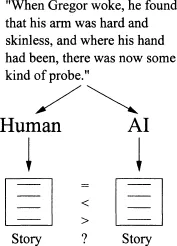
Figure 1.1: S3G.
“Betrayal in Self-Deception” (conscious)
Dave Striver loved the university. He loved its ivy-covered clocktowers, its ancient and sturdy brick, and its sun-splashed verdant greens and eager youth. He also loved the fact that the university is free of the stark unforgiving trials of the business world — only this isn’t a fact: academia has its own tests, and some are as merciless as any in the marketplace. A prime example is the dissertation defense: to earn the PhD, to become a doctor, one must pass an oral examination on one’s dissertation. This was a test Professor Edward Hart enjoyed giving.
Dave wanted desperately to be a doctor. But he needed the signatures of three people on the first page of his dissertation, the priceless inscriptions which, together, would certify that he had passed his defense. One of the signatures had to come from Professor Hart, and Hart had often said — to others and to himself — that he was honored to help Dave secure his well-earned dream.
Well before the defense, Striver gave Hart a penultimate copy of his thesis. Hart read it and told Dave that it was absolutely first-rate, and that he would gladly sign it at the defense. They even shook hands in Hart’s book-lined office. Dave noticed that Hart’s eyes were bright and trustful, and his bearing paternal.
At the defense, Dave thought that he eloquently summarized Chapter 3 of his dissertation. There were two questions, one from Professor Rodman and one from Dr. Teer; Dave answered both, apparently to everyone’s satisfaction. There were no further objections.
Professor Rodman signed. He slid the tome to Teer; she too signed, and then slid it in front of Hart. Hart didn’t move.
“Ed?” Rodman said.
Hart still sat motionless. Dave felt slightly dizzy.
“Edward, are you going to sign?”
Later, Hart sat alone in his office, in his big leather chair, saddened by Dave’s failure. He tried to think of ways he could help Dave achieve his dream.
This story is in fact “authored” by BRUTUS. And, as we shall see, BRUTUS has other interesting narrative within his reach. Note, however, that we have placed the term ‘author’ in scare quotes. Why? The reason is plain and simple, and takes us back to Lady Lovelace’s argument, presented at the start of the chapter: BRUTUS didn’t originate this story. He is capable of generating it because two humans spent years figuring out how to formalize a generative capacity sufficient to produce this and other stories, and they then are able to implement part of this formalization so as to have a computer produce such prose. The engineering method followed here is known as reverse engineering.
1.2 The Midwife
The midwife responsible for BRUTUS1’s arrival is philosophy: Philosophical analysis and argument, as you will see, have played an indispensable role in bringing BRUTUS1 to life. In this regard our work conforms to an approach according to which AI systems, at least ambitious AI systems, need to be born, at least in significant part, out of rigorous philosophizing; and they need to be cultivated with help from ongoing philosophical scrutiny. The paradigmatic case of this approac...
Table of contents
- Cover
- Half Title
- Title Page
- Copyright Page
- Dedication
- Table of Contents
- Acknowledgments
- Preface
- List of Tables
- List of Figures
- 1 Setting the Stage
- 2 Could a Machine Author Use Imagery?
- 3 Consciousness and Creativity
- 4 Mathematizing Betrayal
- 5 The Narrative-Based Refutation of Church’s Thesis
- 6 Inside the Mind of Brutus
- Bibliography
- Index
Trusted by 375,005 students
Access to over 1.5 million titles for a fair monthly price.
Study more efficiently using our study tools.
Frequently asked questions
Yes, you can cancel anytime from the Subscription tab in your account settings on the Perlego website. Your subscription will stay active until the end of your current billing period. Learn how to cancel your subscription
No, books cannot be downloaded as external files, such as PDFs, for use outside of Perlego. However, you can download books within the Perlego app for offline reading on mobile or tablet. Learn how to download books offline
Perlego offers two plans: Essential and Complete
- Essential is ideal for learners and professionals who enjoy exploring a wide range of subjects. Access the Essential Library with 800,000+ trusted titles and best-sellers across business, personal growth, and the humanities. Includes unlimited reading time and Standard Read Aloud voice.
- Complete: Perfect for advanced learners and researchers needing full, unrestricted access. Unlock 1.5M+ books across hundreds of subjects, including academic and specialized titles. The Complete Plan also includes advanced features like Premium Read Aloud and Research Assistant.
We are an online textbook subscription service, where you can get access to an entire online library for less than the price of a single book per month. With over 1.5 million books across 990+ topics, we’ve got you covered! Learn about our mission
Look out for the read-aloud symbol on your next book to see if you can listen to it. The read-aloud tool reads text aloud for you, highlighting the text as it is being read. You can pause it, speed it up and slow it down. Learn more about Read Aloud
Yes! You can use the Perlego app on both iOS and Android devices to read anytime, anywhere — even offline. Perfect for commutes or when you’re on the go.
Please note we cannot support devices running on iOS 13 and Android 7 or earlier. Learn more about using the app
Please note we cannot support devices running on iOS 13 and Android 7 or earlier. Learn more about using the app
Yes, you can access Artificial Intelligence and Literary Creativity by Selmer Bringsjord,David Ferrucci in PDF and/or ePUB format, as well as other popular books in Psychology & Cognitive Psychology & Cognition. We have over 1.5 million books available in our catalogue for you to explore.