- 342 pages
- English
- ePUB (mobile friendly)
- Available on iOS & Android
eBook - ePub
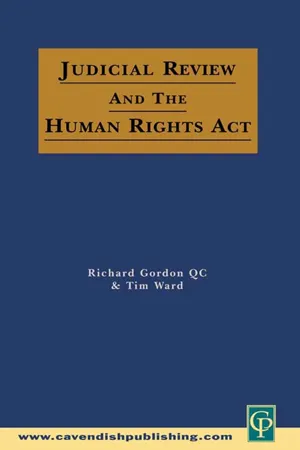
Judicial Review & the Human Rights Act
About this book
The Human Rights Act 1998 had a profound effect on the law of the United Kingdom,and in no area more so than judicial review. This book gives practical guidance on the interplay between the Act and domestic public law.
Information
CHAPTER 1
THE HUMAN RIGHTS ACT
| 1.01 | The central theme of this book is the relationship between the Human Rights Act 1998 and public law. |
| 1.02 | This chapter provides an overview of the Act and a general discussion of the problems that it raises. In some instances, where a more detailed exposition is provided elsewhere, cross-references are given. |
| 1.03 | The text of the Act itself is set out in Appendix 1, p 233. |
INTRODUCTION
| 1.04 | The preamble to the Human Rights Act states that its purpose is to ‘give further effect to the rights and freedoms guaranteed under the European Convention on Human Rights’ (emphasis added). On its face, the Act allows the raising of Convention issues to be raised only by the ‘victim’ of the unlawful acts (or proposed acts) of a public authority.1 Ordinarily, such acts would be challenged by way of judicial review. The scheme of the Act suggests, however, that the Convention will impact upon almost all types of litigation, including that between private parties, and will extend well beyond the confines of judicial review. It will revolutionise the Courts’ approach to both statutory construction2 and development of the common law.3 |
THE RIGHTS INCORPORATED
| 1.05 | Section 1 of the Human Rights Act defines the term ‘Convention rights’. It provides: |
In this Act ‘the Convention rights’ means the rights and fundamental freedoms set out in:
Articles 2 to 12 and 14 of the Convention;
Articles 1 to 3 of the First Protocol; and
Articles 1 and 2 of the Sixth Protocol, as read with Articles 16 to 18 of the Convention.
| 1.06 | The Articles referred to in s 1(1) of the Act are then set out in Schedule 1.4 These rights are separately outlined in Chapter 4 of this book. |
| 1.07 | There are two important points to note about the manner in which the Convention has been given effect by the Human Rights Act. First, as shall be seen be seen later in this chapter, the way in which ‘Convention rights’ can be applied by the domestic courts is entirely dependent upon the structure of the Act itself. Many provisions in the Act restrict full implementation of the Convention. Secondly, not all the Convention provisions have been incorporated. |
| 1.08 | Articles 1 and 13 of the Convention are not among those Articles expressly given effect to by the Human Rights Act.5 They provide: |
| Art 1 | The High Contracting Parties shall secure to everyone within their jurisdiction the rights and freedoms defined in Section I6 of this Convention. |
| Art 13 | Everyone whose rights and freedoms as set forth in this Convention are violated shall have an effective remedy before a national authority notwithstanding that the violation has been committed by persons acting in an official capacity. |
| 1.09 | The exclusion of Article 1 from the Act is readily explained. Article 1 contains an international treaty obligation on Member States which (the government has stated) is now complied with by the Act itself. The omission of Article 13 appears to be because the Act was considered to afford an effective remedy against violations of the Convention and thereby rendered the specific incorporation of Article 13 itself unnecessary: see, for example, Lord Williams of Mostyn: |
Our view is, quite unambiguously, that Article 13 is met by the passage of the [Act].7
| 1.10 | However, Article 13 is an important adjunct to challenging other Convention violations and is sometimes used by the European Court of Human Rights in Strasbourg to criticise existing domestic legal procedures for failing to provide an effective remedy against such violations. Judicial review has, in particular cases, been held by the Strasbourg Court not to afford an effective remedy under Article 13 (see paras 3.26 et seq). |
THE INTERPRETATIVE OBLIGATIONS ON THE COURT
| 1.11 | The Human Rights Act contains three sections that must be read together in order to understand the new interpretative obligations that now lie upon the courts. |
| 1.12 | Section 2(1) provides, materially, as follows: |
A court or tribunal determining a question which has arisen in connection with a Convention right must take into account any:
judgment, decision, declaration or advisory opinion of the European Court of Human Rights…
whenever made or given, so far as, in the opinion of the court or tribunal, it is relevant to the proceedings in which that question has arisen.8
| 1.12 | Section 3(1) of the Act provides: |
So far as it is possible to do so, primary legislation and subordinate legislation must be read and given effect in a way which is compatible with the Convention rights.
| 1.13 | Finally, s 6 provides, materially, that: |
It is unlawful for a public authority to act in a way which is incompatible with a Convention right.
…
In this section, ‘public authority’ includes: a court or tribunal…
| 1.14 | The Act thus contains separate interpret... |
Table of contents
- Cover Page
- Half Title page
- Title Page
- Copyright Page
- Dedication
- Half Title
- Foreword
- Preface
- Contents
- Table of Cases
- Table of Statutes and Statutory Instruments
- Table of European Legislation
- Chapter 1 The Human Rights Act
- Chapter 2 Claimants and Defendants
- Chapter 3 Convention Concepts
- Chapter 4 Convention Rights
- Chapter 5 Article 6, Judicial Review and Natural Justice
- Chapter 6 Damages
- Chapter 7 The Convention and Community Law
- Appendix 1 The Human Rights Act 1998
- Schedules
- Appendix 2 The European Convention on Human Rights
- Index
Trusted by 375,005 students
Access to over 1.5 million titles for a fair monthly price.
Study more efficiently using our study tools.
Frequently asked questions
Yes, you can cancel anytime from the Subscription tab in your account settings on the Perlego website. Your subscription will stay active until the end of your current billing period. Learn how to cancel your subscription
No, books cannot be downloaded as external files, such as PDFs, for use outside of Perlego. However, you can download books within the Perlego app for offline reading on mobile or tablet. Learn how to download books offline
Perlego offers two plans: Essential and Complete
- Essential is ideal for learners and professionals who enjoy exploring a wide range of subjects. Access the Essential Library with 800,000+ trusted titles and best-sellers across business, personal growth, and the humanities. Includes unlimited reading time and Standard Read Aloud voice.
- Complete: Perfect for advanced learners and researchers needing full, unrestricted access. Unlock 1.5M+ books across hundreds of subjects, including academic and specialized titles. The Complete Plan also includes advanced features like Premium Read Aloud and Research Assistant.
We are an online textbook subscription service, where you can get access to an entire online library for less than the price of a single book per month. With over 1.5 million books across 990+ topics, we’ve got you covered! Learn about our mission
Look out for the read-aloud symbol on your next book to see if you can listen to it. The read-aloud tool reads text aloud for you, highlighting the text as it is being read. You can pause it, speed it up and slow it down. Learn more about Read Aloud
Yes! You can use the Perlego app on both iOS and Android devices to read anytime, anywhere — even offline. Perfect for commutes or when you’re on the go.
Please note we cannot support devices running on iOS 13 and Android 7 or earlier. Learn more about using the app
Please note we cannot support devices running on iOS 13 and Android 7 or earlier. Learn more about using the app
Yes, you can access Judicial Review & the Human Rights Act by Richard Gordon,Tim Ward in PDF and/or ePUB format, as well as other popular books in Law & Administrative Law. We have over 1.5 million books available in our catalogue for you to explore.