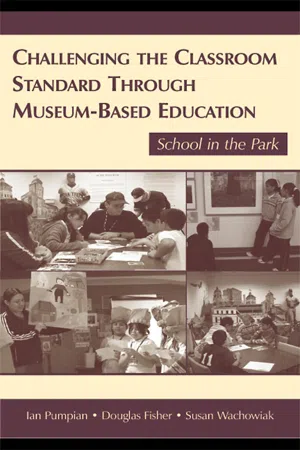
School in the Park is an innovative museum-based educational effort to engage students in their community during the school day. Since 1999 several hundred students have been educated each year in museums and the zoo in San Diego. This is more than a field trip, it is changing the way that education is provided.
Challenging the Classroom Standard Through Museum-Based Education: School in the Park presents the experience of School in the Park from the perspective of different disciplines--oral language, reading, writing, social studies, math, science, and the arts--to determine how students are learning content within museums and the zoo. It provides a number of examples, case studies, references, scenarios, and recommendations for teaching and learning outside of the traditional classroom. The perspectives of teachers, museum educators, and students are represented. Importantly, this book offers ideas that readers can use in their own communities, ranging from long-term partnering with cultural institutions to one-day trips, to ensure that students have authentic experiences with the curriculum.
With the current increased focus on accountability and achievement, less attention and importance is given to community-based learning experiences. This book demonstrates the viability of merging formal and informal learning and using community venues as an extension of the classroom. All those interested in and charged with educating children will find this book useful in exploring powerful learning experiences that occur outside traditional classroom settings.
eBook - ePub
Challenging the Classroom Standard Through Museum-based Education
School in the Park
- 184 pages
- English
- ePUB (mobile friendly)
- Available on iOS & Android
eBook - ePub
Challenging the Classroom Standard Through Museum-based Education
School in the Park
About this book
Information
CHAPTER ONE
School in the Park— A Unique Learning Experience for Children and Teachers
Ian Pumpian
Susan Wachowiak
Douglas Fisher
We believe School in the Park is a unique and bold educational endeavor implemented during a time of shrinking education budgets. Few schools and districts may have access to the resources necessary to operate a program on the scale of School in the Park. However, the practical lessons learned are useful for understanding how community-based learning experiences can enhance educational outcomes for children. In addition, conditions can be created in which students will be motivated, focused, and excited about engaging in challenging learning tasks that most would consider out of their reach.
Provided the right conditions exist, we would be thrilled if this book facilitated every school being able to offer multiple opportunities to apply the principles of School in the Park. At the very least, understanding the principles and practices of School in the Park will result in rethinking and reorganizing traditional field trip resources and moving instruction beyond (see Fig. 1.1).
These principles and practices are described and exemplified throughout this book. We also hope that this book prompts new public and private interest in creating partnerships that continue to promote adding new environments and experiences to excite and enhance learning outcomes for students. Readers are challenged to begin to create their own asset maps of facilities and locations in their immediate community that are readily available to provide educational opportunities that will extend and expand School in the Park–type teaching and learning.
- Grade-level standards must drive the selection of environments, activities, materials, and assessments.
- Grade-level standards can be taught and reinforced via hands-on, interdisciplinary, and experiential learning.
- Formal (directed) and informal (constructive) learning need not be polar opposites.
- Nontraditional classroom environments, when carefully selected, can provide motivation, purpose, and a depth of understanding for a standards-based curriculum.
- If nontraditional classroom environments are to be effective in supporting a standards-based curriculum, then the instructional program must coordinate classroom and nonclassroom learning. The curriculum must be mapped and integrated into a year-long subject-specific pacing chart that identifies key standards that will be taught and assessed.
- The number of nontraditional classroom environments accessible to most schools is limitless and can be inventoried via an environmental scan. Not all of these environments will require extensive logistical arrangements and costs.
- Extending learning outside of traditional classroom settings creates an opportunity to expand instructors and create teaching teams. Time to engage all of the teaching adults in common planning is time well spent and can serve to support multiple classes and programs.
- Extending learning outside of traditional classroom settings can increase the prior knowledge students bring to future learning environments and thereby increase their cultural capital.
FIG. 1.1. Replicable key principles for moving beyond field trips.
OFF-CAMPUS LEARNING: FIELD TRIPS AND BEYOND
The field trip is often seen as a reward used for good behavior or for completing a unit of study. In today’s world, field trips often conjure up thoughts of unfocused playtime where the confines of the typical classroom give way to relaxed amusement in a casual, unstructured setting. Rather than a significant learning experience, field trips are seen as a time for fun, to relax and take a break from the rigors of learning associated with the traditional classroom and school. Most teachers do not sufficiently plan or align the field trip experience with standards taught in their class. Teachers do, however, spend considerable time getting ready for these one-visit events. The demands on time are often limited to bus requests, permission slips, and lunch arrangements. Often the follow-up activities consist of thank-you letters sent to those who toured the class.
During traditional field trips, students may not learn to appreciate, and behave in, the museums and their exhibits. Teachers spend a great deal of their energy herding the group from exhibit to exhibit. There is often far more crowd control than teaching occurring. Field trip destinations are often big, strange places filled with unfamiliar exhibits and collections to look at, but not touch. The museum guides and educators are also unfamiliar with the class and their curriculum. So the field trip often becomes a day to be away from school, a semi-holiday. At School in the Park, the students become familiar with the museum and feel comfortable with the setting and with the museum educators. They take pride in being students of a prestigious institution. As one student noted at the Museum of Photographic Arts, “This is my museum.”
At School in the Park, learning at the museum is taken seriously. When David, a fourth-grade student, saw some field trip students frantically chasing around, he asked his teacher, “Don’t they know they are here to learn?” School in the Park students recognize the abundance of material that is available to them. They are constantly saying that they like the program because they learn things they couldn’t learn at school and that they know more about certain topics than their siblings.
As schools experience budget cuts, and with increased pressure to improve student performance, field trip budgets are often the first to get cut. Some still argue the value of field trips and lament their demise, but their arguments pale in comparison to those demanding a focus on learning, a focus on standards and on increased testing. Thus, learning outside of the traditional classroom has been devalued and is disappearing from much of public education. It is enough to make John Dewey turn in his grave!
If field trips distract students and teachers from focusing on formal learning, their days will be numbered. This is a time of high-stakes accountability that has quantified the untenable numbers of children who read and compute significantly below grade level. Instructional time is a premium and anything seen as a distraction will not find itself welcome, especially in low-performing inner-city schools.
Its designers are quick to let you know that School in the Park is not a field trip. Why? Field trips have become an educational frill, often described and criticized as being an extra often detracting from critical learning time. There is a need to reconceptualize and reorganize resources associated with traditional field trips to support the type of teaching and learning that occurs in School in the Park. Usually schoolchildren come to the museums on field trips that involve little if any preplanning between the school and museum educator. They visit one or two museums and then return to school. Their role is that of an observer. At School in the Park, the approach is different. The museum is the classroom and the student is a participant in the learning process. The museum educators and the teachers are the guides. The resources of the museums are used to teach and enhance the curriculum.
Like Dewey, many educators know important learning can, and indeed must, occur outside the four walls of traditional classroom settings. Can we think beyond the notion of what field trips have become? Can we reinvest in the use of multiple learning environments as a means of promoting learning? Can a new resurgence of teaching and learning outside the classroom be initiated that contributes to, rather than detracts from, the need to focus on learning, on standards, and on testing? The answer is yes, yes, and yes again! School in the Park offers convincing evidence that community- based learning experiences are relevant to not only improving test scores, but are essential to student motivation and a deeper and richer level of learning and understanding.
WHAT IS SCHOOL IN THE PARK:THE PARTICIPANTS AND THE SETTING
School in the Park creates an immersion program founded in research and based on rigorous curriculum standards developed by the State of California. The program takes place in Balboa Park, a large urban park containing numerous cultural and scientific institutions in the heart of San Diego, California. The architects of the program included a group of school and museum educators and administrators brought together through the vision of a business and social entrepreneur. Sol and Robert Price are well known throughout the retail industry. Many of the warehouse retail stores that permeate the country owe a great debt to the Prices for the innovations they introduced in their Price Club stores. Price Charities’ investment in innovative community development initiatives has brought that same entrepreneurial vision and organizational expertise to bear in the public sector throughout San Diego. Their resources, coupled with both their interest in public schools and their involvement with San Diego arts and cultural institutions, led to the School in the Park experiment.
School in the Park began in 1999 as part of the larger City Heights Educational Collaborative. The City Heights Educational Collaborative is a unique partnership between San Diego State University, the San Diego Unified School District, the San Diego Education Association, and Price Charities. A primary goal of the Collaborative is to positively impact the academic achievement of students in three City Heights schools. The schools collectively serve over 5,300 students and include one elementary, one middle, and one high school. Each school has a free and reduced lunch rate of 99% and serves a very culturally, ethnically, and linguistically diverse student body. The goals of the Collaborative are to operate public community schools in which student achievement is accelerated and future, new, and experienced teachers are supported to be effective in inner-city schools.
The community of City Heights faces many challenges. These challenges can be used to paint a very negative picture of City Heights. City Heights has long been considered one of the most dangerous and disadvantaged sections of San Diego—an area plagued by gangs, unemployment, and the lowest school test scores in the district. But, due to the efforts to revitalize City Heights, it now offers a much more positive alternative picture. More than 72,000 people live in a 3,000-acre triangle at the center of the nation’s sixth largest city. City Heights is the first stop for many new immigrants from underdeveloped countries, with 40 different cultural groups represented and over 100 dialects spoken. The community is 41% Hispanic, 21% African-American, 20% Asian/Pacific Islander, and 18% White. Forty percent of adults have not completed high school, compared to 18% citywide. In 2001, the median income was $20,000 in a region where the median housing price is now over $350,000. The majority (65%) of City Heights residents live in rental apartments. Thirty-five percent of the residents live at poverty level or below, and unemployment is more than double the citywide average (12.6% vs. 5.9%). City Heights schools have been among the lowest performing in the State of California. Within this context, a large public/private initiative began 10 years ago to revitalize City Heights. New parks, new schools, new stores, new community programs and services are all part of this vigorous and holistic effort. Rosa Parks Elementary is right in the middle of this redevelopment effort and School in the Park is one of the fruits of this labor.
THE SCHOOL IN THE PARK EXPERIENCE:THINKING BEYOND FIELD TRIPS
One day in Balboa Park in downtown San Diego, California, an out-of-town visitor noticed a line of bright-eyed uniformed third graders toting identical backpacks quietly walking through the porticos linking the museums and gardens of the center city park and cultural center. Impressed with their good behavior and their studious air he asked the teacher, “Who are these children? What private school do they attend?” He was informed that these children were students of School in the Park, a program affiliated with Rosa Parks Elementary, a public San Diego school. “What is School in the Park?” he asked. “I’ve never heard of it.”
School in the Park is an extension of Rosa Parks Elementary School serving 1,600 kindergarten through fifth graders within a rich context of culturally and linguistically diverse students. Originally designed as a solution to overcrowding at Rosa Parks Elementary School, the program was embraced by the teachers because of the possibilities they saw to provide their students a world-class education. In this context, all third-, fourth, and fifth-grade students at Rosa Parks, over 800 students, spend 20% to 25% of their instructional year away from Rosa Parks’ main campus in specially selected museums located in San Diego’s Balboa Park. The Balboa Park educational experience has been aptly named School in the Park. It represents a significant program that positively impacts how, in this case, children from low-income, inner-city, and culturally diverse backgrounds can experience education in a fundamentally different way.
School in the Park, as the name implies, shifts the location of school from traditional classroom settings, in an inner-city community, to include the outstanding resources and educational opportunities available in the many museums and zoo located in Balboa Park. More than an isolated field trip, School in the Park allows students and teachers to experience expanded learning opportunities for approximately one fourth of their instructional year. Teaching and learning are immersed in the rich resources of world-renowned cultural institutions that are clustered together within a central park setting. School in the Park significantly alters the normal educational setting and methodologies for students and teachers by moving school into the larger community. Unlike the traditional and more episodic nature of field trips, School in the Park is a structured learning experience that focuses on high student expectations aligned with rigorous state education standards. Each day, students spend time learning and gaining new experiences within rich museum settings establishing and building new knowledge influencing their subsequent learning. These learning experiences are cumulative, impacting and influencing both the students’ learning in their regular school classroom and in future museum visits. Only time will tell, but all participants and observers seem to agree that the sophistication of prior knowledge these students are gaining and using will not only positively impact their test scores but also their future opportunities, career decisions, and performance.
SCHOOL IN THE PARK: A UNIQUE EXPERIENCE
The concept of blending informal and formal learning opportunities through School in the Park has represented an unparalleled educational alternative. There are a few examples of full-time charter schools located within museums. However, the number of students, teachers, and museums involved in School in the Park coupled with the amount of time students spend there is unique. As an example, New York City Museum School services about 360 sixth- through twelfth-grade students who are taught by classroom teachers in a museum setting. NYCMS students work in five museums for two and one half afternoons a week. A lottery system selects students for this program. School in the Park services 800 third, fourth-, and fifth-grade students in 10 museums (including the San Diego Zoo) each year. Students can spend 1 out of every 4 or 5 weeks in the museums (over 3 years this adds up to 24 weeks). Every third-, fourth-, and fifth-grade student who attends Rosa Parks Elementary participates.
Many students from more affluent families and communities may more regularly be exposed to a variety of cultural settings and experiences, but offering these types of experiences to students who attend large inner-city public schools is rare. Nieto (2003) argued that inner-city schools are least likely to provide their students creative, energetic, and challenging environments. Critics of the standards-based curriculum reform movement suggest high-stakes testing has increased this problem as schools scramble to remediate students. Not so at School in the Park. Students are offered a rigorous and relevant standards-based curriculum.
School in the Park incorporates a continuous improvement process using achievement test data to identify standards and skills that must be more effectively addressed within the program. Some proponents of informal education may shudder at the notion of being so data driven. As a school serving students who are still considered low performing, school leadership cannot afford to not be data driven. However, in its first 5 years of operation, School in the Park’s attention to standards appears to compromise nothing that would alarm either the traditional educator or the informal constructivist.
Students and teachers within School in the Park are changing the way they see and experience the world. Moving into the larger community, students are stepping up to new and challenging learning experiences that expose them to a world far broader than the confines of City Heights. As one teacher from Rosa Parks describes the program, “School in the Park is more relevant for my students because they are able to apply what they learn in real settings that just cannot be replicated in my classroom.” Dr. Arthur Ollman, Director of the Museum of Photographic Arts, describes the impact of School in the Park, “As a result of their experience, the museum now belongs to these students.” Sooner than not, it is hoped that these same students will learn the whole world belongs to them.
School in the Park represents a significant part of the overall efforts of the City Heights Educational Collaborative to improve educational outcomes. Rosa Parks continues to demonstrate academic improvement well beyond the growth targets established by the State of California. The Academic Performance Index (API) is the accountability system created by the State of California. The API is a formula that measures a school’s overall test performance and growth. Each year school growth targets are set to close the gap, over time, between low-performing and well-performing schools. The State of California uses API scores to assess both individual school progress and to compare a school’s performance with other schools in the state. From 2000–2001 to 2002–2003, Rosa Parks has demonstrated a 181-point growth in the API. For these 3 years Rosa Parks exceeded its API targets by over 100%, making it among the top 25% in the city. In 1999 Rosa Parks ranked 5th among its 10 comparison schools; in 2003 and 2004 it ranked 1st. This remarkable trend continues.
Organization and Structure
The design of the program was assigned to a school administrator with an off-campus, educational background who now serves as the School in the Park Director and who provides daily focus and direction to insure consistent program implementation. The program staff includes a lead teacher who, with the director, assists in curriculum development, te...
Table of contents
- COVER PAGE
- TITLE PAGE
- COPYRIGHT PAGE
- FOREWORD
- PREFACE
- ACKNOWLEDGMENTS
- 2004–2005 SCHOOL IN THE PARK TEACHERS
- CHAPTER ONE: SCHOOL IN THE PARK— A UNIQUE LEARNING EXPERIENCE FOR CHILDREN AND TEACHERS
- CHAPTER TWO: PERSPECTIVES ON LEARNING—CREATING OPTIMAL CONDITIONS FOR LEARNING
- CHAPTER THREE: TALKING IN MUSEUMS: WHEN VICES TURN INTO VIRTUES EXPLORING ORAL LANGUAGE DEVELOPMENT
- CHAPTER FOUR: READING IN THE PARK
- CHAPTER FIVE: AN AUTHENTIC CONTEXT FOR WRITING TO LEARN AND TEACHING WRITING INTENTIONALLY
- CHAPTER SIX: ARTS AS A CENTERPIECE FOR INTEGRATED LEARNING
- CHAPTER SEVEN: WHERE IS THE MATHEMATICS?EVERYWHERE!
- CHAPTER EIGHT: THE OPPORTUNITY TO LEARN SCIENCE LIKE SCIENTISTS: MUSEUMS ARE A GOOD IDEA
- CHAPTER NINE: ENGAGING STUDENTS IN SOCIAL STUDIES THROUGH EXPLORATION, DOCUMENTATION, AND ANALYSIS: MUSEUMS AND FIELD STUDIES CAN BRING SOCIAL STUDIES TO LIFE
- ABOUT THE EDITORS
- ABOUT THE AUTHORS
Trusted by 375,005 students
Access to over 1.5 million titles for a fair monthly price.
Study more efficiently using our study tools.
Frequently asked questions
Yes, you can cancel anytime from the Subscription tab in your account settings on the Perlego website. Your subscription will stay active until the end of your current billing period. Learn how to cancel your subscription
No, books cannot be downloaded as external files, such as PDFs, for use outside of Perlego. However, you can download books within the Perlego app for offline reading on mobile or tablet. Learn how to download books offline
Perlego offers two plans: Essential and Complete
- Essential is ideal for learners and professionals who enjoy exploring a wide range of subjects. Access the Essential Library with 800,000+ trusted titles and best-sellers across business, personal growth, and the humanities. Includes unlimited reading time and Standard Read Aloud voice.
- Complete: Perfect for advanced learners and researchers needing full, unrestricted access. Unlock 1.5M+ books across hundreds of subjects, including academic and specialized titles. The Complete Plan also includes advanced features like Premium Read Aloud and Research Assistant.
We are an online textbook subscription service, where you can get access to an entire online library for less than the price of a single book per month. With over 1.5 million books across 990+ topics, we’ve got you covered! Learn about our mission
Look out for the read-aloud symbol on your next book to see if you can listen to it. The read-aloud tool reads text aloud for you, highlighting the text as it is being read. You can pause it, speed it up and slow it down. Learn more about Read Aloud
Yes! You can use the Perlego app on both iOS and Android devices to read anytime, anywhere — even offline. Perfect for commutes or when you’re on the go.
Please note we cannot support devices running on iOS 13 and Android 7 or earlier. Learn more about using the app
Please note we cannot support devices running on iOS 13 and Android 7 or earlier. Learn more about using the app
Yes, you can access Challenging the Classroom Standard Through Museum-based Education by Ian Pumpian,Douglas Fisher,Susan Wachowiak in PDF and/or ePUB format, as well as other popular books in Education & Education General. We have over 1.5 million books available in our catalogue for you to explore.