In eleven original studies by social scientists, this is the first volume to focus on television reality crime programming as a genre. Contributors address such questions as: why do these programs exist; what larger cultural meaning do they have; what effect do they have on audiences; and what do they indicate about crime and justice in the late twentieth century? Adaptable at both undergraduate and graduate levels, Entertaining Crime will contribute to discussions of crime and the media, as well as crime in relation to other issues, such as gender, race/ethnicity, and fear of crime.
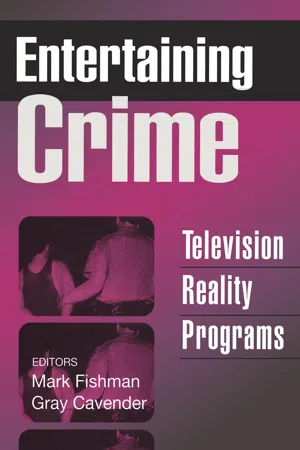
- 218 pages
- English
- ePUB (mobile friendly)
- Available on iOS & Android
eBook - ePub
About this book
Information
IV
Crime, Criminals, and Victims
8
The World of Crime According to "Cops"
PAUL G. KOOISTRA, JOHN S. MAHONEY and SAUNDRA D. WESTERVELT
INTRODUCTION
Television in this country has long presented racist images of minorities. In recent years, racial and ethnic images have become more positive, particularly in the area of television fiction. However, in the nonfiction world of television, subtle forms of racism are still prevalent. The presentation of African-Americans in television news, for example, systematically promotes antiblack sentiment through its emphasis and portrayal of crime stories (Entman 1990).
In the past decade a new form of television "news" has developed: reality-based police shows such as "Cops," "American Detective," "America's Most Wanted," "Top Cops," and "True Stories of the Highway Patrol." These programs employ actual or dramatized accounts of crimes. They have become "television's hottest genre" for their profitability and popularity (Sauter 1992; Fennell 1992). Arguably, these shows have a greater impact on audiences' concern over crime and attitudes toward minorities since they are presenting presumably factual accounts of the social world and in a more intense dramatized form than found in television news. Yet few studies have systematically examined the content of such shows. Instead, broad general impressions are offered that vary from author to author. Friedman argues that programs like "Cops" are good because they demystify police work and also perform "something of a public service: never has crime looked so real. Or so shabby. Or so pointless" (1989:26). Katz (1993) claims that shows such as "Cops" show how dangerous and complex a policeman's job might be and criticizes the press for focusing only on issues of police brutality and racism. Zoglin (1992) notes that supporters of these shows say they humanize police and can help prosecutors fight crime.
In contrast, Rapping claims that tabloid crime shows "are sleazy, crude, and quite often openly racist. They are meant for an audience for whom niceties of taste and gradations of moral nuance and subtlety are not important" (1994:36). And Waters (1989) suggests that these shows exploit suffering for their own profit and contribute to the belief that everyone arrested of crime is guilty, even before a trial has occurred. Rapping even suggests that these shows "present a world view that . . . flirts dangerously with certain aspects of fascist ideology" (1992:35). Crimes, these programs seem to suggest, are acts of irrational (and often drug-induced) evil committed by darkskinned males and promiscuous females. These lawbreakers are a breed of humans different from us who reject many of "our" cherished social values.
This chapter examines the images of crime and race presented in one such program, "Cops." This show was chosen because it is one of the most popular of its genre according to Nielsen ratings, is frequently aired (in some communities several times a week), and is one of the oldest and probably best known of the reality-based crime shows on television. We scrutinize the types and social dynamics of crimes portrayed. Such dynamics include the race of offenders, victims, and police. We hypothesize that nonwhites will be disproportionately portrayed as criminal offenders. Furthermore, although nonwhites are frequently the victims of serious street crimes, we hypothesize that nonwhites will seldom be underrepresented as the victims of serious crime in these shows, in comparison to official crime data.
RACE ON TELEVISION
There has long been concern over the presentation of minorities in mass media. For much of television's history, as MacDonald notes, broadcasters had been "comfortable with racial stereotyping, whether it was the abrasive representations so abundant in the 1950s or the subtler stylizations of the 1970s" (1990:248). In the early days of television, the series "Amos 'n' Andy" portrayed black men as clowns or con men hectored by bossy black women. The problems they confronted in their daily lives were many, though primarily the result of their own ineptitude and unrelated to race (Ely 1991; MacDonald 1983). Images of blacks as overly emotional and servile dominated television shows in the 1950s and early 1960s. The few attempts to show blacks in more positive roles were met with resistance by southern television affiliates, which refused to air them. Since the networks needed to have their shows carried in as many cities as possible, stereotypical images of minorities acceptable to white southern audiences dominated (Montgomery 1989:15). In the 1970s, the image of minorities on television changed dramatically. One reason was the rise of black activism, as the NAACP and the Congress of Racial Equality (CORE) helped bring about congressional hearings that criticized the television industry for its inattention to minorities both on the screen and in its hiring practices (Montgomery 1989:22; MacDonald 1983). Another reason was court rulings that a local television station failing to meet the needs of its community by acting in a discriminatory manner could have its license renewal denied. The result was that southern affiliates could no longer refuse to carry television shows on the basis of the racial characters they contained (Montgomery 1989:23-24). But the primary reason for the rise of positive African-American characters in television fiction was the discovery that blacks were heavy users of the medium. "The TV networks. . . turned to black viewers to bolster sagging primetime ratings" (MacDonald 1990:248). Beginning with daytime soap operas in the mid-1960s and continuing through urban dramas such as "I Spy," "Rockford Files," "Hill Street Blues," "Miami Vice," and "L. A. Law," blacks began appearing as strong and successful characters—doctors, lawyers, detectives—on television. "The Cosby Show" in 1984 epitomized the positive representation of African-Americans.1
A transformation also began to take place on television news sets throughout the 1970s and 1980s as well. Local news operations in the vast majority of American communities have hired black reporters and anchors, in part to attract black audiences (Entman 1990).
CRIME AND RACE ON TELEVISION
Crime is an extremely popular topic in television fiction. About 30 percent of prime time television entertainment programming is crime shows, with crime being the largest subject matter for television fiction (Gerbner and Gross 1980; Surette 1992). Previous content analyses of crime shows reveal an overrepresentation of violent crime. Murder and robbery are the most common forms, with murder accounting for about 25 percent of all television crime.
While images of blacks in television fiction have rarely been positive, stereotypes of minorities as criminals have been uncommon. Studies show that white criminals from higher socioeconomic backgrounds are overrepresented (Dominick 1973; Estep and MacDonald 1984; Garofalo 1981; Potter and Ware 1987). This is partly because of formula demands; that is, in order to have powerful heroic crime fighters, it becomes necessary for them to have formidable foes such as organized crime figures or business cartels. However, the underrepresentation of minorities as criminals is also because of concern about negative stereotyping of minorities and the potential organized protests that might result. Todd Gitlin (1983:286-324) notes that standards policies deliberately limited the portrayal of nonwhites as criminals in television shows. Programs such as "Hill Street Blues" that featured black and Hispanic lawbreakers in an attempt to be "realistic" about crime often had to struggle with network executives and even minority actors on the show to do so.
The nonfiction world of television presents a somewhat more complicated picture of the relationship between race and crime. The amount of attention paid to crime on television news parallels that of fiction television. About 10-15 percent of national news involves crime (Cirino 1972; Graber 1980), while about 20 percent of local news is crime stories (Graber 1980). The image of crime on nonfiction television is similar. Sheley and Ashkins (1981) note that murder and robbery comprised about 80 percent of reported crimes on New Orleans's television news, although police data showed them to be far less common.
But the picture of crime painted by news reports is somewhat unclear. According to Graber (1980:57-58), criminals in the news tend to be either violent street criminals or higher class property offenders. According to Surette (1992:63-64), criminals shown on the news tend to be slightly older than that reflected in official arrest statistics. Although there is some attention given to white collar crime, researchers argue that there is an underrepresentation of elite crime (Evans and Lundman 1983; Molotch and Lester 1981; Quinney 1970). Regardless, although the public may be indignant about corporate crime, it may be safe to assume that it is more concerned about street crime. And street crime, as it is seen in nonfiction television, is primarily an activity of young minority males. Sheley and Ashkins (1981) found that blacks accounted for over 80 percent of robbery suspects on New Orleans television. Entman's study of television news in Chicago showed that violent crime committed by blacks accounted for about 41 percent of all local news stories, and that stories would suggest that blacks are more dangerous than whites:
[T]he accused black criminals were usually illustrated by glowering mug shots or by footage of them being led around in handcuffs, their arms held by uniformed white policemen. None of the accused white criminals during the week studied were shown in mug shots or in physical custody. (1990:337)
Furthermore, white victimization by blacks appeared to have high priority as new stories.
In the past decade a new form of "nonfiction" television has emerged: tabloid-style shows that blur even further the distinction between fact and fiction, a trend noted by numerous media scholars (Altheide 1976; Fishman 1980; Manoff and Schudson 1986; Postman and Powers 1992). As we noted earlier, these shows have proliferated because they are inexpensive and yield relatively high returns in viewership. Most analyses of these shows have been mixed and anecdotal. Oliver (1994) has done one of the few systematic content analyses of reality-based police shows: "America's Most Wanted," "Cops," "Top Cops," "FBI, The Untold Story," and "American Detective." She found that violent crime was overrepresented as was the proportion of crimes solved. The shows also presented a world where white characters were more likely to be police officers, and nonwhites were more likely criminal suspects. These depictions were only slight exaggerations from those found in official data. However, Oliver concludes that these programs are more likely to portray "a cast of characters in which nonwhites are typically the 'bad guys,' and a plot which most often features the 'restoration of justice' though often through aggressive behaviors" (1994:189) of heroic white police officers.
TELEVISED VIOLENCE AND FEAR OF CRIME
At the root of these analyses of race and crime on television is a concern for the impact that these images have on viewing audiences: do they contribute to concern about crime and foster racist attitudes? Studies of the impact of mass media images on audiences are complex, confusing, and contradictory. A good starting place in examining this issue is the work of George Gerbner and his associates (Gerbner and Gross 1976, 1980; Gerbner, Gross, Jackson-Beeck, Jeffries-Fox, and Signorielli 1978; Gerbner, Gross, Morgan, and Signorielli 1980). Gerbner examined the relationship between watching large amounts of television and the viewers' perception of the world. His assumption was that much of television content contained repeated themes, which he identified through "cultivation analysis." Gerbner and his associates began an annual content analysis of television shows in 1968 to identify what they called "cultural indicators," messages about wealth, violence, beauty, power, and prejudice that are portrayed symbolically and may subconsciously influence viewers. These cultural indicators provided quantified measures of the social world depicted on television and were compared to other measures of the social world, such as those found in government statistics. Finally, survey respondents with varying amounts of television exposure were asked questions about their perceptions of the world. Gerbner and his colleagues found that frequent viewers of television were more likely to have a view of the world that matched the images repeatedly presented through the medium than that reflected by official data (the presumed "real world"). Since violent acts pervaded television, these heavy viewers saw the world as a meaner and more dangerous, crime-ridden place than government statistics suggested.
Other studies have criticized and refined Gerbner's arguments, positing that perceptions of crime are more influenced by the context in which crime and violence are presented. Researchers suggest that when individuals attempt to construct reality, they judge the veracity of media sources (Hawkins and Pingree 1981; O'Keefe 1984). Nonfiction accounts presented by what are considered to be reliable sources have more weight than fictional accounts. Some studies report that if a high proportion of crime news focuses on local crime and portrays it in sensational ways or stresses its random, unpredictable nature, it leads to greater fear of crime among readers or viewers (Heath 1984; Liske and Baccaglini 1990). Surprisingly, news of distant sensational crime reduces fearfulness and anxiety about local crime (Heath 1984). From these studies we may draw three general conclusions. First, nonfictional images have greater impact than fictional ones.2 Second, the more a message or theme is repeated, the more influential it becomes. Third, the closer the crime is to home, the more it may generate fear among viewers. Shows such as "Cops," which are presented as factual, would therefore be more likely than fictional television shows to produce fear of crime. Furthermore, "Cops" is a show that is broadcast frequently, allowing for repetition of themes. In some communities, including the one in which our data were gathered, seven episodes are aired weekly. However, for most viewers, the episodes shown on "Cops" describe crimes in distant locales, although the format of the show—traveling each episode to a different community—may make it seem that crime could be happening anywhere. Nonetheless, our position is that "Cops" and similar reality-based programs probably are not significant factors in producing personal fear of crime. However, they may be significant in shaping a general view of crime and increasing social concern over crime as a serious societal problem (Barrile 1984). As Surette suggests: "The media provide both a foundation for the public's various final images and the mortar with which the public constructs its social reality" (1992:96). These shows influence our perceptions of the nature and extent of crime. Furthermore, Roberts...
Table of contents
- Cover
- Half Title
- Title Page
- Copyright Page
- Dedication
- I. INTRODUCTION
- II. THE AUDIENCE FOR REALITY CRIME PROGRAMS
- III. IDEOLOGY AND SOCIAL CONTROL
- IV. CRIME, CRIMINALS, AND VICTIMS
- Biographical Sketches of the Contributors
- Index
Trusted by 375,005 students
Access to over 1.5 million titles for a fair monthly price.
Study more efficiently using our study tools.
Frequently asked questions
Yes, you can cancel anytime from the Subscription tab in your account settings on the Perlego website. Your subscription will stay active until the end of your current billing period. Learn how to cancel your subscription
No, books cannot be downloaded as external files, such as PDFs, for use outside of Perlego. However, you can download books within the Perlego app for offline reading on mobile or tablet. Learn how to download books offline
Perlego offers two plans: Essential and Complete
- Essential is ideal for learners and professionals who enjoy exploring a wide range of subjects. Access the Essential Library with 800,000+ trusted titles and best-sellers across business, personal growth, and the humanities. Includes unlimited reading time and Standard Read Aloud voice.
- Complete: Perfect for advanced learners and researchers needing full, unrestricted access. Unlock 1.5M+ books across hundreds of subjects, including academic and specialized titles. The Complete Plan also includes advanced features like Premium Read Aloud and Research Assistant.
We are an online textbook subscription service, where you can get access to an entire online library for less than the price of a single book per month. With over 1.5 million books across 990+ topics, we’ve got you covered! Learn about our mission
Look out for the read-aloud symbol on your next book to see if you can listen to it. The read-aloud tool reads text aloud for you, highlighting the text as it is being read. You can pause it, speed it up and slow it down. Learn more about Read Aloud
Yes! You can use the Perlego app on both iOS and Android devices to read anytime, anywhere — even offline. Perfect for commutes or when you’re on the go.
Please note we cannot support devices running on iOS 13 and Android 7 or earlier. Learn more about using the app
Please note we cannot support devices running on iOS 13 and Android 7 or earlier. Learn more about using the app
Yes, you can access Entertaining Crime by Mark Fishman in PDF and/or ePUB format, as well as other popular books in Social Sciences & Criminology. We have over 1.5 million books available in our catalogue for you to explore.