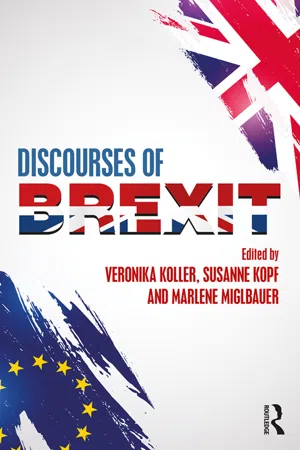
Discourses of Brexit provides a kaleidoscope of insights into how discourse influenced the outcome of the EU referendum and what discourses have sprung up as a result of it. Working with a wide variety of data, from political speeches to Twitter, and a wide range of methods, Discourses of Brexit presents the most thorough examination of the discourses around the British EU referendum and related events. It provides a comprehensive understanding of the discursive treatment of Brexit, while also providing detailed investigations of how Brexit has been negotiated in different contexts. Discourses of Brexit is key reading for all students and researchers in language and politics, discourse analysis and related areas, as well as anyone interested in developing their understanding of the referendum.
eBook - ePub
Discourses of Brexit
- 252 pages
- English
- ePUB (mobile friendly)
- Available on iOS & Android
eBook - ePub
Discourses of Brexit
About this book
Information
1
INTRODUCTION
Context, history and previous research
Veronika Koller, Susanne Kopf and Marlene Miglbauer
At the time of writing this introduction (January 2019), Brexit continues to be an omnipresent and inescapable news item across the United Kingdom (UK) and mainland Europe. Curiously though, how and even if Britain will leave the European Union is still unclear. With the spectre of Brexit looming, regular government business in the UK has seemingly ground to a halt, and pundits and people alike are left to wonder what Europe – and the European Union (EU) – will look like after 29 March 2019. At this moment of uncertainty and paralysis, we invite readers to turn back and seek to understand how we got to this point.
The present volume is the first comprehensive exploration of discourses surrounding the UK’s departure from the EU and as such a step towards understanding the reasons for, and processes of, Brexit. It covers multiple facets of the phenomenon and provides a kaleidoscopic view on aspects of Brexit. First, our contributors draw on data ranging from traditional news media to official governmental communications and parliamentary debates to social media platforms. Thus, we gain an insight into how a plethora of voices in various contexts and multiple public spheres have made sense of Brexit and Brexit-related matters. Second, and as the chronological organisation of this volume already indicates, the studies presented here examine pre-referendum data on Brexit reaching as far back as 2012. The individual chapters present insights from both Leave and Remain campaigns during the run-up to the EU referendum in 2016 and also cover its immediate and extended aftermath, from the UK government’s decision to trigger Article 50 of the Treaty on European Union1 to a time when the exit negotiations were well underway. Third, the wide array of methodological approaches used serves a triangulatory purpose and once more exemplifies this book’s multifaceted perspective. Contributing scholars draw on traditionally quantitative methods, such as corpus linguistic analyses, as well as fine-grained qualitative analysis, for example multimodal analysis. What is more, contributors to this edited volume live and work across Europe and beyond. Thus, this edited volume allows a pan-European perspective to studying Brexit, which is further enriched by a more distant view of the phenomenon (Zappavigna, Chapter 4 this volume). Finally, we cannot but note the remarkable coincidence that amidst this diversity of researchers, it is three Austrians (with links to the UK) who have the privilege of editing this volume on the discourses of Brexit.
The first step towards making sense of Brexit and the discourses surrounding this phenomenon is to examine the political-historical context of Brexit. In the following section, we will address the recent rise of right-wing populism and how Brexit can be viewed as a manifestation of this populist trend.
Political and historical context: Brexit as a manifestation of right-wing populism
The British EU referendum that took place on 23 June 2016 can be regarded as the culmination of the uneasy and complex relationship Britain has had with the European Union since becoming a member in 1973. In fact, Britain’s relationship with Europe in general has been rather complex even since the end of World War Two (Ramiro Troitiño et al., 2018). Tellingly, and importantly for recent developments, the terms ‘Europe’ and ‘European Union’ have frequently been conflated in the British media, by politicians and thus by citizens (Hardt-Mautner, 1995, p. 183; McCormick, 2013, p. vi).
Britain’s request to join the European Economic Community (EEC) – the predecessor to the EU – was vetoed twice by France in the 1960s. After having finally joined the EEC in 1973, only two years later, the first referendum on Britain’s membership was held. Although two-thirds of voters decided to stay within the Common Market, Britain’s stance on being a member had become difficult and Euroscepticism would become part of the British political landscape from the 1980s onwards (Spiering, 2004; Gifford, 2017). In particular, former Prime Minister Margaret Thatcher played a decisive role in both establishing a sceptical standpoint towards the EU and reaching agreements with the EU that still benefit Britain, such as the UK rebate (Daddow, 2013).
The 2016 referendum result surprised the British political establishment as the polls had forecast a majority for staying in the EU. There are a myriad of reasons why a majority of the electorate voted to end British EU membership (Gietel-Basten, 2016; Goodwin & Heath, 2016; Clarke et al., 2017). Delving deeper into voters’ reasons and motivations would go beyond this introduction (but see Miglbauer & Koller, Chapter 6 this volume). Interestingly, the supporters of Brexit were not confined to political parties but both large parties in the UK had so-called Remainers and Brexiteers in their ranks (see Wenzl, Chapter 3 this volume). Next to the fertile ground of Euroscepticism (Vasilopoulou, 2016), there are two aspects that played a crucial role for the success of the Leave campaign: the refugee crises of 2015/2016 and campaigners’ tendency to draw on right-wing populist ideas and rhetoric.
However, can Brexit be regarded as a manifestation of right-wing populism? Despite left-wing populist arguments for Britain leaving the EU (see Demata, Chapter 8 this volume), we would answer (mostly) in the affirmative. The rise in (right-wing) populism since the 1970s can be seen as a ‘cultural backlash’ (Inglehart & Norris, 2016) to the increasing diversification and liberalisation of Western societies. Traditional parties mostly failed to respond in an adequate and timely fashion to issues such as the decline of ideologies, class politics, European integration and immigration, and economic and cultural globalisation (Albertazzi & McDonnell, 2008, p. 1; Inglehart & Norris, 2016), and thus paved the way for new, primarily right-wing populist, parties to enter the political stage.
Right-wing populism has entered the European landscape in the form of parties including the Front National in France, the FPÖ in Austria, the AfD in Germany and Fidesz in Hungary. Regarding Brexit and its connection to populism, Ramiro Troitiño et al. (2018, p. vii) claim that the EU referendum vote represents
a backlash against the modern world and modern politics. This was like the forces at work in the victory of Donald Trump in the USA. Neither of these aspects are exclusively British. They form the backdrop of politics throughout the EU. Brexit should be a wakeup call to the European political establishment to act now before the populists sweep all before them.
There are many definitions of populism, depending on academic field and approach (Gidron & Bonikowski, 2013), but a general and widely used definition is that populism is
an ideology that considers society to be ultimately separated into two homogeneous and antagonistic groups, “the pure people” versus “the corrupt elite”, and which argues that politics should be an expression of the volonté générale (general will) of the people.
(Mudde, 2004, p. 543)
Mudde further argues that right-wing populism is usually combined with other ideologies such as nationalism.
Populist parties tend to be ideologically flexible as well as authoritarian and messianic: in order to overcome fears and perceived threats, voters support right-wing populist parties and, in particular, “politicians who know (rather than ‘listen to’) the people, and who make their wishes come true” (Mudde, 2004, p. 558), i.e. who they can trust and who give them hope. Such a charismatic bond between leaders and followers is crucial for populist parties. Freeden (2017, p. 5) aptly points out that “right-wing populism is not a grassroots phenomenon [. . .] aggressive populist leadership filters, articulates, shapes and streamlines [. . .] some of the worries of the ‘people’ in whose name they speak”. Right-wing populist leaders are regarded as belonging to the group of ordinary people and to achieve this perception, they move beyond conventional styles of communication and language use (Albertazzi & McDonnell, 2008, p. 7). Talking about right-wing populist rhetoric, a crucial element is “fear of change, of globalization, of loss of welfare, of climate change, of changing gender roles” (Wodak, 2015, p. x). This fear is expressed in politicians’ speeches, which are characterised by drawing on “multiple linguistic strategies which allow the persuasive inclusion of many, also contradictory electorates, and the exclusion of ‘others’” (Wodak, 2003, p. 133).
Some aspects of right-wing populism had a crucial impact on the Leave campaign, such as the perceived threat from outside (immigrants and the EU), the scapegoating of the EU and nationalist, xenophobic rhetoric (Gietel-Basten, 2016). Against this background, the chapters in this book will analyse discourses of Brexit in a variety of contexts, from various angles and with different approaches. By doing so the analyses will shed further light on why Brexit was a successful manifestation of mostly right-wing populism in Britain at this point in history and, in particular, what role language and discourse played for the 2016 EU referendum and its result. The next section will review what we know already about language, discourse and the UK–EU relationship.2
Previous research: language, discourse and the UK–EU relationship
While the UK’s imminent departure from the EU represents a crucial point in the country’s and the union’s history, the relationship between the two stretches back almost 60 years. The following few paragraphs will briefly outline some work on the discourses around the first British EU (then EEC) referendum of 1975 and studies on subsequent Euroscepticism in the UK press, before presenting research into the language use before, around and after the 2016 referendum.
Focusing on early UK/EU history, Mullen and Burkitt (2005) outline the three campaigns following Britain’s first failed application to join the EEC (1962–1963), preparing accession (1970–1971) and preceding the referendum on whether to stay in the Common Market (1974–1975), respectively. The authors detail the disproportionate access that pro-EEC campaigners had to discourse, money and government resources, and how the three campaigns employed a range of genres to successfully sway public opinion. Concerning the last of those three campaigns, i.e. the one preceding the 1975 referendum on Britain’s continued membership of the EEC, Blumler (2016) points out a number of differences between the media discourse preceding the 1975 and 2016 referenda. Most notably, media coverage was less concentrated on television formats in the 1970s and face-to-face debates were far fewer in number. Furthermore, Blumler (2016) states that the media played a bigger role in educating the public about the EEC and the Common Market, which contrasts with Mullen and Burkitt’s assessment of that campaign as government-led propaganda. Taking a middle ground, Hardt-Mautner (1995, p. 193) discusses the double-edged nature of public information when showing how the alleged “simplification and clarification” of a question-and-answer piece on the Maastricht Treaty in the Sun newspaper “is abused for misrepresentation and obfuscation”.
Saunders (2016) also compares the 1975 and 2016 referendum campaigns, showing how national sovereignty was debated in both but found more traction with voters in the 2016 referendum, when it was linked to free movement and immigration. The author also points out how more recent memories of two World Wars strengthened the pro-membership argument of the EEC as a guarantor of peace. Daddow (2012, p. 1232) likewise demonstrates that the Sun newspaper used war and fight metaphors as early as 1984 to construct an antagonistic relationship between the UK and the EU, and that this trope persisted all the way through the 1980s and 1990s to sensationalise the EU coverage in the British tabloid press.
Researchers agree that the 1980s saw the beginnings of Euroscepticism as a dominant discourse, a gradual change from “cautious optimism to aggressive opposition” (Hardt-Mautner, 1995, p. 180). This dissent developed most visibly in tabloid newspapers, and increased in proportion to the political integration of the EU as a supranational entity, although economic concerns and historic-cultural resentments were also evident (Anderson & Weymouth, 1999, pp. 63–64). The daily press was instrumental in maintaining and reinforcing Eurosceptic discourse during the 1990s and beyond. To account for why Euroscepticism became the default stance in British newspaper discourse, Daddow (2012) posits that the EU was often constructed as an Other against which to forge a post-Empire British identity. Such identity work is seen during the 1990s, when Euroscepticism in the British press could also take the form of propagating ‘Euromyths’, i.e. falsehoods about alleged EU regulations that served to construct EU bureaucrats as absurd and humourless, and Britons as irreverently unmasking their absurdity with humour, innuendo and claims to British exceptionalism (Henkel, 2018). While the daily press therefore had an important role to play in Eurosceptic, even anti-EU discourse, Larsen (1997) draws attention to primary political discourse, charting how Conservative British politicians, including then Prime Minister Margaret Thatcher, either referred to Britai...
Table of contents
- Cover Page
- Half Title
- Title Page
- Copyright Page
- Dedication
- Table of Contents
- List of Tables
- List of Figures
- Acknowledgements
- Notes on Contributors
- 1 Introduction: Context, History and Previous Research
- PART I Discursive Drivers of the Brexit Vote
- PART II Discursive Consequences of the Brexit Vote
- Index
Trusted by 375,005 students
Access to over 1.5 million titles for a fair monthly price.
Study more efficiently using our study tools.
Frequently asked questions
Yes, you can cancel anytime from the Subscription tab in your account settings on the Perlego website. Your subscription will stay active until the end of your current billing period. Learn how to cancel your subscription
No, books cannot be downloaded as external files, such as PDFs, for use outside of Perlego. However, you can download books within the Perlego app for offline reading on mobile or tablet. Learn how to download books offline
Perlego offers two plans: Essential and Complete
- Essential is ideal for learners and professionals who enjoy exploring a wide range of subjects. Access the Essential Library with 800,000+ trusted titles and best-sellers across business, personal growth, and the humanities. Includes unlimited reading time and Standard Read Aloud voice.
- Complete: Perfect for advanced learners and researchers needing full, unrestricted access. Unlock 1.5M+ books across hundreds of subjects, including academic and specialized titles. The Complete Plan also includes advanced features like Premium Read Aloud and Research Assistant.
We are an online textbook subscription service, where you can get access to an entire online library for less than the price of a single book per month. With over 1.5 million books across 990+ topics, we’ve got you covered! Learn about our mission
Look out for the read-aloud symbol on your next book to see if you can listen to it. The read-aloud tool reads text aloud for you, highlighting the text as it is being read. You can pause it, speed it up and slow it down. Learn more about Read Aloud
Yes! You can use the Perlego app on both iOS and Android devices to read anytime, anywhere — even offline. Perfect for commutes or when you’re on the go.
Please note we cannot support devices running on iOS 13 and Android 7 or earlier. Learn more about using the app
Please note we cannot support devices running on iOS 13 and Android 7 or earlier. Learn more about using the app
Yes, you can access Discourses of Brexit by Veronika Koller, Susanne Kopf, Marlene Miglbauer, Veronika Koller,Susanne Kopf,Marlene Miglbauer in PDF and/or ePUB format, as well as other popular books in Languages & Linguistics & Linguistics. We have over 1.5 million books available in our catalogue for you to explore.