Roadwork
eBook - ePub

Roadwork

Theory and Practice

  1. 354 pages
  2. English
  3. ePUB (mobile friendly)
  4. Available on iOS & Android
eBook - ePub

Roadwork

Theory and Practice

About this book

Roadwork: Theory and Practice, now in its sixth edition, gives the essential information needed by every road worker, highway technician, incorporated, graduate or chartered engineer, not only by explaining the theory of road construction and its associated activities, but by illustrating its application with practical working methods that are in use in everyday engineering practice. As such, it successfully bridges the gap so often found between civil engineering theory and the day-to-day work of a highways engineer.

The authors have drawn from a lifetime of experience in the construction industry and included current design and construction practices.
Frequently asked questions

Yes, you can cancel anytime from the Subscription tab in your account settings on the Perlego website. Your subscription will stay active until the end of your current billing period. Learn how to cancel your subscription.
No, books cannot be downloaded as external files, such as PDFs, for use outside of Perlego. However, you can download books within the Perlego app for offline reading on mobile or tablet. Learn more here.
Perlego offers two plans: Essential and Complete
  • Essential is ideal for learners and professionals who enjoy exploring a wide range of subjects. Access the Essential Library with 800,000+ trusted titles and best-sellers across business, personal growth, and the humanities. Includes unlimited reading time and Standard Read Aloud voice.
  • Complete: Perfect for advanced learners and researchers needing full, unrestricted access. Unlock 1.4M+ books across hundreds of subjects, including academic and specialized titles. The Complete Plan also includes advanced features like Premium Read Aloud and Research Assistant.
Both plans are available with monthly, semester, or annual billing cycles.
We are an online textbook subscription service, where you can get access to an entire online library for less than the price of a single book per month. With over 1 million books across 1000+ topics, we’ve got you covered! Learn more here.
Look out for the read-aloud symbol on your next book to see if you can listen to it. The read-aloud tool reads text aloud for you, highlighting the text as it is being read. You can pause it, speed it up and slow it down. Learn more here.
Yes! You can use the Perlego app on both iOS or Android devices to read anytime, anywhere — even offline. Perfect for commutes or when you’re on the go.
Please note we cannot support devices running on iOS 13 and Android 7 or earlier. Learn more about using the app.
Yes, you can access Roadwork by Malcolm Copson,Peter Kendrick,Steve Beresford in PDF and/or ePUB format, as well as other popular books in Technology & Engineering & Transportation Industry. We have over one million books available in our catalogue for you to explore.

CHAPTER

1

Highway development

1.1 Introduction: Early Road Systems

The need for roads stems from the invention of the wheel some 5000 years ago, probably originating in Samaria (about 3000 BC). In Britain, the earliest wheels date back to the Bronze Age. Some brief notes on early roads in various parts of the world are as follows:
(a) Chinese Civilization
One of the earliest and best known roads was the Chinese Silk Route which dates back to 2600 BC. The Chinese discovered the secret of silk weaving and sent this precious material by road to India and returned with ivory tusks.
(b) Persian Empire
This was a great trading organization. Silk imported from China was re-exported to Europe along the roads they had built. They also sold Chinese porcelain and precious woodware.
(c) Britain 2500 BC
A log-raft type of road has been discovered; this crosses the Somerset peat bogs to Glastonbury dating back to 2500 BC. The Berkshire Ridgeway was used to bring flint axes and weapons from Grime’s Graves in Norfolk over the Chiltern and Berkshire Downs and Salisbury Plain to Stonehenge.
(d) Europe
In the low countries log roads similar to the Somerset ones have been found and there is evidence of the same type of road existing in the Swiss Lakeside Villages and across the Pangola Swamps in Hungary.
(e) India
Their early civilization was centred around the Indus Valley where archaeologists in 1922 discovered roads constructed of bricks and proper piped surface water drainage systems.
(f) Mesopotamia and Egypt
Moving to the Middle East and forward in time to about 1100 BC, Syrian troops constructed a new road through the mountains of northern Mesopotamia. Streets paved in asphalt and brick have been found in the Cities of Nineveh and Babylon. The Egyptians built roads to cart the stone required to construct the pyramids.
(g) Great Britain
Even before Christ, the Iberians and Celts were quite active constructing trackways and a good example is the Wyche cutting which was part of the salt route from Droitwich to Wales. This crossed the Malvern Hills.
(h) Roman Roads
The Roman era was undoubtedly the greatest road building age not only in Britain but throughout Europe. Five thousand miles of their superb highways stretched from Cadiz on the west coast of Spain through France, Germany, Italy, the Adriatic coast to Turkey, through Syria at the eastern end of the Mediterranean, back along the north coast of Africa via Alexandria, Carthage and so on to Tangier to complete the loop.
Their roads were renowned for their straightness but they were only straight in most cases between one hill top and another, i.e. as far as the eye could see. There is less chance of ambush on a straight road and the use of four-wheeled wagons posed no problems. (They had not learnt to pivot the front axle.)
Roman roads were generally constructed well above the ground level, being in some cases on embankments up to 2 m high. The first operation was to cut deep ditches or fosses (hence Fosse Way) and then build up an embankment with layers of chalk, flint, sand and gravel topped off with huge stone slabs. Any marauder would have to cross the ditches and scramble up the embankment first.
Three classes of road structure were used by the Romans, these were:
  • 1 Levelled earth
  • 2 Gravelled surface
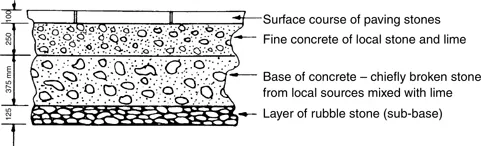
  • 3 Paved (see Figure 1.1).
This conforms roughly with current road structure (i.e. four layers). The carriageway width seldom exceeded 4.25 m. The carriageway had drainage ditches on each side. After the withdrawal of the Romans from Britain at the start of the fifth century AD (AD 407) their road system fell into decay and disuse.

1.2 Terms Used and Their Derivations

1.2.1 Road

This is a recent term only used since the Civil Wars. It is derived from ‘Ride’ then ‘Rode’.

1.2.2 Street

The Romans called their roads VIA STRAETA meaning of course a route or way that had been built up in layers. In time the via was dropped and straeta became STREET. It is town roads that tend to be called streets because in mediaeval times, and indeed up until the sixteenth century, only the roads in towns were paved.
Images
Figure 1.1 Roman road structure

1.2.3 Pavement

The top layer of a Roman road consisted of large stone slabs and these were referred to as the PAVIMENTUM. A lot of stone slabs were used for FOOTWAYS in towns in Victorian times and now, of course, concrete flags are used, hence the term PAVEMENT, although strictly, the pavement is the actual road structure.

1.2.4 Way

This word, originating from the Dark Ages, is a most useful one as it can be prefixed by almost anything and a thumbnail sketch of the History of Roads can be written around it.
In Neolithic times the tracks usually ran along the top of escarpments and were known as RIDGEWAYS of which the Berkshire Ridgeway was the most famous. One had to get down off the top of the hill some time and in so doing the side of the hill became eroded and a hollow formed, hence the HOLLOWAYS – such as Allesborough Hill, Pershore, Kempsey Common, Green Street (The Holloway).
In mediaeval times the only all-weather all-year-round routes were established on high ground to avoid drainage problems, and the principal routes were, therefore, known as HIGHWAYS. During the summer months one could cut across marshes or river meadows and these routes which were of less importance, for obvious reasons were the BYWAYS.
By the eighteenth century wheeled vehicles such as the stage coaches and carriages were in much more frequent use and it soon became necessary to segregate them from the pedestrian traffic and so the highway, particularly in towns, was divided up to give a central CARRIAGEWAY with FOOTWAYS on either side. Routes that were inadequate for wheeled traffic but quite suitable for anyone on horseback were naturally BRIDLEWAYS.
The early nineteenth century saw the first canals in this country and even today they are still officially classed as WATERWAYS. The Americans were very far sighted and started landscaping roads as early as in 1923 and called them PARKWAYS. In the early 1950s congestion of trunk roads was becoming a serious problem and so the Ministry of Transport forbade stopping on certain lengths designated as CLEARWAYS. This did not do the trick and special roads later to become MOTORWAYS had to be built. The Americans called these roads EXPRESSWAYS.

1.3 The Transition Period

When the Romans left, the Britons settled back into self-sufficient communities – they had no desire to travel and hence no maintenance was carried out and woods began to encompass roads. A few Roman roads survived and King Harold, on hearing of the landing of the Conqueror, was able to ride from York to London in four days.
On the Continent the picture was much the same. Numerous small and often warring states were formed and they had neither the will nor the technology to keep their Roman roads repaired. Throughout history it has been shown that a powerful central authority seems essential for a good road network.
In the early tenth century conditions in Europe became more settled, trade developed and, therefore, overland travel began to expand. Routes from Italy to the towns of Flanders were busy carrying considerable quantities of merchandise.

1.3.1 Britain

At home mediaeval man became short of stone and plundered the Roman roads for building material. Roads declined into packhorse tracks, disappearing almost completely in boggy winter conditions.
In Henry II’s time, however, the...

Table of contents

  1. Cover
  2. Half Title
  3. Title Page
  4. Copyright Page
  5. Table of Contents
  6. Preface
  7. 1 Highway development
  8. 2 Maps, drawings and surveying
  9. 3 Earthworks
  10. 4 Drainage
  11. 5 Flexible and composite pavement
  12. 6 Rigid pavements
  13. 7 Kerbing, footways and paved areas
  14. 8 Ancillary construction work
  15. 9 Safety at work
  16. 10 Materials and testing
  17. 11 Highway plant
  18. 12 Street furniture
  19. 13 Bridgeworks: construction and maintenance
  20. 14 Highway maintenance
  21. 15 New Roads and Street Works Act 1991
  22. 16 Site organization
  23. Answers to revision questions
  24. Suggested reading list
  25. Index